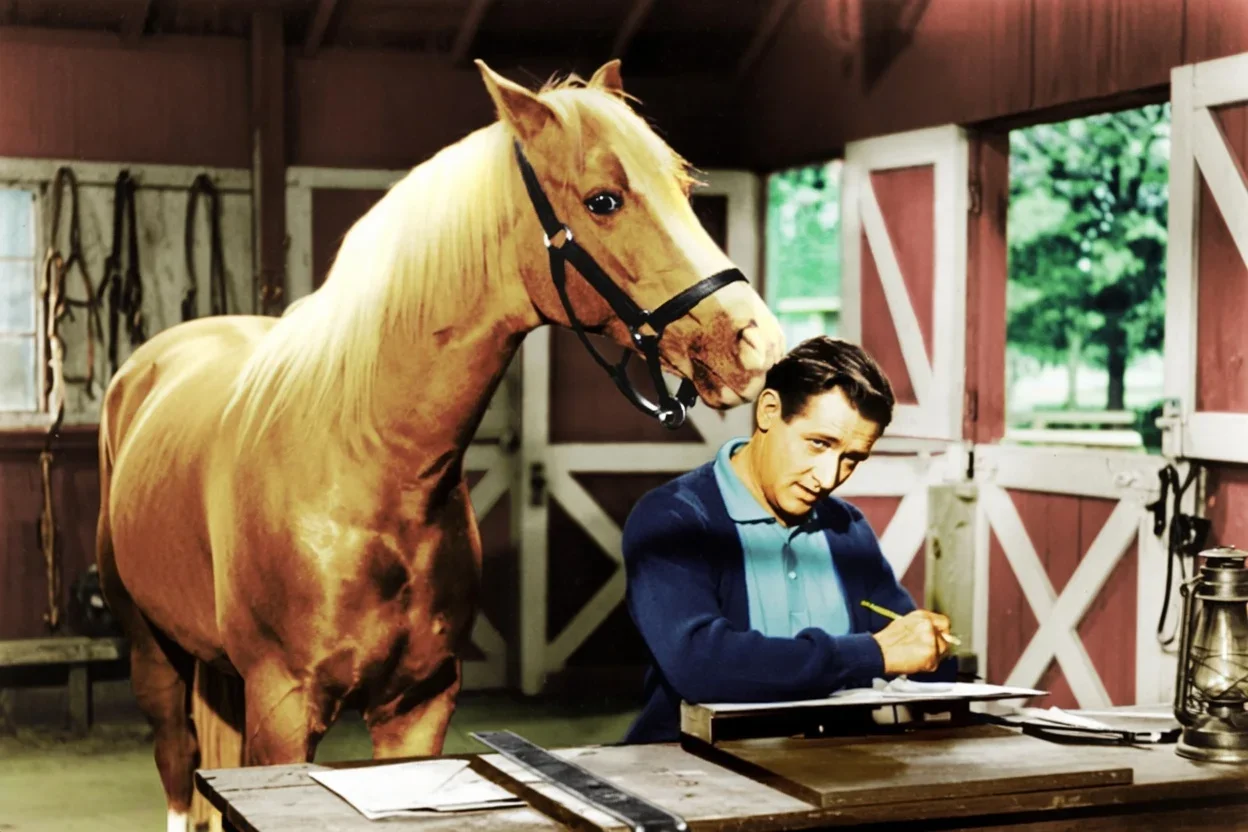
TLDR: Mister Ed ran on CBS for six seasons starting in 1961, and almost everything people think they know about the talking horse trick is wrong. The peanut butter story was invented by the show’s own star, and the horse fans visit at his supposed grave in Oklahoma isn’t actually Mister Ed at all.
The talking horse everyone remembers as wholesome family entertainment actually started out drinking heavily and quoting Latin. Mister Ed began as a series of short stories by children’s author Walter R. Brooks, starting with “The Talking Horse” in a 1937 issue of Liberty magazine.
In Brooks’ original stories, the horse’s human companion was an architect named Wilbur Pope, not Wilbur Post, and Mister Ed himself got drunk on liquor and recited Shakespeare. None of that survived the jump to television.
Networks Passed on It Twice Before It Became a Hit
Director Arthur Lubin, who’d directed six of Universal’s Francis the Talking Mule films, wanted to bring that same talking-animal formula to television. When Universal wouldn’t sell him the rights to Francis, he optioned Walter Brooks’ horse stories instead.
George Burns financed a 1958 pilot for $70,000, and networks still turned it down flat, convinced a talking-horse sitcom couldn’t work.
Producer Al Simon recast the leads with Alan Young and Connie Hines, swapped in a new horse, and when networks passed again, the show went straight into first-run syndication instead.
That syndicated run performed well enough that CBS bought it for its national primetime lineup just nine months later. The show ran for six seasons and 143 episodes before ending in February 1966.
The Peanut Butter Story Was Made Up by the Show’s Own Star
For decades, the accepted explanation for Mister Ed’s talking was that handlers smeared peanut butter on his gums to make him lick his lips. That story is completely false, and Alan Young himself admitted to inventing it.
Producers didn’t want reporters finding out the real technique, worried it would disappoint kids who believed the horse was really talking.
When journalists kept asking, Young simply made up the peanut butter answer on the spot, and it stuck for over 40 years until he finally corrected the record in a 2004 interview.
The actual method involved a fine nylon thread looped under the horse’s upper lip, with trainer Les Hilton applying gentle tension from off camera to get him moving his mouth.
Over time the horse, a palomino named Bamboo Harvester, learned to open his mouth on cue from a hoof tap or simply from Young pausing after his lines, and the thread was eventually phased out entirely.
The Grave Fans Visit in Oklahoma Isn’t Actually Mister Ed
Here’s where the story gets genuinely strange. Bamboo Harvester retired to a Burbank stable after the show ended, and by 1970 he was elderly and struggling with arthritis and kidney problems.
While his regular trainer was away, a temporary caretaker found him lying down and struggling to get up, misread it as an emergency, and gave him a heavy tranquilizer.
Bamboo Harvester had a fatal reaction and died within hours, and his trainer had him quietly cremated to avoid a media circus.
Meanwhile, Bamboo Harvester’s stunt double, a palomino named Pumpkin, kept making publicity appearances billed as “Mister Ed” long after the real horse had already died. When Pumpkin himself died in 1979 in Tahlequah, Oklahoma, newspapers reported it as the death of Mister Ed.
Fans erected a granite headstone there in 1990, and it’s still a small tourist stop today, honoring a horse that was never actually Mister Ed at all. Alan Young reportedly knew the truth in 1979 and chose not to correct it publicly rather than upset fans.
Why the Show Actually Got Cancelled
Mister Ed held steady ratings for most of its run in a favorable Sunday evening slot. In its sixth season, CBS moved it to Sunday afternoons at 5 PM, which broke up its established family audience and sent ratings sliding fast.
At the same time, CBS was pushing hard toward full-color broadcasts and younger, more urban comedies, leaving little room for an aging black-and-white show about a talking horse. The network cancelled it partway through the season, and the final original episode aired on February 6, 1966.
The Voice Almost Went to a Different Talking Animal Star
Before Allan “Rocky” Lane became the voice of Mister Ed, Lubin actually offered the role to Chill Wills, who’d voiced Molly the mule in the Francis the Talking Mule films. Wills turned it down.
The connection between the two properties runs deeper than a rejected job offer. Trainer Les Hilton had worked on the Francis films too, and brought the same nylon-thread mouth trick straight from that set to this one, making Mister Ed the direct television descendant of the movie franchise that inspired it.
You can read the full story of the man who actually did take the role, uncredited for all 143 episodes, in our piece on Allan Lane, the voice of Mister Ed.
Mister Ed, Frequently Asked Questions
Did they really use peanut butter to make Mister Ed talk?
No, that story was invented by star Alan Young himself to keep reporters from discovering the real technique, and he publicly admitted to making it up decades later in 2004. The actual method used a fine nylon thread under the horse’s lip, later replaced by trained behavioral cues.
Where is Mister Ed actually buried?
The horse’s real identity was Bamboo Harvester, who died in 1970 and was cremated privately in California. The grave fans visit in Tahlequah, Oklahoma actually belongs to his stunt double, Pumpkin, who was mistakenly reported as Mister Ed when he died in 1979.
Why was Mister Ed cancelled?
CBS moved the show to an unfavorable Sunday afternoon time slot in its sixth season, which broke its established audience just as the network was shifting toward full-color programming and younger urban comedies. It was cancelled partway through the season in early 1966.
What was Mister Ed’s famous line?
The show’s theme song introduced its signature catchphrase, “A horse is a horse, of course, of course, and no one can talk to a horse, of course, that is, of course, unless the horse is the famous Mister Ed.”