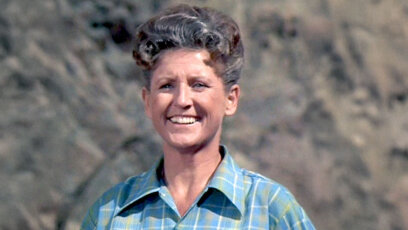
TLDR: Gomer Pyle left Mayberry in 1964 to join the U.S. Marine Corps, becoming the star of his own sitcom that ran for five seasons. After his service ended in 1969, he eventually returned to Mayberry where he became co-owner of the G&G Garage with his cousin Goober, as shown in the 1986 TV movie “Return to Mayberry.”
When Gomer Pyle said goodbye to Mayberry in 1964, fans of The Andy Griffith Show wondered what would become of the lovable gas station attendant with the heart of gold and the brain of, well, Gomer.
The answer turned out to be one of television’s most successful transitions, launching a sitcom that would dominate the Nielsen ratings during one of America’s most turbulent decades.
Gomer’s departure wasn’t a typical character exit. The May 18, 1964 episode “Gomer Pyle, U.S.M.C.” served as both the Season 4 finale of The Andy Griffith Show and a backdoor pilot for what would become a ratings juggernaut.
In that pivotal episode, Gomer confided in Sheriff Andy Taylor that he’d decided to enlist in the Marines because he knew he’d “eventually be drafted” anyway. Unlike so many young men of that era, Gomer was a volunteer, though his motivation stemmed from the inevitability of conscription rather than patriotic fervor.
Andy accompanied Gomer to the recruiting base for his final day in town, serving as a symbolic handoff from the gentle world of Mayberry to the rigid structure of military life. The moment Gomer arrived at fictional Camp Henderson in California, his new drill instructor pegged him as a problem, setting up the central conflict that would define the next five years of his life.
Life as a Marine at Camp Henderson
From 1964 to 1969, Gomer Pyle, U.S.M.C. documented the character’s military service across 150 episodes. The show became an immediate hit, ranking third in its first season and climbing to second place by its sophomore year, surpassed only by Bonanza. What made the show remarkable wasn’t just its popularity but what it chose to ignore.
Throughout its entire run, which aired parallel to major American combat operations in Vietnam, the war was never mentioned, debated, or acknowledged.
Gomer existed in what critics later called a “peacetime bubble” within the military. He was never deployed, never lost a platoon mate to combat, and never faced a war protestor.
This deliberate erasure of geopolitical reality allowed the show to function as what researchers termed a “cultural antidepressant” for Americans watching the real Vietnam War unfold on their evening news.
Throughout all five seasons, Gomer remained a Private First Class, never rising in rank despite years of service. In a realistic military career, a Marine serving from 1964 to 1969 would typically advance to Corporal or Sergeant, but the sitcom format demanded stasis.
Gomer couldn’t outrank his incompetence, nor could he rise to a level where he’d no longer be subjected to the legendary tirades of Gunnery Sergeant Vince Carter.
The relationship between Gomer and Sergeant Carter, played by Frank Sutton, became the emotional core of the series. Carter served as a surrogate for the harsh realities Gomer had been shielded from in Mayberry. Yet beneath the screaming and frustrated attempts to transfer Pyle to another unit, a genuine bond developed.
Carter often sabotaged Gomer’s transfer requests or intervened to save him from failure, driven by reluctant affection or protective duty. The show’s thesis became clear: Gomer’s innocence wasn’t a weakness to be eradicated but a virtue that eventually tamed the cynicism of those around him.
Despite his low rank, Gomer proved himself valuable in specific ways. Drawing on his background as a volunteer fireman in Mayberry, he demonstrated exceptional physical endurance and speed.
His marksmanship improved with proper motivation, and he could execute drill maneuvers with surprising precision. Most notably, Gomer’s baritone singing voice became a strategic asset.
In the Season 4 episode “The Show Must Go On” (1967), he was selected to perform in Washington, D.C. for the President of the United States, backed by the Marine Corps Band. This performance represented the pinnacle of his military achievement, granting him proximity to power that no other Mayberry resident ever reached.
Romance and Near-Marriage
Gomer’s personal life took a significant turn in Season 3 when the show introduced Lou Ann Poovie, a sweet but tone-deaf aspiring nightclub singer from Turtle Creek, North Carolina. Portrayed by Elizabeth MacRae, Lou Ann served as Gomer’s mirror image: naive, genuine, and completely out of place in California.
Their relationship developed throughout Seasons 3, 4, and 5, with Lou Ann becoming a fixture in Gomer’s life and regularly interacting with Sergeant Carter and other Marines.
The question of whether Gomer married Lou Ann remains one of the show’s enduring mysteries. The Season 5 episode “The Return of Monroe” (October 18, 1968) contains explicit dialogue suggesting the couple was “going to get married.” In another episode, “Marriage, Sgt. Carter Style” (January 24, 1969), Carter attempts to manipulate Gomer into marrying Lou Ann specifically to prevent him from re-enlisting.
Despite these plot threads, no wedding ever occurred on screen.
By the time Gomer reappeared in 1986’s “Return to Mayberry,” Lou Ann was entirely absent from his life, and he was living as a bachelor. The most likely explanation is that the relationship dissolved shortly after Gomer’s discharge, with the geographical pull of Mayberry for Gomer conflicting with Lou Ann’s desire to remain in California or return to Turtle Creek.
The Final Episode and Mysterious Discharge
Gomer Pyle, U.S.M.C. ended production not because of cancellation but because Jim Nabors wanted to pursue other opportunities. The show was still the second most popular program on television when it aired its final episode on May 2, 1969.
Oddly, that finale, titled “Goodbye Camp Henderson, Hello Sergeant Carter,” doesn’t actually show Gomer leaving the Marines.
The plot revolves around Gomer requesting a transfer to stop being a burden to Sergeant Carter. In a characteristic twist, Carter realizes he’ll miss Gomer and sabotages the transfer. The series ends with the two men shaking hands after Gomer has been working on a craft project with shellac-covered hands.
When they shake, they become physically stuck together. The final image of Gomer Pyle in the 1960s is him literally bound to the Marine Corps, symbolized by Carter. He didn’t ride off into the sunset; he remained stuck in service.
Since Gomer appears as a civilian in 1986, his discharge must have occurred sometime in the early 1970s. Given his exemplary moral record and the absence of any court-martial events in the show’s canon, he undoubtedly received an Honorable Discharge after completing his enlistment term.
The Return to Mayberry
The 1986 television movie “Return to Mayberry” provided the definitive answer to what happened to Gomer Pyle. By April 1986, Gomer had permanently relocated back to Mayberry, North Carolina.
The wanderlust or sense of duty that drove him to California had dissipated, but he didn’t return as the subordinate gas station attendant audiences remembered from the early 1960s.
Gomer’s most significant post-Marine achievement was becoming co-owner of the G&G Garage with his cousin Goober Pyle. This partnership represented a rare union of the two Pyle cousins, who had only appeared together in a handful of episodes during The Andy Griffith Show’s original run (most notably “The Fun Girls“). For most of the 1960s, Goober had been Gomer’s replacement on the show. In the 1980s, they were equals.
The movie showed Gomer and Goober wearing grease-stained coveralls and working side by side, indicating that despite his years in the military, Gomer had returned to the trade he loved.
His youthful claim of “saving up for college” to become a doctor had been quietly abandoned. Gomer had accepted his place in life as a mechanic, and he seemed content with that choice.
Gomer’s role in the film also confirmed that military service hadn’t hardened him or stripped away his innocent nature. He remained the town’s primary source of well-meaning chaos. While fishing with Goober, Gomer spotted what he believed was a “monster” in Myers Lake and took a photograph of the creature (which was actually a dragon head from a defunct Chinese restaurant being used for a publicity stunt).
His credulity convinced Barney Fife to launch a full investigation, demonstrating that Gomer’s function in the town’s ecosystem remained unchanged: he was still the catalyst for chaos through innocence.
“Return to Mayberry” also clarified Gomer’s personal life. There was no mention of Lou Ann Poovie, no wife, and no children. Gomer attended social functions alone or with Goober, suggesting he had struggled to transition from adolescent bachelorhood to traditional family life. His “family” remained the community of Mayberry itself.
The Real Marines Honor Gomer
Despite being a fictional character who never saw combat, Gomer Pyle earned genuine recognition from the United States Marine Corps. The USMC embraced him as a positive recruiting tool and symbol of good-natured patriotism, recognizing that while goofy, Gomer represented honest service.
The Marine Corps granted Jim Nabors a series of honorary promotions that far exceeded Gomer’s television rank. In 2001, Nabors received an honorary promotion to Lance Corporal. In 2007, he was promoted to Corporal. Finally, in 2017, shortly before Nabors’ death, the Commandant of the Marine Corps promoted him to Sergeant.
This provided poetic closure to the narrative: the Private who could never please Sergeant Carter on television finally achieved the same rank as his tormentor in real life.
The story of what happened to Gomer Pyle after Mayberry ultimately circles back to where it started. Geographically, he traveled from North Carolina to California and back again.
Professionally, he evolved from a gas station attendant to a Marine to a small business owner. Romantically, he experienced deep love that nearly resulted in marriage before returning to bachelorhood. But thematically, nothing really happened to him at all.
The central miracle of the Gomer Pyle narrative is his immutability. He walked through the fire of the Vietnam era, the rigor of the Marine Corps, and the cynicism of Hollywood, and emerged in 1986 exactly as he left in 1964: kind, trusting, and gentle.
His return to Mayberry wasn’t a retreat but a reaffirmation that his character belonged to a world where innocence could survive. In the end, Gomer fixed cars, sang songs, and in the eyes of the real U.S. Marine Corps, eventually earned his stripes.