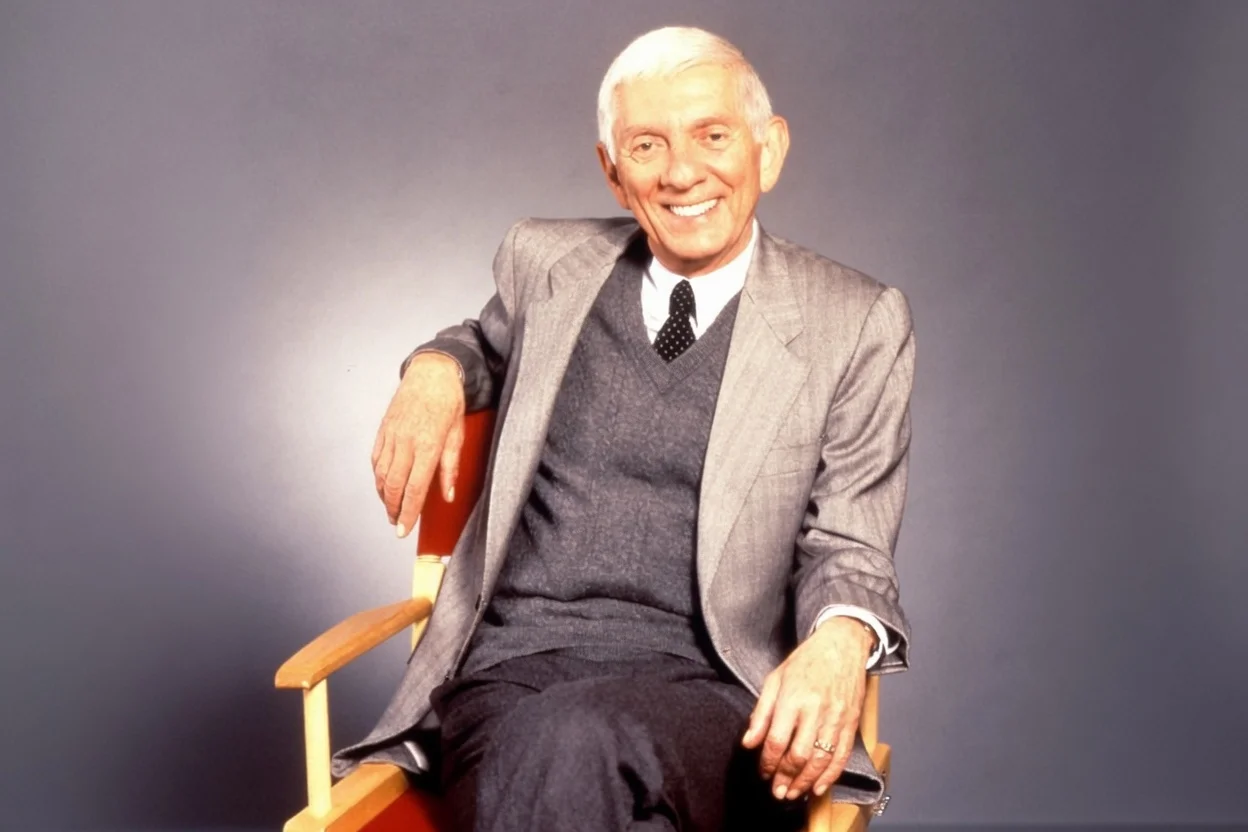
TLDR: Aaron Spelling was born April 22, 1923, in Dallas, Texas, to Jewish immigrant parents, and was bullied so severely as a child that he lost the use of his legs for a year at age eight. He went on to produce more than 200 television series, including Charlie’s Angels, Dynasty, The Love Boat, and Beverly Hills 90210, building a fortune worth $500 to $600 million by the time he died in 2006. His shows once occupied a third of ABC’s entire prime-time schedule, earning the network the nickname “Aaron’s Broadcasting Company.”
Aaron Spelling spent an entire year of his childhood unable to walk. Not from illness or injury, but from the psychosomatic toll of relentless antisemitic bullying in his working-class Dallas neighborhood. He later said he grew up believing “Jew boy” was a single word, because that was how often he heard it directed at him.
That bedridden year is also, by his own account, where his career began. Isolated and immobile, he became a voracious reader, building the imagination that would eventually make him the most commercially prolific producer in American television history.
From Dallas to a Purple Heart
Spelling was born to David Spelling and Pearl Wald, Jewish refugees who had fled Poland and Russia.
His father, a tailor, changed the family surname from the German “Sperling,” meaning sparrow, to better assimilate.
Aaron was one of five children in a household that stood out sharply in their non-Jewish neighborhood, and the hostility he faced there shaped his early psychology profoundly.
After recovering from his year of psychosomatic paralysis, he attended Forest Avenue High School, where writing and academics gave him a foothold he had not previously had. When World War II broke out, he enlisted in the Army Air Forces, organizing theatrical productions for soldiers and writing for Stars and Stripes.
He was wounded by a sniper, earning a Purple Heart and a Bronze Star with Oak Leaf Cluster.
In a twist that would define his lifelong fear of flying, he was pulled off a military flight due to sudden illness minutes before takeoff. The plane later crashed. There were no survivors.
After the war he enrolled in journalism at Southern Methodist University, graduating in 1949 after becoming the first student in the school’s history to direct a major senior class play.
He spent several subsequent years directing community theater and trying, largely unsuccessfully, to break into Broadway as a playwright.
The Actor Who Became a Producer
In 1953 he married actress Carolyn Jones, and the couple moved to Los Angeles together.
Spelling initially tried acting himself, landing minor roles on shows including I Love Lucy, Dragnet, and Gunsmoke.
Recognizing his future was behind the camera, he transitioned to screenwriting, selling his first script in 1954. During this lean stretch, Jones was the primary breadwinner, taking whatever acting work she could find while he wrote.
His real break came under producer Dick Powell at Four Star Television, where he started as a staff writer earning $125 a week and worked his way up to producing by 1959.
There he created the western Johnny Ringo and produced Burke’s Law, which introduced the multiple guest-star format he would later refine into a signature technique on The Love Boat and Fantasy Island.
When Powell died in 1965, Spelling left to start his own production company.
Building an Empire, One Partnership at a Time
Spelling’s rise moved through a series of increasingly ambitious corporate structures.
In 1966 he partnered with Danny Thomas to form Thomas-Spelling Productions, which produced The Mod Squad in 1968. In 1972 he formed Spelling-Goldberg Productions with Leonard Goldberg, which dominated 1970s television with The Rookies, S.W.A.T., Starsky and Hutch, and Charlie’s Angels.
Simultaneously his solo venture, Aaron Spelling Productions, produced The Love Boat and Fantasy Island.
By 1984, Spelling’s shows occupied seven hours of ABC’s weekly prime-time schedule, a full third of the network’s total programming, and industry insiders began joking that ABC stood for “Aaron’s Broadcasting Company.”
He took his company public in 1986, raising $80 million, and later produced Dynasty, Beverly Hills 90210, Melrose Place, 7th Heaven, and Charmed, spanning nearly every genre American television attempted across four decades.
The Real Source of the Fortune
Spelling’s wealth did not primarily come from producer fees. It came from ownership.
Unlike most producers who worked as hired hands for major studios, Spelling structured his companies to retain intellectual property rights over his catalog.
His 1988 acquisition of Worldvision Enterprises, a global syndication distributor, was the cornerstone of that strategy, generating roughly $150 million annually by the late 1990s, with 70% of that revenue coming from international licensing of shows like Dynasty and Beverly Hills 90210.
A 1994 acquisition of Republic Pictures added over 7,000 feature films and 15,000 television episodes to his library.
This is the wealth mechanism that made Spelling worth $500 to $600 million by his death in 2006, a figure that continued compounding independent of any new production because of the sheer scale of the catalog he controlled.
Candy, The Manor, and the Children
After an amicable divorce from Carolyn Jones in 1964, Spelling met Carole “Candy” Marer at The Daisy, an exclusive Beverly Hills nightclub.
Accounts of the exact year vary between 1965 and 1967, but the age gap between them was a consistent 22 years.
They married on November 23, 1968, and remained together for nearly thirty-eight years, until his death.
The marriage produced two children: Tori Spelling, born in 1973 when Aaron was 50, and Randy Spelling, born in 1978 when he was 55.
In the late 1980s the Spellings built The Manor in Holmby Hills, a 56,500-square-foot mansion with 123 rooms, including a bowling alley, a doll museum for Candy’s antique collection, and three rooms dedicated exclusively to gift wrapping.
It was, at the time, the largest single-family home in Los Angeles County, larger than the White House, and required a daily staff of 30 to maintain.
Candy sold it in 2011 to British heiress Petra Ecclestone for $85 million.
Death and the Will
Aaron Spelling died on June 23, 2006, at The Manor, five days after suffering a stroke, at age 83.
His death certificate listed Alzheimer’s disease as a contributing factor. His will left roughly $800,000 each to Tori and Randy, with the overwhelming majority of his estimated $500 million estate passing directly to Candy, who was named sole executor and trustee.
This was not primarily a punitive decision. It reflected the unlimited marital deduction, a standard estate planning tool that allows unlimited tax-free transfers to a surviving spouse.
Leaving significant sums directly to Tori and Randy would have triggered federal estate taxes as high as 50% in 2006.
The full story of that inheritance, and how it played out in Tori’s life afterward, is covered in our piece on why Tori Spelling only inherited $800,000.
A Complicated Professional Legacy
Spelling was widely regarded as a loyal, collaborative producer who maintained decades-long relationships with talent like Heather Locklear and producing partners like Leonard Goldberg.
His career was also marked by legal disputes.
The most significant was the landmark 1997 pregnancy discrimination case brought by actress Hunter Tylo after she was fired from Melrose Place upon disclosing her pregnancy. The full story of that case is covered in our piece on the Hunter Tylo lawsuit against Aaron Spelling.
A separate 2006 civil suit filed by his former home nurse, alleging sexual harassment and battery, was never adjudicated because Spelling died months after it was filed, and his attorney characterized the claims as a retaliatory extortion attempt.
He also faced a decades-long plagiarism dispute over the concept for the family drama Family, which the California Court of Appeal ultimately resolved in his favor in 2001.
What He Actually Built
Spelling famously called his own work “mind candy,” embracing the label critics used to dismiss him as a “schlock merchant.”
He understood, correctly, that the function of network television was to provide accessible, high-production fantasy that let ordinary viewers escape the mundane realities of their own lives, and he built that formula more successfully and more repeatedly than anyone else in the medium’s history.
His ensemble-cast model on Charlie’s Angels, his rotating guest-star model on The Love Boat, and his pioneering ownership of intellectual property and syndication rights all anticipated the media business models that now define the streaming era.
He was, by any measure, one of the architects of modern American commercial television.
Aaron Spelling: Frequently Asked Questions
How rich was Aaron Spelling when he died?
Aaron Spelling’s net worth at his death on June 23, 2006, was estimated between $500 million and $600 million. His wealth came primarily from his ownership of intellectual property rights and syndication royalties from over 200 television series, rather than his producer fees alone, driven especially by his 1988 acquisition of the global distributor Worldvision Enterprises.
What ethnicity was Aaron Spelling?
Aaron Spelling was Jewish. He was born to Jewish immigrant parents, David Spelling from Poland and Pearl Wald from Russia, who settled in Dallas, Texas. His family faced significant antisemitic harassment in their working-class neighborhood, which he later said had a profound and traumatic impact on his childhood.
Why did Aaron Spelling leave so little to his children?
Aaron Spelling left approximately $800,000 each to his children Tori and Randy, with the vast majority of his roughly $500 million estate passing to his wife Candy. This structure primarily reflected the unlimited marital deduction, a standard tax strategy allowing unlimited tax-free transfers to a surviving spouse, avoiding federal estate taxes that could have reached 50% if left directly to his children.