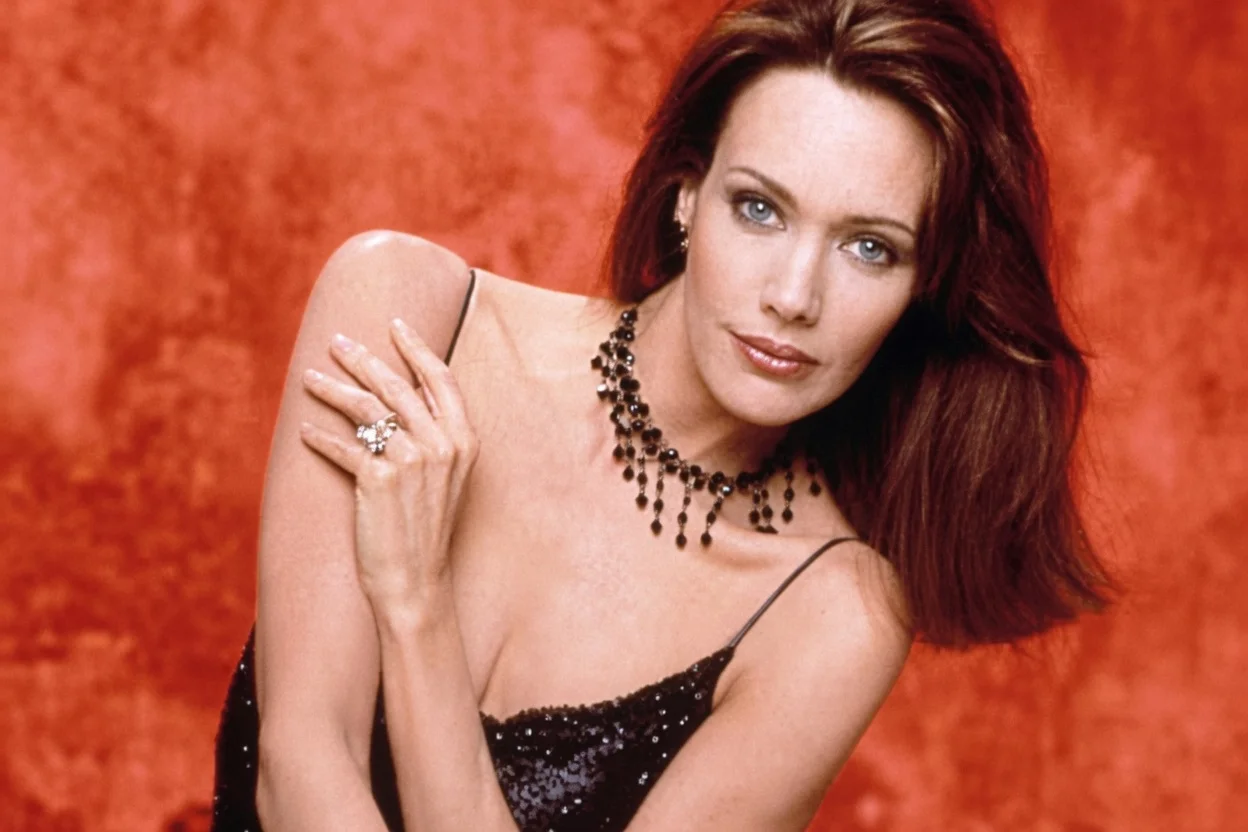
TLDR: In 1996, actress Hunter Tylo signed a contract to join Melrose Place, then was fired less than two months later after informing producers she was pregnant. Aaron Spelling’s production company argued her character, written as a “vixen, seductress, and adulteress,” could not be visibly pregnant. A Los Angeles jury disagreed, awarding Tylo $4.89 million in December 1997 in a verdict that became a landmark pregnancy discrimination precedent still cited in law today. Decades later, Tylo revealed she never actually collected the money.
Hunter Tylo signed her Melrose Place contract on February 16, 1996. She discovered she was pregnant in mid-March. She was fired on April 10, less than two months after signing, before a single scene had been filmed. The character she had been hired to play had not yet even been named.
The Rise of Dr. Taylor Hayes
Born Deborah Jo Hunter in Fort Worth, Texas, Tylo built her early daytime career performing under the name Deborah Morehart before landing her breakout role as Dr. Taylor Hayes on CBS’s The Bold and the Beautiful in 1990.
The character, an elegant psychiatrist locked in a decades-long rivalry with Brooke Logan, made Tylo one of the most recognizable faces in daytime television, landing her on People’s “50 Most Beautiful People” list and lucrative endorsement deals with Cover Girl, Pantene, and Nissan.
In 1996, seeking to move from daytime to primetime, Tylo left The Bold and the Beautiful to accept a role on Aaron Spelling’s flagship Fox drama Melrose Place. She turned down other opportunities, including a Disney pilot, to take the part.
“By Necessity Not Pregnant”
Her contract, signed February 16, 1996, guaranteed exclusive services for at least eight episodes plus a three-year unilateral option held by Spelling Television to extend her run.
It also contained a standard clause allowing termination for any “material change in appearance.” Production was scheduled to begin that summer.
When Tylo discovered she was pregnant with her third child in mid-March, she instructed her manager to notify the production team, hoping to give writers lead time to work the pregnancy into her character’s still-developing storyline.
Instead of accommodation, she got immediate resistance. Spelling’s executives argued the character, eventually named Taylor McBride, had been written specifically as a “vixen, seductress, and adulteress,” and that a visible pregnancy was incompatible with those narrative requirements.
On April 10, 1996, Spelling Entertainment terminated her contract, stating the character “is by necessity not pregnant.” The role was recast with Lisa Rinna.
During discovery, Tylo alleged a producer had gone further, openly questioning her decision to carry the pregnancy to term by asking, “Why doesn’t she just go out and get an abortion? Then she can work.”
The statement became a central point of the trial.
The Fight Over Her Privacy
Tylo filed suit in Los Angeles Superior Court on May 13, 1996, represented by civil rights attorney Gloria Allred, alleging discrimination under California’s Fair Employment and Housing Act, wrongful termination, breach of contract, and related claims.
Before the case reached a jury, Spelling’s defense attorneys attempted to undercut her emotional distress claims by probing deeply into her marriage and psychiatric history during a July 1996 deposition.
Tylo refused to answer on her attorneys’ advice, and when the trial court ordered her to respond, her team appealed.
On June 24, 1997, the California Court of Appeal ruled in her favor in Tylo v. Superior Court, establishing that claiming emotional distress in a discrimination suit does not forfeit a plaintiff’s constitutional right to privacy, and that defendants must prove any requested private information is directly relevant to the specific claims.
The ruling barred questions about her marriage and psychiatric history while permitting narrower questions about her pregnancy intentions. The case remains cited today in California civil procedure and employment law.
The Trial
The trial began in late 1997 and lasted roughly a month.
Aaron Spelling was personally involved in the original decision to fire Tylo and had endorsed the argument that his production’s creative vision could override standard pregnancy protections.
The defense’s central theory, that seductress roles required a non-pregnant silhouette as a legitimate occupational qualification, collapsed under cross-examination.
Tylo’s attorneys subpoenaed Heather Locklear, who had continued starring on Melrose Place while pregnant, and Lisa Rinna, the actress hired to replace Tylo, who was also pregnant during her own tenure on the show.
Both demonstrated that Spelling’s productions were fully capable of accommodating pregnant actresses through camera angles, wardrobe, and body doubles when they chose to.
Rinna later admitted on a podcast that taking the role never “felt clean,” given the circumstances of Tylo’s firing.
Eight months pregnant with her daughter Katya at the time of trial, Tylo herself took the stand in fitted, fashionable clothing, physically demonstrating to the jury that pregnancy had not diminished her ability to portray an attractive, sophisticated character.
On December 22, 1997, after five days of deliberation, the jury returned a verdict in her favor: $894,601 for economic loss and $4 million for emotional distress, a total of $4.89 million.
The Money She Never Got
Spelling’s post-trial motions to overturn or reduce the verdict were denied, and contemporary media reported the case as a definitive $4.89 million victory.
In an August 2025 interview, Tylo revealed the reality had been very different: she never actually collected the award. “I don’t have $5 million, everybody, so I don’t even think about it,” she said. “That was just basically setting a precedent so women can’t be forced to have an abortion.”
The financial pressure that followed was real.
Tylo filed for Chapter 11 bankruptcy protection in Las Vegas in 2011, and in October 2010 a Las Vegas judge ordered her to pay nearly $885,000 to a psychotherapist after an unsuccessful malpractice suit related to treatment of her children.
A famous jury verdict, it turns out, is not the same thing as a collected check.
What Changed Because of the Case
Regardless of the collection outcome, the verdict permanently altered industry practice.
It dismantled the unwritten assumption that “appearance” clauses gave producers license to fire pregnant actresses from sexualized roles, and pushed studios toward genuine accommodation, adjusted schedules, altered storylines, and body doubles, as the standard practice going forward.
Life After the Verdict
Tylo returned to The Bold and the Beautiful in late 1997, reprising Dr. Taylor Hayes on and off until her final appearance in 2019.
Her life away from the courtroom was marked by profound tragedy. In 1998 her newborn daughter Katya was diagnosed with retinoblastoma, a rare childhood eye cancer, requiring the removal of one eye; Tylo subsequently founded the charity Hunter’s Chosen Child and successfully lobbied for California legislation mandating infant eye exams.
In October 2007, her 19-year-old son Michael Tylo Jr. drowned after suffering a seizure in the family’s Nevada pool. When producers scheduled a scene depicting the death of her on-screen daughter just weeks later, Tylo refused to film it, saying: “My pain is not for sale.”
On the frequently rumored rivalry with co-star Katherine Kelly Lang, Tylo has said plainly there was never real animosity: “I love her as a person. She is just a human being trying to make a living.” A more genuine falling-out occurred with actress Kimberlin Brown, once a close friend, after Brown testified against Tylo during a contentious custody battle.
Tylo now lives a largely private life in Henderson, Nevada, with an estimated net worth of approximately $13 million. She declined to return to The Bold and the Beautiful in 2021, and the role has since been recast twice.
For more on the producer at the center of the case, see our Aaron Spelling biography.
The Hunter Tylo Lawsuit: Frequently Asked Questions
Why did Hunter Tylo sue Aaron Spelling?
Hunter Tylo sued Aaron Spelling’s production companies after being fired from Melrose Place in April 1996, less than two months after signing her contract, upon informing producers she was pregnant. Producers argued her character, written as a seductress, could not be visibly pregnant. A jury found in her favor in December 1997, awarding her $4.89 million in a landmark pregnancy discrimination verdict.
Did Hunter Tylo ever receive the money from her lawsuit?
No. Despite winning a $4.89 million jury verdict in 1997, Tylo revealed in an August 2025 interview that she never actually collected the award. She stated the case’s real significance was establishing legal precedent protecting pregnant actresses rather than the monetary payout, and she filed for bankruptcy protection in Nevada in 2011.
What happened to Hunter Tylo’s son?
Hunter Tylo’s 19-year-old son, Michael Tylo Jr., died on October 18, 2007, after suffering a seizure and drowning in the family’s swimming pool in Henderson, Nevada. His death occurred weeks before producers had scheduled a scene depicting the death of Tylo’s on-screen daughter, which Tylo refused to film.