TLDR: Buck Owens was born Alvis Edgar Owens Jr. in Sherman, Texas in 1929, pioneered the Bakersfield Sound, scored 21 consecutive number-one country singles in the 1960s, and influenced the Beatles enough that they covered his “Act Naturally.” He spent 17 years on Hee Haw feeling it destroyed his artistic credibility, left in 1986, and died in Bakersfield in 2006 at age 76, having built a business empire worth over $100 million.
In his posthumous autobiography, Buck Owens described his 17 years on Hee Haw with characteristic directness: “I couldn’t justify turning down that big paycheck for just a few weeks work twice a year. So, I kept whoring myself out to that cartoon donkey.”
This is the tension at the center of Buck Owens’s life.
He was one of the most innovative and commercially successful country musicians of the twentieth century, a man who built an entertainment and broadcasting empire worth over $100 million and influenced artists from the Beatles to Dwight Yoakam.
He also spent nearly two decades in overalls pretending to be a country bumpkin on national television, and it drove him quietly insane.
From a Texas Sharecropper’s Kid to Bakersfield
Alvis Edgar Owens Jr. was born on August 12, 1929, in Sherman, Grayson County, Texas, to a sharecropping family in the Red River Valley.
He got his nickname, Buck, at age three or four by announcing he shared the name of the family’s favorite work mule, a designation his parents found charming enough to stick.
The Dust Bowl forced the family west in 1937. Their trailer broke down near Phoenix, Arizona, and they settled in Mesa with relatives. Owens dropped out of school in ninth grade at thirteen to support the family, hauling produce, washing cars, driving trucks, and picking crops.
The back-breaking nature of that agricultural labor gave him a lifelong aversion to it and an iron determination to never return.
In 1951 he relocated his young family to Bakersfield, California, where he established himself as an elite session guitarist.
He played backup for Tennessee Ernie Ford, Wanda Jackson, and Gene Vincent among others, building the technical foundation that would eventually define a regional sound.
The Bakersfield Sound and 21 Number Ones
The Bakersfield Sound was a deliberate act of rebellion against Nashville. By the late 1950s, Nashville’s major labels had begun smoothing country music’s rough edges with lush string sections and polished background choruses. Owens went the other direction entirely.
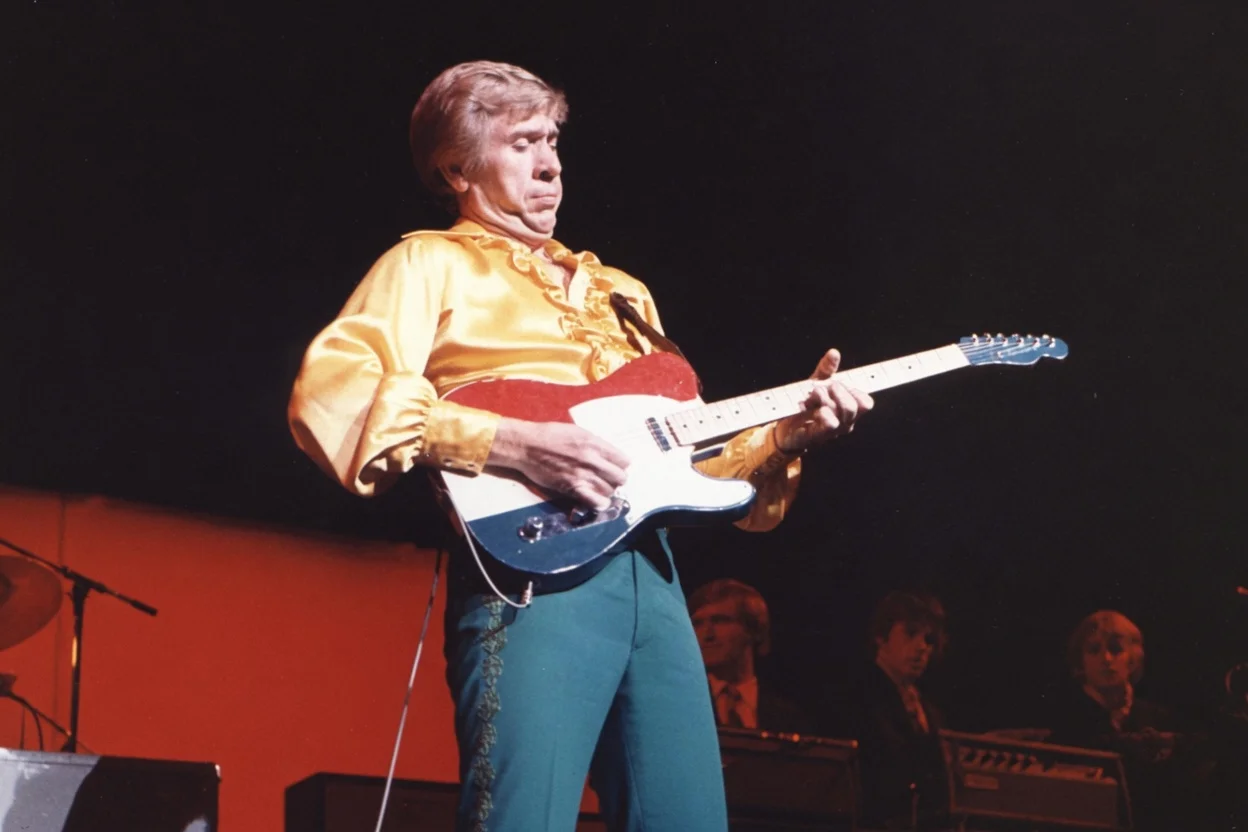
Built around a solid-body Fender Telecaster delivering a bright, treble-heavy twang, a driving 2/4 “freight train” backbeat, and high two-part vocal harmonies, the Bakersfield Sound was stripped, raw, and loud. It sounded like a jukebox in a roadhouse rather than a pop record in a living room.
Alongside his legendary backing band the Buckaroos, built around lead guitarist and fiddler Don Rich, Owens scored 21 consecutive number-one country singles during the 1960s, including “Act Naturally,” “Together Again,” “Love’s Gonna Live Here,” and “I’ve Got a Tiger by the Tail.”
The Beatles were documented fans of his work and covered “Act Naturally” with Ringo Starr on lead vocals on their 1965 album Help!. Merle Haggard, who had once played bass in Owens’s band and is credited with naming the Buckaroos, developed alongside him as the second great force of the Bakersfield scene.
Don Rich and the Loss That Changed Everything
No one was more important to Buck Owens’s music or his life than Donald Eugene Ulrich, known professionally as Don Rich.
Owens discovered Rich in 1958 when the seventeen-year-old was performing at a restaurant in Tacoma. He recruited him immediately and Rich became the Buckaroos’ musical director, lead guitarist, fiddler, and high-tenor harmony vocalist.
Their musical connection was unlike anything Owens had with anyone else. Roy Clark, who knew both men well, observed it precisely: “Buck could think it and Don could do it.”
On July 17, 1974, after completing a late-night recording session at Owens’s studio in Bakersfield, Rich departed on his motorcycle to join his family for a vacation in Morro Bay.
While traveling on Highway 1, his motorcycle struck a center divider in San Luis Obispo. He died approximately one hour after arriving at hospital, at age thirty-two.
No mechanical defects or skid marks were found. The cause of the crash was never determined.
The loss devastated Owens in ways he would not speak about publicly for nearly twenty years.
He later reflected: “He was like a brother, a son, and a best friend. Something I never said before, maybe I couldn’t, but I think my music life ended when he died. The real joy and love, the real lightning and thunder is gone forever.”
Did Buck Owens and Roy Clark Actually Get Along?
The on-screen chemistry between Owens and Roy Clark on Hee Haw suggested a warm, joyful friendship. The off-screen reality was considerably colder.
Their personalities were fundamentally incompatible.
Clark was a natural-born entertainer who viewed television warmly and used humor as a genuine form of connection. Owens was an intensely driven, controlling perfectionist and sharp businessman who resented being reduced to a comedic punchline.
Early in the show’s run, Owens took direct offense when Clark lobbied for Nashville session musicians to replace the Buckaroos as the house band, arguing the Bakersfield sound was too specialized for backing varied guest artists.
Owens took the slight personally.
Their off-screen relationship was not a bitter feud. It was a cold peace between two vastly different men who happened to work together brilliantly on camera and lived entirely separate lives everywhere else.
In his autobiography Owens expressed mild grievances about Clark’s tendency to upstage him during sketches.
Clark’s own memoir was characteristically more diplomatic, and he maintained deep respect for Owens’s musicality throughout his life.
The Japanese Woman Question, the Wig Question, and Dwight Yoakam
Two questions appear repeatedly in searches about Buck Owens that deserve direct answers.
Did he fall in love with a Japanese woman? No. The confusion comes from his 1972 number-one single “Made in Japan,” a song written by Bob and Faye Morris about an American soldier and a Japanese woman, which Owens recorded after a highly successful 1967 tour of Japan.
The song was innovative for its use of a Japanese-scale guitar riff by Don Rich and Farfisa organ tones. It was not autobiographical.
Did he wear a wig? No. The rumor traces to a 1964 concert stunt where Owens and the Buckaroos returned to the stage wearing oversized mop-top Beatles wigs to celebrate receiving royalty checks from the Beatles’ cover of “Act Naturally.” Photos of the stunt circulate widely online. He had his own thick, styled hair throughout his life.
Is Dwight Yoakam his biological son? No. Yoakam was born in Pikeville, Kentucky in 1956 to Ruth and David Yoakam, who were not connected to Owens in any way.
The rumor arose from the intensity of their artistic kinship. In the mid-1980s, Yoakam was the most prominent champion of Owens’s legacy at a time when Owens was in creative retirement and deeply discouraged.
In 1988, Yoakam persuaded him to record “Streets of Bakersfield,” which became Owens’s first number-one in sixteen years.
Owens viewed Yoakam as his artistic heir. The biology was entirely separate from the story.
His Death and the Empire He Left Behind
On the evening of March 24, 2006, Owens was scheduled to perform at his Crystal Palace club in Bakersfield but felt too weak to go on.
When he learned that a family had traveled from Oregon specifically to see him, he insisted on performing.
After completing his set and eating a meal, he went home and died quietly in his sleep of an apparent heart attack. He was 76. His death occurred on March 25, 2006.
His net worth at death was estimated at over $100 million, built on ownership of his master recordings (secured through a prolonged legal battle with Capitol Records), radio stations including KUZZ in Bakersfield and KNIX in Phoenix, the Crystal Palace venue and museum he had constructed in 1996, and substantial real estate holdings.
He was one of the most financially successful musicians of his era precisely because he refused, in business, to be as pliable as he had been on television.
For the full story of his co-host and partner, see our piece on Roy Clark on Hee Haw.
Buck Owens and Hee Haw: Frequently Asked Questions
Why did Buck Owens quit Hee Haw?
Buck Owens left Hee Haw in 1986 after 17 seasons, citing a deep resentment that the show’s cornpone humor was destroying his credibility as a serious musical pioneer. He felt he could no longer separate his identity as the founder of the Bakersfield Sound from the television comedian he had become. In his posthumous autobiography he described staying on the show as “whoring myself out to that cartoon donkey.”
Did Buck Owens and Roy Clark get along?
Off camera, their relationship was a cold peace rather than a warm friendship. Clark was a natural entertainer who genuinely enjoyed television. Owens was a controlling perfectionist who resented the show’s impact on his artistic legacy. There were documented professional tensions, including a dispute over the house band, but they maintained professional respect and never had a public falling out.
Is Buck Owens the father of Dwight Yoakam?
No. Dwight Yoakam was born in Pikeville, Kentucky in 1956 to parents with no connection to Owens. The rumor arose from the intensity of their artistic relationship. In 1988, Yoakam persuaded a discouraged Owens to come out of creative retirement and record Streets of Bakersfield, which became Owens’s first number-one hit in sixteen years.