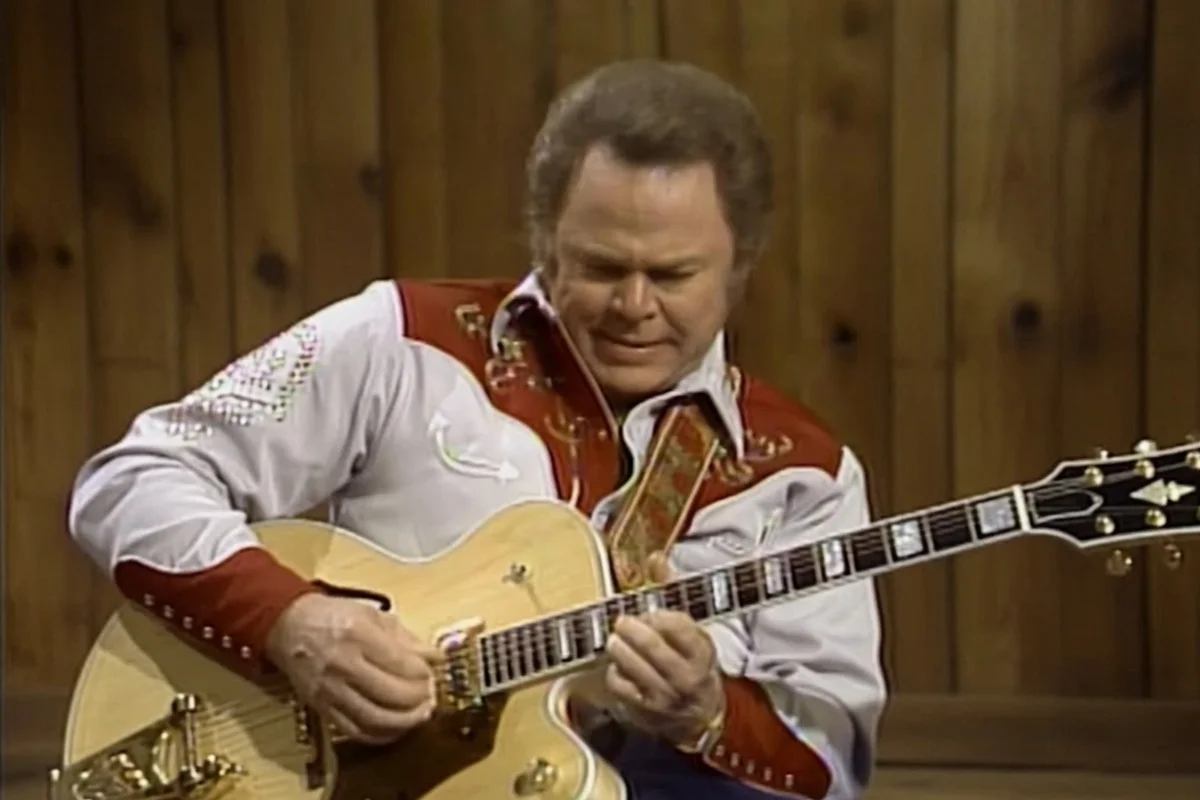
TLDR: Roy Clark was born Roy Linwood Clark in Meherrin, Virginia in 1933, won the National Country Music Banjo Championship at age 14, and became one of the most technically accomplished guitarists in American music history without ever receiving the recognition that reputation deserved.
He co-hosted Hee Haw for 28 years, opened the first major music venue in Branson, Missouri, performed “Yesterday When I Was Young” at Mickey Mantle’s funeral, and died of pneumonia in Tulsa in 2018 at age 85.
The image most people carry of Roy Clark is a grinning man in overalls, trading cornfield jokes with Buck Owens while a laugh track rolls. It is not an inaccurate image. It is just catastrophically incomplete.
The man underneath the comedy persona was a musician his professional peers considered in the same breath as Chet Atkins and Django Reinhardt. Glen Campbell called him a peer who could “sing like a bird and play the hell out of the guitar.”
Jerry Garcia of the Grateful Dead covered his recordings.
He played classical masterpieces like “Malaguena” on a twelve-string acoustic guitar in front of audiences who had come expecting banjo jokes, and left them stunned into silence.
Roy Clark spent 28 years in a cornfield, and it cost him something that most people never noticed was missing.
A Washington Kid Who Taught Himself Everything
Roy Linwood Clark was born on April 15, 1933, in Meherrin, Virginia, the oldest of five children.
His father was a sawmill laborer, tobacco farmer, and accomplished semi-professional musician who played banjo, fiddle, and guitar. His mother was a pianist. Music was the family’s native language.
During the Depression the family moved briefly to New York City before settling in Washington, D.C., following his father’s work at the Navy Yard. At fourteen, Clark received a Sears Silvertone acoustic guitar for Christmas and committed himself to it with an obsessiveness that bordered on physical punishment, practicing until his fingertips bled.
He had no formal training. What he had instead was Washington, D.C. in the 1940s and 1950s, a city with a rich and varied music scene that mixed country, jazz, swing, and early rockabilly.
Clark spent his teenage years sneaking into clubs and stealing everything he could from every player he watched. By fourteen he had won the National Country Music Banjo Championship in Warrenton, Virginia.
He defended the title successfully in 1948 and earned a television contract in Washington and a performance at the Grand Ole Opry at seventeen. He dropped out of school at fifteen to commit fully to music.
What Glen Campbell and Jerry Garcia Knew That Most People Didn’t
Within professional music circles, Roy Clark was regarded as something close to supernatural on a stringed instrument. The question of whether he or Glen Campbell was the more accomplished guitarist is one that serious musicians answer by pointing out the question misses the point.
Campbell was a disciplined, classically influenced melodic stylist who built his early reputation as one of the elite session musicians in the Los Angeles Wrecking Crew.
Clark was an explosive, jaw-dropping flatpicker capable of playing at speeds that seemed physically impossible and executing classical pieces that most conservatory-trained guitarists would not attempt in public.
Their famous 1990 televised duet of “Ghost Riders in the Sky” is frequently cited online as evidence of Clark “toying” with Campbell.
Guitar historians are more precise about it: Campbell was playing a twelve-string electric, an instrument with double the string resistance, while executing complex walking scales over each chord change to provide harmonic foundation.
The fact that he kept up at all was its own form of virtuosity.
Jerry Garcia, whose musical roots ran deep into traditional American string music, held documented admiration for the musicians of Hee Haw. In 1971, Clark released a version of “The Magnificent Sanctuary Band” that became a major hit.
In November 1976, Garcia took his solo group into the studio and recorded his own version of the same song, which appeared on his album Cats Under the Stars.
The recording mirrored the soulful, high-tempo country-gospel energy of Clark’s earlier version in ways that were not coincidental.
Mickey Mantle’s Funeral and Yesterday When I Was Young
Clark and Mickey Mantle were fellow Oklahomans who had forged a genuine friendship over decades of charity golf tournaments and shared late nights.
Clark had moved his family to Tulsa in 1974 and became a beloved civic figure in a state that considered Mantle its most famous athletic export.
In his final months, Mantle, dying of liver cancer caused by a lifetime of severe alcoholism, became fixated on Clark’s 1969 crossover hit “Yesterday When I Was Young,” an English translation of Charles Aznavour’s French song “Hier Encore.”
The lyrics lament a youth wasted on “wayward pleasures” and “drinking songs” while ignoring the “waste and emptiness beyond.” Mantle, a man who had spent his career outrunning his own self-destruction, found the song unbearably accurate.
He planned his funeral meticulously and requested the song be played at the service. Rather than allow a recording to be used, Clark flew to Dallas and performed it live.
Standing before Mantle’s family and a small gathering of close friends, Clark delivered a raw acoustic rendition while visibly grieving. Witnesses described the performance as overwhelming in its weight.
It was August 1995, and it remains one of the most quietly devastating moments in the intersection of American sports and music.
What Hee Haw Cost Him and What It Gave Him
Clark’s relationship with Hee Haw was fundamentally different from Buck Owens’s.
Where Owens privately raged against the show’s impact on his artistic reputation, Clark was a natural entertainer who genuinely enjoyed television as a medium for connecting with audiences.
He felt no shame in mixing comedy with virtuosity, and he believed the show brought traditional American music to thirty million viewers a week who might never have encountered it otherwise.
What the show did cost him was critical validation. Rock-era music journalists who might have placed him in the conversation with the great American guitarists never looked past the overalls and the cornfield backdrop.
His standing within professional music was unimpeachable. His standing in broader cultural memory was permanently colored by a television format that made it easy to underestimate him.
Branson and the Business He Built
In 1983, Clark opened the Roy Clark Celebrity Theatre in Branson, Missouri, becoming the first major country star to own and operate a dedicated performance venue in the town. He was not following a trend. He was creating one. The live-music tourism industry that transformed Branson into a multi-billion-dollar entertainment hub traces its origin directly to that decision.
He was inducted into the Country Music Hall of Fame in 2009, a recognition that arrived thirty years after most of his professional peers would have said it was due.
His Final Years and Death
In his last years, Clark fought severe degenerative arthritis in his hands and fingers.
For an instrumentalist whose reputation rested on the speed and precision of his technique, the inflammation was devastating.
He continued to perform as long as he physically could, still attempting “Malaguena” on a twelve-string guitar in his late seventies despite the pain it caused him.
Roy Clark died on November 15, 2018, at his home in Tulsa, Oklahoma, at the age of 85. The cause of death was complications from pneumonia.
He was survived by his second wife Barbara, whom he had married in 1957 and credited entirely with his survival through the lean early years of his career.
Their first year of marriage they spent 347 days on the road, staying in cheap motels and occasionally borrowing money for food. She was still beside him at the end.
For the full story of the show he helped build, see our guide to the Hee Haw cast where they are now.
Roy Clark and Hee Haw: Frequently Asked Questions
What illness did Roy Clark have?
Roy Clark suffered from severe degenerative arthritis in his hands and fingers in his later years, which caused immense physical pain when playing stringed instruments. He also had hip deterioration that required replacement surgery and altered his mobility. He died on November 15, 2018, at age 85, from complications from pneumonia.
What song did Roy Clark sing at Mickey Mantle’s funeral?
Roy Clark performed Yesterday When I Was Young, his 1969 crossover hit, live at Mickey Mantle’s private funeral in Dallas in August 1995. Mantle had specifically requested the song, whose lyrics about a youth wasted on drinking and wayward pleasures resonated deeply with him in his final months.
Was Roy Clark a better guitarist than Glen Campbell?
Most credible musicians and guitar historians frame this as the wrong question. Campbell was a disciplined, classically influenced melodic stylist. Clark was an explosive flatpicker capable of playing at seemingly impossible speeds and performing classical pieces most trained guitarists would not attempt publicly. They were distinct but equally accomplished masters of different styles.