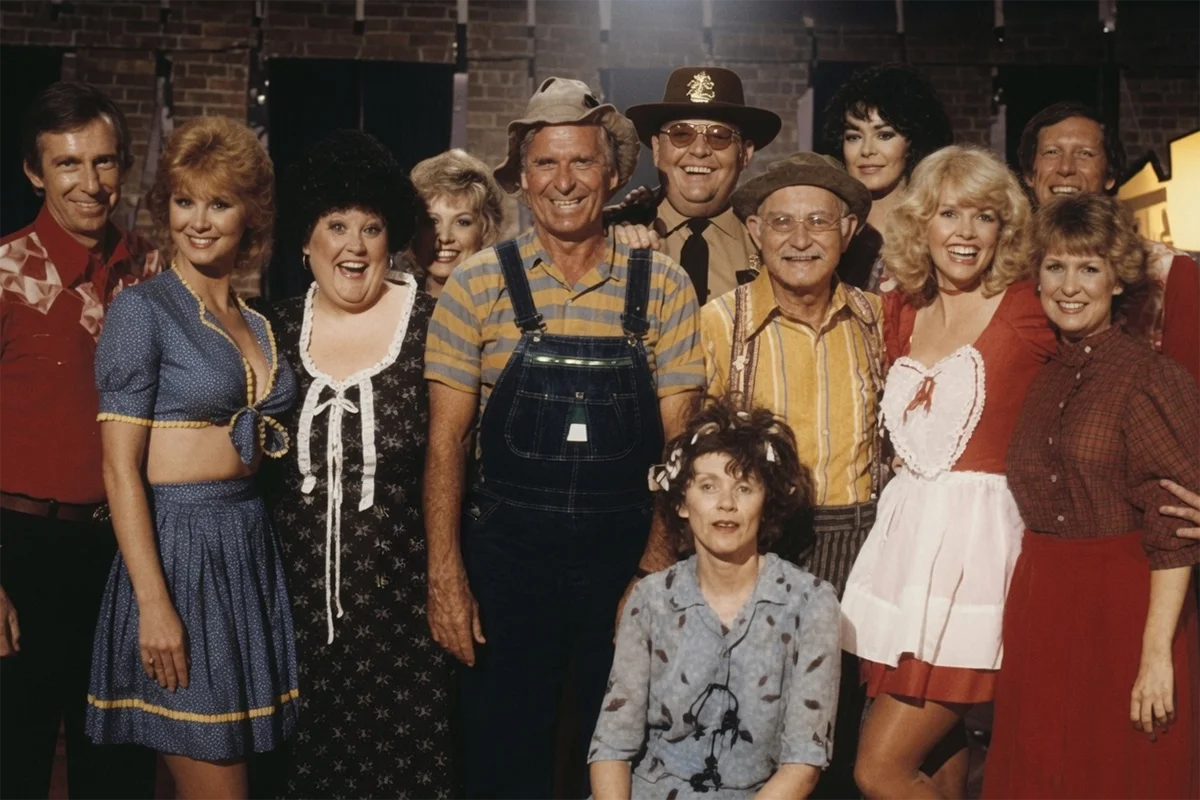
TLDR: Hee Haw ran from 1969 to 1997 across CBS and 26 years of syndication, producing 655 episodes and making household names of its cast. Roy Clark, the show’s most gifted musician, died in 2018. Buck Owens, who resented the show but couldn’t walk away from the paycheck, died in 2006. Junior Samples died on the job in 1983. Grandpa Jones collapsed at the Grand Ole Opry in 1998. The cornfield is gone, but the stories behind it are genuinely remarkable.
For twenty-eight years, a rotating cast of country music performers and comedians gathered twice a year in Nashville to tape hundreds of sketches, songs, and cornfield jokes that were then assembled into weekly episodes and beamed into American living rooms.
The show that CBS cancelled in 1971 for attracting the wrong demographic immediately rebuilt itself in syndication and outlasted every executive who had made that decision.
The people who made it were more interesting than the format ever let on.
Roy Clark
Roy Clark was one of the most technically accomplished guitarists in American music history, a fact his 28 years in overalls made easy to overlook.
Glen Campbell called him a peer who could “sing like a bird and play the hell out of the guitar.” Jerry Garcia of the Grateful Dead covered his recordings.
He performed “Yesterday When I Was Young” live at Mickey Mantle’s funeral in 1995.
He opened the first major music venue in Branson, Missouri in 1983 and transformed the town into a live-music tourism destination.
He was inducted into the Country Music Hall of Fame in 2009. He died of pneumonia on November 15, 2018, at his home in Tulsa, at age 85.
Buck Owens
Buck Owens pioneered the Bakersfield Sound, scored 21 consecutive number-one country singles in the 1960s, influenced the Beatles, and spent 17 years on Hee Haw describing the experience in his posthumous autobiography as “whoring myself out to that cartoon donkey.”
He left the show in 1986, staged a major comeback in 1988 when Dwight Yoakam persuaded him to record “Streets of Bakersfield,” and built a business empire worth over $100 million through radio stations, real estate, and the Crystal Palace venue and museum he constructed in Bakersfield.
He died quietly in his sleep on March 25, 2006, at age 76, having performed a full show that same evening because a family had traveled from Oregon to see him.
Junior Samples
Junior Samples was a sixth-grade dropout, carpenter, and moonshiner from Cumming, Georgia who stumbled into television at age forty after a fish story he told on local radio became a novelty record.
He could not reliably read cue cards and frequently forgot his lines. Audiences loved him for it.
His BR-549 used car salesman sketch became one of the most recognized bits in television history. He died of a heart attack on November 13, 1983, at age 57, in his fourteenth year as a cast member.
Grandpa Jones
Grandpa Jones invented his persona at age 22 by performing in old-man costume on radio, then spent the next sixty years convincing audiences the character was real. Born Louis Marshall Jones in Henderson County, Kentucky in 1913, he was a charter cast member of Hee Haw in 1969 at the age of 56 and brought nearly four decades of professional performance to the cornfield.
He was inducted into the Country Music Hall of Fame in 1978.
On January 3, 1998, he suffered a massive stroke immediately after performing at the Grand Ole Opry, while still in his stage clothes. He died on February 19, 1998, at age 84.
The Hee Haw Honeys and Cathy Baker
Cathy Baker was the recurring cast member who ended sketches with the show’s signature sign-off: “That’s all.”
She was not a performer by training but became one of the show’s most recognized presences through sheer repetition across two decades.
In later years she disclosed that she has Parkinson’s disease, a condition she has managed with characteristic good humor.
The Show Itself
The full story of why CBS cancelled Hee Haw in 1971 when it was the 16th most-watched program in the country, and how it survived for 26 more years in syndication, is told in our piece on why Hee Haw was cancelled.
The short version is that the Rural Purge, which also swept away Green Acres, The Beverly Hillbillies, and Lassie, was one of the most dramatic demographic miscalculations in television history, and Hee Haw proved it by immediately rebuilding a larger audience in syndication than it had ever had on the network.
Hee Haw Cast: Frequently Asked Questions
Is anyone from the original Hee Haw cast still alive?
Most of the core original cast has died. Roy Clark died in 2018, Buck Owens in 2006, Junior Samples in 1983, and Grandpa Jones in 1998. Cathy Baker, the Hee Haw Honey known for the That’s All sign-off, is among the surviving cast members. Several musicians and guest performers from the show’s long run remain alive.
Who passed away from Hee Haw?
Among the most notable deaths from the Hee Haw cast: Junior Samples died of a heart attack in 1983 at age 57, Grandpa Jones died of stroke complications in 1998 at age 84, Buck Owens died of a heart attack in 2006 at age 76, and Roy Clark died of pneumonia in 2018 at age 85.
Where was Hee Haw filmed?
Hee Haw was filmed entirely in Nashville, Tennessee throughout its 28-year run. From 1969 to 1982 it was produced at WLAC-TV Studios on James Robertson Parkway. From 1982 to 1993 production moved to the Grand Ole Opry House at the Opryland USA complex. The 1996-1997 revival season was filmed at The Nashville Network studios adjacent to Opryland.