TLDR: CBS cancelled Hee Haw in July 1971 when it was the 16th most-watched program in the United States, pulling more than 21% of all television households. The cancellation had nothing to do with ratings and everything to do with demographics. CBS decided its rural audience was less valuable to advertisers than urban viewers aged 25-35, and swept away an entire genre of programming in a single season. Hee Haw immediately moved into syndication and ran for 26 more years.
In the summer of 1971, CBS cancelled one of the most popular shows on American television. Not because the ratings were bad. Because the audience was wrong.
This is the story of the Rural Purge, the most dramatic programming overhaul in network television history, and of how Hee Haw responded by outlasting the executives who cancelled it by more than two decades.
The Numbers That Didn’t Save It
Hee Haw debuted on CBS on June 15, 1969, as a summer replacement for The Smothers Brothers Comedy Hour.
It was an immediate hit.
In its first full season it tied for 20th place nationally with a 21.0 Nielsen rating. In its second season it climbed to 16th place with a 21.4 rating. Some contemporary viewer metrics placed it as high as 12th in total individual viewers.
When CBS formally terminated the show in July 1971, it was, by every conventional measure of television success, performing well.
Mayberry R.F.D., cancelled at the same time, had finished 15th. The Beverly Hillbillies, Green Acres, Petticoat Junction, and Lassie were all cancelled in the same coordinated sweep.
The combined ratings of the shows CBS eliminated represented millions of loyal viewers who had no idea their favorite programs were about to disappear.
Why CBS Did It Anyway
By the late 1960s, major television advertisers had begun shifting their priorities away from raw household viewership toward the 18-49 demographic, and more specifically the 25-35 urban and suburban viewer.
The argument was that younger city dwellers had higher disposable incomes and a greater willingness to purchase consumer goods than the older rural and working-class audiences who watched Hee Haw.
The driving force at CBS was Robert Wood, the incoming network president, who aggressively pushed to phase out the rural lineup.
Michael Dann, the longtime programming head who had prioritized total household ratings, resisted.
He argued against catering to a narrow demographic slice, famously saying: “Just because the people who buy refrigerators are between 26 and 35 and live in Scarsdale, you should not beam your programming only at them.”
Wood bypassed Dann, replacing him with Fred Silverman, who was fully committed to demographic-focused scheduling.
Silverman used evolving Nielsen methodology to justify the cancellations and cleared the schedule for urban-centered hits like All in the Family, The Mary Tyler Moore Show, and M*A*S*H.
Pat Buttram, who played Mr. Haney on Green Acres, summarized the moment with characteristic dryness: “It was the year CBS cancelled everything with a tree, including Lassie.”
How Hee Haw Survived
The cancellation turned out to be the best thing that ever happened to Hee Haw.
The producers, working under the banner of Yongestreet Productions, bypassed the networks entirely and sold the show directly to local television stations.
The timing was perfect.
The FCC’s Prime Time Access Rule of 1971 had forced the major networks to surrender the 7:30-8:00 PM time slot to local affiliates, who suddenly needed quality programming to fill the gap. Hee Haw was a proven, ready-made hit that fit the requirement exactly.
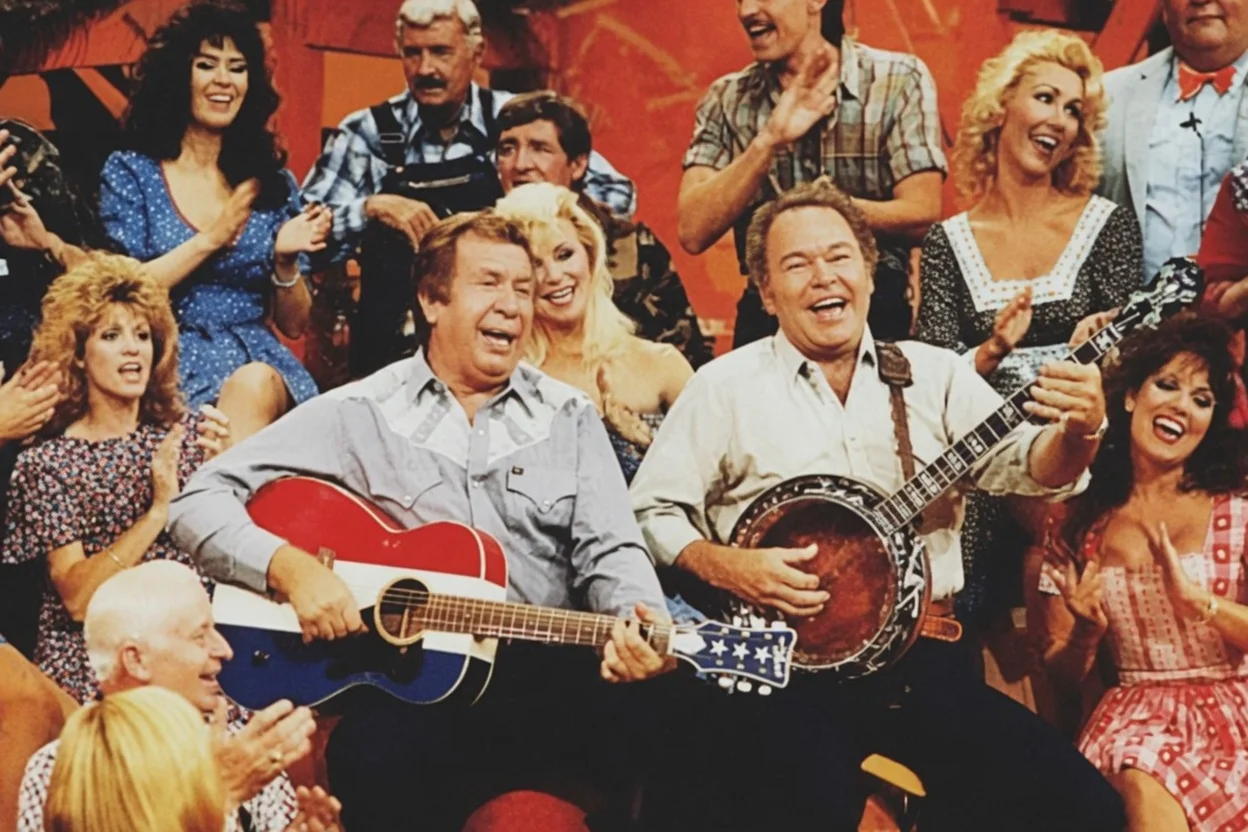
The syndicated version premiered on September 18, 1971, and quickly established itself as the number-one non-network syndicated program in the United States, carried by 205 stations nationally.
It consistently dominated major urban television markets including New York, Los Angeles, Chicago, and Boston, which somewhat undermined the CBS argument that its audience was purely rural.
The show that had been cancelled for attracting the wrong viewers was now making more money in syndication than it had on the network.
Why Buck Owens Left in 1986
Separate from the CBS cancellation, Buck Owens departed the show in 1986 after 17 seasons, in a decision driven by grief, artistic frustration, and financial calculation.
The death of his guitarist Don Rich in a 1974 motorcycle accident had effectively ended his creative drive, and Hee Haw had become his primary public platform by default.
The longer he stayed, the more he felt it was erasing his identity as the pioneer of the Bakersfield Sound.
He left voluntarily to focus on his radio and business interests in Bakersfield. The producers did not replace him, pairing Roy Clark with rotating weekly guest hosts instead.
Why the Show Finally Ended in 1997
After 26 years in syndication, the show’s end came in two stages. The first was self-inflicted.
In 1991, Gaylord Entertainment, which had acquired the rights in 1981, attempted a dramatic modernization.
They eliminated the Kornfield Kounty backdrop, replaced it with a glossy mall-style set, fired most of the traditional cast, and shifted the music toward polished pop-country.
The core audience felt immediately alienated and abandoned the show in large numbers. The original syndicated run ended with its final episode on May 30, 1992.
The nostalgia for the original format proved powerful enough to generate a second life.
The Nashville Network began re-airing classic episodes in 1993 and they became some of the cable channel’s most popular programming.
TNN ordered a new season of first-run episodes that began broadcasting on November 23, 1996. The revival could not sustain itself against modern demographic realities and a format that felt genuinely dated rather than nostalgic. The final first-run episode aired on December 27, 1997.
The show that CBS had cancelled for attracting the wrong audience had lasted 28 years and produced 655 episodes. It outlasted every executive who cancelled it.
For the full story of the people who made it, see our guide to the Hee Haw cast where they are now.
Why Hee Haw Was Cancelled: Frequently Asked Questions
Why was Hee Haw cancelled by CBS?
CBS cancelled Hee Haw in July 1971 as part of its Rural Purge, a coordinated decision to eliminate rural-themed programming and replace it with urban-focused shows targeting the 18-49 demographic. The show was the 16th most-watched program in the US at the time of cancellation, with a 21.4 Nielsen rating. The cancellation was entirely a demographic business decision, not a response to declining ratings.
What was the CBS Rural Purge?
The Rural Purge was a coordinated cancellation in 1971 by CBS of all its rural-themed programming, including Hee Haw, The Beverly Hillbillies, Green Acres, Mayberry RFD, Petticoat Junction, and Lassie. Network president Robert Wood and programming head Fred Silverman eliminated the rural lineup to attract younger, urban advertisers targeting the 25-35 demographic, replacing the shows with All in the Family, The Mary Tyler Moore Show, and MASH.
How long did Hee Haw run after being cancelled?
After CBS cancelled it in 1971, Hee Haw immediately moved into first-run syndication and ran for 26 more years, eventually producing 655 episodes. The original syndicated run ended in 1992, followed by a final revival season on The Nashville Network that concluded on December 27, 1997.