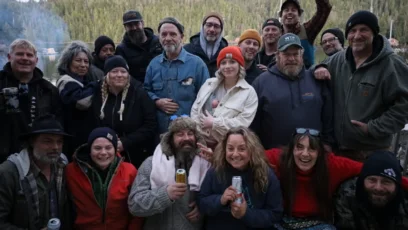
TLDR: Dr. Žiga Ogorelec, 35, is a post-doctoral biologist from Kočevje, Slovenia, who co-founded Gozdovništvo bushcraft school in 2014 and had logged more than 80 days of off-grid survival experience including a 15-day, 270-kilometer solo wilderness crossing of Slovenia with no food.
On Alone Season 13 he made the riskiest gear decision in the cast, deliberately leaving his ferrocerium rod behind to free up a slot for additional passive harvesting tools, meaning he had to start every fire by friction alone in the sub-Arctic. The gamble paid off: he outlasted the entire field at 90 days to become the first-ever Alone World Champion.
Most people who end up on survival television have one thing. A military background, or a hunting credential, or a bushcraft school.
Žiga Ogorelec has a PhD in limnology, a published research record on invasive species and freshwater food webs, a solo bicycle expedition across five continents, a 15-day wilderness crossing of Slovenia on no food, and a bushcraft school he co-founded in the most bear-dense region in Central Europe.
He is also the first Slovenian citizen ever to appear on the franchise, and now the first person from any country to win its inaugural World Championship season.
In his home country, where Slovenian media celebrated his casting extensively, that distinction carries even more weight now.
The Science Behind the Survivalist
Ogorelec completed his PhD in biology and limnology at the University of Konstanz in Germany, with subsequent research tenures in Sweden.
His specialty is freshwater ecosystems, specifically how invasive species disrupt food web dynamics, trophic cascades, and predator-prey relationships in lakes and rivers.
He currently works as a Research Assistant at the National Institute of Biology in Ljubljana, where he is the principal coordinator of PURIFICATION, an ARIS-funded research project on reducing freshwater aquaculture pollution, running from January 2025 through July 2027.
This was not background flavoring for a television bio.
He applied the same bioenergetics thinking he uses in his research directly to his survival strategy, evaluating the caloric cost of active hunting versus passive gill-netting, calculating whether the energy expenditure of building a large log shelter was justified by the thermal return, treating the wilderness as an ecosystem to be understood rather than a problem to be overpowered. It’s the exact approach that ultimately won him the season.
Gozdovništvo and the Kočevsko Forest
In 2014, Ogorelec and his brother Miha co-founded Gozdovništvo, a bushcraft and survival school headquartered in Kočevje. The name translates from Slovenian as “woodcraft” or “forest-craft.”
The school runs programs from two days to eight days in the Kočevsko region, which contains some of the last remaining primary old-growth forest reserves in Europe and one of the highest concentrations of brown bears, gray wolves, and Eurasian lynx on the continent.
Wild camping and dispersed fires are illegal throughout Slovenia and most of Central Europe, which means European bushcraft has developed as a highly precise, craft-intensive discipline focused on working within strict environmental constraints rather than roaming freely across open wilderness.
Ogorelec bridged both worlds. He brought Central European precision to the Canadian sub-Arctic, the exact situation his Season 13 competitor Nero Buys navigated from the opposite direction, bringing Australian arid-climate skills to a boreal winter.
The Experiences That Qualified Him
Ogorelec had logged more than 80 days of fully off-grid survival experience before ever stepping into the Richardson Mountains.
His most significant solo test was a 15-day, 270-kilometer wilderness crossing of Slovenia’s karst and forest regions, carrying no food and relying entirely on wild-foraged resources for the duration.
He had also completed a winter survival test without a sleeping bag or modern fire-starting tools, survived on a marine island without fresh surface water, and crafted a traditional dugout canoe for a 4-day survival rafting trip down the Kolpa River.
Beyond wilderness survival, he completed a one-year solo bicycle expedition covering 19,000 kilometers across five continents and 34 countries, documented in the film From Slovenia, Around the World and Back.
The expedition was conducted with a bicycle, a basic tent, and minimal gear through deserts, jungles, and remote mountain ranges.
The Ferro Rod Gamble
The most discussed decision Ogorelec made before his drop was deliberately leaving his ferrocerium rod off his gear list. Every other contestant brought one.
He used that slot to carry both a gill net and a full length of paracord, giving himself immediate passive food acquisition capability from Day 1.
The consequence was that he had to start every fire through friction, using bow drill, hand drill, or maintaining a continuous coal bed, under wet, cold, and increasingly freezing sub-Arctic conditions. In a region where the temperature eventually dropped to negative 30 or negative 50 degrees Celsius, losing fire could have been fatal.
The decision that looked riskiest at the outset turned out to be the same one that demonstrated how seriously he took the competition, and it held up for all 90 days.
He filtered lake water through his leather boots in Episode 2, improvised physical filtration to remove particulates before boiling, which illustrated the same pattern that defined his entire run: creative problem-solving in place of standard gear solutions.
He was also one of the few contestants who had not begun building a permanent log shelter by Episode 4, deliberately conserving energy while his passive gill net and snare lines generated calories without physical cost, a patient, low-output strategy that proved sustainable over the season’s full length.
The contrast with contestants like Aaron Barnard, who threw enormous energy into a massive log structure from the earliest days, was stark, though Barnard’s own approach carried him to a strong second-place finish at 87 days.
He Became the First-Ever Alone World Champion
Ogorelec outlasted the entire ten-person international field, surviving 90 days in the Richardson Mountains to win the $500,000 grand prize and the inaugural Alone World Championship title.
Aaron Barnard finished second at 87 days, and Nero Buys finished third at 85 days, having left the competition on his own terms after achieving his personal goals.
His win validated the bioenergetics-driven, patience-first approach he’d built his entire strategy around, proving that a research scientist’s careful cost-benefit thinking could outlast the more aggressive, resource-intensive strategies other finalists relied on.
For the full Season 13 cast and results, see our Season 13 hub.
Žiga Ogorelec and Alone Season 13: Frequently Asked Questions
Why did Žiga Ogorelec not bring a ferro rod on Alone?
Ogorelec deliberately omitted his ferrocerium rod to free up a gear slot for both a gill net and a full paracord length, prioritizing passive food acquisition from Day 1. He had to start all fires through friction methods for the entire season, a high-risk strategy that relied entirely on his bushcraft skills rather than a standard ignition tool.
What is Žiga Ogorelec’s background?
Ogorelec is a post-doctoral biologist specializing in limnology and freshwater food webs at the National Institute of Biology in Ljubljana, Slovenia. He co-founded the Gozdovništvo bushcraft school in 2014, had logged over 80 days of off-grid survival experience including a 15-day solo wilderness crossing of Slovenia on no food, and completed a 19,000km solo bicycle expedition across five continents.
Is Žiga Ogorelec the first Slovenian on Alone?
Yes. Ogorelec is the first Slovenian citizen to compete on the Alone franchise. His casting was celebrated extensively in Slovenian media, which framed his appearance as a historic moment for the country, a distinction that grew even larger once he won the season.
Did Žiga Ogorelec win Alone Season 13?
Yes, he outlasted the entire ten-person field, surviving 90 days in Canada’s Richardson Mountains to become the first-ever Alone World Champion and win the $500,000 grand prize.