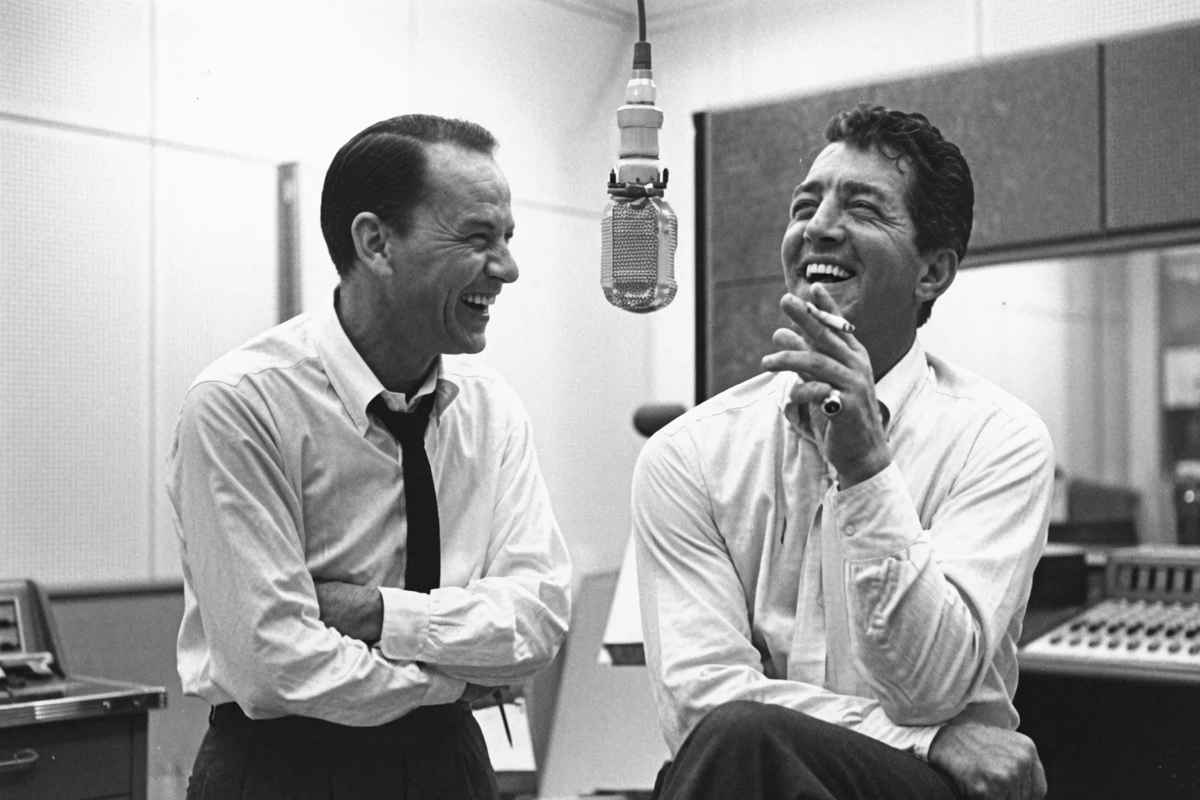
TLDR: Dean Martin and Frank Sinatra were not the inseparable brothers the Sands stage suggested. Their friendship was built on deep professional loyalty and mutual respect, limited by fundamentally incompatible personalities. Sinatra craved late-night company; Martin preferred to be in bed by ten watching Leave It to Beaver. When Martin died on Christmas Day 1995, Sinatra did not attend the funeral. It was not a feud. Sinatra was in the terminal stages of dementia and had already said his private goodbye nine months earlier.
The public story of Frank Sinatra and Dean Martin was one of the great performances of the twentieth century.
Two men sharing a stage at the Sands, a glass in each hand, projecting an image of perpetual, effortless brotherhood.
The private story was considerably more complicated, and considerably more human.
How the Friendship Actually Started
They met professionally in New York in the early 1940s. Martin had signed with MCA in September 1943 and secured a residency at the Riobamba Room, a popular Manhattan nightclub where Sinatra was already establishing himself as a solo phenomenon. They were professional acquaintances during the 1940s and early 1950s, not close friends.
A common misconception holds that the Rat Pack created the Sinatra-Martin friendship.
The reverse was true.
Their real bond was forged in 1958 during the filming of Vincente Minnelli’s Some Came Running, where Sinatra personally approved Martin’s casting as his gambling sidekick.
The sustained hours on set produced a genuine personal connection that then became the engine of the Rat Pack’s second and more famous iteration at the Sands in Las Vegas.
What the Friendship Actually Was
The documented reality of their personal relationship contradicts the public image at almost every point.
Sinatra was a notoriously restless nocturnal figure who surrounded himself with a large entourage and expected his close friends to join him for late-night carousing that often lasted until dawn.
Martin was a deeply private man who went home early, watched television, and prepared for his morning golf game.
Martin’s second wife Jeanne Biegger documented that he routinely avoided Sinatra’s late-night parties.
Biographer Nick Tosches, in his definitive biography Dino: Living High in the Dirty Business of Dreams, argues that Martin maintained a profound deliberate emotional distance from almost everyone in his life.
While Martin was universally liked, he remained fundamentally apart. His studied nonchalance was not a stage prop but a psychological defense mechanism.
Their bond was built on shared understanding of the entertainment industry and unshakeable professional loyalty rather than a conventional intimate friendship. They did not frequently socialize privately outside of performances.
Who Was Actually Dean Martin’s Closest Friend
The individual who came closest to being Martin’s actual best friend was Mack Gray, a former boxer nicknamed “Killer” who worked as his personal assistant and confidant.
Gray was a constant presence in Martin’s daily life, providing an essential buffer between the star and the public.
When Martin’s marriage to Jeanne Biegger produced a separation in February 1953, he did not seek refuge with Sinatra. He moved into Gray’s apartment on Wilshire Boulevard.
In his later years, as Gray and other older friends passed away, Martin retreated further into reclusiveness.
His primary contact became his business manager and talent agent Mort Viner, who managed his daily affairs as Martin withdrew from public view.
His most consistent companion in his final decade was golf, a solitary pursuit that perfectly matched his need for quiet and emotional distance.
The Together Again Tour and What It Revealed
The 1988 Together Again national concert tour was conceived by Sinatra as a therapeutic intervention.
Following the death of his son Dean Paul Martin Jr. in a military jet crash in March 1987, Martin had fallen into severe clinical depression and withdrawn entirely from performing.
Sinatra organized the reunion tour with himself, Martin, and Sammy Davis Jr. to force his grieving friend back into the world.
Martin agreed out of personal loyalty. He should not have. He was physically frail, emotionally checked out, and visibly uncomfortable in the massive arena venues.
He struggled to remember lyrics, slurred his lines on stage, and during an early performance flicked a live cigarette into the audience. After five shows he quietly left the tour, flew back to Los Angeles, and checked into a hospital citing a kidney problem.
Close associates understood that the kidney ailment was real but served as a convenient reason for a man too emotionally shattered to continue performing.
Liza Minnelli replaced him and the tour was rebranded as The Ultimate Event.
Martin never toured again.
Why Sinatra Did Not Attend Dean Martin’s Funeral
When Martin died on Christmas Day 1995, Frank Sinatra’s absence at the funeral at Westwood Village Memorial Park Cemetery generated intense media speculation about a permanent falling out.
The documented truth is different and considerably more heartbreaking.
By December 1995, Sinatra was in the terminal stages of his own decline. He had suffered a physical collapse on stage in Richmond, Virginia in 1994.
In late 1995 and early 1996, he was frequently disoriented, had lost much of his motor function, and was largely confined to his home under medical care.
His daughters Nancy and Tina Sinatra later publicly accused their stepmother Barbara of isolating their father during his final years, stating she routinely failed to inform them of hospitalizations and would not have permitted him to attend a highly publicized public event in his compromised state.
More significantly, Sinatra had already said his private goodbye.
On March 14, 1995, nine months before Martin died, Sinatra made his final visit to Martin’s home in Beverly Hills. He found Martin sitting alone in his chair, staring at the quiet room.
For decades their relationship had been a performance of mutual cool. On that day Martin stopped pretending. He looked at Sinatra and said four words that Sinatra never repeated to anyone, not to his wife or his children.
Sinatra stood up, walked out, and never returned. When Martin died nine months later, the funeral was not the farewell. The farewell had already happened in that chair.
For the full story of the show and Martin’s life, see our Dean Martin Show cast where they are now.
Dean Martin and Frank Sinatra: Frequently Asked Questions
Why did Frank Sinatra not attend Dean Martin’s funeral?
Frank Sinatra did not attend Dean Martin’s funeral in December 1995 because he was in the terminal stages of his own decline, suffering from advanced dementia, cardiovascular disease, and largely confined to his home under medical care. His family has documented that his stepmother Barbara Sinatra isolated him from public events during this period. Sinatra had already made his private goodbye, visiting Martin at his home nine months before his death in March 1995.
Were Dean Martin and Frank Sinatra actually close friends?
Their friendship was built on deep professional loyalty and mutual respect, but was structurally limited by incompatible personalities. Sinatra was a restless nocturnal figure who demanded constant social engagement. Martin was deeply private, went home early, and preferred golf and television to late-night parties. They did not frequently socialize privately outside of performances. Martin’s actual closest friend was his personal assistant Mack Gray, not Sinatra.
Who was Dean Martin’s best friend?
Biographers identify Mack Gray, a former boxer who worked as Martin’s personal assistant and confidant, as the person closest to being his true best friend. When Martin’s marriage temporarily fell apart in 1953, he moved into Gray’s apartment rather than seeking out Sinatra. In his final years, his primary contact was business manager Mort Viner. Martin’s most consistent companion was golf, which he played daily until his health failed.