TLDR: Maverick ran on ABC from September 22, 1957, to April 22, 1962, producing 124 episodes across five seasons. Almost all filming took place at Warner Bros. in Burbank, using Stages 22, 25, 28, and 28A for interiors, and Laramie Street for exterior town scenes.
Outdoor location work used Iverson Ranch in Chatsworth, Corriganville near Simi Valley, and Vasquez Rocks in Agua Dulce. Laramie Street was demolished in 2004.
James Garner sued Warner Bros. and won in 1961, setting a precedent that changed how studios could treat contracted actors.
Every week, Bret Maverick rode into a different frontier town with a different name, a different set of corrupt officials, and a different poker game waiting. The landscape never really changed.
That was because he was always on the same street in Burbank.
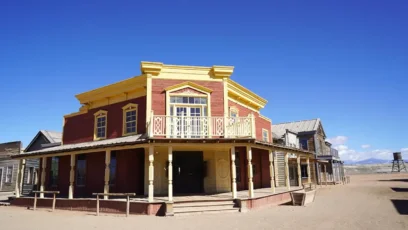
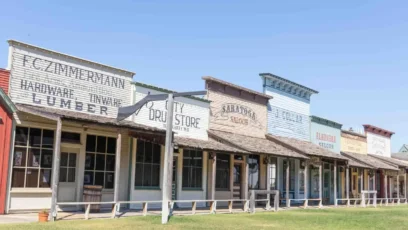
Maverick was a Warner Bros. production filmed at the studio’s Burbank lot, and the town Bret rode into every week was Laramie Street, a modular Western backlot redressed with different signs, props, and lighting to represent dozens of different frontier settlements across five seasons.
Laramie Street and the Warner Bros. Western Factory
Laramie Street was built in 1957 specifically to support Warner Bros.’ television Western boom.
At its peak the studio was simultaneously producing Cheyenne, Bronco, Sugarfoot, Colt .45, Lawman, and Maverick on the same lot, all sharing the same backlot Western street, the same soundstages, the same props and costumes, and sometimes the same scripts with only the character names changed.
Maverick used Stages 22, 25, 28, and 28A for interiors and Laramie Street for all exterior town scenes.
The visual identity of Maverick was deliberately lighter and more comedic than its contemporaries. While Gunsmoke aimed for psychological realism and Have Gun Will Travel for stylized existential drama, Maverick used the same backlot street with a satirical frame, emphasizing riverboats, saloons, poker games, and cons over gunfights.
The sets were identical. The tone was entirely different.
Laramie Street went on to host Blazing Saddles, The Muppet Movie, Westworld, Little House on the Prairie, and dozens of other productions before being demolished in May 2003 and replaced by Warner Village, a fake New England residential street concealing 42,000 square feet of production offices.
The full story of Laramie Street, including its complete production history and what the demolition actually looked like, is covered in detail separately.
Outdoor Filming Locations Across Southern California
When the production needed open country beyond the backlot, it used a network of Southern California movie ranches that Warner Bros. Westerns relied on throughout the late 1950s and early 1960s.
Iverson Movie Ranch in Chatsworth was the most heavily used outdoor location for Warner Bros. Westerns of the era, and Maverick was no exception.
Originally established as a 500-acre homestead in 1884, the ranch was built around distinctive Miocene-era sandstone rock formations that provided an immediately recognizable rugged Western backdrop.
The formations stood in for rocky mountain passes, outlaw hideouts, and frontier wilderness across dozens of episodes.
Corriganville Movie Ranch near Simi Valley was another primary location, used for action sequences and exterior scenes requiring varied terrain. The ranch contained a dedicated Silvertown Western set alongside open range land suitable for horseback chases and stagecoach sequences.
Vasquez Rocks in Agua Dulce provided the dramatic uptilted rock formations that appear in confirmed Maverick episodes. Old Tucson Studios near Tucson, Arizona, was used for episodes requiring authentic desert vegetation and Southwestern town architecture that the California ranches could not convincingly replicate.
Melody Ranch near Santa Clarita, owned by Gene Autry, was another Warner Bros. era location until August 1962, when a massive brush fire swept through the canyon and destroyed nearly all of its original Western town sets.
The fire ended the ranch’s usefulness for the period Westerns that defined the era.
Hadley’s Hunters and the Western Factory in Full Display
The most remarkable episode in the show’s run was not a Bret Maverick adventure at all. “Hadley’s Hunters,” Season 4, Episode 2, which aired September 25, 1960, remains one of the most elaborate corporate crossovers in early television history.
The plot centers on Bart Maverick riding into a town run by a corrupt sheriff named Hadley, played by Edgar Buchanan, who has been using his own deputies to commit stagecoach robberies and frame innocent people.
When a framed fugitive escapes, Hadley gives Bart five days to capture him or face the gallows.
In his search for help, Bart visits the offices of other famous television lawmen on the lot. Ty Hardin appeared as his character from Bronco. Will Hutchins appeared as his character from Sugarfoot. John Russell and Peter Brown appeared as their characters from Lawman.
Edd Byrnes appeared as a stable hand, with the 77 Sunset Strip theme playing as a meta joke in the background.
The episode was not merely a creative exercise. It was deployed specifically to shore up ratings during the most turbulent period in the show’s production history.
James Garner had filed his lawsuit against Warner Bros. and won. The studio was scrambling to present a unified front while reconfiguring the show around Jack Kelly and Roger Moore.
The full story of James Garner’s lawsuit against Warner Bros., Roger Moore’s arrival as Beau Maverick, and what happened to the cast after the show ended is covered in the Maverick cast hub.
The Gun-Shy Episode and the Gunsmoke Parody
Maverick‘s satirical edge extended to directly spoofing its competitors. Season 2, Episode 16, “Gun-Shy,” was a direct parody of Gunsmoke, featuring a character named Marshal Mort Dooley as an obvious caricature of James Arness’s Matt Dillon.
The episode reduced Gunsmoke‘s dramatic conventions to absurdist clichés and included a reference to Richard Boone’s Paladin character from Have Gun Will Travel via a dandy gunslinger presenting a business card.
James Arness openly hated the episode, viewing it as an aggressive attack rather than a friendly nod. Roy Huggins, who created Maverick, had built the show around exactly this kind of self-aware subversion.
The Maverick brothers preferred cons to gunfights, exits to confrontations, and wit to heroism. Their father’s corrupted philosophical advice, known as Pappyisms, included lines like “If you can’t fight them, and they won’t let you join them, best get out of the county.”
The show’s humor was inseparable from its philosophy.
What Happened to Laramie Street
Laramie Street survived the cancellation of Maverick and continued hosting Western productions for decades. The Last Samurai filmed there in 2003, making it one of the final major productions to use the historic street.
In 2004, the entire Laramie Street structure was demolished to clear space for Warner Village, a New England-style residential and production office development with functioning buildings.
No original elements of Laramie Street survive on the active lot today.
The 1994 Mel Gibson Film
The 1994 theatrical film directed by Richard Donner and starring Mel Gibson, Jodie Foster, and James Garner reprising his role as a different Maverick entirely, used a completely different set of locations.
The Crystal River town scenes were filmed at Lake Powell and Warm Creek in Utah. The runaway stagecoach sequence used Lee’s Ferry and Marble Canyon in Arizona. The tribal encampment scenes were filmed at Washburn Point in Yosemite National Park.
The high-stakes poker climax on the paddle steamer Lauren Belle was filmed on the Columbia River Gorge near Portland, Oregon, using a modified sternwheel tugboat called the Portland, owned by the Oregon Maritime Museum.
The production encountered strict environmental obstacles along the Columbia River when the decorative smoke from the boat’s chimneys violated clean air laws in both Washington and Oregon, requiring special regulatory variances from both states before filming could proceed.
What Fans Can Visit Today
Garden of the Gods at Iverson Ranch in Chatsworth is the strongest surviving connection to the television series. The 23-acre parcel preserved by the Mountains Recreation and Conservation Authority off Redmesa Road north of Santa Susana Pass Road contains the iconic sandstone formations that appeared across Warner Bros. Westerns of the era including Maverick.
The park is free, open daily, and offers easy hiking trails with views across the San Fernando Valley. The rock formations themselves are exactly as they appeared on screen.
Corriganville Park in Simi Valley is now a 246-acre public park managed by the Rancho Simi Recreation and Park District. Visitors can walk the Loop Trail, explore concrete foundations and stable walls from the original sets, and see the ruins of the man-made lake with its underwater camera house.
Interpretive signs explain the ranch’s film and television history. Free and open to the public.
Paramount Ranch in Agoura Hills was devastated by the 2018 Woolsey Fire, which destroyed most of the historic Western Town. The National Park Service initiated a $22 million reconstruction project in June 2023, building a new Pavilion, Barn, and Prop Shed on the historic footprints as fire-safe event and filming spaces.
The park remains open for hiking and the surviving historic chapel and train depot are accessible. Check the NPS site for current access.
Warner Bros. Studio Tour Hollywood in Burbank remains active and worth visiting for classic TV fans, though Laramie Street is long gone and there is no dedicated Maverick exhibit. Tours run approximately $70 and focus primarily on current productions. Book ahead.
Norman, Oklahoma honors James Garner with a ten-foot bronze statue on James Garner Avenue in downtown Norman near the depot. The OKPOP Museum has also acquired artifacts honoring the native son. A worthwhile stop for dedicated fans.
Oregon Maritime Museum in Portland houses the Portland, the sternwheel tugboat that was decorated to become the Lauren Belle for the 1994 film. The ship is open for public boarding and tours.
For the full cast story of James Garner, Jack Kelly, Roger Moore, and what happened after the show ended, see the Maverick cast hub.
For more on the Warner Bros. Western era and the shows that shared Laramie Street, the Lawman and Bat Masterson articles cover that world in detail.
Where was Maverick filmed?
Maverick was filmed primarily at Warner Bros. Studios in Burbank, California, using Stages 22, 25, 28, and 28A for interior scenes and Laramie Street for exterior town sequences. Outdoor location work used Iverson Movie Ranch in Chatsworth, Corriganville Movie Ranch near Simi Valley, Vasquez Rocks in Agua Dulce, and Old Tucson Studios in Arizona. Laramie Street was demolished in 2004 and no longer exists.
Why did James Garner leave Maverick?
James Garner left Maverick after Season 3 following a successful lawsuit against Warner Bros. During the 1960 Writers Guild strike, the studio invoked the force majeure clause in his contract to stop paying him while secretly employing writers under the pseudonym W. Hermanos to continue script development. Garner sued for breach of contract. The 1961 appellate decision in Warner Brothers Pictures Inc. v. Bumgarner ruled in his favor, declared his contract terminated, and freed him to pursue film work. The case set important precedent limiting studios’ ability to use force majeure to punish contracted talent.
What was the Warner Bros. Western factory?
The Warner Bros. Western factory was a highly efficient production system in the late 1950s and early 1960s in which multiple Western series filmed simultaneously on the same Burbank lot, sharing Laramie Street, soundstages, props, costumes, and sometimes scripts. Shows including Maverick, Cheyenne, Bronco, Sugarfoot, Colt .45, and Lawman all used the same backlot Western street redressed with different signs and props to represent different frontier towns. Scripts were sometimes recycled across shows with only character names changed.
What was the Hadley’s Hunters episode of Maverick?
Hadley’s Hunters was Season 4, Episode 2 of Maverick, which aired September 25, 1960. It featured Bart Maverick seeking help from other Warner Bros. Western stars in character, including Ty Hardin from Bronco, Will Hutchins from Sugarfoot, John Russell and Peter Brown from Lawman, and Edd Byrnes from 77 Sunset Strip. The episode was one of the most elaborate corporate crossovers in early television history and was deployed to shore up ratings during the turbulent period following James Garner’s departure.
Can you visit Maverick filming locations today?
Yes. The Garden of the Gods at the former Iverson Movie Ranch in Chatsworth is a free public park with hiking trails among the sandstone formations used in Maverick and other Warner Bros. Westerns. Corriganville Park near Simi Valley is a free 246-acre public park with foundations and ruins from the original sets. Paramount Ranch in Agoura Hills is open for hiking with ongoing NPS reconstruction following the 2018 Woolsey Fire. A ten-foot bronze statue of James Garner stands on James Garner Avenue in downtown Norman, Oklahoma.
Where was the 1994 Maverick movie filmed?
The 1994 Maverick film starring Mel Gibson, Jodie Foster, and James Garner used entirely different locations from the television series. The Crystal River town scenes used Lake Powell and Warm Creek in Utah. The stagecoach sequence filmed at Lee’s Ferry and Marble Canyon in Arizona. The tribal encampment scenes were shot at Washburn Point in Yosemite National Park. The poker climax on the steamboat Lauren Belle was filmed on the Columbia River Gorge near Portland, Oregon, using a modified tugboat called the Portland, now on display at the Oregon Maritime Museum.