TLDR: Gunsmoke was set in Dodge City, Kansas, but filmed almost entirely in California and Utah across its 20-season run.
The television Dodge City was built inside Stage 3 at CBS Studio Center in Studio City, California. Outdoor scenes used locations in the Conejo Valley, Kanab, Utah, and various Arizona and California movie ranches.
None of the original sets survive today.
The best place to visit is Boot Hill Museum in the real Dodge City, Kansas, which holds cast memorabilia, a Long Branch Saloon replica, and a dedicated Gunsmoke exhibit.
For twenty years, millions of Americans watched Marshal Matt Dillon patrol the streets of Dodge City, Kansas. The Long Branch Saloon. The Marshal’s Office. Boot Hill Cemetery on the edge of town. All of it felt specific, real, and rooted in a particular place.
None of it was in Kansas. Most of it was inside a soundstage in Studio City, California.
The Television Dodge City Was Built on a Hollywood Soundstage
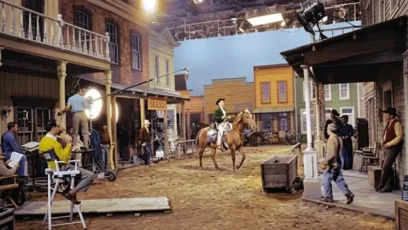
The iconic Dodge City of Gunsmoke was primarily constructed inside Stage 3 at CBS Studio Center, located at 4024 Radford Avenue in Studio City, California. The 24,000-square-foot soundstage housed a complete Western street with full building facades and walk-through interiors for the key permanent structures.

One wall of the stage could slide open to admit horse-drawn wagons.
The dirt street required frequent replacement because of the horses. Crew members who worked the show for years noted the stage had a distinctive, permanent odor that was uniquely its own.
The core buildings were permanent fixtures inside the soundstage for most of the show’s run. The Long Branch Saloon had a full exterior facade on the main street plus a complete accessible interior with bar, batwing doors, tables, and period detail.
The Marshal’s Office had Dillon’s desk, a gun rack, a stove, and the heavy wooden door leading to the jail cells. Doc Adams’ office sat up a wooden staircase in a side alley. Delmonico’s Steak House, the livery stable, and the Dodge House filled out the street.
These were not temporary flats. They were substantial constructions that allowed actors to move seamlessly between exterior street scenes and full interiors without leaving the building.
Amanda Blake, who played Miss Kitty for nineteen seasons, later described the sets as “a frame for the characters” that changed very little across two decades.
The Early Years at Melody Ranch and Paramount
Before the show settled at CBS Studio Center, the early half-hour seasons used Melody Ranch in lower Placerita Canyon near Santa Clarita for outdoor town scenes.
Owned by Gene Autry since 1953, the 110-acre property featured a detailed frontier town set. In August 1962, a brush fire swept through the canyon and destroyed most of the standing Western sets, forcing a relocation.
During those early years, interior soundstage work was done at Paramount Pictures in Hollywood, using Stages 11, 12, 14, and 15. Many exterior street scenes were actually filmed on covered indoor soundstages dressed with dirt, false storefronts, and painted backdrops to maintain control over lighting and sound.
The production relocated to the CBS Radford lot during the 1962-63 or 1963-64 season. CBS had leased the facility in 1963 and purchased it outright in February 1967 for $9.5 million.
The studio had deep Western roots, having previously produced B-Westerns starring Roy Rogers, Gene Autry, and John Wayne. The permanent Dodge City set was erected on the backlot’s western street just inside the facility’s truck gate off Cole Avenue.
The Long Branch Saloon and the Marshal’s Office
Of all the structures in television’s Dodge City, two defined the show’s visual identity more than any other.
The Long Branch Saloon was divided into two distinct physical components. The exterior was a permanent two-story wooden storefront on the backlot street with swinging doors, wide front windows, and a painted sign.
The interior was built on a separate soundstage, featuring a long polished bar, gambling tables, a piano, and a staircase to a second-floor balcony. This split construction allowed directors to stage elaborate multi-character scenes and physical brawls without damaging the backlot structure.
When the show transitioned to color in 1966, the interior was updated with richer wood paneling and colorful upholstery designed to showcase the new format.
The Marshal’s Office exterior sat on the backlot street alongside the Long Branch. The interior soundstage set contained Dillon’s desk, a gun rack stocked with period-accurate rifles and shotguns, a small stove, and the heavy wooden door leading to the jail cells.
The tight, shadow-filled confines of the cell block provided a dramatic visual contrast to the warmth of the saloon, and the cells appeared in almost every episode of the show’s entire run.
The Color Transition and What Changed
Gunsmoke transitioned from black and white to color on September 17, 1966, at the start of Season 12. The change required a significant overhaul of the show’s visual design.
The weathered neutral tones of the Dodge City backlot had to be repainted with colors that registered clearly on early color cameras without looking unnatural. Costumes were redesigned in rich earth-toned fabrics.
Lighting infrastructure was upgraded to handle the significantly higher light levels that color film stock required, making the soundstages considerably hotter for cast and crew.
The opening gunfight sequence was reshot in color. Miss Kitty’s wardrobe shifted from heavy red emphasis to a broader palette of burnt orange, plum, lavender, and green.
Some critics felt the color transition flattened the dramatic chiaroscuro of the earlier black-and-white years. The show kept going regardless, running another nine seasons in color before cancellation.
What Happened to the Sets
The CBS Radford backlot’s Western street survived long after Gunsmoke ended in 1975, continuing to serve other productions including The Wild Wild West.
But the historic Dodge City structures were eventually demolished in the late 1990s to make room for modern parking structures and soundstage expansions.
The lot was renamed Radford Studio Center and changed corporate hands multiple times. In 2021, ViacomCBS sold the 55-acre facility for $1.85 billion. In January 2026, after defaulting on approximately $1.1 billion in debt, the owners relinquished control to lenders led by Goldman Sachs.
No original physical structures from the Gunsmoke Dodge City set survive on the Radford lot today.
Outdoor Filming Locations
The wide-open frontier scenes that gave the show its sense of scale were filmed at several locations across California, Utah, and Arizona.
The Conejo Valley and Thousand Oaks area was the most consistently used outdoor location.
The volcanic formations of Mountclef Ridge at what is now partly Wildwood Regional Park appeared in countless episodes as distinctive background for range scenes and cattle drives. The terrain was used regularly from the earliest seasons onward.
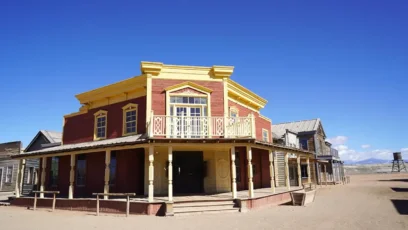
The Johnson Canyon set near Kanab, Utah, was one of the most significant outdoor locations. Kanab is often called “Little Hollywood” for the volume of Westerns filmed there, and a complete rustic Western town was built specifically for productions including Gunsmoke, used for approximately 20 episodes.
The ruins of this set still stand on private property and are visible from the roadside along Johnson Canyon Road, though access is strictly restricted due to the structural instability of the deteriorating buildings.
Visitors can photograph the decaying barn, the isolated stone chimney, and the collapsed homestead structures from the road with a zoom lens.
In Arizona, Old Tucson Studios near Tucson was used for episodes requiring authentic desert vegetation and Southwestern adobe architecture, particularly in the later color seasons.
An area near the Painted Desert east of Flagstaff was also used for fort sequences in the show’s final years.
Additional California locations included Iverson Ranch in Chatsworth for stagecoach chases and rocky terrain, Vasquez Rocks in Agua Dulce for outlaw-in-the-passes sequences, Paramount Ranch in Agoura Hills for cattle ranching and woodland scenes, and Bronson Canyon in Griffith Park for cave and mine sequences.
The Real Dodge City and How It Compares
The actual Dodge City, Kansas, began as a buffalo hide hunters’ camp established in 1872 on the Arkansas River just west of Fort Dodge. The Santa Fe Railway arrived that same year.
When quarantine laws pushed Texas cattle drives off the Chisholm Trail, the Great Western Trail emerged as the primary route to Dodge City’s stockyards.
Between 1875 and 1886, approximately five million cattle were herded up the trail to the Dodge City railhead.
The seasonal influx of cowboys, gamblers, and outlaws earned the town nicknames including “The Wickedest Little City in America” and “Queen of the Cowtowns.” Real lawmen policing this environment included Wyatt Earp and Bat Masterson.
They enforced the “deadline” south of the railroad tracks, which required all firearms to be surrendered upon entering town.
The television version romanticized considerably. The real Dodge City relied on successive short-term tenures of different lawmen rather than a single marshal holding power for twenty years.
The real Long Branch Saloon operated from roughly 1874 to 1885 before closing as the cattle drives ended. The real Boot Hill Cemetery, which operated from about 1872 to 1879, held not legendary gunfighters but transient buffalo hunters, unidentified travelers, and destitute cowboys who died of disease or exposure.
The prominent frontier lawmen associated with Dodge City — Earp, Masterson, Bill Tilghman — all left the town alive and died elsewhere years later.
The phrase “get out of Dodge” is a direct cultural product of the television series. Marshal Dillon delivered variations of the ultimatum to vanquished outlaws starting as early as the Season 1 episode “How to Die for Nothing” in 1956.
The phrase entered common American vernacular and has been in use ever since.
What Fans Can Visit in Dodge City Today
The real Dodge City has built a substantial tourism industry around both its authentic frontier history and the show’s legacy. The flagship destination is Boot Hill Museum at 500 W. Wyatt Earp Boulevard, located directly on the original historical site of the Boot Hill Cemetery.
The museum holds over 60,000 historical objects, photographs, and documents. Its permanent “Hollywood and the Wild West” exhibit features a recreated 1960s family living room where visitors can sit and watch classic Gunsmoke clips surrounded by original memorabilia, props, and costumes donated by former cast members and their estates.
The “Guns That Won the West” exhibit features more than 200 firearms and artifacts, some linked to Bat Masterson and other historical figures from the era.
Within the museum complex, visitors walk down a reconstructed replica of Front Street as it appeared in 1876, including a fully operating Long Branch Saloon replica where costumed interpreters serve sarsaparilla.
From Memorial Day through mid-August, the saloon hosts a nightly Long Branch Variety Show alongside a Country Style Dinner, and the Boot Hill Gunfighters perform daily shootout reenactments on the street outside.
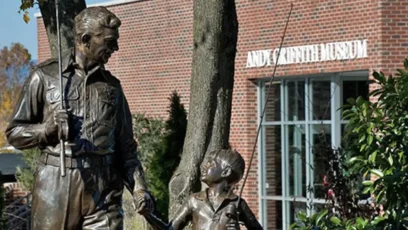
Outside the Dodge City Visitor Information Center stands a life-size bronze statue of James Arness as Marshal Matt Dillon, part of the Dodge City Trail of Fame. The walking tour includes bronze sidewalk medallions honoring the primary cast alongside real historical figures.
Museum hours vary by season. Summer hours run daily 8 AM to 8 PM. Off-season hours are Monday through Saturday 9 AM to 5 PM and Sunday 1 to 5 PM. Admission runs approximately $18 to $20 for adults and $14 for children aged 5 to 12, with family packages available. Check boothill.org for current pricing before visiting.
The largest annual event is Dodge City Days in late July and early August, a ten-day Western heritage festival featuring a longhorn cattle drive down Wyatt Earp Boulevard, a PRCA rodeo, concerts, and family events that draws approximately 100,000 visitors annually.
James Arness visited Dodge City on several occasions, including a notable 1958 street-renaming ceremony tied to the show and events around the 50th anniversary in 2005.
The city’s relationship with the cast extends to Buck Taylor, who played deputy Newly O’Brien and is the sole surviving main cast member of the series. Now an accomplished Western artist, Taylor regularly paints watercolor scenes of the Gunsmoke era and attends fan events keeping the show’s memory active.
For the full story of the cast and what happened to everyone after the show ended, the Gunsmoke cast hub covers it in detail.
Where was Gunsmoke filmed?
Gunsmoke was filmed primarily at CBS Studio Center (CBS Radford) in Studio City, California, where the permanent television Dodge City set was built inside Stage 3. Earlier seasons used Melody Ranch near Santa Clarita and Paramount Studios in Hollywood. Outdoor scenes were filmed at Conejo Valley locations near Thousand Oaks, the Johnson Canyon set near Kanab, Utah, and various California and Arizona locations including Old Tucson Studios, Vasquez Rocks, Iverson Ranch, and Paramount Ranch.
Did Gunsmoke ever film in Kansas?
No. Despite being set in Dodge City, Kansas, Gunsmoke never filmed in the state. The entire production took place in California, Utah, and Arizona. James Arness visited the real Dodge City on several occasions, including a 1958 street-renaming ceremony and events around the show’s 50th anniversary, but no filming ever took place there.
What happened to the Gunsmoke sets?
The original Gunsmoke sets at CBS Studio Center were demolished in the late 1990s to make room for parking structures and soundstage expansions. No original structures from the television Dodge City survive today. The CBS Radford lot, now called Radford Studio Center, continues as a working production facility but contains no remnants of the show’s Western street.
Can you visit Gunsmoke filming locations today?
The best destination for Gunsmoke fans is Boot Hill Museum in the real Dodge City, Kansas, which holds cast memorabilia, a Long Branch Saloon replica, and a dedicated Gunsmoke exhibit. The Johnson Canyon set ruins near Kanab, Utah, are visible from the roadside but on private property. Some California outdoor locations including Vasquez Rocks remain as public parks. The CBS Studio Center soundstage where the main set stood is now a working production facility with no public access.
What is Boot Hill Museum and what does it contain?
Boot Hill Museum at 500 W. Wyatt Earp Boulevard in Dodge City, Kansas, is located on the original site of the historical Boot Hill Cemetery. It holds over 60,000 historical objects, photographs, and documents. Key features include the ‘Hollywood and the Wild West’ exhibit with Gunsmoke memorabilia donated by cast members, a reconstructed Front Street with a working Long Branch Saloon replica, daily gunfight reenactments, and a life-size bronze statue of James Arness as Marshal Matt Dillon.
Where did the phrase ‘get out of Dodge’ come from?
The phrase ‘get out of Dodge’ came directly from Gunsmoke. Marshal Matt Dillon regularly delivered variations of the ultimatum to defeated outlaws, telling them to leave town. The phrase first appeared as early as the Season 1 episode ‘How to Die for Nothing’ in 1956 and quickly entered common American speech, where it has remained ever since as a shorthand for needing to leave a dangerous situation immediately.