TLDR: Tallgrass Prairie National Preserve sits two miles north of Strong City, Kansas, in the Flint Hills.
It protects nearly 11,000 acres of one of the rarest ecosystems on Earth: less than 4% of the original tallgrass prairie survives globally, and this is the largest remaining tract.
Admission is completely free.
A herd of roughly 90 bison roams the preserve. The 1881 limestone ranch house is open daily for self-guided tours. Over 40 miles of hiking trails are open 24 hours a year-round.
It is approximately 2.5 hours from both Wichita and Kansas City, and about 130 miles north of Pawhuska, Oklahoma, making it a natural extension of a Pioneer Woman road trip.
Most people drive through the Flint Hills without stopping. The land rolls in every direction, grass and sky, no obvious reason to pull over. That is exactly the point. This is what 170 million acres of North America looked like before the plow arrived. Almost none of it is left.
The Tallgrass Prairie National Preserve protects nearly 11,000 acres of it. Entry is free. The bison are real. The silence is genuine. It rewards people who slow down.
Why So Little of It Survived
Tallgrass prairie once covered more than 170 million acres across North America, from Canada to Texas and from Indiana to Kansas. Today less than 4 percent of it exists anywhere on Earth.
The rest was converted to farmland within a generation of Euro-American settlement. The deep, nutrient-rich prairie soils made exceptional agricultural land, and settlers with steel plows turned it over as fast as they could reach it.
The Flint Hills escaped because of geology. Nearly 300 million years ago, shallow inland seas covered this region. Over millennia, those seas receded and left layers of limestone, shale, and chert.
Chert, also known as flint, is a dense erosion-resistant form of silica. When Euro-American settlers arrived, they found the soil thin, rocky, and full of sharp flint chunks that broke plow blades.
The land could not be farmed profitably, so it was used for cattle grazing instead. The native sod was never turned. The grasses and wildflowers that had grown here for thousands of years kept growing.
The same rock that frustrated the farmers is the reason this place exists.
What Tallgrass Prairie Actually Looks Like
Tallgrass prairie is not what most people picture when they think of grassland. This is not the flat, dry, short-grass range of the far West. The Flint Hills receive 30 to 35 inches of rain annually, enough to support three dominant grasses: big bluestem, little bluestem, and Indiangrass.
By September and October, under good conditions, these grasses reach four to seven feet tall. Big bluestem is sometimes called turkey foot for the shape of its seed head.
In autumn the grasses shift to copper, bronze, and gold. The effect at golden hour is extraordinary.
The real marvel is underground. Up to two-thirds of the prairie’s total biomass is below the surface.
The root systems of these grasses plunge ten feet or more into the earth, binding the soil, preventing erosion, and sequestering significant amounts of atmospheric carbon.
The preserve hosts more than 400 species of vascular plants, with wildflowers rotating through from March to October. Spring brings prairie violets and wild alfalfa.
Summer brings purple coneflower, butterfly milkweed, and black-eyed Susan. Fall brings goldenrod, sky blue aster, and Maximilian sunflower.
The Bison Herd
Thirteen bison were reintroduced to the preserve in October 2009, sourced from Wind Cave National Park in South Dakota, selected specifically for their genetic diversity and disease-free status.
The herd has grown to approximately 90 animals and roams freely across the Windmill Pasture and adjacent West Traps Pasture.
The best way to see them is to hike the Scenic Overlook Trail, a 6.4-mile round trip on a wide gravel ranch road that climbs into the uplands and into bison territory. Rangers can advise at the visitor center on where the herd has been spotted recently.
The backcountry bus tour, when running, takes visitors deep into the prairie on a specialized vehicle with a ranger narrating the geology, ecology, and history of what passes outside the window.
Bison are wild animals capable of running 35 miles per hour. The mandatory viewing distance is 100 yards, the length of a football field. If bison are blocking a trail, detour widely around them rather than walking through the herd.
If an animal lowers its head, raises its tail, paws the ground, or bellows, it is agitated. Back away slowly. Do not run.
The annual bison roundup happens each fall, typically in October or November. The animals are funneled into historic stone corrals for health evaluations, vaccinations, weight measurement, and genetic monitoring.
It is a working conservation operation rather than a public spectator event, so visitor access is limited. Check the NPS calendar or call ahead to confirm current details.
The Spring Hill Ranch House
The preserve’s other great attraction has nothing to do with grass. The Spring Hill Farm and Stock Ranch, later known as the Z Bar Ranch, was established in the 1880s by land speculator and cattleman Stephen F. Jones.
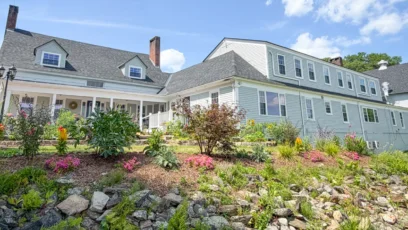
The centerpiece is a four-story limestone mansion completed in 1881, built from native Flint Hills stone quarried directly from the surrounding hills.
The architectural style blends Second Empire influence with Plains Vernacular pragmatism: a mansard roof, elegant arched windows, and a grand front porch looking east across the Fox Creek valley.
The house is open daily from 9 AM to 4:30 PM for self-guided exploration. A cell phone audio tour is available by calling 620-805-3185, walking visitors through the formal kitchen, dining room, sitting room, butler’s pantry, business office, bedrooms, and a zinc bathtub area on the mansard level.
The Spring Room, built directly over a natural flowing spring, served as the ranch’s refrigerator: cold water kept dairy and meat cold year-round, and it still flows today.
The three-story limestone barn, spanning 19,000 square feet and built so that horse-drawn wagons could drive directly into the third floor to unload feed, is currently closed for repairs.
The Lower Fox Creek Schoolhouse, a one-room limestone building from 1878 that served local ranching families through 1930, sits on a hill north of the ranch house and can be viewed through its windows year-round.
The entire ranch complex is listed on the National Register of Historic Places.
Hiking Trails
Over 40 miles of trails are open 24 hours a day, year-round, with no permit required. Most follow historic ranch roads marked with limestone posts. Trail maps are available at the visitor center and at trailhead kiosks.
The Bottomland Nature Trail is the most accessible: a flat half-mile loop on hardened crushed limestone that works for wheelchairs in dry conditions and runs through restored bottomland prairie.
The Southwind Nature Trail covers 1.75 miles with scenic overlooks, spring streams, and a path to the historic schoolhouse. The Scenic Overlook Trail is 6.4 miles on a wide gravel road that climbs into the Windmill Pasture for the best bison viewing.
The Fox Creek Hiking Trail runs 6.1 miles along a creek through riparian woodland with towering autumn grasses. For experienced hikers, the Prairie Fire and Gas House Loops cover 8 to 10 miles of remote northern ridges on rocky, flint-strewn paths offering complete solitude, geological layers, and the occasional horned lizard.
The West Branch and Palmer Loop reaches 12 miles, accessing limestone slabs and dramatic river-cut cliffs at Palmer Creek.
Cell service drops significantly in valleys and disappears inside the limestone buildings. Download offline maps or pick up a paper map at the visitor center before heading out.
The Bus Tour and Ranger Programs
The Scenic Vista Bus Tour covers 6.4 miles into the upland prairie on a specialized off-road vehicle, providing older visitors and those with mobility limitations a comfortable way to experience the high prairie and view bison.
When running, tours depart daily at 11 AM with an additional 1 PM run on weekends. They are free. Space is limited, so reservations at the visitor center or by calling 620-273-8494 are recommended. Tour availability fluctuates with seasonal funding. Call ahead to confirm.
Rangers offer guided programs seasonally, and group tours of the ranch complex can be arranged by reservation for groups of 15 or more. Junior Ranger programs are available for families with children.
Birding and Stargazing
The preserve is a significant grassland bird habitat, supporting species that have declined sharply elsewhere as their habitat disappears. The greater prairie-chicken, famous for its spring lekking displays, breeds here alongside dickcissel, grasshopper sparrow, and upland sandpiper. Spring is the peak birding season for breeding and migrating species.
The preserve is not formally certified as an International Dark Sky Park, but its remoteness produces some of the darkest skies remaining in the American Midwest.
Trails are open at night, and the Lower Fox Creek Schoolhouse parking lot is a good stargazing base. Lay a blanket in the grass and look up. On a clear night the Milky Way is plainly visible.
Practical Information
The preserve is located at 2609 US-177, Strong City, KS 66869, along the Flint Hills National Scenic Byway.
From Wichita it is approximately 1.5 hours northeast via I-35 to US-50 East and then north on K-177. From Kansas City it is approximately 2 hours southwest via I-35 to US-50 West and then north on K-177.
From Emporia it is 20 minutes west on US-50 to Strong City, then north on K-177.
Admission is free. No entry fee. No parking fee. National Park passes are accepted at any sites that charge fees elsewhere but are not needed here. Trails are open 24 hours year-round.
The visitor center and historic buildings are open daily from 9 AM to 4:30 PM, closed Thanksgiving, Christmas, and New Year’s Day.
The nearest towns with lodging and dining are Strong City, 2 miles south, and Cottonwood Falls, 4 miles south, a charming historic town with bed-and-breakfasts and local cafes built around the magnificent 1873 Chase County Courthouse, the oldest continuously operating courthouse in Kansas.
For chain hotels and larger restaurants, Emporia is 20 minutes east.
The Flint Hills Scenic Byway
The preserve is best experienced as part of the Flint Hills National Scenic Byway, a 47-mile stretch of Kansas Highway 177 running from Council Grove in the north to Cassoday in the south.
Tune a car radio to 1680 AM while driving for a synchronized broadcast of geological, ecological, and historical narratives about the landscape passing outside the window. A few miles south of Cottonwood Falls, an overlook area offers panoramic views of unbroken rolling Flint Hills.
The Flint Hills Discovery Center in Manhattan, Kansas, about 50 miles north, provides excellent context on the geology, ecology, and cultural history of the region and is worth visiting before or after the preserve.
For Pioneer Woman Fans: The Drummond Connection
The Flint Hills of Kansas extend directly south into northern Oklahoma, where they become the Osage Hills.
The Drummond Ranch sits in those hills in Osage County, Oklahoma, less than 20 miles from the Joseph H. Williams Tallgrass Prairie Preserve, a 39,000-acre Nature Conservancy site with a free-roaming herd of more than 2,100 bison and a vehicle-accessible scenic loop.
The connection is direct. Frederick Drummond, Ladd Drummond’s uncle, was a founding member and chairman of the Oklahoma Nature Conservancy and played a leading role in negotiating the purchase of the historic Barnard Ranch in Osage County that became the Oklahoma preserve.
The same conservation ethic that shaped the Drummond family’s approach to their 433,000-acre cattle operation is the ethic that established both preserves.
Driving distance from Pawhuska, Oklahoma, to the Kansas preserve in Strong City is approximately 130 miles, a 2.5-hour drive straight north through the Flint Hills.
A two-day road trip that combines Pawhuska attractions and the Oklahoma preserve on day one with the Kansas preserve and Flint Hills Byway on day two is genuinely worth the effort.
The Oklahoma preserve is larger and better for vehicle-based bison viewing. The Kansas preserve has the hiking trails, the ranch house, and the more intimate prairie experience.
Together they tell the complete story of what this landscape is and why what remains of it matters.
Is Tallgrass Prairie National Preserve free?
Yes. Tallgrass Prairie National Preserve is completely free. There is no entry fee, parking fee, or charge for ranger programs or the bus tour. National Park passes are not required. The preserve is managed jointly by the National Park Service and The Nature Conservancy.
Can you see bison at Tallgrass Prairie National Preserve?
Yes. A herd of approximately 90 bison roams the preserve’s Windmill Pasture. The best way to see them is to hike the Scenic Overlook Trail, a 6.4-mile round trip that climbs into bison territory, or to join the Scenic Vista Bus Tour when it is running. Rangers at the visitor center can advise on where the herd has been spotted recently. Visitors must maintain a minimum distance of 100 yards from the animals at all times.
When is the best time to visit Tallgrass Prairie National Preserve?
Each season offers something distinct. Spring brings wildflower displays and bison calves but may involve prescribed burns and smoke. Summer delivers full prairie height and peak wildflower blooms but is hotter. Fall offers the most dramatic scenery as the grasses turn copper and gold, and the annual bison roundup occurs in October or November. Winter offers solitude and excellent stargazing but can be cold and windy with some trail limitations. Avoid midday in summer for photography.
Why is the tallgrass prairie so rare?
Less than 4% of the original tallgrass prairie survives globally. The rest was converted to farmland during the 19th and 20th centuries as settlers turned the deep nutrient-rich prairie soils into cropland. The Flint Hills of Kansas survived because their thin, rocky, chert-filled soils broke plow blades and made large-scale cultivation impossible. The land was used for cattle grazing instead, which preserved the native sod.
How far is Tallgrass Prairie National Preserve from Wichita and Kansas City?
Tallgrass Prairie National Preserve in Strong City, Kansas, is approximately 1.5 hours northeast of Wichita and approximately 2 hours southwest of Kansas City. It is also about 130 miles north of Pawhuska, Oklahoma, making it a natural addition to a Pioneer Woman road trip itinerary.
What is the connection between the Drummond Ranch and the Tallgrass Prairie Preserve?
The Drummond Ranch in Osage County, Oklahoma, sits in the Osage Hills, the southern extension of the same Flint Hills landscape protected in Kansas. Frederick Drummond, Ladd Drummond’s uncle, was a founding member and chairman of the Oklahoma Nature Conservancy and helped establish the Joseph H. Williams Tallgrass Prairie Preserve in Osage County, a 39,000-acre site with over 2,100 bison. The Kansas and Oklahoma preserves are both managed by The Nature Conservancy and together protect the two most significant remaining tracts of tallgrass prairie in the world.