TLDR: Bonanza was set on the shores of Lake Tahoe, Nevada, but filmed almost entirely at Paramount Studios in Hollywood across its first eleven seasons, with a move to Warner Bros. in Burbank for the final three.
Only approximately 15 episodes feature significant on-location footage at Lake Tahoe. The Ponderosa Ranch theme park at Incline Village operated from 1968 to 2004, when it was purchased for $55 million and closed.
The ranch house replica no longer stands on the site. The best fan destinations today are Virginia City, Nevada and the Incline Village Visitor Center.
When the hand-drawn map of the Ponderosa caught fire in Bonanza‘s opening sequence every Sunday night, it placed the Cartwright ranch squarely on the shores of Lake Tahoe in the Sierra Nevada mountains. For fourteen seasons and 431 episodes, that map sent millions of viewers to Nevada in their imaginations.
Almost none of it was actually filmed there.
The Lake Tahoe Connection and Its Limits
The fictional Ponderosa Ranch was a 1,000-square-mile timber and livestock empire on Lake Tahoe’s North Shore, near present-day Incline Village, Nevada. Producer David Dortort chose the location for its spectacular scenery and its ability to showcase color television at its most vivid: deep blue water, lush green pines, and snow-capped Sierra Nevada peaks.
This was crucial. Bonanza was NBC and RCA’s flagship vehicle for selling color television sets to American households. Lake Tahoe’s natural color palette was the most persuasive advertisement imaginable.
The problem was logistics. Shuttling a full cast, crew, and heavy color cameras from Los Angeles to the Sierra Nevada on a weekly basis was prohibitively expensive.
The solution was a two-unit system: a second unit would capture panoramic establishing shots and scenic B-roll at Lake Tahoe, which were then spliced with dialogue scenes filmed on Hollywood soundstages.
Only approximately 15 episodes across the show’s entire run feature significant on-location footage shot at Lake Tahoe itself.
The opening title sequence, with the Cartwright family riding toward the camera against the Sierra Nevada backdrop, was filmed near Incline Village on Lake Tahoe’s North Shore. That footage became one of the most recognized television images of the 1960s.
The Studio That Built the Ponderosa
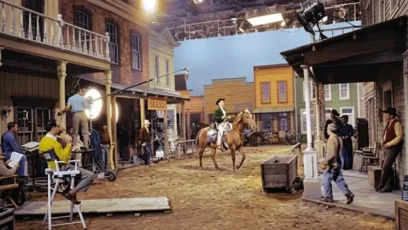
The interior of the Ponderosa ranch house, including the grand stone fireplace, Ben’s writing desk, the heavy dining table, and the famous wooden staircase, was constructed inside Stage 17 at Paramount Studios in Hollywood. Paramount offered the largest soundstages in the city and a versatile Western street backlot originally built in 1947 for the Alan Ladd film Whispering Smith.
The set was designed with a heavy rustic mid-century aesthetic using massive wooden beams and a grand stone fireplace. The second-story bedrooms, however, were entirely separate, built on a different, less expensive soundstage.
Directors choreographed scenes carefully: an actor would climb the stairs on Stage 17, the camera would cut, and the continuation would be filmed on the bedroom set elsewhere on the lot.
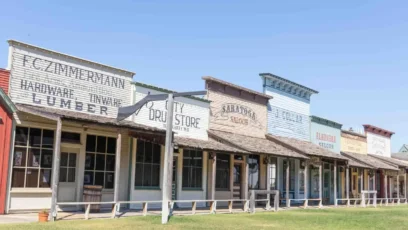
Paramount’s Western street portrayed the bustling streets of Virginia City. The backlot was a shared facility simultaneously serving Have Gun Will Travel, Branded, and The Guns of Will Sonnet.
To create the illusion of a vast high-altitude mountain settlement on a cramped urban backlot, the crew used wide-angle lenses and erected a massive fake mountain at the rear of the street, a rigid chicken-wire framework covered in plaster and painted to resemble the Sierra Nevada slopes.
Its purpose was to block the view of an industrial construction mill built by Desilu in 1957.
The fake mountain had one persistent problem. Local pigeons would land on its peak. Because the birds appeared unnaturally large relative to the forced perspective of the “distant” mountain, filming had to pause regularly while crew members scattered them. The pigeons outlasted the show.
In May 1979, Paramount demolished the historic Western street to make way for an executive parking lot. A single historic barn was spared, first seen in Cecil B. DeMille’s 1914 feature The Squaw Man, which had made infrequent appearances on Bonanza as a freight station.
The Move to Warner Bros. and the Night Virginia City Burned
By 1970, production demands and corporate realignments prompted a move to Warner Bros. in Burbank for the show’s final three seasons. This created a continuity problem: Warner’s Laramie Street backlot looked noticeably different from Paramount’s Western street.
The writers solved it with a storyline. In the twelfth season premiere, “The Night Virginia City Died,” a series of arsons burns down the town. The episode was loosely based on the real Great Fire of 1875 that had destroyed much of the actual Virginia City, Nevada. It allowed the production to transition seamlessly to the new backlot sets without breaking continuity.
The Warner Bros. Laramie Street backlot continued hosting various Western productions after Bonanza ended. It was demolished in May 2003 and replaced by an office park known as Warner Village.
Outdoor Filming Locations Across California and the Southwest
Beyond the studio, Bonanza used a network of California movie ranches and outdoor locations for the wide-open frontier scenes that gave the show its visual scale.
Iverson Movie Ranch in Chatsworth was used regularly for horseback chases, stagecoach ambushes, and rugged terrain sequences, with its distinctive sandstone boulder formations appearing in multiple episodes.
Spahn Ranch in Simi Valley, before its dark association with the Manson family in the late 1960s, hosted trail riding and wilderness camp scenes. Golden Oak Ranch in Newhall, owned by Disney, provided peaceful meadow scenes and stream crossings.
Vasquez Rocks in Agua Dulce depicted harsh desert territories and outlaw hiding spots. Red Rock Canyon in the Mojave Desert provided layered cliff backdrops for long-distance journey sequences.
For high-altitude forested scenes that needed to evoke the Ponderosa’s Sierra Nevada setting, the production used Lake Hemet and the Idyllwild area in the San Jacinto Mountains.
Old Tucson Studios near Tucson and the Mescal Movie Set near Benson, Arizona provided authentic desert-town architecture for Southwest-set episodes. Monument Valley and the Kanab, Utah red-rock locations, while extensively used by other Westerns, were not primary Bonanza locations.
The Ponderosa Ranch Theme Park: How a Fake Set Became a Real Destination
One of the more remarkable stories in television history involves what happened when tourists started showing up in Incline Village looking for the Ponderosa.
In the early 1960s, a Lake Tahoe contractor named Bill Anderson had been hired to clear pine trees and granite boulders to build the infrastructure for the new town of Incline Village.
A contract clause gave him ownership of more than 400 acres of prime land adjacent to the town. Because the show’s hand-drawn opening map placed the fictional Ponderosa directly over Incline Village, fans began wandering onto Anderson’s property searching for the ranch.
Anderson recognized the opportunity. He contacted David Dortort and NBC in 1965, negotiated a licensing agreement, and constructed an exact physical replica of the Cartwright ranch house on his property using the actual Paramount Studio blueprints from Stage 17.
The Ponderosa Ranch theme park opened in 1968.
The replica ranch house was the centerpiece. Tourists found the stone fireplace, Ben’s writing desk, the heavy dining table, and the famous wooden staircase inside. During guided tours the illusion was gently broken: the staircase led nowhere.
The second-story bedrooms depicted on television had always been on a separate Hollywood soundstage. One wall of the living room was engineered to slide away, replicating how long-angle shots had been achieved in the studio.
Beyond the ranch house, visitors could ride in authentic wagons, experience staged stagecoach robberies, ride horses, explore a mystery mine, and eat Hoss-burgers. A replica Virginia City street was added. The restaurant eventually served over three million Hoss-burgers across the park’s lifetime.
As the original cast members died over the years, symbolic gravesites for Dan Blocker, Victor Sen Yung, Lorne Greene, and Michael Landon were erected on the grounds so fans could pay their respects.
Under the licensing agreement, cast members including Greene, Landon, Blocker, and later David Canary made promotional appearances in full costume to sign autographs and mingle with visitors. By the early 2000s the park was still drawing approximately 250,000 visitors annually.
On September 26, 2004, the gates closed permanently. Software billionaire David Duffield purchased the entire 400-acre property for an estimated $55 million and converted it to a private residential estate.
Most structures were eventually removed due to liability, insurance, and maintenance costs. Many artifacts, including Little Joe’s green corduroy jacket, Hoss’s brown suede vest, props, scripts, vehicles, wagons, and building elements, were gifted to the Thunderbird Lodge Preservation Society and distributed to the Nevada State Museum, the Nevada Railroad Museum in Carson City, and other collections.
The property sold again around 2020 for $38 million and remains private.
Lorne Greene Built His Own Ponderosa in Arizona
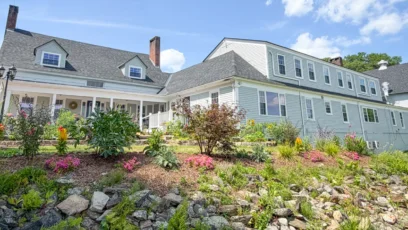
One of the more extraordinary offshoots of the show’s location history sits at 602 S. Edgewater Drive in Mesa, Arizona. Built in 1960 under the direct supervision of Lorne Greene, this 3,766-square-foot mid-century residence is a full-scale livable replica of the Ponderosa ranch house set from Paramount’s Stage 17.
Greene and his wife Nancy lived in the home as a quiet retreat from the Hollywood filming schedule, enjoying its 325 feet of golf course frontage. It features the iconic stone fireplace, exposed wooden beams, and rustic styling of Ben Cartwright’s study and living room.
Known as “Ponderosa II,” the home is officially listed on the Mesa Historic Property Register. On January 17, 2026, it was opened to the public for tours for the first time in its history.
The Real Virginia City vs. the Television Version
In Bonanza, Virginia City was depicted as a flat, dusty cattle town where the Cartwrights rode to deposit money, resolve legal disputes, and confront outlaws. The real Virginia City, established in 1859 following the discovery of the Comstock Lode, was a starkly different place.
It was one of the most industrialized and ethnically diverse cities in the United States during its boom years. Multi-story brick buildings, gas lighting, advanced underground mining machinery, and complex labor organizations defined it. The terrain was steep and mountainous, not the flat layout of the Paramount backlot.
No filming for the television series was ever conducted in the real Virginia City. Instead, the show’s enormous global popularity transformed the fading near-abandoned mining town into a thriving tourist destination, effectively saving it from becoming a ghost town.
Creator David Dortort, who held a history degree, wove genuine historical elements into the show, including the clear-cutting of surrounding forests to support the underground mines, the politics of Nevada Territory during the Civil War, and the development of the square-set timbering system, even while building his fictional world on a Hollywood backlot.
What Fans Can Visit Today
Virginia City, Nevada is the strongest fan destination and a genuine highlight as a travel experience. The Comstock Historic District preserves over 400 historic structures.
C Street offers wooden boardwalks, authentic saloons including the Bucket of Blood, shops, restaurants, and lodging in historic buildings. The Virginia and Truckee Railroad runs scenic steam train rides.
Mine tours let you descend into real shafts like the Chollar or the Ponderosa Mine. The Way It Was Museum holds Comstock-era artifacts. Piper’s Opera House, the Mackay Mansion, and the Washoe Club, reputedly one of the most haunted buildings in Nevada, round out a full day.
Virginia City markets itself with a nod to the Bonanza connection and is entirely worth the trip for fans of the show.
Incline Village is worth visiting for the Lake Tahoe scenery and nostalgia, but the former Ponderosa Ranch site is entirely private with no public access and no surviving ranch house.
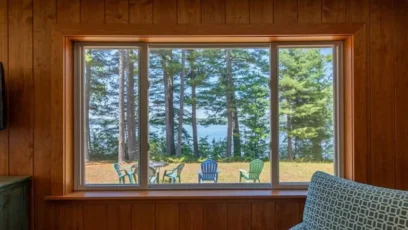
Drive Highway 28 through the North Shore area for the pine-and-lake views that defined the show’s establishing shots. The Incline Village Visitor Center at 969 Tahoe Blvd displays Bonanza memorabilia and some artifacts preserved from the theme park era.
Ponderosa II in Mesa, Arizona at 602 S. Edgewater Drive is now occasionally open for public home tours. It is the closest surviving physical connection to the actual soundstage set. Contact the City of Mesa for current tour availability.
Old Tucson Studios near Tucson, used for desert Southwest episodes of the show, is open to the public with tours, live stunt shows, and Western entertainment. The Mescal Movie Set near Benson, Arizona, another Bonanza location, offers 28 historical replica buildings across 70 acres.
For the full cast story and what happened to everyone after the show ended, see the Bonanza cast hub.
Where was Bonanza filmed?
Bonanza was filmed primarily at Paramount Studios in Hollywood across its first eleven seasons, with a move to Warner Bros. in Burbank for the final three. The interior Ponderosa ranch house was built on Stage 17 at Paramount. Virginia City street scenes used Paramount’s Western backlot. Only approximately 15 episodes feature significant on-location footage at Lake Tahoe, Nevada, despite the show being set there.
Can you visit the Ponderosa Ranch from Bonanza?
The Ponderosa Ranch theme park at Incline Village, Nevada, closed permanently on September 26, 2004, when the property was purchased for $55 million and converted to a private estate. The ranch house replica no longer stands on the site. The property remains private with no public access. Artifacts from the park, including cast costumes and props, were distributed to the Nevada State Museum and other collections. The Incline Village Visitor Center displays some Bonanza memorabilia.
Did Bonanza film in Virginia City, Nevada?
No. Despite Virginia City being a central location in the show’s storylines, no filming for the television series was ever conducted there. Virginia City was recreated on Paramount’s Western backlot in Hollywood. Ironically, the show’s enormous popularity transformed the real Virginia City from a fading mining town into a thriving tourist destination. Today Virginia City is one of the best Bonanza-related destinations fans can visit, with preserved 1860s architecture, mine tours, and the Virginia and Truckee Railroad.
What happened to the Bonanza sets?
The Paramount Studios sets were struck after the show’s cancellation in 1973. The Western street backlot at Paramount was demolished in May 1979 to make way for an executive parking lot. The Warner Bros. Laramie Street backlot, used for the final three seasons, was demolished in May 2003. No original set structures from either studio survive today. The Ponderosa Ranch theme park replica, built using the original Paramount blueprints, operated until 2004 before being demolished.
Where is the best place to visit for Bonanza fans today?
Virginia City, Nevada is the strongest destination for Bonanza fans, offering preserved 1860s architecture, wooden boardwalks, mine tours, the Virginia and Truckee Railroad, and a direct connection to the show’s depicted world. Incline Village on Lake Tahoe’s North Shore provides the scenery seen in the show’s opening sequences, though the former Ponderosa Ranch site is private. Ponderosa II, Lorne Greene’s personal replica of the ranch house at 602 S. Edgewater Drive in Mesa, Arizona, is occasionally open for public tours.
Did Lorne Greene build a real Ponderosa Ranch house?
Yes. Lorne Greene personally supervised the construction of a full-scale livable replica of the Ponderosa ranch house at 602 S. Edgewater Drive in Mesa, Arizona, completed in 1963. Known as Ponderosa II, the 3,766-square-foot home features the iconic stone fireplace, exposed wooden beams, and rustic styling of Ben Cartwright’s living room and study. It is officially listed on the Mesa Historic Property Register and was opened to the public for tours for the first time on January 17, 2026.