TLDR: Rod Serling served as a paratrooper in the Pacific during World War II, surviving brutal combat in the Philippines that left him with a permanent knee injury, a Bronze Star, and a lifetime of nightmares.
The trauma he carried home from the war became the emotional foundation for much of what he later wrote on The Twilight Zone.
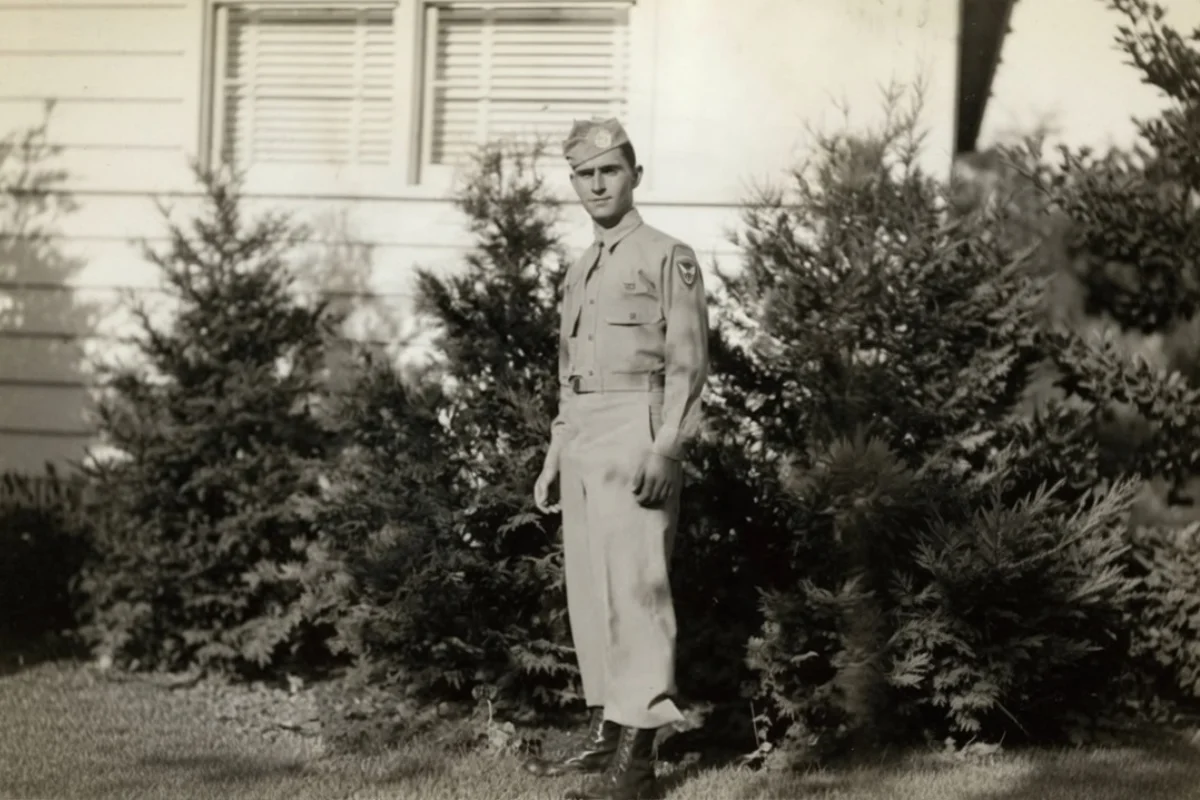
Long before he became the calm, narrating voice of The Twilight Zone, Rod Serling was a teenage paratrooper fighting through some of the most brutal combat of World War II.
He enlisted the morning after his high school graduation in 1943, hoping to fight the Nazis in Europe. Instead, he was sent to the Pacific.
From Brooklyn Bullies to the Battlefield
Serling joined the 511th Parachute Infantry Regiment of the 11th Airborne Division, training at the notoriously grueling Camp Toccoa in Georgia.
He was eventually transferred to the regiment’s demolition platoon, a unit so dangerous it was nicknamed the “Death Squad” for its high casualty rate.
According to his sergeant, Frank Lewis, the transfer wasn’t an honor. Lewis later said Serling simply “didn’t have the wits or aggressiveness required for combat,” recalling one tense firefight where he noticed Serling had forgotten to reload any of his extra ammunition magazines.
Whatever his sergeant thought of his soldiering, Serling saw the worst of the Pacific war firsthand. His unit fought through the mountains of Leyte in the Philippines in late 1944, then parachuted into the brutal Battle of Manila in early 1945, where his regiment suffered a 50 percent casualty rate.
He was wounded twice by shrapnel, once in the knee, an injury that never fully healed and plagued him for the rest of his life.
A Bronze Star and a Brush With Death
Despite his sergeant’s doubts, Serling had at least one genuine moment of battlefield heroism. During a lull in the fighting in Manila, his unit was watching a small celebration with local civilians when Japanese artillery suddenly opened fire on the gathering.
Serling spotted a wounded performer out in the open and ran through the shelling to carry her to safety. Sergeant Lewis was impressed enough to recommend him for the Bronze Star, which he was later awarded.
His own survival came down to luck more than once. During the fighting around Manila, Serling once came face to face with a Japanese soldier who had him directly in his rifle sights. He froze, certain he was about to die, until a fellow soldier fired from behind him and killed the enemy combatant first. Serling also remembered shooting and killing an enemy soldier himself while his squad cleared Rizal Stadium, near what would have been third base on the field.
The Death That Followed Him Home
Of everything Serling witnessed in the Philippines, one moment stayed with him more than any other. While his starving unit was pinned down in the mountains of Leyte, a resupply plane finally flew over to drop desperately needed food.
Private Melvin Levy, the squad’s resident comedian, was so overjoyed at the sound of the plane that he stood out in the open celebrating instead of taking cover.
One of the ration crates had been dropped without a parachute. It struck Levy and killed him instantly, right in front of Serling.
Serling later led the funeral for his friend and placed a Star of David over his grave in honor of Levy’s Jewish heritage.
The senseless, almost cruelly ironic nature of Levy’s death, killed by the very supplies meant to save him, became one of the defining moments of Serling’s war, and one that echoes through the random, fate-driven cruelty found throughout The Twilight Zone.
The War That Never Really Ended
Serling was discharged in 1946 with a Purple Heart, a Bronze Star, and a knee that would buckle without warning for the rest of his life.
His wife, Carol, later recalled hearing him fall on the stairs at home, his bad knee giving out beneath him without notice.
The deeper wounds were invisible. Serling suffered from nightmares for decades after the war, and his daughter Anne has spoken openly about growing up hearing her father scream in his sleep.
She has said plainly that what he carried home would today be recognized as PTSD, a term that did not exist yet in his lifetime. “I knew that my father, like so many, was traumatized by the war,” she has said. “I was also aware that there was no treatment back then.”
In his own words, Serling admitted he came home “bitter about everything and at loose ends,” and turned to writing as a way to process what he had been through.
How the War Became The Twilight Zone
Serling’s combat experience shows up most directly in “The Purple Testament,” an episode he set explicitly in the Philippines, about a lieutenant who can see which of his men are about to die.
The episode opens with one of Serling’s most pointed wartime prologues, describing the faces of young men in combat in stark, unsentimental terms.
The same instinct toward unflinching, real world subject matter shows up again in some of the show’s most disturbing episodes, several of which Serling wrote with the same wartime conscience in mind.
“A Quality of Mercy” pushed even further, forcing an aggressive American officer fighting in the Philippines to suddenly experience the same battle from the perspective of a Japanese officer.
Serling later told his daughter that after the war, he vowed he would never again injure another living thing, and the episode reads as a direct plea for empathy between enemies.
Even outside his explicitly war-themed scripts, the randomness and cruelty that defined Serling’s time in the Philippines, the idea that survival has more to do with chance than virtue, runs through much of the series.
Serling once said that science fiction let him say things on television that network censors would never have allowed in a straightforward war story.
Behind the aliens, the twist endings, and the eerie theme music, much of The Twilight Zone was Serling working through what he saw in the Philippines, one episode at a time.
Rod Serling’s War Trauma: Frequently Asked Questions
Did Rod Serling suffer from PTSD?
Yes. His daughter Anne Serling has said publicly that what he experienced would now be recognized as PTSD, including decades of nightmares and screaming in his sleep, though the term did not exist during his lifetime.
Did Rod Serling see combat in World War II?
Yes. He served as a paratrooper in the 511th Parachute Infantry Regiment and fought in the Battle of Leyte and the Battle of Manila in the Philippines, where he was wounded twice and earned a Bronze Star and Purple Heart.
How did Rod Serling’s war experience influence The Twilight Zone?
Episodes like “The Purple Testament” and “A Quality of Mercy” were directly inspired by his combat experience in the Philippines, and themes of random, fate-driven death that run throughout the series trace back to what he witnessed during the war.