TLDR: “Time Enough at Last” is widely considered the saddest Twilight Zone episode ever made, while critics split between “The Invaders” and “It’s a Good Life” for the scariest. The series also produced a handful of genuinely disturbing episodes that confronted real world horrors like fascism and the Holocaust head on.
The Twilight Zone built its reputation on twist endings, but the show’s most talked about episodes today tend to be the ones that left people sad, scared, or genuinely unsettled long after the credits rolled. For a broader look at the show’s highs and lows, see our roundup of the best and worst Twilight Zone episodes.
The Saddest Episode: “Time Enough at Last”
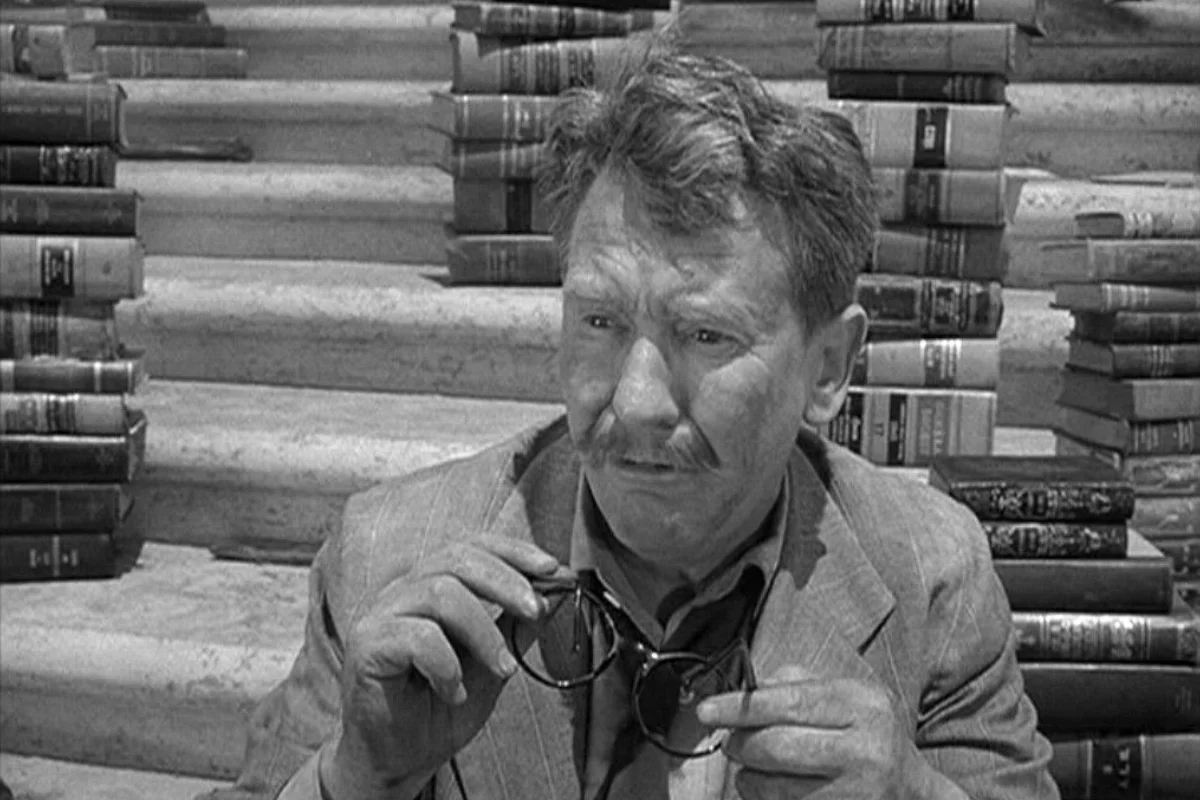
Ask almost any critic which Twilight Zone episode is the saddest, and the same answer comes up. Burgess Meredith plays Henry Bemis, a gentle, bookish bank teller worn down by a cruel wife and an impatient boss who just wants time to read in peace.
When a nuclear war levels everything around him while he is sheltered in a bank vault, Henry emerges to find an entire public library still standing.
Just as he organizes the books he plans to read for the rest of his life, he trips and shatters his glasses, leaving him unable to see well enough to read a single word.
Rod Serling himself called the episode one of his favorites, and reportedly described its irony as “sheer, pure, beautiful” in a later interview.
Not everyone agrees on who deserves sympathy by the end. A vocal corner of modern fans on Reddit and elsewhere have soured on Henry over the years, arguing he neglected his wife and brought his own misery on himself, with one widely shared comment going so far as to say he “got what he deserved.”
Whichever side of that debate someone lands on, the ending itself remains one of the most quoted gut punches in the show’s history.
The Scariest Episode: A Genuine Split Decision
Unlike “saddest,” there is no single consensus pick for scariest. The honor usually comes down to two very different episodes.
“The Invaders” stars Agnes Moorehead as a woman living alone in a remote farmhouse who is attacked by tiny, armored figures who emerge from a miniature flying saucer.
The episode runs almost entirely without dialogue, relying on Moorehead’s physical performance alone to carry the tension, and critics frequently call it the show at its most brutal and visceral.
“It’s a Good Life” takes a different approach to fear entirely. A small Ohio town lives under the thumb of Anthony, a six year old boy with god-like powers who can erase anyone who upsets him into a mysterious cornfield, forcing the adults around him to fake constant cheerfulness just to survive.
Several major outlets rank it as the scariest episode for exactly that reason, since it draws its horror entirely from human behavior rather than any visible monster.
A few other episodes regularly show up in scariest rankings as well, including “The Howling Man,” a theological horror story about monks who claim to be holding the literal devil prisoner, and “The Dummy,” about a ventriloquist who slowly realizes his dummy is alive.
The Most Disturbing Episodes: When the Show Turned Real
Some of the show’s most unsettling episodes left aliens and monsters out of the equation entirely, choosing instead to confront real historical horrors and the darker edges of American society.
One episode, “The Encounter,” proved so controversial that CBS pulled it from circulation entirely for over five decades, a story that deserves its own dedicated look.
“Death’s-Head Revisited” follows a former Nazi SS officer who returns to the Dachau concentration camp years after escaping it, only to be confronted by the ghosts of the men he tortured and killed there in a kind of trial.
Rod Serling closed the episode with a direct statement that places like Dachau must remain standing as a permanent reminder of what people are capable of doing to one another.
It remains one of the most serious and unflinching episodes the series ever produced, and it draws directly on Serling’s own wartime convictions about confronting atrocity rather than looking away from it.
“He’s Alive” stars a young Dennis Hopper as a struggling, insecure American neo-Nazi who is mentored in the art of demagoguery by a shadowy figure eventually revealed to be the ghost of Adolf Hitler.
Broadcast less than two decades after World War II ended, the episode argues that fascism does not require an invading army, just hatred dressed up as belonging. Serling’s closing narration warns that figures like Hitler stay alive exactly as long as the hatred that created them does.
“The Shelter” takes the same idea and applies it to ordinary people. When a civil defense siren warns of an incoming nuclear strike, a group of friendly suburban neighbors turns violent within minutes, trying to force their way into the only fallout shelter on the block.
The siren turns out to be a false alarm, but the episode’s bleakest twist is the one that has nothing to do with the bomb at all: the neighbors’ friendships never recover.
Taken together, these episodes are a reminder that the scariest thing The Twilight Zone ever put on screen usually was not a monster at all. It was the audience.
Saddest, Scariest, and Most Disturbing Episodes: Frequently Asked Questions
What is the saddest Twilight Zone episode?
“Time Enough at Last” is the episode most consistently named as the saddest, thanks to its ending in which a bookish man finally has time to read, only to lose his glasses.
What is the scariest Twilight Zone episode?
There is no single consensus pick. Critics most often split between “The Invaders,” a nearly wordless home invasion story, and “It’s a Good Life,” about a town terrorized by a child with god-like powers.
What is the most disturbing Twilight Zone episode?
“Death’s-Head Revisited,” which confronts a former Nazi officer with the ghosts of his victims at Dachau, and “He’s Alive,” about the rise of an American neo-Nazi mentored by the ghost of Hitler, are both frequently cited as the show’s most disturbing episodes.