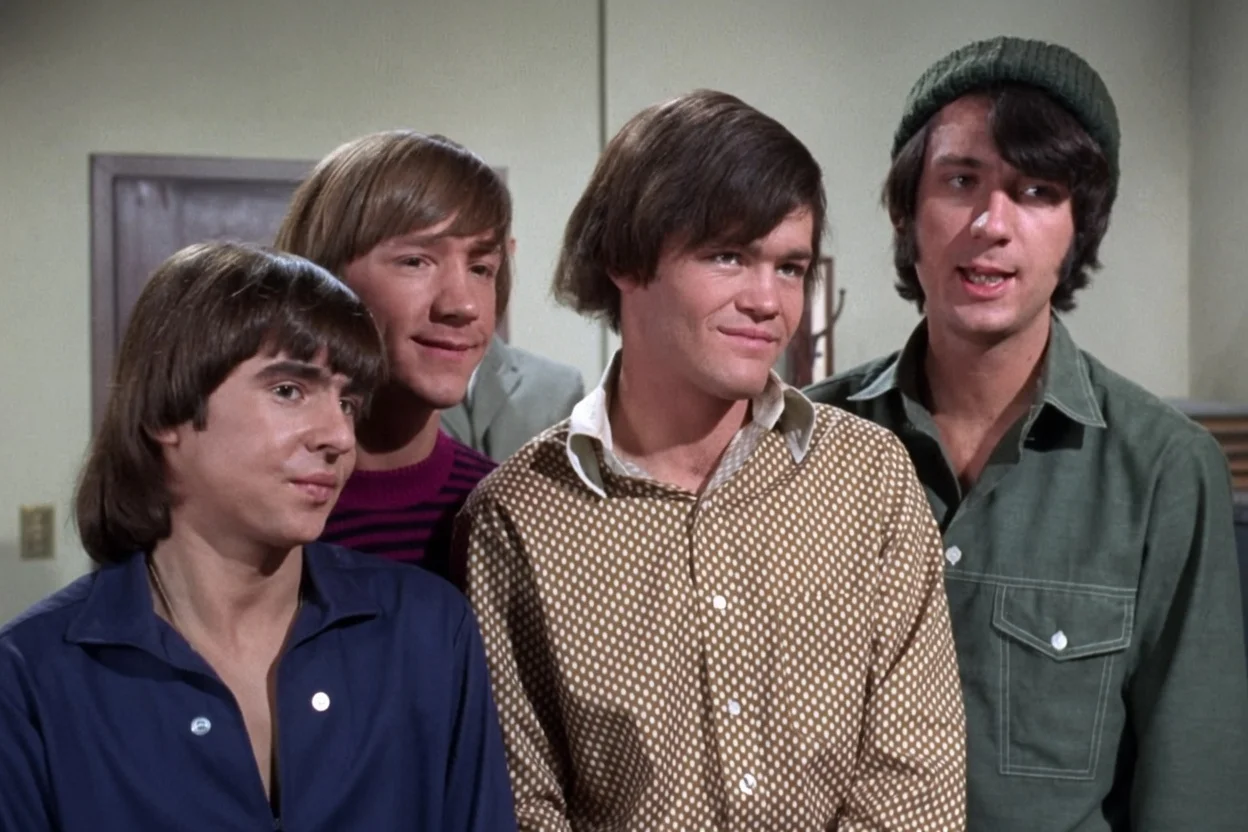
TLDR: The Monkees were cast as actors for a television show about a fictional band and were not expected to play their own instruments on the earliest recordings, which were handled entirely by professional session musicians including the Wrecking Crew. The four cast members did sing their own vocals from the start. In January 1967, led by Michael Nesmith, the band publicly revolted, got music supervisor Don Kirshner fired, and began playing and writing a significant share of their own material starting with the album Headquarters.
The Monkees were never supposed to be a real band.
Producers Bob Rafelson and Bert Schneider conceived the 1966 television series as a fictional sitcom about a struggling rock group, inspired by the Beatles’ film A Hard Day’s Night, and cast four young men based primarily on chemistry and screen presence rather than musical ability.
What happened afterward, when the actors decided the fiction wasn’t good enough for them anymore, became one of the most consequential creative revolts in television history.
Who Actually Got Cast, and Why
The casting call sought “four insane boys” and drew over 400 applicants, including Stephen Stills, who was rejected for his appearance but recommended his friend Peter Tork instead.
Michael Nesmith was a working country-folk songwriter who auditioned after seeing a trade magazine ad.
Davy Jones was already under a Screen Gems solo contract from his Broadway run in Oliver! Micky Dolenz was a former child star with no drumming experience whatsoever, cast primarily for his comedic energy and given a twelve-week crash course to fake it competently for promotional appearances.
Two of the four, Tork and Nesmith, arrived with genuine musical training. The other two were cast as actors first.
Who Actually Played the Instruments
On the earliest recordings, the cast filmed physical comedy during the day and were brought into the studio late at night solely to record vocal overdubs. Instrumentation came from two overlapping groups of professionals.
Tracks written by songwriters Tommy Boyce and Bobby Hart used a dedicated studio band called the Candy Store Prophets. Tracks supervised directly by Don Kirshner or produced by Nesmith used the Wrecking Crew, the same Los Angeles session collective that played on records by the Beach Boys and, years later, The Partridge Family.
Session guitarist Louis Shelton played the iconic opening riff on their debut single “Last Train to Clarksville.” On “Mary, Mary,” a Nesmith composition, the Wrecking Crew lineup included guitarist Glen Campbell, drummer Hal Blaine, and pianist Larry Knechtel.
Peter Tork was credited with acoustic guitar on that track, though union contracts from the session show he was the only non-union player present, leaving music historians uncertain whether his part was actually used on the final mix.
This was not unusual practice for the era. The Byrds relied on the Wrecking Crew for their breakthrough single “Mr. Tambourine Man,” and the Beach Boys used them extensively on Pet Sounds.
The difference was that the Monkees were marketed as a genuine, self-contained band, which made the eventual disclosure of ghost players a sharper betrayal in the eyes of the emerging underground rock press.
Who Actually Sang
Unlike the instrumentation, the vocals were genuinely the band’s own from the beginning.
Lead duties were distributed by style rather than assigned to one frontman. Micky Dolenz, with a powerful radio-friendly belt, handled most of the uptempo rock tracks.
Jones’s theatrical training suited ballads and vaudevillian pop. Nesmith sang his own country-folk compositions. Tork occasionally took lead or co-lead on eclectic album tracks.
Their biggest hit, “I’m a Believer,” written by a then-emerging Neil Diamond, became the best-selling single of 1967, reaching number one for seven consecutive weeks.
Because of the band’s filming schedule, only Dolenz was present for the initial vocal session in New York; Jones and Tork added backing vocals afterward, while Nesmith was excluded entirely following a dispute with producer Jeff Barry.
Diamond wrote three more songs for the group, including “A Little Bit Me, a Little Bit You,” which reached number two on the Billboard Hot 100.
The Fist Through the Wall
Tension with Kirshner escalated through early 1967, culminating in a confrontation at the Beverly Hills Hotel after the band discovered their second album had been compiled and released without their knowledge.
Nesmith slammed his fist through a drywall panel and told Kirshner’s attorney, “That could have been your face.” Weeks later, Kirshner bypassed the band and the show’s own producers to release a single in Canada under his own authority.
He was fired that spring.
Freed from Kirshner’s control, the band recorded their third album, Headquarters, released in May 1967, with all four members playing their own instruments for the first time, aside from producer Chip Douglas on bass and a small number of orchestral players.
It hit number one on the Billboard album chart for a single week before being displaced by the Beatles’ Sgt. Pepper’s Lonely Hearts Club Band, and held the number two spot for nearly three months anyway.
What Changed, and How Much
On their first two albums, the band contributed only two self-written songs total, both by Nesmith. On Headquarters, half of the fourteen tracks came from the band itself, including Nesmith’s “You Just May Be the One,” Tork’s “For Pete’s Sake,” and Dolenz’s autobiographical “Randy Scouse Git.”
Across their remaining original albums through 1970, the band maintained roughly 50% original songwriting content, with Nesmith providing the majority.
The full reclamation came decades later.
Their 1996 album Justus, marking the group’s 30th anniversary, was the first record since 1968 to feature all four original members and the only album in their catalog written, performed, and produced entirely by the band themselves, with zero outside songwriters or session musicians.
What John Lennon Actually Thought of Them
John Lennon was one of the group’s most consistent public defenders. At a party thrown in their honor during their 1967 visit to England, Nesmith directly asked Lennon whether he viewed the Monkees as a cheap Beatles imitation.
Lennon’s response was unambiguous: “I think you’re the greatest comic talents since the Marx Brothers. I’ve never missed one of your programs.” He later added to the press, “They’ve got their own scene, and I won’t send them down for it. You try doing a weekly show and see if you can manage one half as good.”
George Harrison offered similar respect, predicting they would “turn out to be the best” once they got their creative situation sorted out.
Frank Zappa became a genuine friend of Nesmith’s, guest-starring on the show in a surrealist identity-swap sketch and later respecting Dolenz’s musicianship enough to offer him a spot as drummer for the Mothers of Invention.
The band returned the favor by booking the then-unknown Jimi Hendrix Experience as their opening act on their first major US tour in the summer of 1967, a legendary commercial mismatch in which crowds of screaming preteen girls drowned out Hendrix’s feedback-heavy sets.
Why The Partridge Family Was Built the Opposite Way
The Monkees’ rebellion permanently changed how Hollywood structured future manufactured bands. When Screen Gems developed The Partridge Family in 1969, executives deliberately designed it to prevent a repeat.
Ed Justin, the studio’s head of merchandising, later joked that the biggest mistake with the Monkees was that “we didn’t poison the four actors the first week.”
The result, as covered in detail in our piece on whether the Partridge Family actually sang their own songs, was a cast hired purely as actors with zero songwriting input and zero instrumental contribution, apart from David Cassidy and Shirley Jones singing their own vocals.
Every note of every Partridge Family record came from the Wrecking Crew, the same session musicians who had backed the Monkees a few years earlier, this time hired by a studio determined to keep its actors from ever gaining the leverage the Monkees had won for themselves.
For the full Monkees cast story, see our cast where are they now.
The Monkees’ Musical Authenticity: Frequently Asked Questions
Did any of the Monkees actually play their own instruments?
On their first two albums, no, all instrumentation was handled by professional session musicians including the Wrecking Crew. Starting with their third album, Headquarters, released in May 1967, all four Monkees played their own instruments after successfully forcing out music supervisor Don Kirshner. The band retained significant creative control across their remaining catalog, culminating in their 1996 album Justus, performed entirely by the band with no outside musicians.
Did Davy Jones actually sing on Monkees records?
Yes. Unlike the instrumentation, all four Monkees sang their own vocals from the start of the series. Davy Jones sang lead on many of the group’s biggest songs, including Daydream Believer, I Wanna Be Free, and A Little Bit Me, a Little Bit You, leveraging his theatrical training on ballads and vaudeville-style pop numbers.
What did John Lennon think of the Monkees?
John Lennon was a vocal public defender of the group. When Michael Nesmith directly asked him if the Monkees were a cheap Beatles imitation, Lennon replied: I think you’re the greatest comic talents since the Marx Brothers. I’ve never missed one of your programs. He continued to defend their creative work to the press throughout the 1960s.