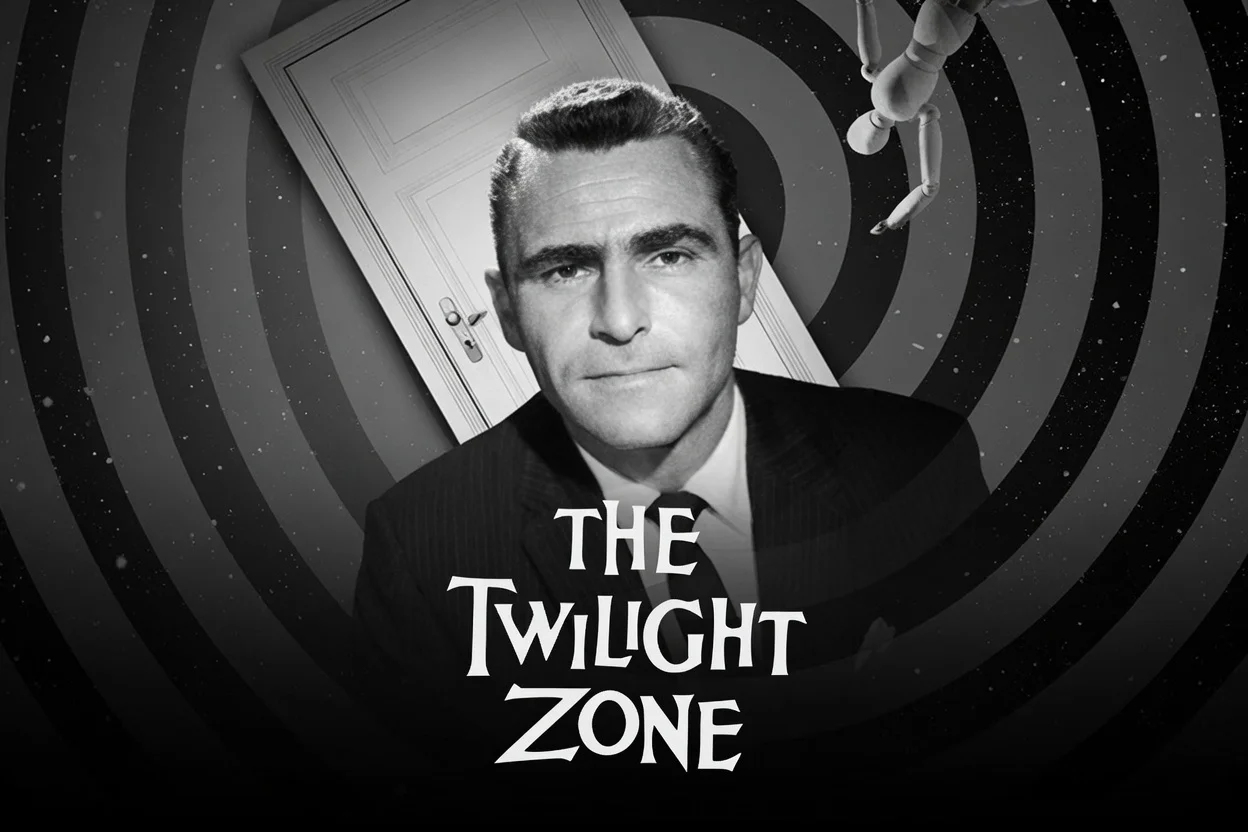
TLDR: Rod Serling was a decorated World War II veteran turned television writer who created, hosted, and wrote most of The Twilight Zone before his death from heart failure in 1975 at age 50.
Behind the famous voice and the cigarette was a complicated, driven man shaped by war, frustrated by network censorship, and devoted to his wife and two daughters.
Millions of people can recognize Rod Serling’s voice instantly, even if they have never seen a single full episode of The Twilight Zone. He was the clipped, deliberate narrator who stepped into frame every week to tell viewers they were crossing into another dimension.
Off camera, he was a far more complicated man than that calm screen presence ever let on.
From Binghamton to the Battlefield
Rodman Edward Serling was born on December 25, 1924, in Syracuse, New York, and grew up in nearby Binghamton, where his father ran a grocery store.
He enlisted in the Army the day after his high school graduation in 1943, hoping to fight in Europe. Instead, he was sent to the Pacific as a paratrooper, where he survived brutal combat in the Philippines that left him with a permanent knee injury, a Bronze Star, and decades of nightmares afterward.
That chapter of his life shaped nearly everything he wrote later, and it is its own story worth reading in full.
After his discharge in 1946, Serling enrolled at Antioch College in Ohio, where he met a fellow student named Carolyn “Carol” Kramer.
The two married in 1948 and went on to have two daughters, Jodi and Anne. Carol would go on to become Serling’s closest collaborator and, after his death, the dedicated steward of his legacy for decades.
Finding His Voice in Early Television
Serling broke into radio and television writing in the early 1950s, eventually earning real acclaim for live dramas like “Patterns” and “Requiem for a Heavyweight,” both of which won him Emmy Awards before The Twilight Zone ever existed.
He quickly developed a reputation as television’s “angry young man,” a writer constantly butting heads with network censors and sponsors who wanted to soften his scripts about race, war, and corruption.
That ongoing battle with censorship is part of what pushed Serling toward science fiction in the first place. He once said an alien could say things on screen that a Republican or a Democrat never could.
Aliens, time travel, and supernatural twists let him smuggle real social commentary about prejudice, conformity, and fear past nervous sponsors who would have rejected the same ideas in a more realistic setting.
One real-life injustice pushed him especially hard in this direction. Serling was reportedly transfixed and appalled watching coverage of the 1955 murder of Emmett Till, a 14 year old boy beaten and killed in Mississippi, and the acquittal of his killers by an all white jury after barely an hour of deliberation.
He tried to dramatize the case directly for television twice, in “Noon on Doomsday” and “A Town Has Turned to Dust,” and watched network and sponsor censors water both scripts down until they barely resembled the real story anymore.
That frustration is widely credited as a turning point that pushed him toward telling the same kinds of stories through science fiction instead, where censors paid far less attention.
A Writer Who Practiced What He Wrote
Serling’s social conscience was not confined to his scripts. He was an outspoken supporter of the civil rights movement throughout the 1960s, and in May 1964 he stood alongside Dr. Martin Luther King Jr. at a multi faith civil rights rally in Los Angeles, where actor Dick Van Dyke read aloud a speech Serling had written for the occasion calling hatred and prejudice “cancers of the soul.”
He was equally outspoken about the Vietnam War. In a well known 1968 speech to college students, Serling said he would rather his own children grow up to march in protest of injustice than grow up to be police officers who would club “anyone who’ll get in his way,” reportedly in direct response to the violent crackdown on anti war protesters at that year’s Democratic National Convention in Chicago.
He refused to sign a loyalty oath required for at least one paid campus speaking engagement around that time, waiving his fee entirely rather than comply.
Friends and collaborators often described him as warm but restless. Fellow Twilight Zone writer Richard Matheson once said Serling “seemed to be driven, almost harassed by life,” someone who reached the heights of fame relatively young and then struggled to adjust to everything that came with it.
The Twilight Zone Years
The Twilight Zone premiered on CBS in October 1959, with Serling serving simultaneously as creator, executive producer, head writer, and on-camera host. He personally wrote 92 of the show’s 156 episodes over five seasons, an extraordinary workload that left him chain-smoking up to four packs of cigarettes a day and increasingly exhausted as the years went on.
The show was never a runaway ratings hit, and it was cancelled and revived twice before its final ending in 1964. Serling did not fight especially hard to save it that last time, and he later sold his ownership stake in the series to CBS, a decision he came to regret once the show became enormously profitable in syndication after his death.
Life After The Twilight Zone
Serling kept working steadily after The Twilight Zone ended, writing the western series The Loner, co-writing the screenplay for the original Planet of the Apes, and creating another horror anthology, Night Gallery, which debuted in 1969.
Planet of the Apes let him return to the same themes of prejudice and self destruction that ran through so much of his earlier work, just dressed up in a different costume.
None of it quite matched the cultural impact of his most famous creation, though he remained a respected, in-demand writer for the rest of his life.
He also became a familiar face on college campuses throughout the 1960s and 70s, frequently speaking to students and teaching writing courses, first at Antioch and later at Ithaca College, where he taught until his death.
By his own description, he did not see himself as a science fiction pioneer on the level of contemporaries like Isaac Asimov or Ray Bradbury. “I have nothing but a television show,” he once said modestly, “my only claim is that I put science fiction and fantasy into a mass media more than any other person.”
A Life Cut Short
Serling’s heavy smoking habit and relentless work schedule caught up with him in 1975.
He suffered a heart attack that May, followed by a second one weeks later, which led doctors to recommend open heart surgery. Serling suffered a third, fatal heart attack during the operation and died on June 28, 1975, at Strong Memorial Hospital in Rochester, New York. He was only 50 years old.
His wife Carol spent decades after his death protecting and promoting his work, founding The Twilight Zone Magazine and helping bring several of his unproduced scripts to the screen, until her own death in 2020.
Today, Serling is remembered not just as a talented writer, but as one of the rare television figures who used a hit show to say something that actually mattered.
Rod Serling: Frequently Asked Questions
What was Rod Serling’s real name?
His full name was Rodman Edward Serling.
How did Rod Serling die?
Serling died on June 28, 1975, at age 50, after suffering a third heart attack during open heart surgery following two earlier heart attacks that year.
What did Rod Serling do before The Twilight Zone?
He served as a paratrooper in World War II, then became a television and radio writer in the early 1950s, winning Emmy Awards for live dramas like “Patterns” and “Requiem for a Heavyweight” before creating The Twilight Zone in 1959.