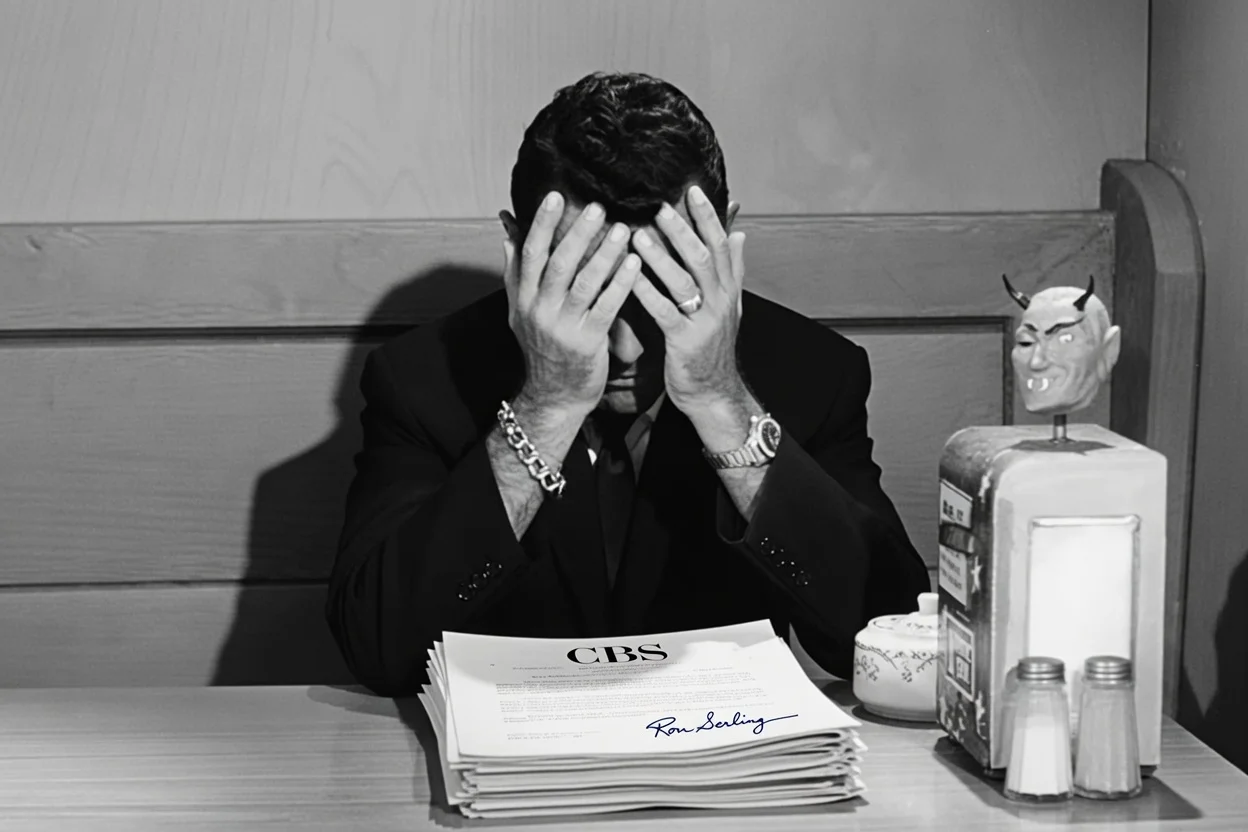
TLDR: The Twilight Zone was cancelled twice during its five season run before finally ending for good in 1964, driven largely by a CBS executive who openly said he was sick of the show.
Rod Serling sold his ownership stake in the series to CBS shortly afterward, a decision he came to deeply regret once the show became a massive success in syndication.
For a show now considered one of the greatest in television history, The Twilight Zone had a surprisingly rocky relationship with its own network.
It was cancelled and brought back twice before CBS finally pulled the plug for good in 1964, and the story behind why involves sponsors, budgets, and one network executive who simply didn’t like the show created by Rod Serling.
The First Cancellation: No Sponsor, No Show
The show’s first cancellation, in the spring of 1962, came down to something fairly mundane. The Twilight Zone had struggled every year to lock down a long term sponsor, and when the search for season four funding came up empty, CBS simply pulled the show from its fall lineup and replaced it with a new sitcom called Fair Exchange.
Longtime producer Buck Houghton left for another job amid the confusion, and Rod Serling took a teaching position at his alma mater, Antioch College, apparently resigned to the show’s end.
Fair Exchange flopped almost immediately, and CBS came back to Serling that winter with an offer to revive The Twilight Zone as a mid-season replacement, on the condition that episodes expand from 30 minutes to a full hour.
The Network Executive Who Wanted It Gone
Looming over the show’s final years was CBS programming chief James Aubrey, who took over the network early in the show’s run and made no secret of his priorities.
Aubrey favored cheap, broadly appealing sitcoms like The Beverly Hillbillies over expensive, intellectually demanding anthology dramas, and associate producer Del Reisman later said Aubrey was “particularly tough” on The Twilight Zone specifically because of its cost.
That pressure showed up in very concrete ways. Aubrey ordered seven fewer episodes for season two and mandated that six of them be shot on videotape instead of film to save money, a format Serling openly disliked.
The multi-camera videotape setup made location shooting nearly impossible and gave those episodes a flat, stagy look that still stands out from the rest of the series today.
By early 1964, Aubrey had had enough. According to producer William Froug, “Jim Aubrey decided he was sick of the show,” citing budget overruns and ratings that weren’t strong enough to justify the cost. Serling, for his part, didn’t put up much of a fight.
When Daily Variety reported that a sixth season looked unlikely, Serling famously responded by saying he had “decided to cancel the network” instead.
A Decision Serling Would Come to Regret
Serling had produced the entire series through his own company, Cayuga Productions, named after the lake near his family’s summer home in upstate New York.
Through Cayuga, he held a substantial ownership stake in the show, with different sources placing it somewhere between 40 and 50 percent.
Not long after the cancellation, Serling sold that entire stake directly to CBS. According to his wife Carol, CBS executives convinced him that because the show had so frequently gone over budget during production, the network would likely never even recoup its original costs, let alone turn a profit.
Believing his ownership stake was effectively worthless, Serling accepted a modest payout and walked away.
It turned out to be one of the costliest miscalculations in television history. The Twilight Zone‘s self-contained, anthology format made it perfectly suited for syndication, since local stations could air episodes in any order without confusing viewers.
The show went on to generate enormous, ongoing revenue in syndication and licensing for decades, all of it flowing to CBS instead of to Serling or his family.
Who Owns The Twilight Zone Today
CBS, and by extension its current parent company, has owned the rights to The Twilight Zone ever since Serling’s sale in the 1960s. That ownership is why the franchise has continued well beyond Serling’s death in 1975, including a 1983 feature film, three separate television revivals, and a steady presence in reruns and streaming.
Serling’s widow, Carol, and later his daughter Anne, remained closely involved in shepherding his creative legacy even though the family no longer held a financial stake in the show itself. It is a strange footnote for one of the most influential series ever made: the man who created it never saw a cent of the fortune it eventually earned.
Twilight Zone Cancellation and Rights: Frequently Asked Questions
Why was The Twilight Zone cancelled?
CBS programming chief James Aubrey, who preferred cheaper sitcoms, grew tired of the show’s high production costs and inconsistent ratings, and Rod Serling did not fight to keep it on the air once the final cancellation came in early 1964.
Did Rod Serling make money from The Twilight Zone?
Not in the long run. Serling sold his ownership stake in the show to CBS shortly after its cancellation, believing it would never turn a profit, only for the show to become enormously successful in syndication afterward.
Who owns the rights to The Twilight Zone now?
CBS has owned the rights since Rod Serling sold his stake in the 1960s, and continues to control the franchise today.