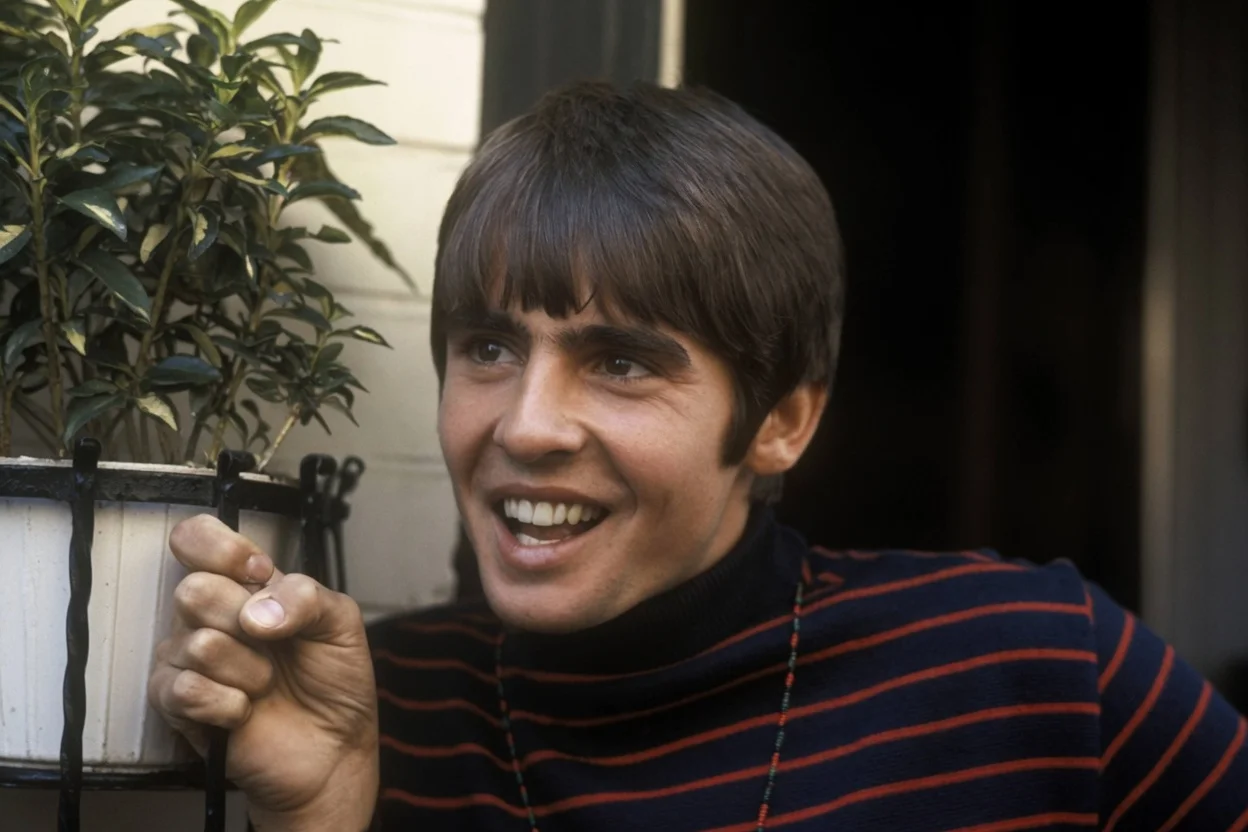
TLDR: David Thomas Jones was born December 30, 1945, in Openshaw, Manchester, played the Artful Dodger on Broadway before he was twenty, and beat out 436 other candidates including Stephen Stills for a role on The Monkees. He married three times, was left out of nothing by his surviving bandmates when he died suddenly of a heart attack in 2012, and the funeral controversy that followed was never the feud people assumed it was.
Davy Jones was standing in the wings of CBS Studio 50 on February 9, 1964, watching a British band called the Beatles make their American television debut and reduce a studio audience of teenage girls to screaming chaos.
He had just performed his own number on the same broadcast, playing the Artful Dodger from Oliver!, and he understood immediately that musical theater brought respect but pop music brought a different kind of power entirely. Two years later he had it.
From Manchester Stable Boy to Broadway
Jones was the youngest child and only son of Harry Jones, a railroad fitter, and Doris Jones, growing up in the working-class Manchester suburb of Openshaw alongside three older sisters.
When he was fourteen, his mother died of emphysema, and the loss reshaped everything about his adolescence.
He described himself as a self-admitted “con man” in school, chasing acting roles primarily to escape formal lessons he had no patience for.
He initially wanted nothing to do with performing after his mother’s death. He wanted to be a jockey, and his father arranged a grueling apprenticeship with a Newmarket trainer.
It was a chance encounter on a golf course, caddying and singing while the trainer played with a theatrical producer, that redirected him back to the stage. The producer heard his voice and recommended him to agents in London.
Jones auditioned for Lionel Bart’s Oliver!, perfected a cockney accent to cover his Manchester one, and landed the role of the Artful Dodger. The production transferred to Broadway, and at eighteen he earned a 1963 Tony nomination for Best Featured Actor in a Musical.
Beating 436 Other Candidates
By 1965, Jones was already under contract to Screen Gems, the studio producing The Monkees, which put him on the shortlist automatically.
He still had to compete against 436 other actors and musicians, including future stars Stephen Stills and Paul Williams. His screen test showed a self-deprecating, funny nineteen-year-old who, when asked what kind of sound he made as a singer, replied bluntly that he made “a terrible sound.”
His theatrical training, comic timing, and British accent made him the obvious choice for the group’s heartthrob role.
What He Actually Sang, and What He Could Actually Play
Jones sang his own lead vocals on many of the group’s most enduring recordings, including “Daydream Believer,” “I Wanna Be Free,” and “A Little Bit Me, a Little Bit You.”
His theatrical delivery made him the natural choice for ballads and the vaudeville-inflected pop numbers, distinct from the garage rock sensibility that Michael Nesmith and Peter Tork brought to the group.
Although the show depicted him mostly playing tambourine, he was a genuinely capable multi-instrumentalist, having taken music lessons as a child and developing into a skilled drummer and rhythm guitarist.
During live performances the band actually played their own instruments, and Jones would swap onto drums when Micky Dolenz came forward to sing lead.
Peter Tork later said flatly that if the stage lineup had reflected actual musical ability rather than television casting, Jones should have been the drummer and Dolenz the frontman.
Three Marriages and Four Daughters
Jones married Dixie Linda Haines in December 1968, keeping the marriage secret to protect his image as an unmarried teen idol until their first daughter, Talia, was born.
A second daughter, Sarah, followed in 1971. The marriage collapsed in the mid-1970s and ended in divorce in 1975. Jones later expressed real guilt about the touring schedule that kept him away from his daughters’ childhoods.
He married English singer Anita Pollinger in 1981 after she became pregnant; the union produced two more daughters, Jessica and Annabel, and ended in divorce in 1996.
On August 30, 2009, at age 63, he married Jessica Pacheco, a Venezuelan dancer thirty-two years his junior whom he had met performing in Cinderella.
His four daughters boycotted the wedding, concerned about the age gap and reports of a volatile relationship. They remained married until his death.
The Horses
Jones’s deepest, most consistent passion throughout his adult life was horse racing, a direct throughline from his teenage apprenticeship as a jockey.
His most significant physical asset was a 15.5-acre estate in Indiantown, Florida, with stables and a private training track.
His wealth was continuously drained by alimony, child support from two divorces, and the cost of purchasing and training racehorses.
His net worth at death was estimated at approximately $5 million.
His Death
On the morning of February 29, 2012, Jones died suddenly at age 66.
He had just finished riding his favorite horses around the training track at his Florida stables when he suffered a severe heart attack caused by advanced coronary arteriosclerosis.
He walked to his car, complained of crushing chest pain, and was rushed to a hospital in Stuart, Florida, where he was pronounced dead.
There were no documented final words at his bedside, but two weeks earlier he had told a close friend on the phone: “My doctor tells me I have the heart of a 25-year-old. Come visit me soon.”
His body was cremated. His widow and daughters flew his ashes to Manchester for a private memorial, placing them on his parents’ grave in Southern Cemetery.
His will, drafted in 2004 before his third marriage, left the bulk of his estate to his four daughters and excluded Jessica Pacheco entirely.
Pacheco filed a probate claim as a “pretermitted spouse,” and the family ultimately asked the court to seal the records to avoid a public trial.
Why the Monkees Skipped His Funeral
The absence of Micky Dolenz, Peter Tork, and Michael Nesmith from Jones’s funeral triggered immediate speculation about a lasting feud.
The reality was a deliberate, unified decision made in consultation with the family. Dolenz explained it directly to the press: “My understanding is they want to avoid a media circus and the family wants to keep it very, very low-key and very, very private. As soon as one or two or any of us were to show up, it would very quickly be degraded into something that I don’t think his immediate family would want to deal with.”
Tork wrote a private letter read at the Manchester memorial, calling Jones “one of the funniest men and most talented I have ever known.”
Nesmith released a statement describing “heart-to-heart moments with him that were among the best in my life.” Later that year, the three surviving members embarked on a twelve-city reunion tour as a public tribute to Jones.
There was no rift. There was a private family that his bandmates chose to protect.
Setting the Record Straight on Peter Tork
A persistent internet rumor claims Peter Tork harbored romantic feelings for Jones.
The claim traces to a radio interview where Tork was asked if he had ever had a “homosexual experience” and answered “sure,” combined with a separate, later comment that he’d had a “crush” on Jones as a young man because Jones was objectively the best-looking member of the group.
Neither statement claimed any romantic relationship between the two, and both have been amplified into an unfounded theory largely through online fan fiction communities.
Tork and Jones shared a close, affectionate friendship within a genuinely bohemian social circle, nothing more.
The genuinely close relationship was Jones’s decades-long friendship with Micky Dolenz.
The two bonded instantly at their 1965 auditions, both being former child stars with television and theater backgrounds unlike Nesmith and Tork’s folk-scene origins.
They lived together for a month in 1966 while waiting for apartments and continued performing together as a duo for decades. Dolenz called Jones the brother he never had.
For the full cast story, see our Monkees cast where are they now.
Davy Jones: Frequently Asked Questions
Why didn’t the Monkees attend Davy Jones’ funeral?
The surviving Monkees, Micky Dolenz, Peter Tork, and Michael Nesmith, made a deliberate, unified decision in consultation with Jones’s family to skip his funeral in order to protect the family’s privacy and avoid what Dolenz called a media circus. There was no feud behind the decision. All three released heartfelt tributes and later toured together in his memory.
What did Davy Jones pass away from?
Davy Jones died on February 29, 2012, at age 66, from a severe heart attack caused by advanced coronary arteriosclerosis. He collapsed shortly after riding horses at his stables in Indiantown, Florida, and was pronounced dead at a nearby hospital.
Did Peter Tork have a crush on Davy Jones?
Peter Tork once said in an interview he had a youthful crush on Jones because Jones was the best-looking member of the group, and separately acknowledged having had a homosexual experience unrelated to Jones. Neither statement indicates a romantic relationship between them. The rumor is largely fueled by online fan fiction rather than documented history.