TLDR: Robert Michael Nesmith was born December 30, 1942, in Houston, and wore his signature green wool hat for the practical reason of keeping his hair out of his eyes while riding his motorcycle to auditions, not for any sentimental reason. His mother invented Liquid Paper and sold the company for $47.5 million, an inheritance that later gave him complete financial independence. He led the 1967 revolt that got music supervisor Don Kirshner fired, punching a hotel wall to make his point, and pioneered the music video format that became MTV. He died in 2021, and a bitter, three-year estate battle followed.
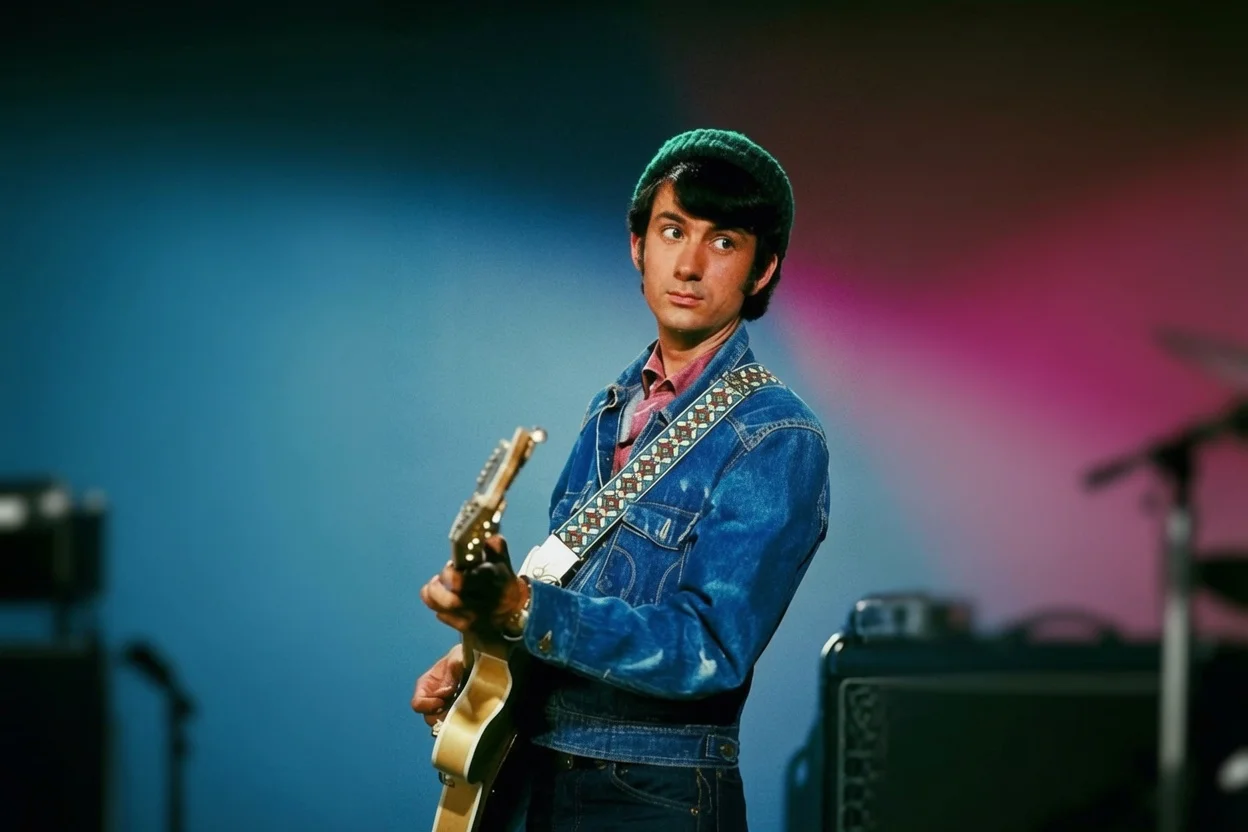
Michael Nesmith rode his motorcycle to his 1965 audition for The Monkees wearing a green wool knit hat, carrying his guitar, a harmonica, and a bag of dirty laundry he planned to wash immediately after.
Producers Bob Rafelson and Bert Schneider were so struck by his dry, nonchalant manner that they referred to him internally as “the wool hat guy” before they even knew his name.
The Hat
Fan magazines and studio publicity spent decades attributing the hat to sentiment, usually claiming it had been knitted by a loved one.
The real reason was practical.
Before moving to Los Angeles, Nesmith lived in San Antonio and owned a Triumph Bonneville motorcycle. He wore the wool hat to keep his long hair secured and out of his eyes while riding.
Once cast, Screen Gems initially wanted to name his character “Wool Hat” to match early promotional materials. Nesmith refused, and after negotiation the character was called Mike, provided he kept the hat in his wardrobe.
It became his defining visual signature during the show’s two-year run, and his first small act of resistance against being reduced to a corporate caricature.
A Real Songwriter Before the Show
Unlike much of the cast, Nesmith arrived with genuine songwriting credentials, having performed folk music under the pseudonym “Michael Blessing” and signed a Los Angeles publishing deal.
He wrote “Different Drum” in 1964 and offered it to the Monkees’ producers, who rejected it as too country. Linda Ronstadt and the Stone Poneys recorded it in 1967, and it became a major hit, vindicating him.
He went on to write or co-write “Mary, Mary,” “Tapioca Tundra,” “Circle Sky,” and “Listen to the Band” for the group, along with the technically sophisticated “You Just May Be the One,” which incorporated 5/4 bars into a standard 4/4 pop structure.
The Fist Through the Wall
Nesmith’s frustration with music supervisor Don Kirshner reached a public boiling point in a January 1967 Saturday Evening Post interview, where he stated bluntly: “The music on our records has nothing to do with us. It’s totally dishonest.”
The confrontation came to a head that same month at the Beverly Hills Hotel, after the band discovered their second album had been compiled and released without their knowledge or consent.
When Kirshner’s attorney resisted Nesmith’s demand for creative control, Nesmith slammed his fist through a drywall panel and told him, “That could have been your face.”
The confrontation led directly to Kirshner’s dismissal and cleared the path for the band to record their third album, Headquarters, entirely on their own instruments.
The full story of that revolt, and how it compares to The Partridge Family‘s deliberately opposite structure, is covered in our piece on whether the Monkees actually played and sang on their own records.
The $50 Million Mother
Nesmith’s mother, Bette Nesmith Graham, invented what became Liquid Paper correction fluid at her kitchen table in 1956, after growing frustrated with typing errors on the newly popular electric typewriters at her secretarial job.
She employed a teenage Michael and his friends to bottle the fluid and attach labels during the company’s earliest years.
She sold Liquid Paper to Gillette in 1979 for $47.5 million plus ongoing royalties, and died of a stroke in 1980 at age 56.
Nesmith inherited a direct fifty percent share of an estate exceeding $50 million. The windfall arrived after years of genuine financial distress, during which he had paid $150,000 a year for three years to buy out his Monkees contract and was, by his own account in a 1980 Playboy interview, telling “little tales to the tax man” while agents tagged his furniture for repossession.
The inheritance completely reoriented his career, freeing him from commercial pressure and allowing him to fund experimental multimedia projects rather than chase hit records.
The Man Who Basically Invented MTV
After leaving the Monkees, Nesmith formed the First National Band, pioneering country rock and scoring moderate hits with “Joanne” and “Silver Moon.”
By the late 1970s he turned to the intersection of music and video, creating PopClips for Nickelodeon, a continuous promotional video program that directly inspired the format MTV launched two years later.
In 1981 his long-form video project Elephant Parts won the first-ever Grammy Award for Video of the Year.
He later produced the films Repo Man and Tapeheads, and in 1998 developed one of the earliest virtual online performance environments.
Death and a Three-Year Estate Fight
Nesmith died of heart failure on December 10, 2021, at his home in Carmel Valley, California, at age 78.
Despite widely circulated fan-site estimates of a $50 million net worth, verified probate documents from Monterey County Superior Court valued his actual estate at approximately $5 million, the difference explained by creditor claims and his lifelong pattern of investing in critically respected but commercially modest passion projects.
He had handwritten a single-page will in 2014 leaving his possessions and musical rights to the Gihon Foundation, the charitable organization his mother had founded.
His four adult children contested the document, arguing it did not explicitly revoke a more detailed 1994 will and trust.
The dispute settled out of court in December 2023, after three years of litigation and more than $200,000 in legal fees, splitting his estate between his children and the foundation.
“I Didn’t Like Peter and Peter Didn’t Like Me”
Nesmith’s relationship with Peter Tork was one of the more misunderstood dynamics in the band.
Their personalities were fundamentally opposed: Nesmith was an orderly perfectionist who demanded precision, while Tork embraced the loose, communal ethos of the Greenwich Village and Laurel Canyon folk scenes.
Real friction accumulated over specific incidents.
Nesmith unilaterally hired producer Chip Douglas for the Headquarters sessions without consulting the others, which Tork resented, believing he could have secured his own friend Stephen Stills for the job.
During post-production for the film Head, Nesmith quietly replaced the band’s live group recording of his song “Circle Sky” with a studio version featuring session musicians, without telling Tork, who saw it as a betrayal of the group dynamic they had fought to establish.
Most seriously, Nesmith had an extramarital affair with photographer Nurit Wilde in 1967 while his wife was pregnant, resulting in a son, Jason, born in 1968.
When Nesmith provided minimal support to Wilde during her pregnancy, Tork stepped in and offered her shelter in his own home.
Despite the accumulated grievances, the bond between the two men proved resilient.
When Tork left the band in 1968, Nesmith gave him a gold watch inscribed “From the guys down at work.”
In a 2019 Australian television interview filmed shortly after Tork’s death, Nesmith stated flatly, “I didn’t like Peter and Peter didn’t like me,” then broke down in tears less than thirty seconds later while discussing his reaction to the news.
For the full cast story, see our Monkees cast where are they now.
Michael Nesmith: Frequently Asked Questions
Why did Michael Nesmith always wear a hat?
Michael Nesmith wore his signature green wool knit hat for a practical reason, not a sentimental one. Before moving to Los Angeles, he owned a Triumph Bonneville motorcycle in San Antonio and wore the hat to keep his hair secured while riding. He wore it to his 1965 Monkees audition, and producers referred to him as the wool hat guy before even learning his name.
Why did Michael Nesmith not like Peter Tork?
Nesmith and Tork clashed over fundamentally different personalities and several specific incidents, including Nesmith unilaterally hiring a producer without consulting the band, secretly replacing a group recording with a session-musician version, and an extramarital affair that Tork helped clean up after Nesmith failed to support the woman involved. Despite the tension, the two maintained a deep, sibling-like bond that Nesmith acknowledged tearfully after Tork’s 2019 death.
How much was Michael Nesmith worth when he died?
Michael Nesmith’s actual estate was valued at approximately $5 million at the time of his death in 2021, despite widely circulated fan-site estimates of $50 million. He had inherited a 50% share of his mother’s Liquid Paper fortune, over $50 million, in 1980, but much of that wealth was reinvested into commercially modest passion projects over the following decades.