TLDR: William Frawley spent forty years in vaudeville and Hollywood before alcoholism nearly destroyed his career entirely.
At 64, virtually unemployable, he signed a strict three-strike sobriety pact with Desi Arnaz to land the role of Fred Mertz, honored every term of it for nine years, and became one of the most beloved character actors in television history.
Before Fred Mertz ever complained about the heating bill or traded insults with Ethel across the kitchen table, William Frawley had already lived several complete careers.
He had toured the vaudeville circuits for decades, performed at the Palace Theatre in New York, appeared in over 100 films, and was widely regarded in the early 1950s as too difficult, too drunk, and too old to employ.
The story of how he became one of television’s most recognizable faces is, at its core, the story of a man who got one final chance and did not waste it.
Burlington, Iowa and the Stage That Wouldn’t Let Him Go
William Clement Frawley was born on February 26, 1887, in Burlington, Iowa, the second of four children born to Michael Arthur Frawley, a local steamboat captain, and Mary Ellen Brady, both Irish immigrants.
He grew up in a deeply religious Catholic household where his mother actively discouraged his interest in performance, viewing the theater as morally questionable. He sang in the choir at St. Paul’s Catholic Church and participated in amateur productions at the Burlington Opera House anyway.
After high school, he made a brief and unsatisfying attempt at a conventional life, relocating to Omaha to work as a stenographer for the Union Pacific Railroad while quietly writing scripts on the side.
He left for Denver, where he found work as a singer at the Rex Cafe, and never looked back at the railroad.
Forty Years in Vaudeville and Hollywood
Frawley broke into the vaudeville circuit by partnering with his younger brother Paul, touring as the Frawley Brothers through East St. Louis and surrounding regions.
He later partnered with pianist Franz Rath for an act called “A Man, a Piano, and a Nut,” which toured the Pacific Coast and established his reputation as a sharp, physically expressive comic.
In 1914, he married fellow performer Edna Louise Broedt, and the two formed the comedy act “Frawley and Louise,” touring the prestigious Orpheum and Keith vaudeville circuits for more than a decade.
Their act reached its peak in 1915 when they performed at the legendary Palace Theatre in New York. Frawley became a premier song-and-dance man of the era, distinguished by his vocal delivery and comedic timing.
Theater lore credits him as the first performer to popularize “My Melancholy Baby,” and he was instrumental in introducing “My Mammy” and “Carolina in the Morning” to American audiences.
These songs remained a source of deep personal pride for him. In 1958, he recorded them on the LP Bill Frawley Sings the Old Ones.
As vaudeville declined in the mid-1920s, Frawley transitioned to legitimate theater, making his Broadway debut in the 1925 production of Merry, Merry. He earned particular acclaim for his portrayal of the cynical press agent Ward O’Malley in the original 1932 Broadway run of Twentieth Century at the Broadhurst Theater.
His film career began in earnest when he signed a seven-year contract with Paramount Pictures in 1932. Over the next two decades he appeared in over 100 films, frequently cast as a tough-talking detective, a cynical newspaper reporter, a comic gangster, or a sports manager.
His physical appearance, balding and stout with a deadpan expression and a gravelly voice, was perfectly suited to characters requiring streetwise authority.
Among his best work were roles in Frank Capra’s Going My Way (1944), Charlie Chaplin’s Monsieur Verdoux (1947), and Miracle on 34th Street (1947), in which he played the cigar-chomping political adviser who warns a judge of the electoral disaster that will follow if he rules Santa Claus does not exist.
By the late 1940s, his productivity was increasingly overshadowed by a reputation for being cantankerous, abrasive, and unreliable. His alcoholism had caused serious professional incidents, including being fired from the Broadway show That’s My Baby after punching actor Clifton Webb.
By 1951, major film studios had grown wary of casting him at all. He was considered too high-risk, too volatile, and too old. Television was beginning to emerge as a dominant medium, and William Frawley was staring at the end of his career.
The Pact With Desi Arnaz
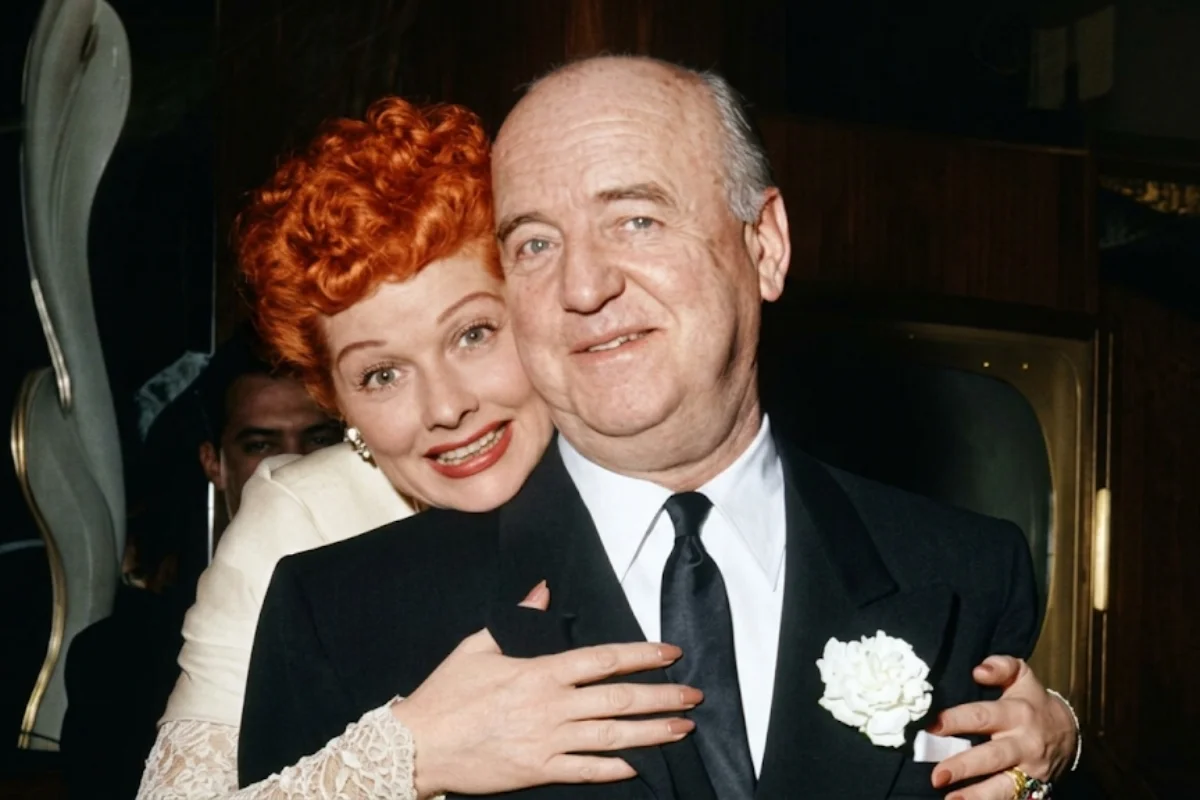
When Desi Arnaz and Lucille Ball were casting I Love Lucy in mid-1951, Frawley personally contacted Ball to express interest in the role of the miserly, curmudgeonly landlord Fred Mertz.
Their first choice for the role, veteran actor Gale Gordon, was unavailable. Both Ball and Arnaz were hesitant about Frawley. The industry’s consensus on his drinking was well established and widely shared.
Arnaz arranged a direct, face-to-face meeting and confronted Frawley about his reputation. He then laid down a strict three-strike pact that Frawley had to sign to get the job.
The terms were unyielding. If Frawley showed up to rehearsal drunk, late, or unable to perform, he would forfeit his entire paycheck for that week’s episode. A second infraction would result in a formal reprimand and final warning.
A third violation would mean immediate termination, his character written out of the show permanently, and Arnaz blackballing him from further employment across the television industry.
Frawley was 64 years old, divorced, living alone in a Hollywood apartment at the Knickerbocker Hotel, and facing the end of his professional life. He accepted the terms with a handshake.
Against every industry expectation, he honored every term of that agreement for nine consecutive years. He never missed a performance, never arrived late, and never showed up intoxicated.
He also possessed a near-photographic memory that allowed him to master an entire week’s worth of dialogue and blocking after a single read-through, which became one of his most valuable qualities on a show that operated on a relentless weekly production schedule.
Fred Mertz and What Frawley Brought to the Role
The character of Fred Mertz became an enduring archetype of American television comedy largely because Frawley did not merely play the role. He lived it.
His portrayal of the cheap, cantankerous landlord who begrudged every nickel spent on heat or maintenance resonated deeply with postwar suburban audiences who recognized the type immediately.
His physical choices defined the character: the habit of standing with his hands tucked into his trousers, the slow deliberate head shakes, the dry deadpan delivery that could land a devastating insult with quiet conversational indifference.
These choices were rooted in his vaudevillian training. He understood how to hold a beat, how to execute a double take, and how to make an audience wait for a laugh in a way that made the laugh bigger when it arrived.
His dry stillness provided the perfect counterweight to the physical clowning of Lucille Ball and the explosive charm of Desi Arnaz.
He earned five consecutive Primetime Emmy nominations for the role between 1953 and 1957, never winning but establishing himself in that time as one of the most respected supporting performers in the new medium.
Behind the scenes, when Frawley was in a good mood, he was a genuinely beloved presence. He was warm toward children, took pleasure in practical jokes, and formed deep bonds with the young actors he worked alongside throughout his career.
He also negotiated a unique stipulation into his contract: he was legally exempt from working during the World Series if his New York Yankees were playing, allowing him to attend the games in person.
Arnaz, who understood how to manage Frawley’s pride, gave him that without argument.
The Feud With Vivian Vance
The warmth Frawley extended to friends and co-stars did not reach Vivian Vance, who played his television wife Ethel Mertz. Their real-life relationship was defined by mutual, sustained hostility that never softened.
The wound was inflicted on Vance’s first day of rehearsals. Upon meeting Frawley, who was 22 years her senior, Vance loudly complained within his earshot: “Husband? That old coot could be my grandfather!”
Frawley, who had arrived early that morning to demonstrate his reliability to the crew, heard every word. His professional ego was deeply wounded.
From that point onward he harbored a resentment that he expressed publicly and often.
The tension was constant throughout the show’s run. Vance arrived at rehearsals with her lines fully memorized. Frawley preferred to study his script at the last minute while listening to baseball on his radio, which led to repeated clashes over preparation standards.
In one exchange that became famous among cast members, Vance glanced over and asked what Frawley was reading. He replied that he was reviewing his lines. She informed him it was last week’s script.
The feud reached its most financially significant point after the show ended its run. CBS offered both of them a lucrative spin-off series centered on their characters, variously referred to as The Mertzes or Fred and Ethel. Frawley was enthusiastic.
Vance flatly refused, stating she would never work with him again. That refusal cost Frawley a starring vehicle that would have significantly extended his career and income. He never forgave her for it.
In interviews, Frawley was characteristically blunt: “Vivian Vance is one of the finest girls to come out of Kansas, but I often wish she’d go back there.”
He also reportedly visited the Paramount soundstage where Vance was filming The Lucy Show and deliberately dropped heavy film canisters onto the floor to ruin her takes.
The mutual contempt was total and completely genuine, which makes it all the more remarkable that their on-screen chemistry gave Fred and Ethel Mertz the appearance of a marriage that was worn and irritable but somehow still intact.
My Three Sons and the Forced Retirement
Following I Love Lucy and the subsequent Lucy-Desi Comedy Hour, Frawley was cast as Michael Francis “Bub” O’Casey, the live-in grandfather and housekeeper on the ABC sitcom My Three Sons starring Fred MacMurray.
The role gave him a new generation of young co-stars, and he formed deep attachments to them, particularly to Stanley Livingston, who viewed Frawley as a surrogate grandfather.
The young Livingston brothers, aware that Frawley was still drinking heavily during extended midday breaks, would deliberately stall production by asking directors complex questions about their scenes, buying Frawley extra time to return and compose himself before cameras rolled.
By the fall of 1964, Frawley’s health was failing visibly. He had suffered a stroke that impacted his energy and timing. Following a mandatory physical examination, the studio’s insurance providers declared him uninsurable given his cardiovascular condition.
The production company had no choice but to release him midway through the 1964 to 1965 season. The writers scripted a storyline in which Bub traveled to Ireland to celebrate his Aunt Kate’s 104th birthday to explain his disappearance.
He was replaced by veteran character actor William Demarest, whom Frawley publicly accused of actively plotting to steal his job. Don Grady, one of the young cast members who knew both men, later observed that while they were both professional curmudgeons, Frawley was far warmer and funnier.
Demarest, he said, was like Frawley but with all the fun removed.
His final on-camera performance occurred on October 25, 1965, in a brief cameo on The Lucy Show, playing a horse trainer. In a quietly moving moment, Lucille Ball’s character looks at him and says: “He reminds me of someone I used to know.”
The Last Walk on Hollywood Boulevard
On the afternoon of March 3, 1966, five days after his 79th birthday, Frawley went to a movie theater on Hollywood Boulevard for a matinee, one of his favorite pastimes. Upon exiting, he began walking down the boulevard with his live-in companion and male nurse.
As they passed the Hollywood Walk of Fame, where his own star had been placed in 1960, he collapsed from a massive coronary. He lost consciousness immediately.
His nurse carried him into the lobby of the nearby Hollywood Roosevelt Hotel. An ambulance was summoned. Frawley was pronounced dead on arrival at Hollywood Receiving Hospital.
Lucille Ball issued a public statement: “I’ve lost one of my dearest friends and show business has lost one of the greatest character actors of all time. Those of us who knew him and loved him will miss him.”
Desi Arnaz, deeply affected by the death of his close companion, took out a full-page tribute in major industry trade papers. The ad contained only Frawley’s photograph and the words: “Buenas noches, amigo.”
A funeral service was held at the Roman Catholic Church of the Blessed Sacrament on Sunset Boulevard. Arnaz, Fred MacMurray, and My Three Sons executive producer Don Fedderson served as pallbearers. Frawley was buried at San Fernando Mission Cemetery in Mission Hills, Los Angeles.
In March 2012, Frawley and Vivian Vance were posthumously inducted together into the Television Academy Hall of Fame. They were linked permanently in the annals of broadcasting history, which is exactly what both of them would have hated.
He started as a stenographer for the Union Pacific Railroad who had no business being on any stage. He ended as one of the most recognizable faces American television ever produced.
In between, he made the most of a second chance that almost nobody thought he deserved.
What deal did William Frawley make with Desi Arnaz to get the role of Fred Mertz?
Desi Arnaz required Frawley to sign a strict three-strike sobriety pact before casting him as Fred Mertz. The terms were that a first offense of arriving drunk, late, or unable to perform would forfeit his entire weekly paycheck; a second offense would result in a formal reprimand and final warning; and a third offense would mean immediate termination, his character written out of the show, and Arnaz actively blackballing him from the television industry. Frawley honored every term of the agreement for nine consecutive years.
Did William Frawley and Vivian Vance really hate each other?
Yes, genuinely. The feud began on Vance’s first day of rehearsals when she complained within Frawley’s earshot that he was too old to play her husband. He never forgave her. Their hostility persisted throughout the show’s run and beyond. When CBS offered them a lucrative spin-off series called The Mertzes, Vance refused to participate, costing Frawley a highly profitable continuation of his career. Frawley reportedly later visited the set of The Lucy Show to drop film canisters on the floor and ruin Vance’s takes.
What happened to William Frawley after I Love Lucy?
After I Love Lucy ended, Frawley was cast as Bub O’Casey on the ABC sitcom My Three Sons starring Fred MacMurray, a role he held until 1964. He was forced off the show when the production’s insurance company declared him uninsurable following a mandatory physical examination that revealed serious cardiovascular problems. He made one final cameo appearance on The Lucy Show in October 1965. He died on March 3, 1966, of a heart attack on Hollywood Boulevard, five days after his 79th birthday.
How did William Frawley die?
William Frawley died on March 3, 1966, five days after his 79th birthday. He suffered a massive heart attack while walking along Hollywood Boulevard after attending a movie matinee. His companion carried him into the lobby of the Hollywood Roosevelt Hotel. He was taken by ambulance to Hollywood Receiving Hospital, where he was pronounced dead on arrival. He was buried at San Fernando Mission Cemetery in Mission Hills, Los Angeles.
Did Vivian Vance really celebrate William Frawley’s death with champagne?
The story is almost certainly exaggerated. The widely circulated version claims Vance shouted for champagne for everyone in a restaurant upon hearing of Frawley’s death. More credible accounts from those present suggest she ordered drinks to quietly toast his memory rather than to celebrate his death. Television historians have noted that Vance, despite genuinely disliking Frawley, was a highly professional woman who would not have engaged in such public cruelty. The champagne story has become Hollywood folklore that outlasted the more nuanced reality.
What did William Frawley do before I Love Lucy?
Before I Love Lucy, Frawley had a forty-year career in vaudeville, Broadway, and Hollywood films. He toured the vaudeville circuits as part of The Frawley Brothers act, then as part of the comedy duo Frawley and Louise with his wife Edna Broedt. He is credited in theater lore as the first performer to popularize My Melancholy Baby. He made his Broadway debut in 1925 and appeared in over 100 films between 1932 and 1951, including Miracle on 34th Street, Going My Way, and Monsieur Verdoux.