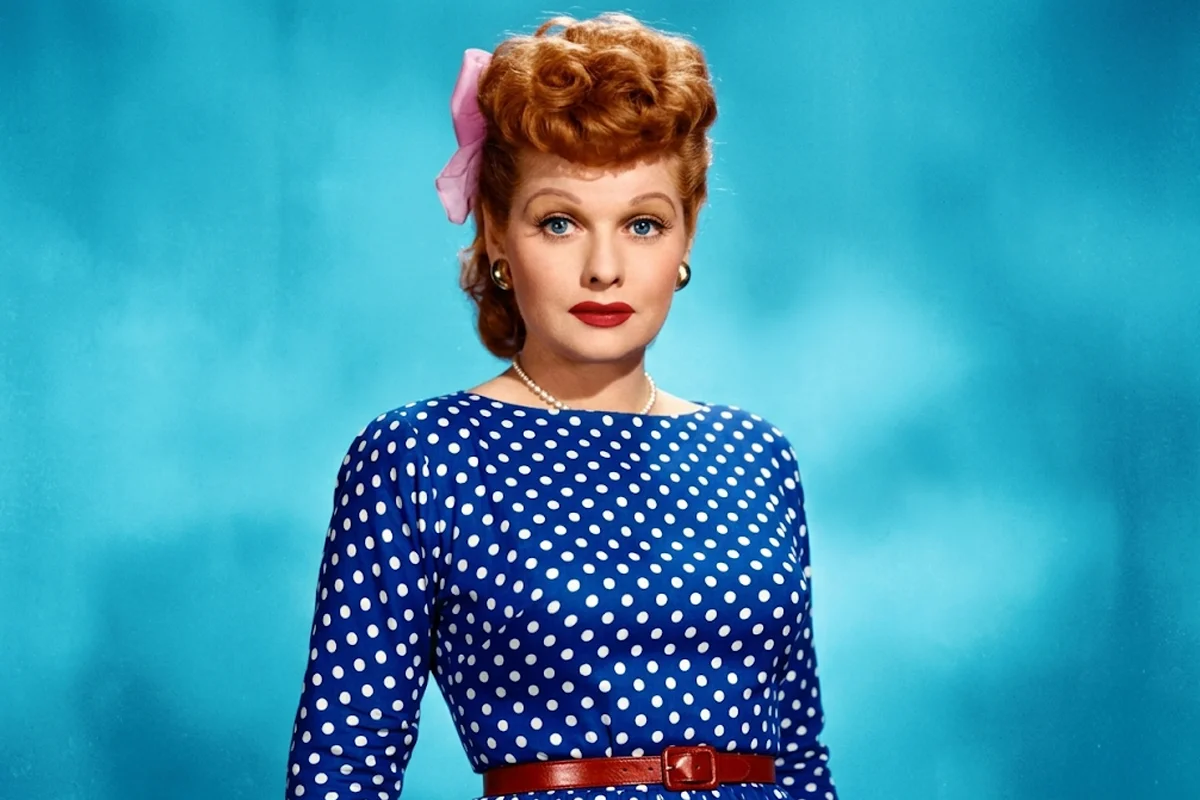
TLDR: Lucille Ball was far more than Lucy Ricardo. Her life included childhood instability, years of rejection, a turbulent marriage to Desi Arnaz, a dangerous Red Scare accusation, and a historic rise as the first woman to run a major Hollywood television studio.
Lucille Ball made chaos look adorable.
As Lucy Ricardo, she stomped grapes, hid chocolates, schemed her way into show business, and turned panic into some of the most famous comedy television ever produced.
But the woman behind that bright red hair was not a carefree clown. Lucille Ball’s real life was shaped by loss, rejection, financial fear, a stormy marriage, political scandal, and a need to control every inch of the world around her.
That may be why she became so good at pretending to lose control.
The Little Girl From Jamestown Learned Insecurity Early
Lucille Desirée Ball was born on August 6, 1911, in Jamestown, New York, to Henry Durrell Ball and Desirée “DeDe” Hunt Ball.
Her father’s work as a telephone lineman kept the family moving, so stability was never something young Lucille could count on for long.
Then, in 1915, Henry died of typhoid fever. Lucille was only three. Her mother was pregnant with Lucille’s brother, Fred.
Ball later traced her lifelong fear of birds to that traumatic day, recalling gray sparrows outside the window and a picture falling from the wall. Like many childhood memories, the details come through her own telling, but the fear stayed with her for life.
After her father’s death, Lucille spent part of her childhood in the care of strict relatives connected to her mother’s second marriage. According to family accounts and later biographies, the home was so severe that mirrors were discouraged because vanity was considered sinful.
For a future star, it was a strange beginning. Before millions watched her face do impossible things on television, she was a girl being taught not to look at herself.
The Celoron Accident Changed The Family Forever
For a while, Lucille found more comfort with her maternal grandparents in Celoron, New York. Her grandfather, Fred Hunt, became one of the most important adults in her life.
But another disaster hit the family in 1927, when a neighborhood boy was accidentally shot and paralyzed during target practice supervised by her grandfather.
The lawsuit that followed devastated the family financially. Their home and belongings were lost, and the shock left a permanent mark on Ball’s sense of security.
That hunger for control would follow her into Hollywood, marriage, television, and the executive suite.
Hollywood Did Not Know What To Do With Her At First
As a teenager, Ball headed to New York with dreams of becoming an actress. The first verdict was brutal.
At the John Murray Anderson School for the Dramatic Arts, instructors reportedly considered her too shy and uncertain to succeed. Bette Davis, another student, stood out. Lucille did not.
She did not quit.
She modeled under the name Diane Belmont, worked for designer Hattie Carnegie, appeared as a Chesterfield cigarette poster girl, and eventually landed in Hollywood as a Goldwyn Girl in Roman Scandals.
For years, she worked constantly without becoming a top movie star. At RKO, she earned the nickname “Queen of the B’s,” appearing in a long string of second-feature films and studio assignments.
Those years mattered. They gave her discipline, camera sense, stamina, and the ability to make something funny even when the material was thin.
She also learned how a studio machine worked from the inside. Ball watched directors set up shots, listened to timing in the editing room, and learned which performers survived a bad script by finding the one honest laugh in it.
Her film career was not the failure some later summaries make it sound like. She appeared opposite major names, worked in musicals, comedies, dramas, and crime pictures, and became a dependable studio professional. But she was not quite glamorous enough to be Garbo, not quite conventional enough to be Lombard, and not yet famous enough to be herself.
That was the trick Hollywood missed. Lucille Ball did not become immortal by fitting the system. She became immortal only after television let her bend the system around her own odd, elastic, fearless gifts.
Desi Arnaz Brought Romance And Trouble
Lucille Ball met Desi Arnaz in 1940 while making Too Many Girls. Their attraction was immediate, and their marriage followed quickly on November 30, 1940.
It was a love story, but never a simple one. Arnaz was charismatic, talented, ambitious, and often on the road. Ball wanted a home life. His nightclub and bandleader lifestyle made that almost impossible.
The marriage survived separations, reconciliations, and a 1944 divorce filing before becoming the business engine behind one of television’s greatest breakthroughs.
When CBS wanted to turn Ball’s radio hit My Favorite Husband into television, she insisted Desi play her husband. Part of the decision was romantic. Part of it was practical. Television could keep him in one place.
In other words, I Love Lucy was not just a sitcom idea. It was also a marriage strategy.
That was the emotional motor hiding under the laugh track. Lucy Ricardo wanted to get into Ricky’s act. Lucille Ball wanted to keep Desi Arnaz close enough to build a real family.
Their real marriage gave the show heat that no casting department could fake. She knew how to push him. He knew how to react to her. Even when the jokes were broad, the chemistry had a grown-up charge.
But the same tension that made them electric on screen made them fragile off it. Arnaz’s drinking, gambling, and absences hurt Ball deeply. Her own perfectionism could be fierce. Together, they were both combustible and brilliant, which is a dangerous combination in a house and a useful one on a soundstage.
I Love Lucy Had To Prove Itself Before America Fell In Love
CBS was not instantly sold on the idea of an American housewife married to a Cuban bandleader. In the early 1950s, that was not considered a safe network bet.
Ball and Arnaz knew the public would understand them if executives could simply see the act work. So they took a version of Lucy and Desi on the road, testing their rhythm in front of live audiences before the television show became a sure thing.
It was old show business solving a new show business problem. Instead of waiting for permission, they packed the jokes, took them to vaudeville-style crowds, and let laughter make the argument.
The network also had to be convinced that viewers would accept Ball and Arnaz as a married couple. The audience already knew them as a real-life husband and wife, but television was still young, cautious, and easily frightened by anything that did not look familiar.
Ball’s insistence on Desi was not just personal loyalty. It was also instinct. The show needed his authority, his accent, his temper, his elegance, and his musical world. Without Ricky Ricardo, Lucy Ricardo would have had nobody solid enough to bounce off.
That balance became the show’s secret recipe. Lucy could be outrageous because Ricky was grounded. Ricky could be stern because Lucy made him lovable. The more she schemed, the more he tried to restore order, and the more America wanted to see order lose.
I Love Lucy Changed Television And Saved Their Image
I Love Lucy premiered on October 15, 1951, and quickly became a national obsession.
The timing was perfect. American families were buying television sets, gathering in living rooms, and learning what it meant to watch the same show at the same time. Lucille Ball did not just become a star. She became a household habit.
The show also understood domestic comedy better than almost anything before it. Lucy Ricardo was not a glamorous movie star trapped in an apron. She was restless, ambitious, emotional, vain, loyal, and funny in a way that felt recognizable even when the situation was ridiculous.
She wanted more than laundry, rent, and dinner on the table. She wanted the spotlight. She wanted a number at the club. She wanted to be seen. That longing gave the comedy a little sting, which is one reason the show still plays.
Desilu did not invent the three-camera sitcom, but it helped standardize and perfect the model for filmed narrative comedy in front of a live audience. Shooting on 35mm film also gave the show a life beyond its first broadcast.
That decision was not a small technical footnote. It changed the money. A live broadcast could vanish after it aired, but a filmed episode could be rerun, sold, preserved, and rediscovered. In plain English, Lucy and Desi helped prove that yesterday’s television could become tomorrow’s revenue.
Desi Arnaz deserves enormous credit for the business side, especially the ownership and rerun value of the filmed episodes. He understood production, negotiation, and infrastructure in a way that made him far more than the handsome husband yelling “Lucy!” from the nightclub door.
Ball, meanwhile, was the engine on the stage. She rehearsed fiercely, trusted the writers, and made physical comedy look spontaneous because every movement had been drilled.
Her genius was precision disguised as panic. The chocolate conveyor belt, the Vitameatavegamin commercial, the grape vat, the freezer, the loving fights with Ethel, the wild eyes when a plan began to collapse, none of it was accidental. Ball treated a pratfall like choreography and a double take like music.
The wider I Love Lucy cast helped complete the magic, especially Vivian Vance as Ethel Mertz and William Frawley as Fred Mertz.
Vance gave Lucy a best friend who could be skeptical, exasperated, and somehow still ready to climb into the next scheme. Frawley gave the show a dry, cranky counterweight.
Together, the four performers created one of television’s strongest comedy boxes. Any two of them could carry a scene, and all four together could make a tiny apartment feel like Broadway.
The show also turned Ball’s real pregnancy into television history. Network standards would not allow the word “pregnant,” so the scripts used softer language, but the story was clear to everyone watching at home. When Lucy Ricardo gave birth to Little Ricky, the event became a national moment.
That blend of real life and sitcom fantasy helped protect the Ball-Arnaz brand. Their marriage was messy behind the scenes, but on television it looked funny, glamorous, musical, and oddly sturdy. America was not just watching a sitcom. America was rooting for a marriage.
That made the eventual cracks even sadder. The show turned Lucy and Desi into a symbol of domestic comedy, but it could not remove the old problems from the real house when the studio lights went off.
The Red Scare Nearly Swallowed Lucy
In 1953, at the height of her fame, Ball faced a crisis that could have destroyed everything.
Records showed she had registered to vote as a Communist in 1936 and 1938. Ball explained to investigators that she had done so to please her grandfather, Fred Hunt, and said she had never been an active Communist or political operative.
That distinction matters. Lucille Ball was not exposed as a secret radical agent. She was caught in the machinery of the Red Scare because of old registration records and a family explanation that investigators accepted.
Desi handled the public moment with showman instinct. Before a studio audience, he defended her and joked that the only thing red about Lucy was her hair, and even that was not real.
The audience laughed. The crisis passed. Many careers did not survive that era, but Lucille Ball’s did.
It helped that she was already woven into American family life. By then, Lucy Ricardo was in living rooms across the country. Viewers felt they knew her, and Desi’s public defense turned a potentially career-ending accusation into a moment of loyalty, humor, and relief.
Still, the episode showed how fragile fame could be in the 1950s.
One old registration card could threaten a studio, a marriage, a hit show, and hundreds of jobs. Ball survived it, but she never forgot the lesson.
Desilu Made Her More Than A Star
After Ball and Arnaz divorced in 1960, their personal partnership ended, but Desilu still had a future.
In 1962, Ball bought Arnaz’s shares for about $3 million and became the first woman to run a major Hollywood television studio.
It was a remarkable turn. The woman once dismissed as too shy was now sitting in the chair where expensive decisions were made.
Desilu was not simply a vanity company with Lucy’s name on the stationery. By the 1960s, it was a real production operation with stages, offices, employees, development decisions, budgets, and pressure from networks that wanted hits without surprises.
Ball had learned the business the hard way.
She had watched Desi fight for filmed production, negotiate ownership, and build a company that understood the value of reruns before much of the industry fully respected them.
When she took control, she was not pretending to be one of the boys. She was a working performer who knew what a set needed, what a star feared, what a schedule cost, and what happened when executives underestimated creative people.
Her leadership style was not soft and decorative. Ball could be blunt, demanding, and impatient with sloppy work.
That could make her intimidating, but it also made sense. She had spent decades being underestimated. Once she had power, she did not treat it like a party favor.
Her time at Desilu helped support major television productions, including Mission: Impossible and Star Trek. Ball did not personally create Star Trek, and she was not its creative champion in the fan-myth sense. But her executive decision helped keep the costly project alive when others at Desilu were nervous about the expense.
That nuance is important because the legend can get a little too shiny. Lucille Ball was not sitting around designing Vulcan ears.
She was running a company that had to decide whether ambitious, expensive, unusual television was worth the risk.
In the case of Star Trek, that risk mattered. The original series did not become a ratings monster in its first run, but it became one of the most durable entertainment properties in American television history. Desilu’s willingness to carry it through development sits quietly inside that legacy.
Mission: Impossible was another piece of the Desilu story. It was stylish, intricate, and very different from the apartment comedy that made Ball famous. That range showed how far Desilu had traveled from the Ricardo living room.
Ball’s business legacy also rests on what Desilu represented for women in Hollywood. She was not merely a star with producer credit. She owned, managed, and sold a major television studio in an era when women were often expected to smile, hit their marks, and leave the real money conversations to men.
In 1967, Ball sold Desilu to Gulf+Western for about $17 million. By then, she had already secured a place not only in comedy history, but in television business history.
The sale also marked the end of one extraordinary chapter.
Ball had turned a marriage, a sitcom, and a production gamble into a company that helped shape the future of television. That would have been impressive for any executive. For a redheaded comedian once labeled the Queen of the B’s, it was almost outrageous.
Her Children Inherited The Spotlight And The Complications
Lucille Ball and Desi Arnaz had two children, Lucie Arnaz and Desi Arnaz Jr.
Desi Jr.’s birth in January 1953 became part of television history because it coincided with Lucy Ricardo giving birth to Little Ricky on I Love Lucy. The episode drew a massive audience and became one of the great shared TV events of the decade.
But growing up as the children of Lucy and Desi was not simple. Their family story became public property, and after Ball’s death, even personal belongings became part of a legal dispute.
Lucie and Desi Jr. inherited famous names, famous faces, and a family mythology that fans felt they owned. That is a strange thing for any child to carry.
Their parents were not just Mom and Dad. They were Lucy and Ricky, Desilu, Hollywood royalty, rerun fixtures, and national nostalgia.
Ball could be loving, but she was also a star with a star’s schedule and a perfectionist’s expectations.
Arnaz could be warm and charming, but his demons were not private for long. Their children grew up inside both the privilege and the turbulence.
Her estate was valued at an estimated $40 million. Years later, items that had passed through her second husband, Gary Morton, became the subject of a public fight involving love letters, awards, and family heirlooms. The dispute became part of the complicated story of Lucille Ball’s estate.
The Later Years Were Not All Applause
Ball married comedian Gary Morton in 1961, and the marriage lasted until her death.
Morton gave her a steadier home life than the one she had known with Arnaz. He was funny, supportive, and less threatening to her need for order.
He did not replace Desi in the public imagination, because nobody could, but he became her partner through the long second act of her career.
Professionally, she stayed busy. The Lucy Show and Here’s Lucy were successful, though they lived in the long shadow of I Love Lucy.
The Lucy Show gave Ball a way to continue as a weekly television presence after the Ricardo years. At first, Vivian Vance helped provide a familiar female friendship dynamic, which softened the transition for viewers who still missed Lucy and Ethel.
As the series changed, Ball leaned on the skills that had always carried her. She could still sell a panic, still turn a room into a playground, and still pull a laugh from a look that seemed to say the ceiling was about to fall.
Here’s Lucy made the family connection even more visible by featuring Lucie Arnaz and Desi Arnaz Jr. For viewers, it offered the comfort of seeing the Ball-Arnaz children step into their mother’s television world. For Ball, it was another way to keep working, keep control, and keep the Lucy brand alive.
But the television landscape was changing. By the 1970s, sitcoms were getting sharper, younger, more topical, and sometimes more cynical.
Ball belonged to an older school of broad physical comedy, big timing, and studio-audience release. She could still command a scene, but the culture around her was no longer built entirely in her image.
Not every comeback worked.
Her 1974 film version of Mame was harshly received, and her 1986 sitcom Life with Lucy was canceled after only a short run.
Mame was especially bruising because Ball had survived so many doubts before. Critics questioned whether she was right for the musical role, and the response reminded her that even legends could still be treated roughly when a project missed.
Life with Lucy hurt in a different way. It was not just a failed series. It was a public rejection of a woman who had once been television’s safest bet. The audience that had adored Lucy Ricardo did not show up in the same way for an older Lucy trying to recapture the old rhythm.
For someone who had survived by working harder than everyone else, public rejection still hurt.
Her final years were filled with honors, tributes, and affection, but also with the ache of knowing that the industry had moved on. That is one of the crueler parts of show business.
It begs stars to stay young, then applauds them for surviving, then quietly acts surprised when they still want to work.
Ball remained Lucille Ball to the end, proud, funny, disciplined, and not especially interested in being treated like a museum piece. She had spent her whole life fighting to be taken seriously. Retirement was never going to suit her as neatly as applause did.
Lucille Ball Died After A Final Medical Crisis
Lucille Ball died on April 26, 1989, at Cedars-Sinai Medical Center in Los Angeles. She was 77.
Days earlier, she had undergone aortic valve replacement and aortic root surgery. She later died after a rupture involving the abdominal aorta.
She was first buried at Forest Lawn Memorial Park in Los Angeles. Her children later moved her remains to Lake View Cemetery in Jamestown, New York, returning her to the family ground that had shaped so much of her story.
She Never Let Chaos Win
Lucille Ball is remembered because she was funny. That will always come first.
But her life matters for a larger reason. She turned insecurity into discipline. She turned a troubled marriage into a television empire. She survived a political scare that could have ended her career. She became a studio president in an industry that had never expected a woman like her to hold that kind of power.
Lucy Ricardo was allowed to fall apart every week because Lucille Ball never did.
Behind the laughter was a woman who spent her life trying to keep chaos from winning.
What was Lucille Ball famous for?
Lucille Ball was famous for starring as Lucy Ricardo on I Love Lucy, one of the most influential sitcoms in television history. She was also a producer, studio owner, and the first woman to run a major Hollywood television studio.
Was Lucille Ball married to Desi Arnaz?
Yes. Lucille Ball married Desi Arnaz on November 30, 1940. Their marriage was passionate but difficult, and they divorced in 1960. They remained closely tied through their children, their company Desilu, and their television legacy.
Did Lucille Ball have children?
Yes. Lucille Ball and Desi Arnaz had two children, Lucie Arnaz and Desi Arnaz Jr. Both grew up in the public eye because of their parents’ fame and the massive success of I Love Lucy.
Was Lucille Ball accused of being a Communist?
Yes. During the Red Scare, old voter registration records showed that Lucille Ball had registered as a Communist in 1936 and 1938. Ball explained that she had done so to please her grandfather and said she had never been an active Communist or political operative. Investigators accepted her explanation.
Did Lucille Ball save Star Trek?
Lucille Ball did not create Star Trek, but her executive decision at Desilu helped keep the project alive when the studio was worried about the cost. The claim that she saved Star Trek is partly true, but it needs that business context.
How did Lucille Ball die?
Lucille Ball died on April 26, 1989, at age 77. Days earlier, she had undergone aortic valve replacement and aortic root surgery. She later died after a rupture involving the abdominal aorta.