TLDR: Ted Cassidy, who played Lurch on The Addams Family from 1964 to 1966, died on January 16, 1979 at just 46 years old from complications after open-heart surgery to remove a benign tumor. His towering 6-foot-9 frame and booming voice came from acromegaly, a hormone disorder that also placed severe strain on his heart and ultimately killed him.
Lurch only said “You rang?” but Ted Cassidy said so much more with that voice.
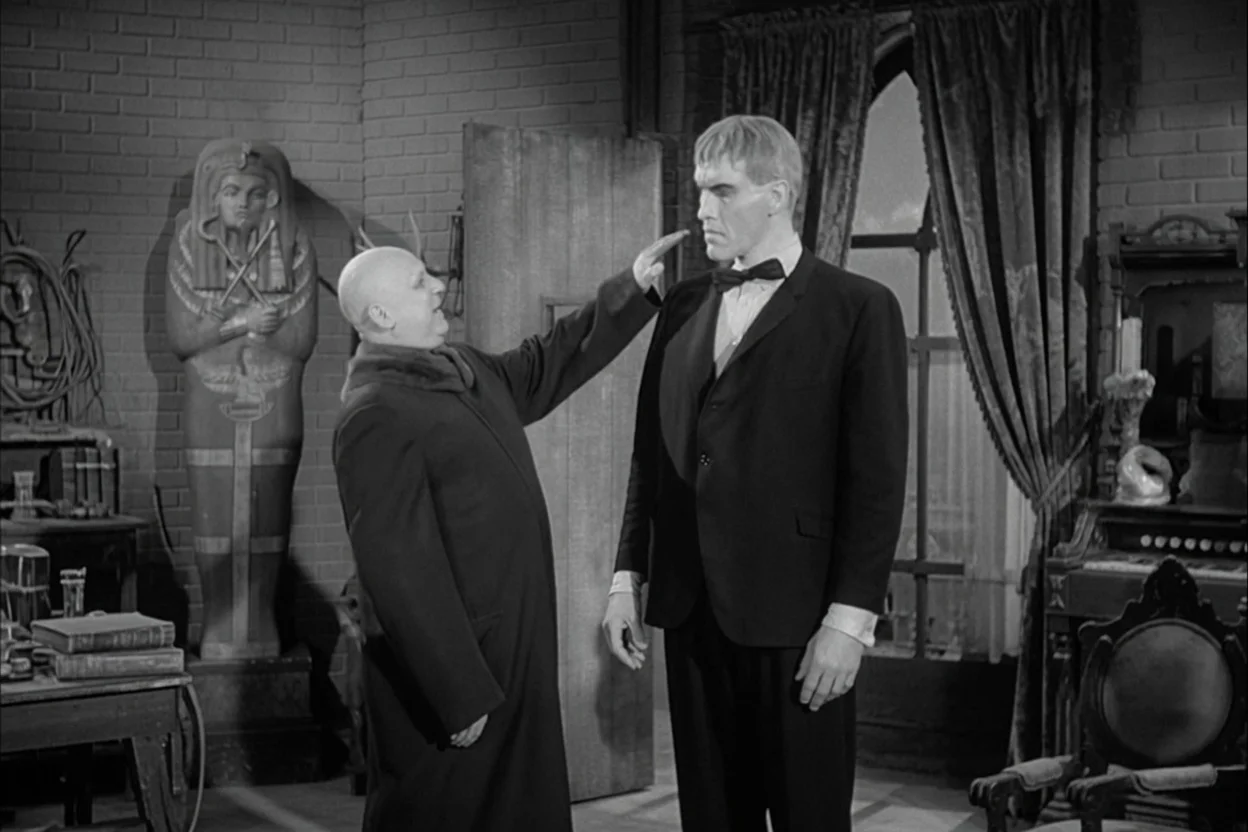
He stood 6 feet 9 inches tall. His voice rumbled like it came from the bottom of a well. And for two seasons of The Addams Family, he played the most memorable butler in television history.
But the same condition that gave Ted Cassidy his unforgettable presence also killed him at just 46 years old.
The Radio Announcer Who Covered A Presidential Assassination
Before he was Lurch, Ted Cassidy was already remarkable.
Born July 31, 1932 in Pittsburgh and raised in Philippi, West Virginia, he was academically gifted. He skipped three grades in grammar school. He finished high school at 16.
He grew fast too. By age 11, he was already 6 feet 1 inch tall, which let him play varsity football and basketball as a freshman.
He went on to graduate from Stetson University in Florida with a degree in Speech and Drama. Then he became a radio announcer, first in Pensacola, Florida, then in Dallas, Texas.
On November 22, 1963, Ted was on the air in Dallas. That was the day President Kennedy was assassinated. Ted provided some of the earliest broadcast interviews with eyewitnesses right there in Dealey Plaza.
A year later, he’d be playing a fictional butler in a spooky mansion. Hollywood works in strange ways.
“You Rang?” Wasn’t Even In The Script
When Ted auditioned for The Addams Family in 1964, the character of Lurch wasn’t supposed to talk at all. He was written as a mute butler who communicated through grunts, sighs, and physical comedy.
Ted had other ideas.
During his audition, he ad-libbed a response to the family’s summons. Drawing on his years of radio training, he delivered two words in a cavernous, deadpan bass: “You rang?”
The producers were delighted. The contrast between his massive size and his dry, articulate delivery was perfect. They rewrote the show to give Lurch actual lines. “You rang?” became his permanent catchphrase.
John Astin, who played Gomez Addams, had actually been considered for the Lurch role too, but he wasn’t right for such a towering character. Ted was perfect.
He Was Secretly Playing Two Characters
Here’s something a lot of fans never realized. Ted Cassidy wasn’t just Lurch. He was also Thing, the disembodied hand that popped out of boxes throughout the Addams mansion.
This was the 1960s. No digital effects. So how did they pull it off?
Ted would lie flat on his back on a low wooden trolley, hidden beneath the floorboards or behind furniture. He’d stick his arm straight up through a hole in the bottom of the prop box.
Because his arms were so long, Thing sometimes emerged all the way up to the elbow. It was less a hand and more a whole forearm making an appearance.
Thing was supposed to be a right hand, but Ted would occasionally use his left hand just to see if anyone would notice. Nobody did.
The tricky part came when Lurch and Thing needed to appear in the same scene.
Ted obviously couldn’t play both at once. So the show’s assistant director, Jack Voglin, would climb onto the trolley and provide his own hand instead. Sometimes other crew members did it. Even John Astin lent a hand a few times, literally.
The Real Reason He Was So Big And Sounded Like That
People have wondered for decades whether Ted had gigantism. His son Sean has debunked that rumor directly. Ted actually had acromegaly, a different condition entirely.
Both conditions come from a benign tumor on the pituitary gland that causes the body to produce too much growth hormone. But the timing matters. Gigantism happens in childhood, before your bones stop growing, which is why it causes someone to grow extremely tall in a symmetrical way.
Acromegaly happens in adulthood, after your bones have already stopped growing longer.
Instead of getting taller, your bones get wider. Your hands, feet, and skull grow thicker. Your facial features coarsen. Your brow ridge gets more prominent. Your jaw sticks out further.
That deep, booming voice everyone remembers? That was real, not a character voice.
Acromegaly thickens your vocal cords and expands the space in your throat and sinuses, which naturally deepens your voice. Ted didn’t have to fake anything. His body did it for him.
The problem is, acromegaly doesn’t just change how you look and sound. It puts enormous strain on your internal organs too. It causes your heart to work harder than it should, thickening the heart muscle in dangerous ways. It affects your liver and kidneys. It raises your blood pressure.
Ted’s unforgettable presence and this deadly strain on his body came from the exact same source.
Typecast As “The Big Dumb Galoot”
When The Addams Family ended in 1966 after just two seasons, Ted faced a problem a lot of distinctive-looking actors know well. He couldn’t disappear into other roles. His size made that impossible.
He privately complained that Hollywood kept casting large men as “the big dumb galoot.” He was an educated man, a former radio broadcaster with a degree in speech and drama, and he kept getting offered roles that ignored all of that.
So Ted found a workaround: voice acting. Behind a microphone, nobody could see him. All they heard was that incredible bass voice, and that voice could be anything.
He voiced Frankenstein Jr. for Hanna-Barbera. He provided monster roars for Godzilla. He played Black Manta and Brainiac on Challenge of the Superfriends.
He also kept getting live-action work, usually tied to his size. He played the android Ruk on Star Trek. He appeared as Bigfoot in crossover episodes of The Six Million Dollar Man and The Bionic Woman. He even had a role in Butch Cassidy and the Sundance Kid as Harvey “Kid Curry” Logan.
His most memorable later work came from The Incredible Hulk. Ted delivered the opening narration for every single episode, setting up Dr. David Banner’s tragic story in that unmistakable voice.
He also provided the Hulk’s roars and grunts for the first two seasons.
The Surgery That Should Have Saved Him
By the late 1970s, the years of strain from acromegaly had caught up with Ted’s heart.
Doctors discovered a cardiac myxoma, a benign tumor growing inside his heart. Benign meant it wasn’t cancerous, but it still needed to come out. Left untreated, it could block blood flow or cause other serious problems.
Ted underwent open-heart surgery at St. Vincent Medical Center in Los Angeles to remove it. The surgery itself was considered a success. He was discharged to recover at his home in Woodland Hills.
But his heart, already weakened by years of acromegaly-related strain, couldn’t handle the recovery. Severe complications developed just days later. He was rushed back to St. Vincent Medical Center.
Doctors couldn’t stabilize him this time. Ted Cassidy died on January 16, 1979. He was only 46 years old.
The Backyard Burial Mystery
Here’s where Ted’s story gets genuinely strange.
After his death, Ted was cremated. According to contemporary reports, his live-in girlfriend at the time buried his ashes in the backyard of their Woodland Hills home.
When she eventually moved away, the story goes, the ashes stayed right there in the ground. Somewhere in Woodland Hills, an unsuspecting homeowner might be living on a property with Ted Cassidy’s cremated remains still buried in the yard.
It sounds like an urban legend, and honestly, it might be one.
Ted’s son Sean has pushed back on this story. He and his sister were away at college when their father died. They came back to Los Angeles for the funeral and wake, but Sean has said the actual chain of custody for the ashes remains a genuine unsolved mystery within the family itself.
So the backyard burial theory is intriguing, but nobody, not even Ted’s own children, can confirm exactly where his remains ended up.
What He Actually Left Behind
People searching for Ted Cassidy’s net worth today won’t find much. No probate records or tax documents have ever been made public.
Ted himself once said in an interview that “Lurch bought the house I live in,” which tells you the show provided real financial stability, even if it wasn’t a fortune.
Throughout the 1970s, his voiceover work and guest appearances kept him steadily employed. This wasn’t a rags-to-riches Hollywood story or a story of a star burning through millions. It was a working actor supporting his family through consistent, respectable work.
Any claims online about him leaving behind a massive fortune are speculation, often confused with unrelated people who share his name.
He Was Never Actually Replaced
A lot of people search online asking why Ted Cassidy was replaced as Lurch. The answer is that he wasn’t, at least not during his lifetime.
Ted played Lurch in all 64 episodes of the original series from 1964 to 1966. The show wasn’t canceled because of any casting issue. ABC simply canceled it due to declining ratings as color programming and shows like Batman pulled viewers away.
Ted even came back to voice Lurch again in 1972 for a crossover episode of The New Scooby-Doo Movies, and again for the 1973 Hanna-Barbera animated series. He and Jackie Coogan, who played Uncle Fester, were the only original cast members to reprise their roles for the cartoon.
It wasn’t until after Ted’s death in 1979 that anyone else played Lurch. Dutch actor Carel Struycken took over the role for the 1991 and 1993 feature films.
Struycken actually had acromegaly himself, which is part of why he was chosen. He genuinely resembled Ted’s original portrayal.
More recently, people confuse this history with the modern Netflix series Wednesday, which features a completely new actor as Lurch. That casting has nothing to do with the original 1960s production or any replacement drama from back then.
More Than A Monster
Ted Cassidy could have let his size define him as nothing more than a prop. A lot of Hollywood wanted exactly that.
Instead, he brought genuine wit and warmth to Lurch. He turned a mute background character into someone audiences adored. When typecasting limited his opportunities, he found a way around it entirely through voice work, proving his talent went far beyond how he looked.
The same condition that made him unforgettable also cut his life short at 46. His heart simply couldn’t carry the weight that acromegaly placed on it, even after the surgery meant to fix the problem.
Decades later, that voice is still instantly recognizable. Two words, delivered in a deadpan bass that came from deep within his chest: “You rang?”
Ted Cassidy and The Addams Family, Frequently Asked Questions
How did Ted Cassidy die?
Ted Cassidy died on January 16, 1979 from complications following open-heart surgery. Doctors had removed a benign tumor called a cardiac myxoma from his heart at St. Vincent Medical Center in Los Angeles. He was sent home to recover, but his heart could not handle the strain. He was rushed back to the hospital days later and passed away shortly after. He was 46 years old.
Did Ted Cassidy have gigantism or acromegaly?
Ted Cassidy had acromegaly, not gigantism. His son Sean has confirmed this directly. Gigantism happens in childhood before bones stop growing, causing symmetrical extreme height. Acromegaly happens in adulthood after bones have stopped growing longer, which is why it caused his features to widen and coarsen rather than making him grow taller in a proportional way.
Was Ted Cassidy’s deep voice real or a character choice?
His voice was completely real. Acromegaly thickens the vocal cords and enlarges the throat and sinus cavities, which naturally produces a deeper, more resonant voice. Ted did not put on a character voice for Lurch. That booming bass was simply how he sounded, and it is the same voice that made him such an in demand voice actor later in his career.
Did Ted Cassidy play Thing as well as Lurch?
Yes. Ted played both roles throughout most of the series. He would lie on a hidden trolley beneath the set and extend his arm through a hole in the prop box to perform as Thing. When Lurch and Thing needed to appear in the same scene, assistant director Jack Voglin or other crew members filled in for Thing since Ted obviously could not play both parts at once.
Was Ted Cassidy ever replaced as Lurch?
Not during his lifetime. Ted played Lurch in all 64 episodes of the original 1964 to 1966 series and even returned to voice the character in 1972 and 1973 animated projects. He was never recast. After his death in 1979, Carel Struycken took over the role for the 1990s feature films. The character has been played by different actors in later adaptations, including the Netflix series Wednesday, but none of that involved Ted being pushed out.
Is it true Ted Cassidy is buried in someone’s backyard?
This is unconfirmed. The popular story says his girlfriend at the time buried his ashes in the backyard of their Woodland Hills home, and that they were left behind when she moved. His son Sean has said the family itself does not actually know the true final resting place of the cremains, so the backyard burial remains an interesting but unverified legend.
What was Ted Cassidy’s net worth when he died?
No official figure has ever been made public. There are no probate records or tax documents available. Ted himself said in an interview that Lurch bought the house he lived in, suggesting the show gave him financial stability rather than a massive fortune. He continued working steadily in voiceover roles throughout the 1970s to support his family.