TLDR: When Dallas ended its third season with J.R. Ewing shot by an unseen assailant, nobody involved expected it to become a genuine global obsession.
The eight-month wait for an answer was driven as much by a real contract standoff with Larry Hagman as it was by clever marketing, and the reveal still stands as one of the most-watched scripted episodes in American television history.
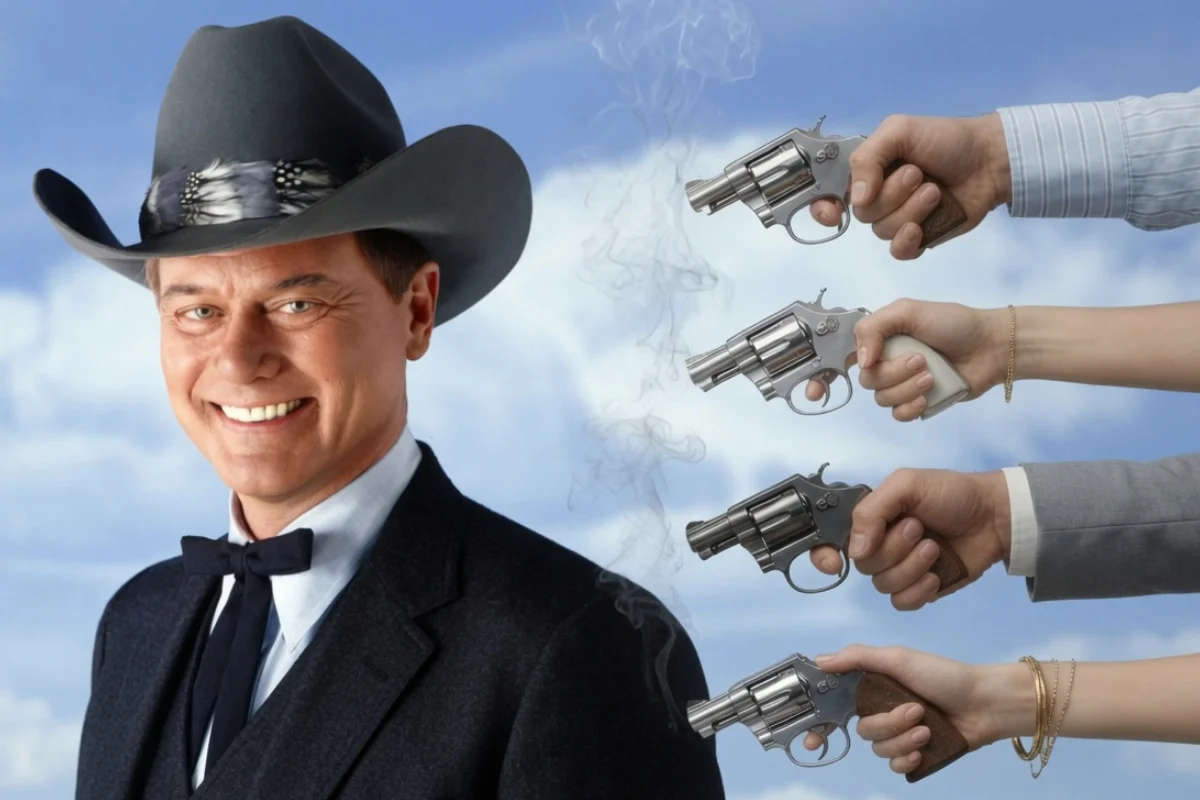
On March 21, 1980, Dallas closed its third season with J.R. Ewing shot twice in his office by someone the camera never showed. The episode, titled “A House Divided,” was written by Rena Down and directed by Leonard Katzman, and it was supposed to be a fairly standard cliffhanger.
Instead, “Who Shot J.R.?” became one of the biggest pop culture events of the decade. Here is what actually happened behind the scenes, and why the wait for an answer took eight full months.
For more on how the show came together in the first place, the story behind how Dallas almost had a completely different name covers the show’s chaotic creation.
The Delay Wasn’t Just Clever Marketing
It’s tempting to assume CBS dragged the mystery out purely to build hype, and the network certainly leaned into the publicity once it took off. But the real reason the answer took so long had nothing to do with marketing strategy at all.
Larry Hagman realized that surviving a near-fatal shooting had made his character, and by extension his own leverage, suddenly very valuable to the network.
He refused to report for the fourth season, demanding a major salary increase and a cut of the show’s profits. CBS and Lorimar actually drafted a contingency script in which J.R. would undergo facial reconstructive surgery after the shooting, which would have let them recast the role entirely if Hagman didn’t budge.
Production on the new season began in June 1980 without Hagman on set. An eight-week Writers Guild of America strike that began in July added even more delay, pushing the new season’s premiere into November.
Hagman ultimately re-signed that July, reportedly for around $100,000 per episode plus a share of J.R. merchandise royalties, and the recast plan was scrapped. You can read more about Larry Hagman’s full life and career for the rest of his story.
The Secrecy Around the Reveal Was Real
To keep the shooter’s identity from leaking, the production filmed nearly every major cast member in the act of pulling the trigger, including Hagman himself shooting a version of the scene. No single actor or crew member knew which version was the real one.
Even that level of precaution wasn’t airtight. According to later reporting, a copy of the resolution script was stolen from Lorimar at one point, and the Los Angeles Herald Examiner received it from a source before ultimately returning it to police rather than publishing the answer.
The Mystery Became a Genuine Global Event
Through the summer and fall of 1980, “Who Shot J.R.?” stopped being just a TV storyline and became something closer to a cultural fixation. T-shirts reading “Who Shot J.R.?” and “I Shot J.R.” sold internationally, and a novelty record about the mystery cracked the Billboard Hot 100.
Politics got pulled in too. The Republican Party distributed campaign buttons reading “A Democrat shot J.R.” during the 1980 presidential race, and President Jimmy Carter joked publicly that he could fund his entire campaign if someone would just give him the answer.
Hagman has said that even Queen Elizabeth The Queen Mother personally pressed him for the shooter’s identity during a UK visit, and he wouldn’t tell her either.
In Turkey, the parliament reportedly suspended an active legislative session specifically so members could get home in time to watch the broadcast.
The Actual Answer Was a Calculated Risk
The mystery was finally resolved on November 21, 1980, in an episode titled “Who Done It,” written by Loraine Despres and directed by Leonard Katzman. The shooter turned out to be Kristin Shepard, played by Mary Crosby, J.R.’s scheming sister-in-law and former mistress.
The setup leaned hard into classic soap mechanics. Sue Ellen, struggling with alcoholism, briefly believed she might have committed the shooting herself after a gun turned up in her closet, and only pieced together the truth under hypnosis with her psychiatrist.
Kristin had drugged Sue Ellen, taken the gun, shot J.R., and planted the weapon to frame her. J.R. ultimately chose not to press charges against Kristin after she revealed she was pregnant with his child.
Critical reaction was mixed even at the height of the hype.
New York Times critic John J. O’Connor noted in his review that “the real culprit was her conniving sister, Kristin.” Some critics appreciated the symmetry of J.R. being undone by someone equally ruthless, while others felt the episode itself, aside from its final minutes, played out like an ordinary hour of television padded with unrelated subplots about an oil refinery deal.
The Ratings Were Genuinely Historic
“Who Done It” pulled a 53.3 Nielsen rating and a staggering 76 percent audience share, meaning more than three out of every four American households watching television that night were tuned to CBS. Roughly 83 million people watched, more than had voted in the 1980 presidential election just weeks earlier.
That made it the highest-rated scripted episode in American television history at the time, a record it held for more than two years until the M*A*S*H series finale broke it in February 1983 with a 60.3 rating and nearly 106 million viewers.
Even today, the Dallas reveal remains the second-most-watched scripted episode in U.S. television history, and its 76 percent household share is a number modern television, fragmented across cable and streaming, will likely never see again.
It Reshaped How Networks Made Television
Before 1980, network executives generally avoided leaving major storylines unresolved heading into a summer break, worried that audiences would simply lose interest and wander off.
The runaway success of “Who Shot J.R.?” proved the opposite was true, and the season-ending cliffhanger quickly became standard practice across American television.
The show’s success also triggered a real arms race among networks. ABC commissioned Dynasty specifically to compete with Dallas, building a similarly wealthy oil-family premise but set in Denver rather than Texas.
Dynasty struggled in its first season before the addition of Joan Collins as Alexis Carrington transformed it into a stylish, campier rival, eventually overtaking Dallas as the top-rated show in America during the 1984 to 1985 season.
Dallas also spun off its own sister series, Knots Landing, built around two minor Ewing family characters and grounded in a much quieter, more realistic tone.
More than four decades later, the phrase “Who Shot J.R.?” still gets used as shorthand for any unresolved pop culture mystery, a strange kind of immortality for a storyline that started as little more than a routine way to end a season.
For more on what happened to everyone involved, the full Dallas cast breakdown covers where the rest of the Ewing family ended up.
Who actually shot J.R. Ewing on Dallas?
Kristin Shepard, J.R.’s sister-in-law and former mistress, played by Mary Crosby, was revealed as the shooter on November 21, 1980, in the episode Who Done It.
Why did it take so long to reveal who shot J.R.?
The delay was caused partly by a real contract dispute, since Larry Hagman held out for a higher salary after the shooting aired, and partly by an eight-week Writers Guild of America strike in the summer of 1980 that pushed back production.
How many people watched the Who Shot J.R. reveal?
Approximately 83 million Americans watched the reveal episode, earning a 53.3 Nielsen rating and a 76 percent audience share, making it the highest-rated scripted television episode in history at the time.
Did the Dallas cliffhanger create the modern TV cliffhanger format?
Yes. Before Who Shot J.R., networks generally avoided unresolved storylines heading into a summer break. Its massive success established the season-ending cliffhanger as standard practice across American television.