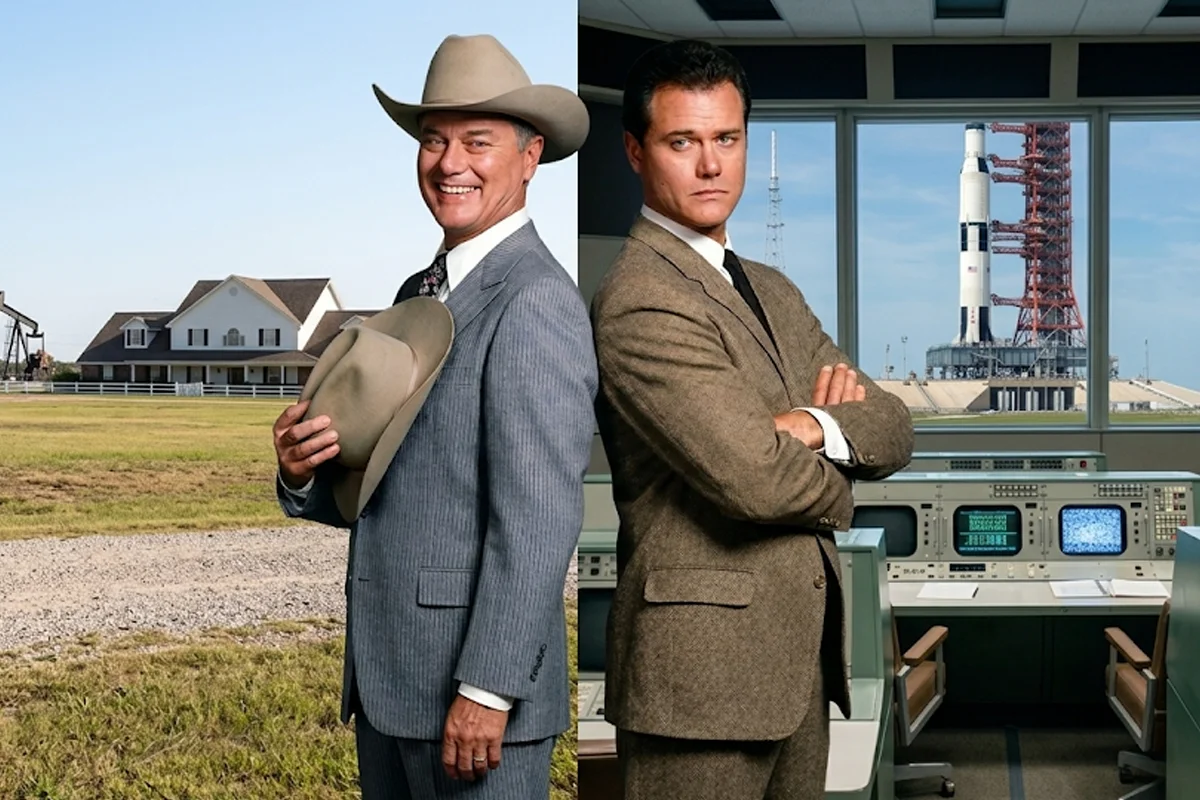
TLDR: Larry Hagman played two of the most iconic television characters in American history, the earnest Major Anthony Nelson on I Dream of Jeannie and the scheming J.R. Ewing on Dallas, while privately battling decades of alcoholism that nearly killed him before a 1995 liver transplant gave him seventeen more years.
He died on November 23, 2012, at age 81, surrounded by his family and his Dallas co-stars Linda Gray and Patrick Duffy.
Larry Martin Hagman was born on September 21, 1931, in Fort Worth, Texas, the only child of Benjamin Hagman, a criminal defense attorney, and Mary Virginia Martin, who was seventeen years old at the time and who would go on to become one of Broadway’s most celebrated stars.
His parents divorced when he was five. His mother moved to Los Angeles to sign with Paramount Pictures.
Hagman was raised in Texas by his maternal grandmother while Mary Martin built the career that would make her famous.
When his grandmother died, Hagman was integrated into his mother’s household in New York, where he lived with her and his stepfather Richard Halliday, whom he later described as an abusive alcoholic who subjected him to psychological torment.
To keep the peace, Hagman was shipped off to boarding schools, including the Black-Foxe Military Institute in Los Angeles and the Woodstock Country School in Vermont.
He graduated from Weatherford High School in Texas in 1949, the town where his mother had grown up, and enrolled at Bard College before dropping out after one year to pursue acting.
The shadow of Mary Martin was enormous and complicated. She originated Nellie Forbush in South Pacific and Peter Pan on Broadway. In 1951, Hagman traveled to London to join the West End cast of South Pacific, performing in the chorus while his mother starred in the lead. A young Sean Connery was in the company with him.
The Korean War interrupted this theatrical apprenticeship.
Hagman enlisted in the Air Force in 1952 and served until 1956 in London, producing and performing in USO variety shows for Allied troops stationed across Europe.
I Dream of Jeannie and the Making of a Star
In 1965, after a decade of theater and daytime television, Hagman was cast as Captain (later Major) Anthony Nelson in NBC’s I Dream of Jeannie, a fantasy sitcom about a NASA astronaut who discovers a genie, played by Barbara Eden, inside a bottle on a deserted island.
The show was NBC’s response to ABC’s supernatural comedies Bewitched and My Favorite Martian, and it ran for five seasons and 139 episodes until 1970.
Eden deeply respected Hagman’s comedic timing, later describing him as “an element of pure Americana.” Off camera, though, he was struggling.
Frustrated by the constraints of the sitcom format and by scripts he considered subpar, he frequently erupted in behavioral outbursts that alienated the production crew.
Eden recalled routinely retreating to her dressing room during these episodes. She also observed that he was “his own worst enemy” on set, a description that would follow him for years.
The show ended in 1970. Hagman starred in two more short-lived sitcoms, The Good Life (NBC, 1971 to 1972) and Here We Go Again (ABC, 1973), neither of which found an audience.
He worked in films throughout the mid-seventies, including supporting roles in Harry and Tonto (1974) and Mother, Jugs and Speed (1976), and a cameo in Superman (1978). None of it approached the cultural reach of Jeannie. That was about to change.
J.R. Ewing and the Role That Made Him the Most Famous Actor in the World
CBS launched Dallas in 1978 as a primetime soap opera about the Ewing family, owners of the independent oil giant Ewing Oil. The role of J.R. Ewing, the show’s central villain, was originally offered to Robert Foxworth, who demanded that the character’s amoral qualities be softened.
The producers refused. Hagman was cast as the second choice, and the decision changed television history.
Hagman modeled J.R. on composite figures he had observed growing up in Texas, particularly Jess Hall Jr., the ruthless head of the Weatherford-based Antelope Tool Company.
He played the character as a charismatic predator who caught more flies with honey than vinegar, making “greed, treachery and blackmail seem like good, sexy, all-American fun,” as one obituary later put it.
The New York Times would eventually declare that Hagman “could lay claim to the title of most famous actor in the world.” Dallas was broadcast in 57 countries at its peak.
The show’s most famous moment came on March 21, 1980, when J.R. was shot by an unidentified assailant in the third-season finale. The shooting was not entirely a creative choice. Behind the scenes, CBS conceived it partly as a contingency plan in case contract negotiations with Hagman stalled.
He was demanding a historic salary increase, and the producers needed leverage. The mystery was resolved on November 21, 1980, in “Who Done It,” which identified J.R.’s sister-in-law and mistress Kristin Shepard as the shooter.
The episode drew 83 million viewers in the United States and 24 million in the United Kingdom, making it one of the most-watched dramatic broadcasts in television history.
Hagman appeared in all 357 episodes of the original series run from 1978 to 1991, making him the only cast member with a perfect attendance record.
The show’s cast during those years included Victoria Principal as Pamela Barnes Ewing, Sheree J. Wilson as April Stevens, and Priscilla Presley as Jenna Wade, Bobby’s first love, who joined in Season 7 and stayed for five years and 143 episodes.
The Drinking, the Cirrhosis, and the Transplant That Saved His Life
Behind the glittering success of the Dallas years was a drinking problem that had begun in his teens and never stopped.
Hagman admitted to consuming approximately four bottles of champagne daily on set for fifteen years, remaining constantly inebriated while filming but functional enough to deliver one of television’s great performances.
By 1992, his liver was destroyed. He was diagnosed with advanced cirrhosis.
He stopped drinking immediately, but the damage was irreversible. In July 1995, doctors discovered a malignant tumor on his liver. In August 1995, he underwent a liver transplant at a facility in Los Angeles, receiving a matching donor organ through standard UNOS protocols despite his celebrity status.
His recovery was complete and his sobriety held for the remaining seventeen years of his life.
What followed was a profound personal transformation. Hagman became a prominent national advocate for organ donation, volunteering at hospitals to counsel patients awaiting transplants.
He would use his J.R. Ewing persona to disarm anxious patients, telling them the procedure would be “a little uncomfortable for a brief time, but you’ll be OK.”
He also served as national chairman of the American Cancer Society’s Great American Smokeout campaign from 1981 to 1992, having quit a two-pack-a-day cigarette habit at age 34.
He converted his 43-acre Ojai estate into one of the largest residential solar-powered properties in the world, installing a $750,000 solar panel system and driving an electric vehicle.
He delighted in the irony of TV’s most notorious oil baron promoting clean energy.
The Man Behind J.R.
Off screen, Hagman was known in Hollywood circles as “Wacky Larry” and “The Mad Monk of Malibu.” He flew a custom flag over his oceanfront Malibu home bearing the Latin motto “Vita Celebratio Est,” meaning Life Is a Celebration.
He led impromptu parades down the beach in outlandish costumes. He once shopped at a local grocery store in a full gorilla suit. He tested social boundaries by licking Lauren Bacall’s arm upon their first meeting after being told she disliked being touched.
He practiced “silent Sundays,” a weekly ritual during which he refused to speak, using a hand-held whistle to communicate with family and guests. His Dallas co-stars Linda Gray and Patrick Duffy remained his closest friends for decades. Gray called him her “best friend for 35 years” and “a Pied Piper of life.”
His domestic life was, by Hollywood standards, remarkably stable. In October 1954, while performing in London, he married Swedish clothing designer Maj Irene Axelsson.
Their marriage lasted 58 years until his death. They raised two children, Heidi Kristina, born 1958, and Preston, born 1962, and eventually had five granddaughters.
The Return to Dallas and a Final Season
In 2011, Hagman agreed to reprise J.R. Ewing in TNT’s Dallas revival series, which debuted in June 2012 to strong ratings. He filmed ten episodes of the first season and six of the second while actively undergoing cancer treatment. “As J.R. I could get away with anything,” he said. “But I got caught by cancer.”
In October 2011, he had been diagnosed with Stage 2 throat cancer, which required surgical removal of a tumor from his tongue.
The throat cancer went into remission by mid-2012, but in July 2012 he was diagnosed with myelodysplastic syndrome, a pre-leukemic blood disorder that progressed rapidly into acute myeloid leukemia.
Larry Hagman died on November 23, 2012, at 4:20 p.m. at Medical City Dallas Hospital in Dallas, Texas. He was 81 years old.
Linda Gray and Patrick Duffy were at his bedside. In accordance with his wishes, his body was cremated and his ashes were scattered over the grounds of Southfork Ranch in Parker, Texas, the real-world filming location of the Ewing family estate.
The New York Times honored him as “one of television’s most beloved villains.” His death was written directly into the second season of the Dallas revival, in a memorial episode that recalled the cultural impact of the original 1980 cliffhanger.
For more on the Dallas cast, including Priscilla Presley’s five years on the show and why Victoria Principal left, the full cast breakdown is coming soon.
How did Larry Hagman die?
Larry Hagman died on November 23, 2012, at Medical City Dallas Hospital in Dallas, Texas, at the age of 81. The cause of death was acute myeloid leukemia, which had progressed from myelodysplastic syndrome diagnosed in July 2012. He had previously battled throat cancer in 2011, which had gone into remission. His Dallas co-stars Linda Gray and Patrick Duffy were at his bedside when he passed.
What happened to Larry Hagman’s liver?
Larry Hagman was diagnosed with advanced cirrhosis of the liver in 1992 after decades of heavy drinking. He later described consuming approximately four bottles of champagne daily during the Dallas years. Although he stopped drinking immediately after the diagnosis, the damage was irreversible. In July 1995, doctors found a malignant tumor on his liver, and in August 1995 he underwent a successful liver transplant. He remained sober for the rest of his life and became a prominent national advocate for organ donation.
What was the ‘Who Shot J.R.’ episode?
The ‘Who Shot J.R.?’ storyline began on March 21, 1980, when J.R. Ewing was shot by an unidentified assailant in the Dallas Season 3 finale. The mystery was resolved on November 21, 1980, in an episode called ‘Who Done It,’ which identified J.R.’s sister-in-law and mistress Kristin Shepard as the shooter. The resolution episode drew 83 million viewers in the United States and 24 million in the United Kingdom, making it one of the most-watched dramatic broadcasts in television history.
Was Larry Hagman related to Mary Martin?
Yes. Mary Martin was Larry Hagman’s mother. She was one of Broadway’s most celebrated stars, originating the roles of Nellie Forbush in South Pacific and Peter Pan on Broadway. She was only seventeen years old when Hagman was born. His parents divorced when he was five, and he was largely raised by his maternal grandmother in Texas while his mother pursued her career. Their relationship was complicated but deeply influential on his decision to become an actor.
How long was Larry Hagman married?
Larry Hagman married Swedish clothing designer Maj Irene Axelsson in October 1954 while performing in London. Their marriage lasted 58 years until his death in November 2012. Together they raised two children, Heidi Kristina and Preston, and had five granddaughters. Despite his wild public reputation as ‘Wacky Larry,’ his domestic life was remarkably stable by Hollywood standards.
What happened to J.R. Ewing in the Dallas reboot?
Larry Hagman reprised his role as J.R. Ewing in TNT’s Dallas revival series, which launched in June 2012. He filmed ten episodes of the first season and six of the second while undergoing cancer treatment. After his death in November 2012, the show’s writers incorporated his passing directly into Season 2, creating a memorial episode that paid tribute to both Hagman and the character he had played for over 30 years.