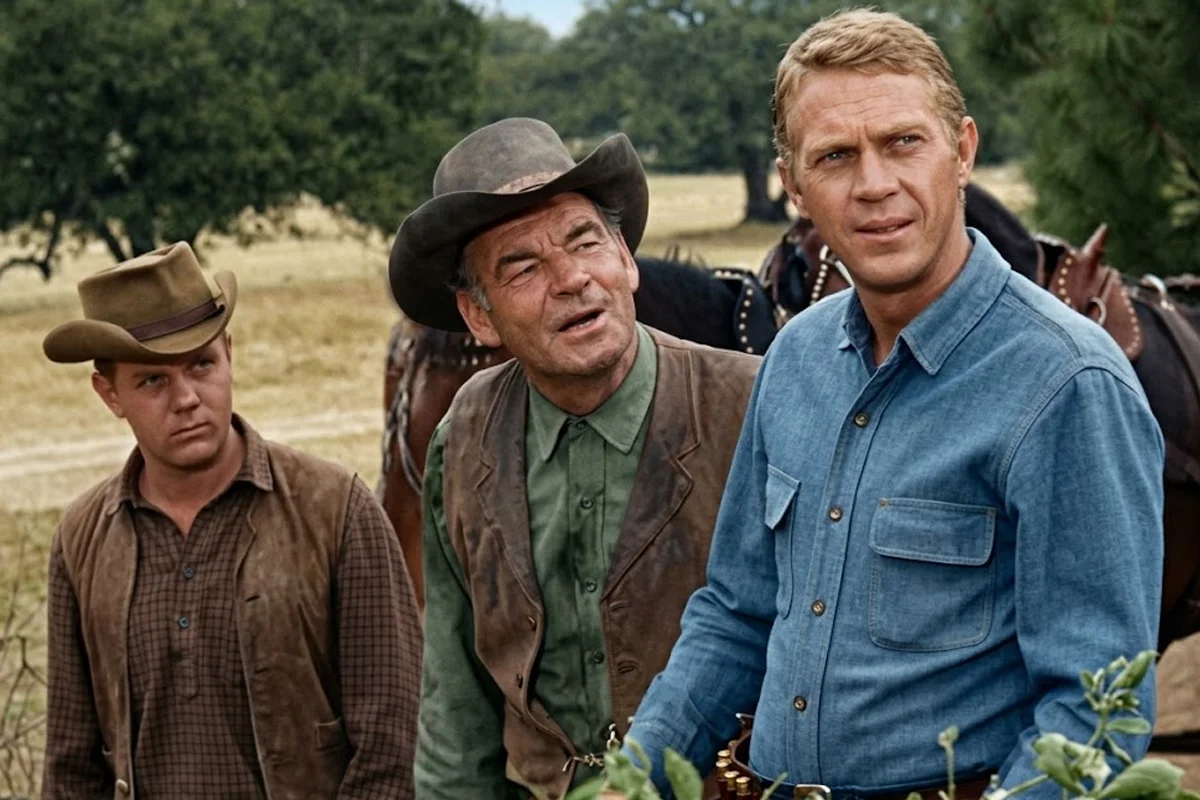
TLDR: Wanted Dead or Alive ran on CBS from September 6, 1958, to March 29, 1961, for 3 seasons and 94 episodes. Steve McQueen played bounty hunter Josh Randall and carried a sawed-off Winchester carbine called the Mare’s Leg in a thigh holster.
The show was his only regular television role before The Magnificent Seven and The Great Escape launched his film career. McQueen served in the Marines, was demoted seven times, and rescued five men from a sinking tank in the Arctic.
He died of mesothelioma on November 7, 1980, at age 50. T
he Heuer Monaco watch he wore in Le Mans sold for $2,208,000 at Phillips in 2020. His 1967 Ferrari sold for $5,395,000 in 2023. The show currently airs on the WEST channel.
In 1958, Steve McQueen was 28 years old, had a reform school background, a Marine Corps record that included seven demotions and 41 days in the brig, and a small handful of film and stage credits. Then CBS gave him a Western.
Wanted Dead or Alive made him a television star. He used the platform to become something bigger than television could hold. Three years in, he left for the movies and did not look back.
Steve McQueen (Josh Randall): The Man Before the Myth
Terrence Stephen McQueen was born on March 24, 1930, in Beech Grove, Indiana. His father abandoned the family when he was an infant. His mother was volatile and largely absent.
He was raised for stretches by his great-uncle Claude Thomson in Missouri, then returned to his mother in Los Angeles, where he fell in with gangs and accumulated a juvenile arrest record for petty theft.
Unable to manage him, his mother sent him to the California Junior Boys Republic in Chino Hills. The reformatory’s combination of manual labor and student-led self-governance became the turning point of his life. He credited Boys Republic with saving him from prison.
He kept his student ID number, 3188, as a permanent reference point: the license plate on his personal 1958 GMC pickup read “3188.” He visited the campus throughout his career, funded a scholarship in his name, and left $200,000 to the institution in his will.
He enlisted in the Marines in 1947. His military record was a study in contrasts. He was demoted to private seven times and sentenced to 41 days in the brig after going AWOL.
He was also, during an Arctic training exercise, the person who entered freezing water to rescue five fellow Marines from a tank that had broken through the ice and was sinking.
That act of bravery got him reassigned to guard President Truman’s yacht, the USS Williamsburg. He received an honorable discharge in 1950 and used the G.I. Bill for acting classes in New York.
Josh Randall and the Mare’s Leg
Josh Randall was a bounty hunter, which in 1958 television was a provocative premise. Bounty hunters were not heroes in the genre’s conventional moral framework.
Wanted Dead or Alive made Randall something different: a man operating in the gray space between law and frontier justice, who frequently donated his earnings to charity and helped the wrongfully accused.
His signature weapon was the Mare’s Leg: a sawed-off Winchester Model 1892 carbine carried in a thigh holster like a pistol, with the high-velocity lever action of a frontier rifle. The rapid-draw capability and unusual visual profile made it one of the most distinctive props in television Western history.
McQueen’s physical acting style gave the show its texture. He was compact, fast, and watchful, projecting the kind of coiled readiness that came from genuine athletic ability rather than theatrical training. The persona he built as Josh Randall translated directly into his film work.
He left the show in 1961, having already filmed The Magnificent Seven (1960) during production breaks. The Great Escape followed in 1963. Television could not compete with what was being offered on the other side.
The Cars: Ferrari, Porsche, Hudson and the Numbers
McQueen raced seriously. SCCA events, the Baja 1000, desert endurance runs. His passion for driving was not a hobby he managed around his career. It was the other way around.
The 1971 film Le Mans was his personal obsession. He rejected Hollywood special effects and filmed on location in France during the actual 1970 race, driving a Gulf-liveried Porsche 917 at speeds exceeding 200 mph along the Mulsanne Straight to capture authentic footage. Insurance underwriters blocked him from entering the race itself, which was the only constraint he accepted.
His friendship with James Garner ran through both their television careers and their racing lives. They were neighbors in Los Angeles, both starred in landmark Western series, and co-starred in The Great Escape.
Garner eventually formed a professional racing team and stepped back from driving himself. McQueen refused to stop driving, which was entirely characteristic of both men.
The auction results on his vehicles tell the rest of the story:
His 1967 Ferrari 275 GTB/4 by Scaglietti, painted Chianti Red and used to commute to the set of Bullitt, sold at RM Sotheby’s Monterey 2023 for $5,395,000.
His 1970 Porsche 911S, used as his personal vehicle during the European production of Le Mans and featured in the film’s iconic opening sequence, sold at RM Auctions Monterey 2011 for a record premium.
His 1952 Hudson Wasp, which he called his “Sunday-go-to-church car” and kept at Santa Paula Airport, was consigned directly from the Petersen Automotive Museum where it had been displayed since 2006, and sold at RM Sotheby’s Hershey 2025.
The Heuer Monaco: The Watch He Wore in Le Mans and What It Sold For
In 1970, the property master on Le Mans presented McQueen with several chronograph watches for the role of driver Michael Delaney. Among them was an Omega Speedmaster.
McQueen chose the Heuer Monaco instead, because his character’s racing suit already carried a Heuer sponsor patch matching the real-world uniform of racing driver Jo Siffert. Branding consistency won over personal preference.
The Monaco Reference 1133B was a technical landmark. Introduced in 1969, it was powered by the Caliber 11, one of the world’s first self-winding chronograph movements, and featured the world’s first water-resistant square watch case.
The bold blue dial, white registers, and red hands were not popular with consumers initially. McQueen changed that permanently.
Six Monaco watches were sent to the set by the Heuer factory. After filming, McQueen distributed them. He gave one to his business manager Bill Maher. He gave another to his personal mechanic Haig Altounian, engraving the caseback to thank Altounian for keeping him alive during the high-speed filming.
Altounian kept the watch in a safety deposit box for nearly fifty years before consigning it to auction. In December 2020 at Phillips, it sold for $2,208,000.
One additional note for watch collectors: the Rolex Explorer II Reference 1655 has been nicknamed the “Steve McQueen” by vintage collectors for decades.
There is no evidence McQueen ever owned or wore one. The nickname is thematic association only, which has nonetheless generated a significant collector premium for the reference.
The Asbestos, the Diagnosis and the End
In late 1979, McQueen was diagnosed with pleural mesothelioma, an aggressive cancer of the chest cavity lining caused by asbestos exposure. Two sources of exposure have been identified.
The first was the Marine Corps. As punishment for disciplinary infractions, McQueen was repeatedly assigned to scrape asbestos insulation off steam pipes in the unventilated boiler rooms of military transport ships.
The second was racing: fireproof suits, helmets, and face masks in that era used woven asbestos as flame retardant.
Facing a terminal prognosis with no approved treatment options, McQueen traveled to a clinic in Juarez, Mexico, for alternative therapies. He died on November 7, 1980, of cardiac arrest following surgery to remove tumors from his chest and abdomen. He was 50 years old.
The show that launched him airs today on the WEST channel alongside the other Warner Bros. and CBS Westerns of his era.
For more on the actor who raced alongside him and built a parallel legacy on television, see the James Garner biography.
What was Wanted Dead or Alive about?
Wanted Dead or Alive was a CBS Western that ran from September 6, 1958, to March 29, 1961, for 3 seasons and 94 episodes. Steve McQueen played Josh Randall, a bounty hunter who operated in the moral gray area between law and frontier justice. Randall carried a sawed-off Winchester Model 1892 carbine called the Mare’s Leg in a thigh holster. The show was McQueen’s only regular television role before his film career took over.
Did Steve McQueen serve in the military?
Yes. Steve McQueen enlisted in the United States Marine Corps in 1947. His service record was marked by repeated disciplinary infractions: he was demoted to private seven times and served 41 days in the brig after going AWOL. He also rescued five fellow Marines from a sinking tank during an Arctic training exercise, an act of bravery that led to his reassignment to guard President Truman’s yacht. He received an honorable discharge in 1950.
How did Steve McQueen die?
Steve McQueen died on November 7, 1980, of cardiac arrest in Juarez, Mexico, following surgery to remove tumors from his chest and abdomen. He was 50 years old. He had been diagnosed with pleural mesothelioma in late 1979, caused by asbestos exposure during his Marine Corps service and his racing career, when fireproof suits and helmets used woven asbestos as flame retardant.
What is the Steve McQueen Heuer Monaco watch worth?
Steve McQueen wore a Heuer Monaco Reference 1133B while filming Le Mans in 1970. After filming, he gave one of the on-set Monacos to his personal mechanic Haig Altounian with a signed authentication letter. In December 2020 at Phillips auction house, that watch sold for $2,208,000. A standard vintage Heuer Monaco Reference 1133 without McQueen provenance trades at a significantly lower price, demonstrating the value premium his ownership adds.
Where can I watch Wanted Dead or Alive?
Wanted Dead or Alive currently airs on the WEST channel, the free over-the-air network launched by Weigel Broadcasting on September 29, 2025, which broadcasts classic Westerns uncut to over half of US households. The show also streams on Philo. It ran for 3 seasons and 94 episodes on CBS from 1958 to 1961.