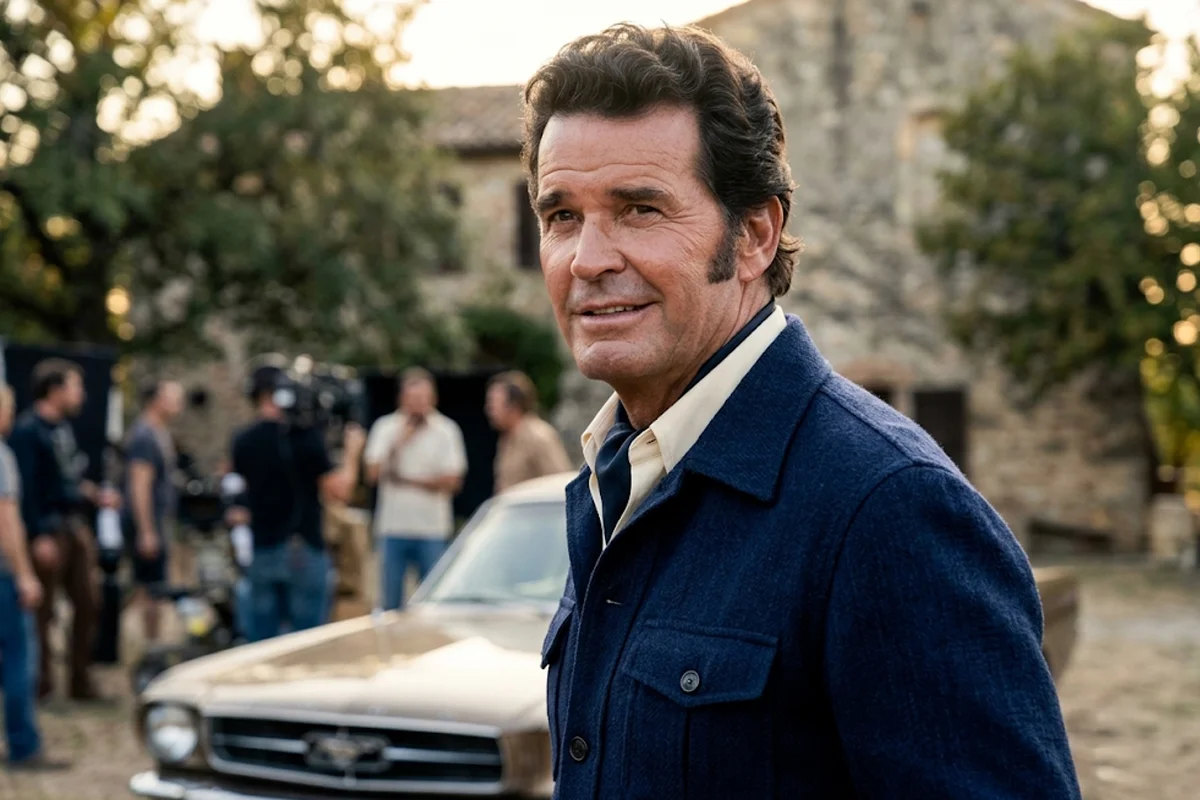
TLDR: James Garner starred in two of the greatest television shows ever made, sued two major Hollywood studios, and won both times.
Most actors who challenge the studios get quietly buried.
Garner’s secret was that he had spent his whole life fighting people with more power than him, and he had never once considered losing.
James Garner is the kind of Hollywood story that sounds fabricated.
A kid who fled an abusive home at fourteen, drifted across the American West doing manual labor, got wounded twice in Korea including once by his own side’s jets, walked into a talent agent’s office on a whim because he recognized the name on the door from a previous job, studied Henry Fonda from the wings of a Broadway stage, and became one of the most naturally gifted television actors of the twentieth century without a day of formal training.
The Childhood He Left at Fourteen
James Scott Bumgarner was born on April 7, 1928, in Denver, Oklahoma, a rural settlement nine miles east of Norman.
His mother died when he was four. His father was largely absent.
The three Bumgarner boys were distributed among relatives. When his father remarried in 1934, the stepmother subjected the boys to severe physical and emotional abuse.
At fourteen, Garner left home permanently.
He spent his teens doing manual labor across the American West: telephone installer, oilfield roughneck, janitor, lifeguard.
His maternal grandfather was documented as a full-blooded Cherokee.
At sixteen, near the end of World War II, he enlisted in the Merchant Marines, but severe and persistent seasickness ended that quickly.
He eventually followed his father to Los Angeles, attended high school briefly, worked as a swimsuit model for Jantzen, and laid carpets.
Korea: Two Purple Hearts, One Arrived 32 Years Late
Garner was the first draftee called from the state of Oklahoma during the Korean War. He served as a rifleman in the 5th Regimental Combat Team, attached to the 7th Infantry Division, and was wounded twice.
The first wound came from shrapnel when an enemy mortar round exploded nearby, striking him in the hand and face. He received his first Purple Heart while still in the combat zone.
The second wound is the one that tells you something about Garner’s sense of humor.
His unit retreated eight miles behind enemy lines. The soldier carrying the unit’s identification panels had been killed. U.S. Navy Panther jets, unable to identify the troops below, launched a strafing run on their own men.
Garner dove headfirst into a foxhole and was wounded in the buttocks by his own side’s fire.
Due to administrative errors and lost paperwork, he did not receive the second Purple Heart until 1983, thirty-two years after the incident.
The Army corrected the error only after Garner mentioned the friendly-fire strafing on Good Morning America.
How He Became an Actor by Accident
In 1953, at age twenty-five, Garner was laying carpets in Los Angeles when he noticed a sign for theatrical agent Paul Gregory on La Cienega Boulevard.
He recognized Gregory from a previous encounter when Gregory was a soda jerk and Garner was a gas station attendant. On a whim, he pulled into a parking space and walked inside.
Gregory cast him in a small non-speaking role as one of the judges in the Broadway production of Herman Wouk’s The Caine Mutiny Court-Martial, alongside Henry Fonda, John Hodiak, and Lloyd Nolan.
Garner used the touring run as a nightly masterclass. He later said: “I swiped practically all my acting style from Fonda.” In 1956 he signed a contract with Warner Bros.
The following year they cast him as Bret Maverick.
Maverick and the Lawsuit That Set Him Free
Maverick made Garner famous. The show was a deliberate comedic subversion of the Western genre.
Bret Maverick was a card sharp and coward who preferred talking his way out of situations over gunplay. That was radical for 1957 television.
Garner’s easy physicality and natural comic timing made it work better than it had any right to.
Warner Bros. paid him a modest weekly salary. The show was a hit. The studio got rich. Garner did not.
When the Writers Guild of America went on strike in 1960, Warner Bros. suspended him without pay, invoking a force majeure clause in his contract, claiming the strike prevented them from producing.
Garner challenged the suspension in court.
During trial, testimony revealed that Warner Bros. had secretly stockpiled approximately one hundred television scripts during the strike and had continued producing other shows.
The Los Angeles Superior Court ruled that the production of Maverick had not been genuinely prevented by the strike, declared Garner’s contract terminated, and awarded him $1,750 in damages.
When his lawyer asked if he wanted a raise or a new contract, Garner replied: “I want out.”
He walked away from Maverick and into a film career. The ruling established a landmark legal precedent: studios could not use industry-wide strikes as a pretext to freeze talent contracts under force majeure if they were otherwise capable of continuing production.
Hollywood labor law was never quite the same.
The Rockford Files and the Second Lawsuit
In 1974, Garner returned to series television with The Rockford Files, reuniting with Maverick creator Roy Huggins and co-creator Stephen J. Cannell.
Jim Rockford was Bret Maverick transported to 1970s Los Angeles: an ex-convict wrongly pardoned, living in a trailer on Malibu Beach, charging $200 a day and rarely collecting, keeping his gun in a cookie jar, preferring a fast-talking con over a fistfight.
The show ran until 1980. Garner won the Emmy for Outstanding Lead Actor in a Drama Series in 1977 for the episode “So Help Me God,” a critique of the grand jury system that he later noted with pride was cited during real-world legislative efforts to reform grand jury procedures.
The physical demands of the role were severe. He performed many of his own stunts, including the high-speed reverse turn known as the “Rockford Turn,” and the accumulated damage required six or seven knee surgeries during the show’s run, culminating in bilateral knee replacements in 2000.
When the show ended, Garner discovered that Universal Studios claimed The Rockford Files had generated a $9 million deficit over five seasons, meaning no net profits were owed to his production company Cherokee Productions despite the show’s massive syndication success.
In July 1983, he sued Universal for $16.5 million, accusing the studio of breach of contract, fraud, and deceit. His lawsuit helped popularize the term “creative accounting” as a description of Hollywood’s financial practices.
Universal countersued. Garner fought the studio for six years. The case settled out of court in 1989 for a confidential sum reported at approximately $14 million.
His victory proved that talent could challenge studio bookkeeping without being blacklisted.
Racing, Films, and the Rest of the Career
Garner’s passion for racing was genuine and well-documented. While filming Grand Prix in 1966, he impressed professional Formula One drivers with his natural driving ability.
He formed and owned the American International Racers team from 1967 to 1969, competing in major endurance events including the Baja 1000. He drove the Indianapolis 500 pace car in 1975, 1977, and 1985. His racing friends included Paul Newman and champion driver Parnelli Jones.
His film career produced several memorable performances. He played Flight Lieutenant Hendley in The Great Escape (1963), a character directly inspired by his own real-life role as a company scrounger in Korea.
He received his only Academy Award nomination for Best Actor for Murphy’s Romance (1985) opposite Sally Field.
His final major film appearance was as the older Duke in The Notebook (2004), which introduced him to a generation of viewers who had not grown up with Maverick or Rockford.
The Memoir, the Marriage, and the End
In 2011 Garner published The Garner Files, co-written with Jon Winokur. It was remarkably candid. He disclosed lifelong struggles with clinical depression and stage fright.
He described accidentally breaking Doris Day’s ribs during a physical scene on a film set.
He critiqued every film he ever made. Of 1966’s Mr. Buddwing he wrote: “Zero stars. Worst picture I ever made. What were they thinking? What was I thinking?”
His personal life was defined by one marriage. On
August 17, 1956, after a fourteen-day courtship, he married Lois Josephine Fleischman Clarke. She had a nine-year-old daughter from a previous marriage whom Garner raised as his own. Together they had a daughter, Greta “Gigi” Garner, born 1958.
The marriage survived two brief separations and lasted fifty-eight years until his death.
Garner underwent quintuple heart bypass surgery in 1988 and suffered a severe stroke in 2008. He died on July 19, 2014, at his Brentwood home at age 86.
Early reports listed the cause as “natural causes,” which his death certificate corrected to acute myocardial infarction. Director Robert Altman had described him in 1979 in a way that stuck: “He makes it so easy, and that is not easy to do.”
A ten-foot bronze statue of him as Bret Maverick stands in Norman, Oklahoma, nine miles from where James Scott Bumgarner was born.
For more on the shows that defined his legacy, see the pages on the Maverick cast and the Rockford Files cast.
How did James Garner die?
James Garner died on July 19, 2014, at his home in Brentwood, Los Angeles. He was 86 years old. Early reports attributed his death to natural causes, but his official death certificate confirmed the cause as an acute myocardial infarction (heart attack). He had previously undergone quintuple heart bypass surgery in 1988 and suffered a stroke in 2008.
Did James Garner serve in the military?
Yes. James Garner was drafted into the United States Army during the Korean War and was the first draftee called from the state of Oklahoma during the conflict. He served as a rifleman in the 5th Regimental Combat Team and was wounded twice: once by enemy mortar shrapnel and once by friendly fire when U.S. Navy jets strafed his unit after misidentifying them as enemy troops. He received two Purple Hearts. The second was not awarded until 1983, thirty-two years after the incident, due to lost paperwork.
What was James Garner’s lawsuit against Warner Bros.?
In 1960, during the Writers Guild of America strike, Warner Bros. suspended James Garner without pay using a force majeure clause in his contract. Garner sued, and during trial it emerged that the studio had secretly stockpiled approximately one hundred scripts and continued producing other shows during the strike. The Los Angeles Superior Court ruled against Warner Bros. and declared Garner’s contract terminated. The ruling established a landmark legal precedent that studios could not use industry strikes as a pretext to freeze talent contracts if they were otherwise capable of continuing production.
What was James Garner’s lawsuit against Universal?
After The Rockford Files ended in 1980, Universal Studios claimed the show had generated a $9 million deficit despite its massive syndication success, meaning no net profits were owed to Garner’s production company. In 1983, Garner sued Universal for $16.5 million, accusing the studio of creative accounting, fraud, and breach of contract. After six years of litigation, the case settled out of court in 1989 for a confidential sum reported at approximately $14 million.
What shows did James Garner star in?
James Garner’s two defining television roles were Bret Maverick in Maverick (ABC, 1957-1962) and Jim Rockford in The Rockford Files (NBC, 1974-1980). He won the Emmy Award for Outstanding Lead Actor in a Drama Series in 1977 for The Rockford Files. He also appeared in numerous films including The Great Escape (1963), Grand Prix (1966), Murphy’s Romance (1985), and The Notebook (2004).