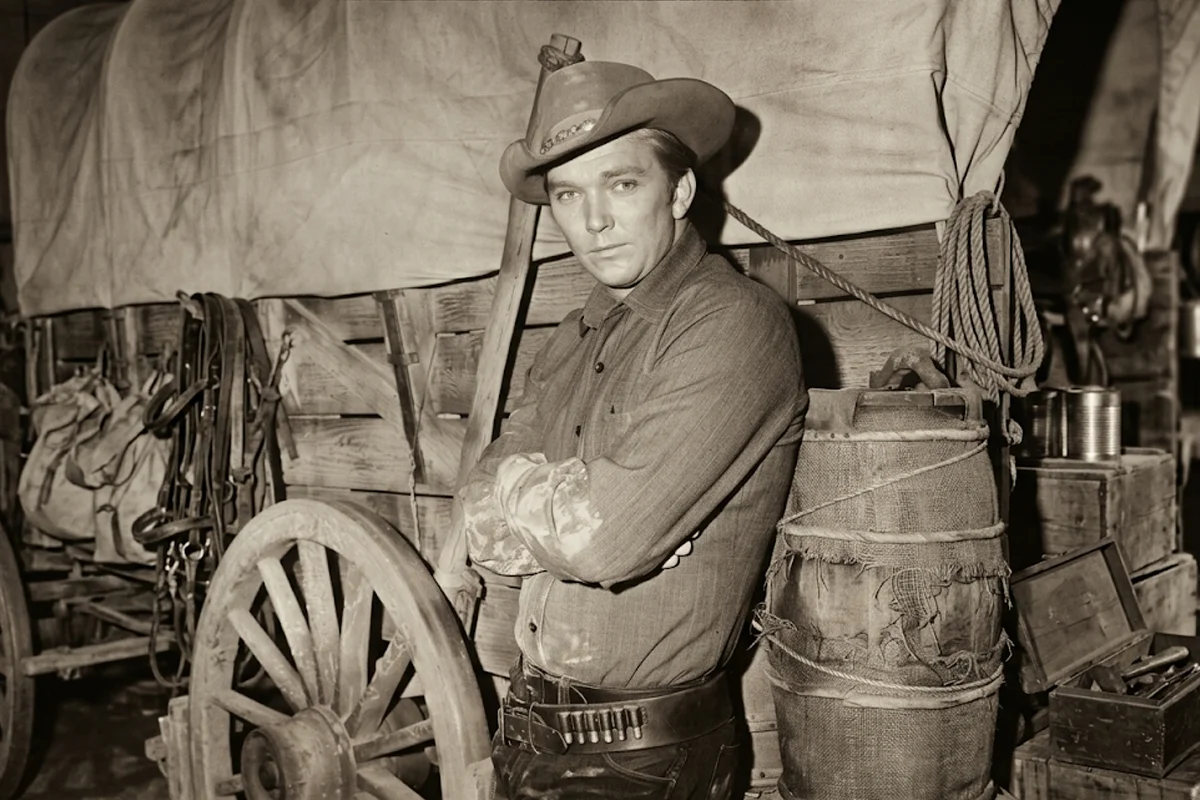
TLDR: Denny Miller was a UCLA basketball player under John Wooden who was spotted by a Hollywood talent agent while working as a furniture mover on Sunset Boulevard and went on to become the first blond actor to play Tarzan in a major film, a series regular on Wagon Train, and the face of Gorton’s seafood for fourteen years.
He died of ALS on September 9, 2014, in Las Vegas at age 80.
Dennis Linn Miller was born on April 25, 1934, in Bloomington, Indiana, to Bernard “Ben” Miller, a physical education instructor at Indiana University, and Martha Alice Miller.
Sports were not a hobby in the Miller household. They were a way of life.
Denny and his younger brother Kent were playing basketball almost before they could properly walk, and by the time the family had made its way through Silver Spring, Maryland, and Baldwin, New York, and finally settled in Los Angeles, both boys had developed into serious players.
At University High School in Los Angeles, Denny and Kent caught the attention of the most important basketball coach in America. John Wooden offered both brothers full athletic scholarships to UCLA.
Their father eventually joined the UCLA faculty and served as chairman of the university’s physical education department. The Miller family had found its permanent home, and it was one built entirely around athletic achievement.
Denny stood 6 feet 4 inches and weighed 212 pounds. He was studying physical education at UCLA, planning to become a coach, when Hollywood intervened in the specific way that Hollywood used to intervene in mid-century Los Angeles: through a chance encounter on a street corner.
Spotted on Sunset Boulevard
During his senior year at UCLA, Miller took a summer job as a furniture mover to help cover his tuition. While working a job on Sunset Boulevard in 1958, his size and his physical presence caught the attention of a Hollywood talent agent who signed him on the spot.
Within weeks he had a contract with Metro-Goldwyn-Mayer.
His introduction to the industry was unusually prestigious for an untrained actor. His screen test was directed by George Cukor, one of Hollywood’s most celebrated directors.
His actual debut was a brief uncredited role as Dewey Cole in Vincente Minnelli’s Some Came Running (1958), filmed on location in Madison, Indiana, alongside Frank Sinatra, Dean Martin, and Shirley MacLaine.
Miller later recalled that his sole contribution to the film was delivering one line to Dean Martin’s character. He found the experience instructive.
The First Blond Tarzan
MGM’s next move was to cast Miller as the lead in Tarzan, the Ape Man (1959), making him the first blond actor to play Edgar Rice Burroughs’ jungle hero in a major film release. He was recommended for the role by actor William Smith, who had also been under consideration for the part.
The production was, by design, a low-budget exercise in studio economics. Director Joseph M. Newman built the film around recycled background, action, and animal footage lifted directly from earlier Johnny Weissmuller Tarzan films, which created a visually jarring result.
Weissmuller had dark hair. Miller was blond. Anyone watching carefully could spot the mismatches between close-ups of Miller and wide-angle shots clearly featuring his predecessor.
MGM held Miller under a twenty-month contract, but he spent only eight weeks actually working as Tarzan during that entire period.
The film was not well received, and Miller himself had very few lines in the final cut.
What it gave him, though, was a name and a community. He became deeply connected to Edgar Rice Burroughs enthusiasts, a relationship that would last the rest of his life and eventually lead him to volunteer work supporting archival collections of Burroughs’ literary materials at the University of Louisville.
Duke Shannon — or Scott Miller, if You Preferred
After leaving MGM, Miller moved into television and in April 1961 joined the cast of Wagon Train as Duke Shannon, the show’s new scout.
He appeared in the episode “The Duke Shannon Story” and remained with the program for three seasons, spanning 1961 to 1964, accumulating more than 100 episodes.
There was one catch. Studio and network executives decided that “Denny” did not sound sufficiently masculine or Western for the character they had in mind.
They required him to be billed as Scott Miller for the duration of his Wagon Train run. Miller tolerated the change with characteristic good humor, reportedly remarking that “an actor by any other name smells the same,” but the moment his contract ended in 1964, he took his own name back immediately and never used Scott Miller again.
His Wagon Train years overlapped with the final seasons of the show’s original cast, placing him alongside John McIntire as the new wagonmaster Christopher Hale and the eventual arrival of Robert Fuller as replacement scout Cooper Smith. For the full story of the cast changes that defined those final seasons, the Wagon Train cast breakdown covers all of it.
He followed Wagon Train with a co-starring role as Mike McCluskey in the NBC sitcom Mona McCluskey (1965 to 1966), appearing alongside Juliet Prowse. The show lasted one season.
The Yellow Slicker That Paid the Bills for Fourteen Years
The most lucrative and recognizable chapter of Denny Miller’s career had nothing to do with dramatic acting. For fourteen years, he was the Gorton’s Fisherman, the man in the bright yellow slicker and fisherman’s cap who became one of the most familiar faces in American television advertising.
The campaign ran for more than a decade, providing the kind of stable residual income and sustained national visibility that most episodic television guest appearances could not match.
It was a role that required him to project weathered reliability and wholesome outdoor authority, which was essentially the same set of qualities he had been deploying on screen since Wagon Train.
He was very good at it, and the campaign ran long enough that an entire generation of American viewers grew up knowing his face without necessarily knowing his name.
A Career Built One Guest Appearance at a Time
Throughout the 1960s, 1970s, and 1980s, Miller established himself as one of the most recognizable guest performers in American television.
His physical size and his ability to move easily between drama and comedy gave him unusual versatility for an actor primarily known for Westerns and action roles.
He played Duke Williams, a surfer who rides a tsunami to the island, in the Gilligan’s Island episode “Big Man on a Little Stick.” He appeared in The Brady Bunch, in M*A*S*H, and in The Rifleman, where he played a dimwitted, childlike gunfighter named Reuben Miles.
On the big screen, he played “Wyoming” Bill Kelso in Blake Edwards’ The Party (1968) alongside Peter Sellers, a broad comic caricature of a cinematic cowboy that Miller frequently cited as his favorite acting experience of his entire career.
He also found time to write. In 2004, he published an autobiography titled Didn’t You Used to Be… What’s His Name?, a title that captured both the humor and the particular condition of being a face everyone recognized and a name fewer people could place.
He followed it with Toxic Waist? Get to Know Sweat!, a book on exercise and nutrition that reflected the lifelong physical discipline his father had instilled in him at Indiana University.
The Strongest Patient in the Room
In January 2014, Miller was diagnosed with amyotrophic lateral sclerosis, the progressive neurodegenerative disease commonly known as ALS or Lou Gehrig’s disease. He was 79 years old.
His wife Nancy later recalled that even after his diagnosis, the medical staff treating him repeatedly remarked on his physical condition, noting that his muscle strength and overall health resembled that of a man decades younger.
A lifetime of athletic discipline had made him, even in his final months, an exceptionally resilient patient.
Denny Miller died on September 9, 2014, in Las Vegas, Nevada, at age 80. He was survived by Nancy, his son Brad, and his daughter Courtney. His first marriage, to Kit Smythe, had ended in divorce.
He had been a furniture mover, a Tarzan, a scout, a fisherman, and one of the most reliably entertaining guest performers of the mid-century television era.
He never became a household name in the way that Ward Bond or Robert Horton had been, but he worked steadily for five decades, stayed physically remarkable into his eighties, and left behind a body of work that continues to find audiences through syndication.
That is not a bad career for a man who was spotted hauling furniture on Sunset Boulevard.
Who was Denny Miller?
Denny Miller was an American actor born on April 25, 1934, in Bloomington, Indiana. He played basketball at UCLA under coach John Wooden before being discovered by a Hollywood talent agent while working as a furniture mover on Sunset Boulevard. He is best known for playing Tarzan in the 1959 MGM film, Duke Shannon on Wagon Train (1961 to 1964), and the Gorton’s Fisherman in a long-running television advertising campaign. He died of ALS on September 9, 2014, in Las Vegas at age 80.
Why was Denny Miller billed as Scott Miller on Wagon Train?
Studio and network executives believed that “Denny” did not sound sufficiently masculine or Western for a frontier scout character, so they required him to be credited as Scott Miller during his Wagon Train years from 1961 to 1964. Miller tolerated the change with good humor but immediately reclaimed the name Denny Miller the moment his contract ended and never used Scott Miller again.
What was Denny Miller’s role in Tarzan?
Denny Miller played the title role in MGM’s Tarzan, the Ape Man (1959), making him the first blond actor to portray Tarzan in a major film release. The film was a low-budget production that relied heavily on recycled footage from earlier Johnny Weissmuller Tarzan films, creating obvious visual mismatches between the dark-haired Weissmuller in wide shots and the blond Miller in close-ups. Despite holding Miller under a twenty-month contract, MGM had him actively working as Tarzan for only eight weeks.
How did Denny Miller get discovered?
During his senior year at UCLA, Miller worked a summer job as a furniture mover to help pay his tuition. While working a moving job on Sunset Boulevard in 1958, his impressive athletic frame caught the attention of a Hollywood talent agent who signed him on the spot to a contract with MGM. His screen test was directed by George Cukor, one of Hollywood’s most celebrated directors.
How did Denny Miller die?
Denny Miller was diagnosed with amyotrophic lateral sclerosis (ALS), the progressive neurodegenerative disease also known as Lou Gehrig’s disease, in January 2014. He died from complications of ALS on September 9, 2014, in Las Vegas, Nevada, at age 80. He was survived by his wife Nancy Miller, his son Brad, and his daughter Courtney.
How long was Denny Miller the Gorton’s Fisherman?
Denny Miller portrayed the Gorton’s Fisherman in the company’s television advertising campaign for fourteen years. The campaign gave him one of the most sustained periods of national visibility in his career, with his face in American living rooms long after his Wagon Train and Tarzan years had faded from the headlines.