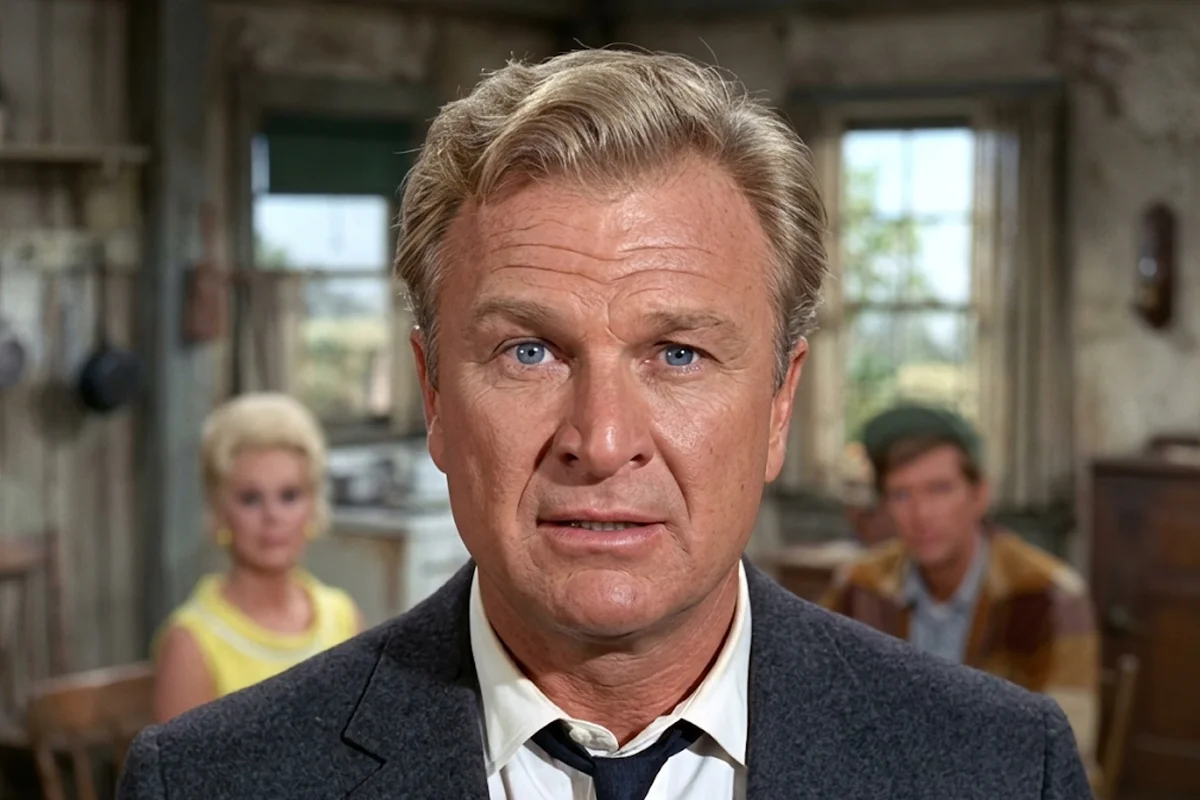
TLDR: Eddie Albert played Oliver Douglas on Green Acres for six seasons, but that was the least interesting thing about him.
He saved at least 47 Marines under fire at the Battle of Tarawa in 1943, spent years before the war photographing German U-boats in Mexico as a circus clown spy, helped ban DDT, founded City Children’s Farms, and inspired Senator Gaylord Nelson to set Earth Day on April 22nd — Albert’s birthday.
He died at 99 in 2005.
The joke on Green Acres was that Oliver Douglas was the only sane person in Hooterville, yet somehow the least capable of understanding how anything worked.
Eddie Albert played that role with perfect conviction for six seasons, maintaining the earnest bewilderment of a man who had given up everything for a dream that kept failing to cooperate.
It was a good performance. It was not the most impressive thing Eddie Albert ever did. Not even close.
Born in Rock Island, Raised as the Enemy
Edward Albert Heimberger was born on April 22, 1906, in Rock Island, Illinois, the eldest of five children.
His mother later altered his birth certificate to list 1908 as his birth year. The alteration was done because his parents were not married at the time of his birth, and the later date provided social cover for the family.
The true date was not established until much later.
The family moved to Minneapolis when he was one year old. His father was of German descent and the family’s heritage made the First World War years genuinely difficult.
Classmates called him “the enemy.” The experience contributed to the shy demeanor he carried through his school years at Saint Stephen’s Parochial School, though he found his footing in drama by the time he reached Central High School, where he performed alongside a classmate named Harriet Lake, who would later become known as Ann Sothern.
He attended the University of Minnesota, dropped out, and spent the early Depression years doing whatever was available: soda jerk, insurance salesman, nightclub singer, and trapeze performer in a traveling circus.
Radio announcers kept mangling his surname as “Hamburger,” so he dropped it entirely and used his middle name. He became Eddie Albert.
The Circus Clown Who Was Spying for America
Before the United States officially entered World War II, Albert was already working for U.S. Army Intelligence.
While touring Mexico with the Escalante Brothers Circus as a clown and high-wire artist, he was secretly using his access to coastal areas and his own sailboat to photograph German U-boats docked in Mexican harbors.
He documented potential landing sites and provided the data to American military planners.
It is not a detail that comes up often in accounts of his career. It probably should.
Tarawa
In September 1942 Albert enlisted in the U.S. Coast Guard, was discharged, and accepted a commission as a lieutenant in the U.S. Naval Reserve. He was assigned to the USS Sheridan, an attack transport ship in the Pacific.
In November 1943 the Sheridan was part of the assault on Tarawa Atoll in the Gilbert Islands, one of the most brutal battles of the Pacific War. The geography was catastrophic for the landing forces.
Shallow coral reefs prevented larger vessels from reaching shore, forcing Marines to disembark hundreds of yards out and wade through chest-deep water under Japanese machine-gun fire.
The tide was rising. Men were drowning alongside those being shot.
Albert’s assigned role was salvage officer, returning to the lagoon after the troops had landed to recover reusable equipment. He looked at what was happening in the water and made a different decision.
He steered his landing craft back into the kill zone and began pulling men out.
He made approximately 30 separate trips. He personally pulled 47 Marines from the water and oversaw the rescue of approximately 30 more by other boats.
On several trips his deck sat nearly two feet below the waterline from the weight of the wounded he had loaded.
One veteran, Dean Snyder, later said Albert had saved his life while the Japanese were “using us for target practice.”
On one trip Albert found a group of Marines who were unharmed but had lost their weapons in the surf.
He offered to evacuate them. They refused, asking only for rifles. He went back to get rifles and returned to find them all dead.
He was awarded the Bronze Star with a Combat “V” for valor. The award ceremony was delayed 54 years because military records were filed under his birth name, Edward Albert Heimberger, and could not be located under Eddie Albert.
The ceremony was finally held in York, Pennsylvania, after surviving Marines identified him and a congressman helped navigate the records.
For the rest of his life, Albert described Tarawa as the single most important thing he had ever done. He meant it. His son later said that acting was one-tenth of his father’s life. The rest was committed to other things.
Hollywood, the Blacklist, and Two Oscar Nominations
Albert had been building a Hollywood career before the war and resumed it afterward.
He had appeared on Broadway in the late 1930s in a series of George Abbott productions, made his film debut in the 1938 Warner Bros. adaptation of Brother Rat, and established himself as one of those reliable performers a director could put anywhere and trust to deliver.
He famously described his career philosophy as never wanting to be a star but aiming to be the star’s best friend. In 1953 that approach earned him his first Academy Award nomination for Best Supporting Actor for Roman Holiday, playing the photographer friend to Gregory Peck’s journalist while Audrey Hepburn’s princess navigated Rome.
His marriage complicated things.
On December 5, 1945, the day of his naval discharge, he married the Mexican actress and dancer Margo at St. Patrick’s Cathedral in New York.
By 1950 both of them had been listed in Red Channels, the pamphlet that alleged Communist influence in the entertainment industry.
Margo’s advocacy for refugees and her anti-fascist stances had drawn the scrutiny of investigators. Albert’s status as a decorated war hero gave him a measure of protection that many of his peers lacked, but his son later said his father “never got as far as he should have” during that period.
Margo was effectively blacklisted by major studios for much of the 1950s.
His second Oscar nomination came in 1972 for The Heartbreak Kid, playing Cybill Shepherd’s father with an iciness that demonstrated how thoroughly he could abandon the warmth that had defined most of his career.
The following year he played the sadistic warden in The Longest Yard. The range was always there. Green Acres just happened to be where most people met him.
Oliver Douglas and the Straight Man in Hooterville
Green Acres premiered in 1965, with Albert as Oliver Wendell Douglas, a New York attorney who abandons the city to become a farmer in the surreal rural town of Hooterville.
The show was part of Paul Henning’s Hooterville universe alongside The Beverly Hillbillies and Petticoat Junction. Paul Henning had originally offered the role to Don Ameche, who declined.
Albert jumped at it.
He had been living with an organic garden in his Pacific Palisades backyard for years and described the show’s central premise as tapping an “atavistic urge” dating back to Aristophanes.
The comedy of Green Acres was more sophisticated than it appeared. Oliver was nominally the only rational person in Hooterville, but the show’s internal logic made him the outsider who couldn’t understand the world everyone else navigated effortlessly.
Albert’s technique was to play the reality of every scene with absolute seriousness, no matter how absurd the surrounding material.
He described the writing as so precise that the cast never changed a word.
His working relationship with Eva Gabor, who played his wife Lisa, became one of the genuine friendships of his life.
They were together more than with their own spouses during the production years and remained close until her death in 1995.
He described her as kind, hardworking, and one of the best partners he had ever had. They reunited for a television movie, Return to Green Acres, in 1990.
Earth Day Is on His Birthday
The environmental activism predated the fame and intensified throughout the 1970s. Albert had been growing vegetables in his backyard since before Green Acres made it seem like a joke.
He testified before Congress about the dangers of DDT and was a significant figure in the campaign that eventually led to its ban. TV Guide called him an “ecological Paul Revere.”
He rejected the label of ecologist, preferring “human survivalist,” because he believed the stakes were existential rather than aesthetic.
He founded the Eddie Albert World Trees Foundation and City Children’s Farms, which brought working gardens to inner-city children. He served as a world envoy for Meals for Millions, consulted with UNICEF, and traveled to the Congo with Albert Schweitzer to document malnutrition.
He served on the U.S. Department of Energy’s advisory board and was national chairman of the Boy Scouts of America’s conservation program.
Senator Gaylord Nelson, who founded Earth Day, chose April 22nd as the date for the first national celebration in 1970 specifically in recognition of Albert’s work and to honor his birthday.
Albert spoke at the inaugural ceremony and spent the rest of his life celebrating Earth Day rather than his own birthday. He was 64 years old the first time it was observed and considered it among the greatest honors of his life.
The Final Years
Margo died of brain cancer in 1985 after 40 years of marriage. Eva Gabor died in 1995.
Albert was diagnosed with Alzheimer’s disease around the same time.
His son Edward Jr., who had built his own acting career including a Golden Globe for Butterflies Are Free, moved in to care for his father and paused his own work to do it.
Albert continued exercising regularly. Even in a wheelchair in his nineties he was known to play basketball with his granddaughter.
He died of pneumonia at his Pacific Palisades home on May 26, 2005. He was 99 years old.
He was buried at Westwood Village Memorial Park Cemetery, beside Margo and near Eva Gabor. Edward Jr. died of lung cancer sixteen months later.
Every April 22nd, somewhere between one billion and two billion people observe Earth Day.
Most of them have no idea whose birthday it is.
Who played Oliver Douglas on Green Acres?
Oliver Douglas on Green Acres was played by Eddie Albert, born Edward Albert Heimberger on April 22, 1906. He played the role for all six seasons of the show from 1965 to 1971 and described it as tapping an atavistic urge that Aristophanes would have recognized. He was already an accomplished film and theater actor with two Academy Award nominations before and after the show.
What did Eddie Albert do in World War II?
Eddie Albert served as a lieutenant in the U.S. Naval Reserve and participated in the Battle of Tarawa in November 1943. When Marines were stranded in the water under heavy Japanese fire, Albert disobeyed his salvage orders and made approximately 30 trips into the kill zone, personally rescuing 47 Marines and overseeing the rescue of approximately 30 more. He was awarded the Bronze Star with a Combat V for valor, though the ceremony was delayed 54 years because records were filed under his birth name.
Did Eddie Albert really help create Earth Day?
Yes. Senator Gaylord Nelson, who founded Earth Day, chose April 22nd as the date for the first national celebration in 1970 specifically in recognition of Eddie Albert’s environmental work and to honor his birthday. Albert spoke at the inaugural Earth Day ceremony and considered the observance one of the greatest honors of his life. He was a major figure in the campaign to ban DDT, founded City Children’s Farms, and served as a world envoy for Meals for Millions.
Was Eddie Albert really a spy before World War II?
Yes. Before the United States officially entered World War II, Albert worked for U.S. Army Intelligence while touring Mexico as a circus performer. Under the cover of his work with the Escalante Brothers Circus as a clown and high-wire artist, he used his access to coastal areas and his own sailboat to photograph German U-boats docked in Mexican harbors and document potential landing sites, providing intelligence to American military planners.
How old was Eddie Albert when he died?
Eddie Albert died on May 26, 2005, at the age of 99, from pneumonia at his home in Pacific Palisades, California. He had been diagnosed with Alzheimer’s disease around 1995 but remained physically active, continuing to exercise regularly into his late nineties. He was buried at Westwood Village Memorial Park Cemetery beside his wife Margo, who had died in 1985, and near Eva Gabor, his Green Acres co-star, who had died in 1995.