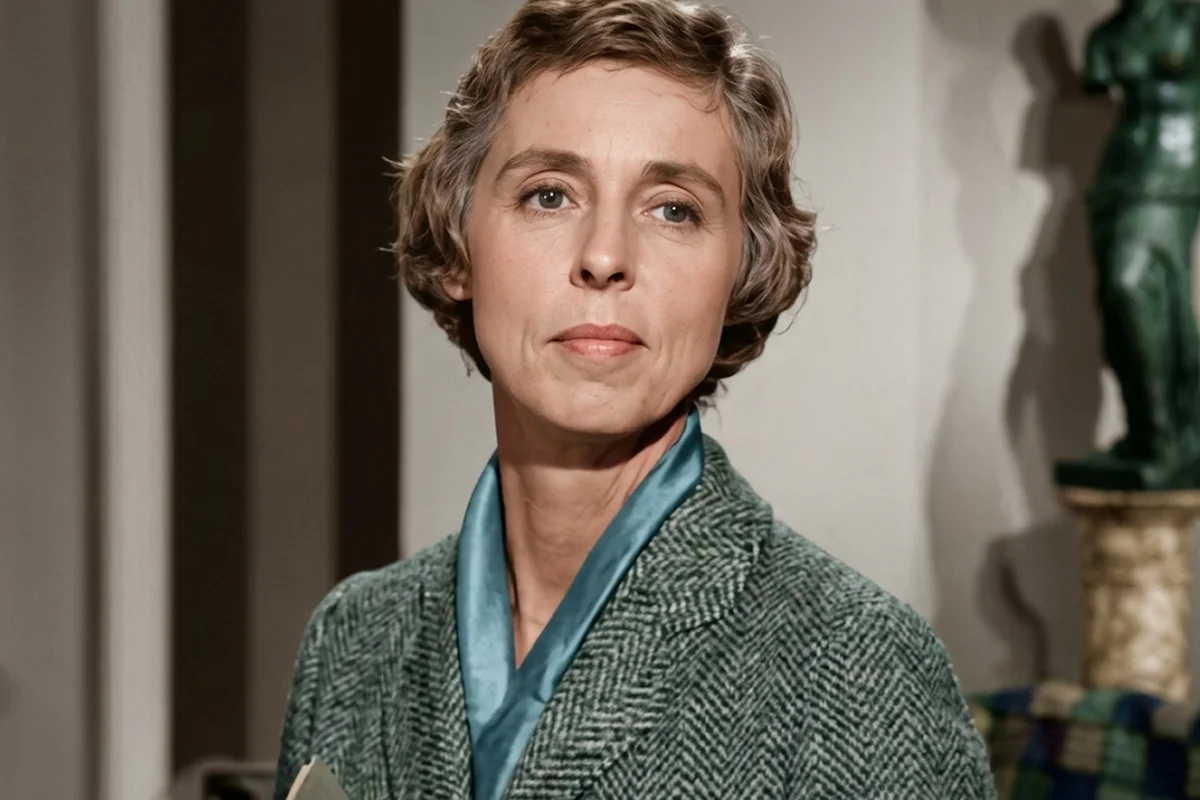
TLDR: Nancy Kulp played Jane Hathaway on The Beverly Hillbillies for nine seasons, served as a naval officer in World War II, ran for Congress in Pennsylvania in 1984, and was opposed in a radio advertisement by her former co-star Buddy Ebsen, who said he loved her dearly but she was too liberal for him.
She lost decisively.
She died of cancer in 1991 at 69. Her headstone in Mifflintown, Pennsylvania reads Miss Jane Hathaway.
Before Nancy Kulp was Miss Jane Hathaway, she was a naval officer, a journalist who had profiled Clark Gable and the Duke and Duchess of Windsor, a publicist at MGM, and someone who had never intended to act professionally at all. George Cukor saw her in the publicity department and told her she was wasting herself behind a desk.
She was 30 years old. She made her film debut that year.
The character she became famous for playing — the efficient, unflappable, bird-watching secretary who harbored an inexplicable crush on Jethro Bodine — was written specifically for her by Paul Henning, who had already seen what she could do on The Bob Cummings Show.
The role ran for nine seasons across 246 episodes. It earned her an Emmy nomination.
It also followed her into a congressional race thirty years later, where hecklers called out for Jethro at campaign stops and her former co-star recorded a radio ad urging voters to reject her.
Pennsylvania, Florida, and the WAVES
Nancy Jane Kulp was born on August 28, 1921, in Harrisburg, Pennsylvania, the only child of Robert Tilden Kulp, a traveling salesman and lawyer, and Marjorie Snyder Kulp, a schoolteacher who eventually became a principal.
The family relocated to Florida before 1935, and Nancy graduated from Florida State College for Women in 1943 with a degree in journalism. She had already been working as a feature writer for the Miami Beach Tropics, where her subjects included Clark Gable, Errol Flynn, and the Duke and Duchess of Windsor.
She started a master’s degree in English and French at the University of Miami and left it unfinished in 1944 to enlist in the Navy.
She served in the WAVES — Women Accepted for Volunteer Emergency Service — and rose to the rank of Lieutenant Junior Grade before her honorable discharge in 1946.
She received the American Campaign Medal among other decorations. She later said her motivation for enlisting was twofold: patriotism, and an attraction to the all-female environment of the service, which she described as supportive and intellectually stimulating.
That description, offered in retrospect, carried more meaning than it might have seemed at the time.
George Cukor and the Accidental Career
After the war she moved to Hollywood and took a job in the MGM publicity department. Director George Cukor encountered her there and told her she should be in front of the camera rather than behind a press release.
She made her film debut in 1951 in Cukor’s The Model and the Marriage Broker and spent the next decade working steadily in character parts across some of the most prestigious productions of the era.
She appeared in Shane in 1953, in Billy Wilder’s Sabrina in 1954, in Cukor’s A Star is Born the same year, in The Three Faces of Eve in 1957, and in Disney’s The Parent Trap in 1961.
The roles were consistently in the same register: prim, efficient, slightly eccentric professional women with interior lives considerably more complex than their brief screen time allowed.
She was reliable, precise, and funny in a way that required genuine skill to sustain across small parts.
Her tall, angular frame and what critics described as a cultivated, flute-like voice made her immediately recognizable.
Her television breakthrough came as Pamela Livingstone, a pith-helmeted bird-watcher, on The Bob Cummings Show from 1955 to 1959.
Paul Henning was watching.
When he created The Beverly Hillbillies, he wrote Miss Jane Hathaway with Nancy Kulp specifically in mind.
Miss Hathaway for Nine Seasons
Jane Hathaway was Mr. Drysdale’s secretary at the Commerce Bank of Beverly Hills, a Vassar graduate fluent in French and Latin who was genuinely fond of the Clampett family in ways her mercenary boss was incapable of being.
She protected them from his schemes, translated their world for Beverly Hills, and maintained a running unrequited attraction to Jethro Bodine that the show mined for comedy across nine seasons.
Kulp brought intelligence and dignity to a role that could easily have been one-dimensional. The unrequited crush was played not as desperate but as genuinely felt, which made it funnier and more sympathetic than the standard spinster comedy it resembled.
She earned an Emmy nomination for Outstanding Supporting Actress in 1967. Raymond Bailey, who played Mr. Drysdale, called her Slim and they remained close friends long after the show ended.
Her relationship with Buddy Ebsen, who played Jed Clampett, was more complicated.
They were ideologically opposite in ways that created underlying tension throughout the show’s run — Ebsen a committed conservative Republican, Kulp a committed liberal Democrat.
They maintained professional decorum on set. The tension surfaced publicly in 1984 in a way neither of them could take back.
Running for Congress
In 1984, Nancy Kulp returned to Pennsylvania and ran as the Democratic candidate for the Ninth Congressional District against six-term Republican incumbent Bud Shuster.
She established residency on a farm in Port Royal, near her birthplace. Her platform was broadly liberal, covering environmental protection, unemployment relief, and support for the arts.
She received support from Ed Asner, among others. She encountered hecklers at campaign stops who asked after Jethro. She kept going.
Then Buddy Ebsen recorded a radio advertisement for her opponent.
The ad ran in the district. Ebsen’s voice: “Hi, this is Buddy Ebsen. When I heard that one of our Beverly Hillbillies was running for Congress, I recalled the many discussions we had on the set out here in California. I was pretty conservative and she was real liberal. So I dropped her a note to say, ‘Hey Nancy, I love ya dearly but you’re too liberal for me — I gotta go with Bud Shuster.'” He also contributed $100 to Shuster’s campaign.
Kulp’s response to the UPI was immediate and pointed: “I think it’s rotten. I can’t conceive that, after I’ve put so much time and money into this race, that he would come along and do something like this.” She called him “not the kindly old Jed Clampett” and said he had been “difficult to work with.”
She argued the ad might actually help her because people were repelled by it.
It did not help her. On November 6, 1984, she received 59,449 votes — approximately 34 percent — to Shuster’s 117,203.
It was a Ronald Reagan landslide year in a heavily Republican district. She was always going to face difficult odds.
Ebsen’s ad made it worse and made it public and made it personal in a way that the two of them would spend years not fully resolving.
Birds of a Feather
Nancy Kulp was a closeted lesbian throughout her years on The Beverly Hillbillies.
In 1989, in an interview with Boze Hadleigh for what would become the book Hollywood Lesbians, she addressed the question as directly as she had addressed most things in her life — obliquely, precisely, and with enough clarity that anyone listening understood exactly what she meant.
When asked whether opposites attract, she replied: “My own reply would be that I’m the other sort — I find that birds of a feather flock together. Does that answer your question?”
She added: “If one is past 60, coming out is almost like saying that most of your life you’ve been too embarrassed to admit it or to speak up.”
She said she admired openly gay Congressman Barney Frank and that if outed she would not deny it, but she would not volunteer the information.
The avian metaphor was perfect and probably deliberate. The woman who had spent nine years playing a bird-watcher on national television confirmed who she was by saying birds of a feather flock together. It was the most Miss Hathaway thing she ever did off screen.
The Final Years and the Headstone
After the congressional race Kulp served as Artist-in-Residence at Juniata College in Huntingdon, Pennsylvania, teaching film and drama and directing campus productions.
She appeared in the 1981 Beverly Hillbillies television movie, guested on Sanford and Son and Quantum Leap, and performed on Broadway in the 1980-81 revival of Morning’s at Seven.
She retired eventually to Palm Springs, where she served on the boards of the Humane Society of the Desert and United Cerebral Palsy.
She was diagnosed with cancer of the larynx around 1989-1990.
She died on February 3, 1991, at a friend’s home in Palm Desert, California. She was 69 years old.
Her remains were returned to Pennsylvania and she is buried at Westminster Presbyterian Cemetery in Mifflintown, overlooking the Juniata River.
Her headstone reads Miss Jane Hathaway.
There is something in that choice worth sitting with. A woman who spent her career playing a specific kind of educated, unflappable, slightly eccentric professional woman, who served her country, ran for Congress, acknowledged who she was in the most precisely worded possible way, and chose as her permanent public identification not her own name but the character she had played.
Maybe it was affection. Maybe it was the recognition that for millions of people, Miss Jane was who she had been.
Either way, it is how she chose to be remembered.
Who played Miss Hathaway on The Beverly Hillbillies?
Miss Jane Hathaway on The Beverly Hillbillies was played by Nancy Kulp, born August 28, 1921, in Harrisburg, Pennsylvania. She appeared in 246 of the show’s 274 episodes across nine seasons from 1962 to 1971 and received an Emmy nomination for Outstanding Supporting Actress in 1967. Paul Henning wrote the role specifically for her.
Did Buddy Ebsen really campaign against Nancy Kulp?
Yes. When Nancy Kulp ran for Congress in Pennsylvania in 1984 as a Democrat, her former co-star Buddy Ebsen recorded a radio advertisement for her Republican opponent Bud Shuster. In the ad he said he loved Kulp dearly but she was too liberal for him and that he had to go with Shuster. He also contributed $100 to Shuster’s campaign. Kulp called the ad rotten and said Ebsen was not the kindly old Jed Clampett. She lost the race with approximately 34 percent of the vote.
Was Nancy Kulp gay?
Yes. In a 1989 interview with Boze Hadleigh for the book Hollywood Lesbians, Kulp obliquely confirmed her sexuality by saying she was the other sort and that birds of a feather flock together. She added that coming out past 60 was almost like saying most of your life you had been too embarrassed to admit it. She remained largely closeted during her years on The Beverly Hillbillies, consistent with the pressures placed on gay performers in mid-twentieth century Hollywood.
How did Nancy Kulp die?
Nancy Kulp was diagnosed with cancer of the larynx around 1989-1990 and died on February 3, 1991, at age 69, at a friend’s home in Palm Desert, California. She was buried at Westminster Presbyterian Cemetery in Mifflintown, Pennsylvania. Her headstone reads Miss Jane Hathaway rather than her real name.
What did Nancy Kulp do after The Beverly Hillbillies?
After The Beverly Hillbillies ended in 1971, Nancy Kulp appeared in the 1981 Beverly Hillbillies television movie, performed on Broadway in the 1980-81 revival of Morning’s at Seven, and had guest roles on Sanford and Son and Quantum Leap. In 1984 she ran for Congress in Pennsylvania as a Democrat and lost. She then served as Artist-in-Residence at Juniata College in Pennsylvania before retiring to Palm Springs, where she served on the boards of local charitable organizations.