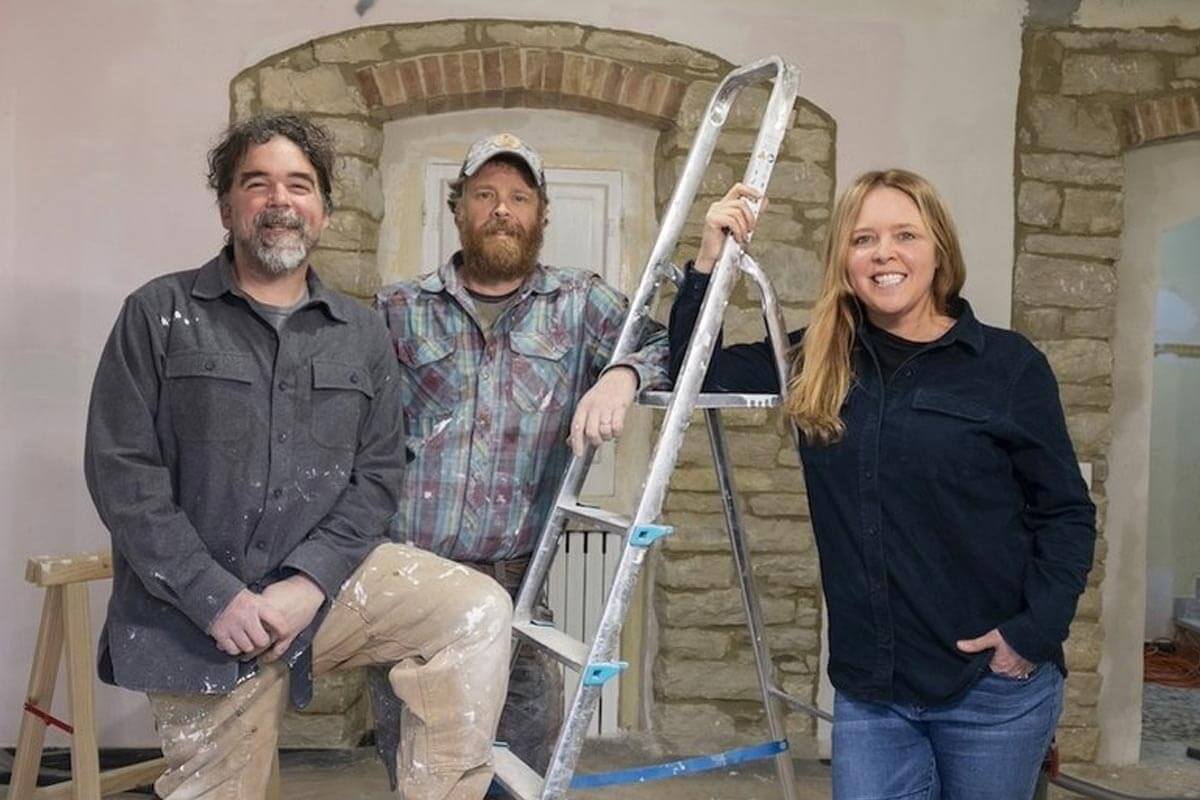
In an unprecedented adventure, the Maine Cabin Masters left the pine forests of Maine for the rolling hills of Italy. For more than a decade, Chase Morrill and his crew had restored hundreds of rustic cabins across Maine, breathing new life into weathered camps and forgotten lakeside retreats.
But in 2023, they faced their most ambitious project yet. A three-level stone house in the remote Molise region, owned by 13 different sellers, in a country where they didn’t speak the language.
The six-episode spinoff Maine Cabin Masters: Building Italy chronicles this remarkable journey. It’s a story of family, determination, and what happens when Maine ingenuity meets centuries-old Italian craftsmanship.
A Dream Deferred No Longer
“My wife Sarah and I always talked about purchasing an old Italian home to renovate once we retired,” Chase Morrill tells House Beautiful. “We love to travel and have been to many places around the world but always felt a special connection to Italy.”
For years, it was just talk. A someday plan. A retirement dream.
Then Chase saw the 1-euro home programs that Italian villages were promoting. Small towns across Italy, struggling with declining populations as young people left for cities, were selling historic properties for symbolic prices to anyone willing to restore them.
After seeing the 1-euro homes that Italian villages were promoting, it got us looking more seriously and we decided to go for it now, to buy and renovate a home with our four kids while we were still all living under one roof.
There were many reasons to wait. Work commitments. School schedules. Pets that needed care. The sensible choice would have been to postpone.
But life is uncertain, and we did not want to wait until retirement to get started, Morrill adds.
So they didn’t.
Finding The Balcony House
The search began in earnest. “We traveled all over southern Italy from Umbria down to the lesser-known Molise and Abruzzo regions,” Morrill says. “We viewed lots of properties that were beautiful and had pieces of what we wanted, but this house had all the right stuff.”
Working with Abruzzo Rural Property, a real estate agency specializing in helping international buyers, Chase and Sarah toured multiple properties. Each had something appealing. But none felt quite right.
Then they found it in Fossalto, a small municipality in Molise. The region itself is something of a hidden gem, often called “the region that does not exist” because it’s overlooked by tourists and even many Italians.
The house ticked all their boxes. Four bedrooms that would eventually become five. A large open kitchen and living area. Beautiful land with olive trees stretching across 7.4 acres. Panoramic views of the mountains. An outdoor pizza oven that the kids immediately loved.
And four balconies, which would give the property its nickname: The Balcony House.
“It was important to us that the kids be involved, so everyone brought their perspective to the search,” Chase explains.
When the real estate agent discovered the house also had a nearby footpath perfect for Sarah’s morning walks, the decision was made.
The asking price was $97,000. For a five-bedroom house on 7.4 acres with an olive grove in a location roughly three hours from Rome and two-and-a-half hours from Naples.
Thirteen Sellers and a Notary’s Office
Then came the complication.
The property was owned by 13 different people from five families, each with a share of the land and parts of the house. Many of them had not spoken to each other in years.
Coordinating a sale among 13 co-owners across multiple families would have been challenging under any circumstances. Doing it while filming a television show added another layer of complexity.
On the day of the closing, the notary’s office felt more like a movie set, with cameramen, producers, Chase, Sarah, the notary, and all 13 sellers packed into the room. It was quite the scene.
But in the end, the sale was completed, and Chase and his family officially owned their Italian dream home, and everyone left happy.
Who Made the Journey
The spinoff features a slightly different crew configuration than the main show. Chase and his wife Sarah took center stage, along with their four teenagers: Nori, Maggie, Fletcher, and Eva.
Ashley Morrill and Ryan Eldridge joined them, bringing both carpentry expertise and family support. Ashley was particularly excited about the opportunity.
I am most excited to be working with my nieces and nephew, Ashley says. They are all growing up so fast so any chance we get to hang out with them is the best.
Jared “Jedi” Baker also made the trip, providing additional carpentry muscle for the more demanding phases of the project.
Notably absent were Matt “Dixie” Dix, who remained in Maine. This made Building Italy more of a family-focused project than the typical Maine Cabin Masters build.
The crew also relied heavily on a team of Italian contractors and a local geometra, a surveyor who helped navigate the unique challenges of Italian construction.
Maine Meets Italian Stone
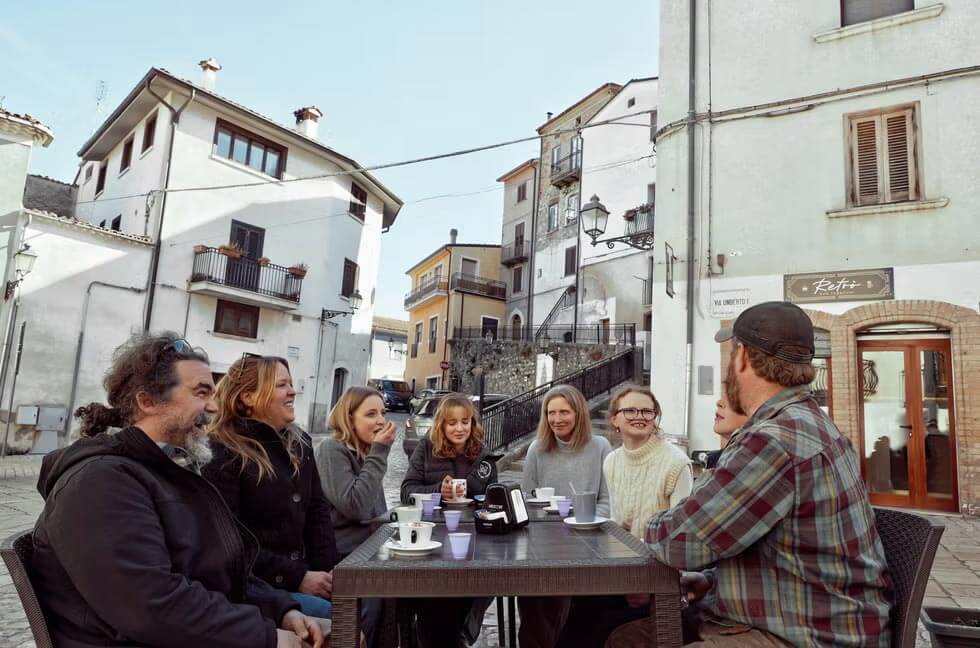
Once the sale was finalized, Chase and his building team got to work. With the help of the local geometra, they quickly discovered that renovating an Italian stone house with 70 cm thick walls is a bit different from renovating cabins in Maine.
The three-level house was presumably 100 to 200 years old and had been renovated once around the 1960s or ’70s. While structurally sound, it needed a serious overhaul to be functional for a modern family.
It didn’t take long to realize the differences in building techniques between Italy and the States and how physically demanding the work is, Ryan says.
In Maine, the crew worked primarily with wood. Framing camps. Building decks. Installing pine paneling. The materials were familiar, the techniques well-practiced.
In Italy, everything was stone and concrete and plaster. Walls weren’t framed but rather built from ancient stone. Repairs required mixing plaster by hand. Traditional Italian techniques that had been refined over centuries.
The kids became essential to the renovation. There were plenty of unforeseen challenges and lots of new skills to learn, but the way the kids stepped up was truly remarkable, Chase says.
They learned how to strip every kind of hard stone wall down to bare bones. How to mix up and apply so many variations of plaster, stucco, and cement. How to tile like an Italian master. How to hang wallpaper. How to install crown molding. How to build new furniture and restore old furniture. And so many other things.
The Language Barrier
Working in a country where you don’t speak the language presents obvious challenges. Communicating technical construction details becomes exponentially more difficult when you’re relying on gestures and translation apps.
But Ryan found a solution, one that’s as old as human communication itself.
Even though you may not speak the same language as someone, a smile and some bad acting (aka charades) can overcome this most of the time.
The crew worked closely with Italian contractors who brought local expertise and knowledge of traditional building methods. Together, despite the language divide, they figured it out.
Chase discovered local stoneworkers. The team learned to mix materials the Italian way. They embraced techniques that had been passed down through generations in this mountainous region.
The Renovation Takes Shape
The project unfolded over three intense months on a tight timeline. The six-episode series documents the entire transformation, episode by episode.
First came demolition and the race to install a working bathroom before the kids arrived. They needed to work with the locals to complete this first big project because, as Chase knew, these kids will need a working bathroom.
Then Chase juggled two big projects simultaneously. The kids had big ideas for their four bedrooms on the second floor. Meanwhile, the basement needed walls demolished and new floors poured if they were to keep on schedule for the future family room.
The kitchen became their most ambitious project yet, a complete overhaul. To open up the home’s hub, they removed a wall dividing the kitchen from the dining room.
They brought in gray cabinetry, yellow tile for the backsplash, and warm stone counters to complement the existing mismatched flooring. Chase discovered local stoneworkers who provided authentic Italian materials.
Even with Ashley, Ryan and Jedi to help, Chase and family had a ton of work to do to turn their walkout basement into a family room complete with a new bathroom. Only Chase could find a second life for old animal troughs, repurposing them as part of the renovation.
Personalizing The Balcony House
When it came time to furnish and decorate, the team took a practical approach. They salvaged many pieces the previous owners had left behind: beds, nightstands, dressers, kitchenware, and decor including green glass bottles.
They shopped locally for new materials, like stone for the kitchen counters, and special elements for the kids’ rooms, including lighting, wallpaper, and crown molding.
It was fun seeing each one of their personalities come through in their rooms, Ashley says. The crown molding ended up being her favorite part of the house.
For son Fletcher’s bedroom, the team built a wooden loft bed with a skateboard ladder and railing, a custom piece that perfectly captured his personality.
Daughter Maggie’s bedroom features an amber and gold light from Luce Più, a local Italian lighting company.
Ashley surprised her brother and sister-in-law with hand-stamped decorative pillows for the primary bedroom that matched the blue patches of pattern seen throughout the Italian home.
The Final Push
With two weeks left and a ton of work remaining, including exteriors, roofing, decking, landscaping and a missing bedroom, Chase, Ashley, Ryan, Sarah and the kids had to rally to finish the house.
Installing fundamentals like all-new electrical and plumbing and repainting everything was crucial. But the family didn’t stop there.
Off the dining area, a balcony with a staircase leads to the home’s deck and lower-level family room, creating flow between the indoor and outdoor spaces.
Exposed stonework and pale green stucco add character to the home’s exterior, honoring the building’s Italian heritage while making it functional for modern living.
The transformation was truly incredible.
Why This Project Mattered
Adventuring together is an important part of our family identity and has been the foundation of so many shared memories, Morrill says. For now, we plan to use the house as a place to retreat and relax, as well as a vacation jump-off spot.
The mountainous region of Molise is roughly three hours from Rome and two-and-a-half hours from Naples, meaning it’s well-positioned for travel, which the Morrills have prioritized since their kids were young.
Our Italian home base will also allow us to easily explore more of Europe, which is exciting.
Looking ahead, the Morrills hope to produce and share olive oil from the olive trees on their property, a tangible connection to the Italian countryside they’ve come to love.
It is an incredible privilege to have had this opportunity, and we want to share this incredible place with the friends and family that have supported this journey, Morrill says.
The Series Reception
Maine Cabin Masters: Building Italy premiered on June 17, 2024, on Magnolia Network at 9 p.m. ET. New episodes aired weekly on Mondays until the finale on July 22, 2024.
The six hour-long episodes document the entire buying and renovation process. The full season became available to stream on Max and Discovery+ on August 30, 2024.
On IMDB, the series holds an impressive 8.7 rating, showing strong viewer appreciation for the family-focused international adventure.
For fans of the main series, Building Italy offered something different. Less focus on the typical crew dynamic, more emphasis on family working together across generations.
The challenges they faced, finding tools without speaking the local language and dealing with unfamiliar materials, all with the same grit and humor that their fans have come to love, gave viewers a fresh perspective on renovation television.
Maine Lessons in Italian Hills
The Building Italy project proved that the Maine Cabin Masters’ skills translate beyond the borders of New England. Their resourcefulness, their commitment to preservation, their ability to work with limited budgets and tight timelines, all of it worked in Italy just as it did in Maine.
But they also learned. They adapted. They discovered that 70 cm stone walls require different approaches than wooden frames. That mixing plaster by hand is more physically demanding than they expected. That Italian building traditions developed over centuries have wisdom worth respecting.
And they learned that family, working together toward a shared goal, can overcome language barriers and cultural differences and the inevitable frustrations that come with any major renovation.
The Morrill teenagers learned skills they’ll carry for life. Ashley got to spend precious time with nieces and nephew who are growing up fast. Ryan proved that charades and a smile really can bridge a language gap.
And Chase fulfilled a dream he’d been talking about for years, but this time with his whole family by his side instead of waiting for retirement.
The Balcony House in Fossalto stands as testament to what’s possible when you don’t wait for someday. When you bring your family along for the adventure. When you’re willing to learn from people whose language you don’t speak but whose craftsmanship you can respect.
It’s a Maine cabin master’s dream, realized in the hills of Italy, built with Italian stone and American determination and the boundless energy of kids who learned to tile like Italian masters.
For viewers who want to see how it all came together, all six episodes are available to stream. The journey from that crowded notary’s office with 13 sellers to the final reveal of a fully restored Italian vacation home makes for compelling television.
But more than that, it’s a reminder that the best family memories are often made when you decide to stop waiting and start building.