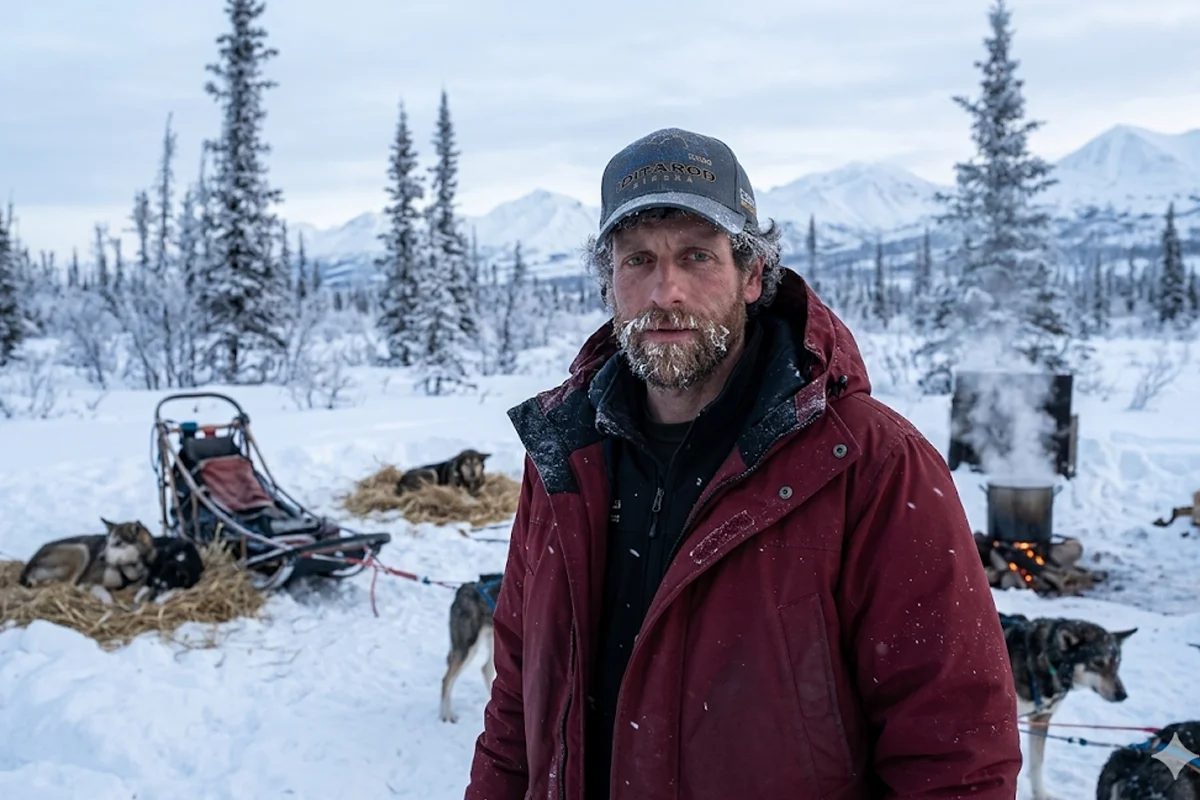
TLDR: Jessie Holmes, originally from Sylacauga, Alabama, appeared in 132 episodes of Life Below Zero over eight seasons before the show was cancelled in February 2025.
He used his cast earnings to build a championship sled dog kennel near Denali National Park. On March 17, 2026, he won the Iditarod Trail Sled Dog Race for the second consecutive year, finishing in 9 days, 7 hours and 32 minutes.
He is only the third musher in the race’s 54-year history to repeat as champion the year after winning for the first time.
When Life Below Zero was cancelled in February 2025 after 23 seasons, most of its cast members quietly returned to their private Alaskan lives.
Jessie Holmes had already moved on. He had been spending the years since his first Iditarod entry in 2018 building toward something specific, and the reality television money had funded every step of it.
Forty sled dogs. Land near Denali National Park. A hand-built homestead where his closest neighbor lives thirty miles away. A carpenter by trade, Holmes constructed the infrastructure of a championship mushing operation from the ground up, paid for in part by eight seasons of National Geographic cameras following him around Alaska.
The Alabama Kid Who Moved to Alaska
Jessie Holmes was born around 1982 in Sylacauga, Alabama. He moved to Alaska in 2004, eventually settling near Nenana, about fifty miles southwest of Fairbanks.
He worked as a carpenter and began building his sled dog operation from scratch. National Geographic approached him in 2015 to join the cast of Life Below Zero, a show that followed subsistence hunters and trappers living in remote Alaska.
He appeared in 132 episodes over eight seasons. After his victory in the 2025 Iditarod, he was candid about the transaction: the show gave him financial stability and he used it to fund his early mushing career.
He had stepped away from production to dedicate himself more fully to training.
The Iditarod Record He Built Over Eight Years
Holmes ran his first Iditarod in 2018, finishing seventh and winning the Rookie of the Year award. That result established a pattern. He entered every Iditarod from 2018 to 2026, finishing the majority in the top ten.
In 2022, he finished third. In 2025, he won for the first time on a rerouted 1,130-mile course out of Fairbanks, the longest iteration of the race due to a lack of snow, finishing in just over ten days.
Before the 2026 race, Holmes told the Associated Press it was the most important of his career. “That’s hard to put that on yourself because you got to live with that pressure every day,” he said. “And if I do not make it, it is going to absolutely crush me.”
The 2026 Win: Zeus, Polar, and a Place in History
On March 17, 2026, Holmes crossed the finish line in Nome wearing bib number seven, his lucky number, finishing in 9 days, 7 hours, 32 minutes and 51 seconds.
He raised both arms as his twelve-dog team pulled down Front Street to the Burled Arch. His lead dogs were Zeus, a three-year-old black-and-white dog who was promoted from the junior role he played in 2025, and Polar, a nine-year-old veteran who had led the previous year’s championship team.
Holmes brought Polar forward to lead at the final checkpoint. “Man, when I put Polar up there he puffed his chest out, he got his strut on and he said, ‘Let’s go!’ It was amazing,” Holmes told reporters after crossing the finish line.
The win made him the third competitor in the 54-year history of the Iditarod to repeat as champion the year after their first victory. The others were Susan Butcher in 1986 and 1987 and Lance Mackey in 2007 and 2008. Both went on to win four titles. Holmes has made his intentions clear about 2027.
He collected $80,000 for the win, up from $57,000 the previous year. His first act after completing the mandatory paperwork was to pass out giant ribeye steaks to his dogs. “It’s a blessing to be out here,” he said. “I was just so full of gratitude and gratefulness.”
The Show That Funded the Dream
Life Below Zero aired its final episode on February 23, 2025, ending a 23-season run on National Geographic after BBC Studios’ production contract expired.
Holmes had been part of the show from Season 4 onward. He used the income from those eight seasons to purchase equipment, fund veterinary care for his kennel, and acquire the land near Denali where he now lives and trains.
The show is gone. The kennel is not. Holmes has announced his intention to chase a three-peat at the 2027 Iditarod, which will run the southern route, his favorite course and the one where he believes his team can break the all-time course record.
For more on the show that launched his public profile and the cast members who shared it with him, see the full Life Below Zero cast hub.
Did Jessie Holmes win the Iditarod?
Yes. Jessie Holmes won the Iditarod Trail Sled Dog Race in both 2025 and 2026. His 2026 win on March 17 made him only the third competitor in the race’s 54-year history to repeat as champion the year after winning for the first time. He finished in 9 days, 7 hours and 32 minutes, earning $80,000. He has announced his intention to pursue a third consecutive title at the 2027 Iditarod.
Is Jessie Holmes still on Life Below Zero?
No. Life Below Zero was cancelled in February 2025 after 23 seasons when National Geographic did not renew its production contract with BBC Studios. Jessie Holmes appeared in 132 episodes over eight seasons. After his 2025 Iditarod victory, Holmes said he had stepped away from the show to dedicate himself more fully to training his championship sled dog team.
Where does Jessie Holmes live?
Jessie Holmes lives on a hand-built homestead near Denali National Park in Alaska, where his closest neighbor lives thirty miles away. He is originally from Sylacauga, Alabama, and moved to Alaska in 2004. He works as a carpenter and maintains a kennel of approximately forty sled dogs.
What dogs did Jessie Holmes use to win the 2026 Iditarod?
Jessie Holmes used a twelve-dog team in the 2026 Iditarod, led by Zeus, a three-year-old black-and-white dog, and Polar, a nine-year-old veteran who had been a lead dog in the 2025 championship race. Both dogs were named Golden Harness winners as the most valuable dogs of the 2026 race.