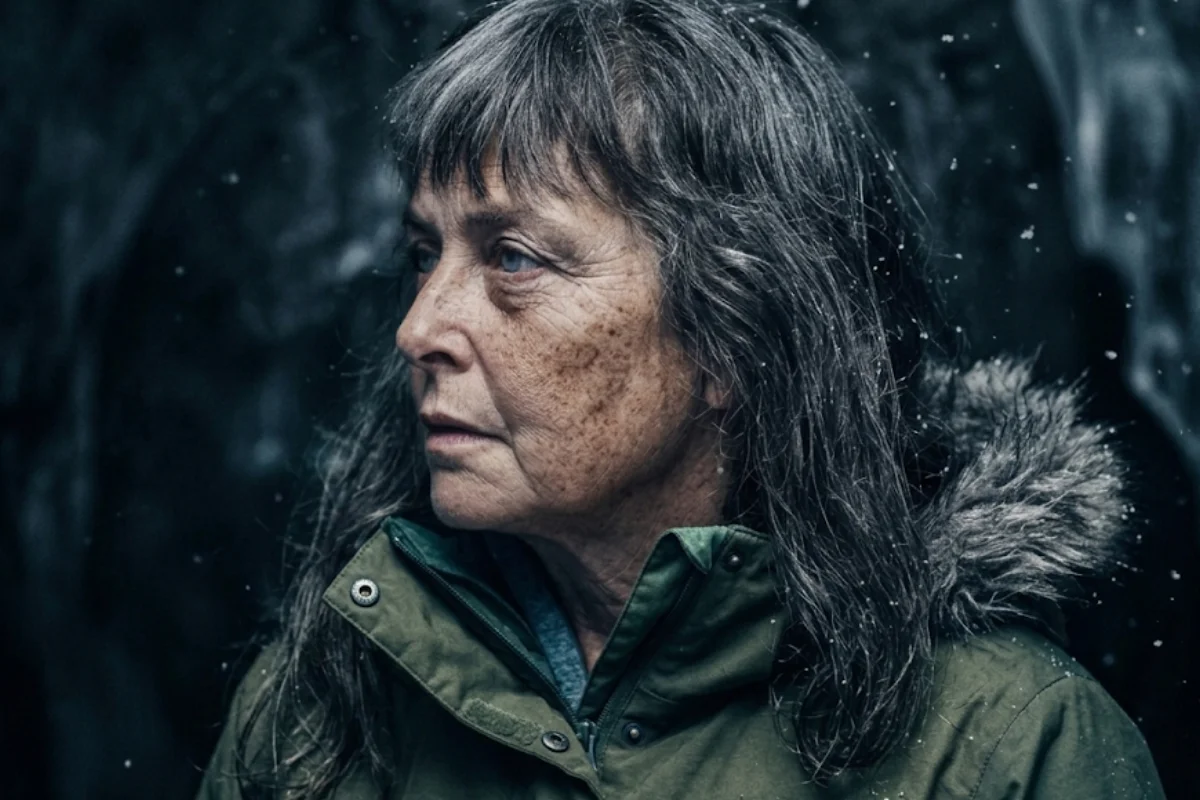
TLDR: Sue Aikens was born on July 1, 1963, in Mount Prospect, Illinois. When she was 11 or 12, her mother drove her to Alaska, declared it was “as far as she could go,” and abandoned her 50 miles north of Fairbanks.
Aikens registered herself for school to get hot meals and learned to hunt to survive. She has operated Kavik River Camp, a remote outpost 197 miles north of the Arctic Circle, for decades.
In 2007, a grizzly bear bit into her skull, dislocated both her hips, and tore her throat. S
he dragged herself to her cabin, cinched her hips back into alignment with a leather gun belt, stitched her own wounds, tracked the bear, and shot it dead.
She was alone for ten days before rescue arrived. She starred on Life Below Zero from 2013 to 2025, sued the producers in 2017 over a snowmobile stunt that fractured her collarbone in ten places, and published her memoir North of Ordinary in March 2026.
She is alive at 62. Reports claiming she died are false.
Sue Aikens has a philosophy about pain and trauma: “It’s only luggage if you choose to pick it up.”
Given what she has survived, that line is not self-help rhetoric. It is a description of how she has actually operated for fifty years in the Alaskan wilderness, starting when she was twelve years old and had no other choice.
The Mother Who Drove to Alaska and Left
Susan Aikens was born on July 1, 1963, at Holy Family Hospital in Mount Prospect, Illinois, a northwest suburb of Chicago. She grew up in Palatine, Illinois, in a family environment characterized by domestic turmoil and physical abuse.
In 1975 or 1976, when Aikens was approximately 11 or 12, her mother left her marriage and drove the family to Alaska. She declared it was “as far as she could go.”
She settled at a vacant property about 50 miles north of Fairbanks, then abandoned her daughter there to pursue her own life.
Aikens was alone in the sub-Arctic wilderness. She found a small creekside cabin, known as the Chena cabin, where her hand-carved initials remain visible today. She registered herself for the local school, motivated by a desire for education and the necessity of a regular hot meal.
An old Alaskan sourdough became a mentor, presenting her with a rifle and telling her to learn to hunt if she wanted to eat.
She learned. She has been in Alaska ever since.
Kavik River Camp: What It Actually Is
Kavik River Camp sits at GPS coordinates 69.4 degrees north, 146.54 degrees west, on Alaska’s North Slope, 197 miles north of the Arctic Circle. Aikens purchased it and began operating it around 2002.
The show portrayed it as a place of unbroken solitude. The reality is more complex. The camp functions primarily as a commercial logistical outpost: a refueling depot for bush pilots, a base camp for environmental scientists, geologists, archaeologists, and registered hunters navigating the North Slope.
It has a private aviation runway, fuel depots, generators, and bunkhouses. Aikens owns her improvements, buildings, and equipment. The land itself is a state-owned leasehold.
It is genuinely isolated in winter. From September through June the camp sees almost no visitors and Aikens operates it alone. In summer the traffic is significant. The show filmed the winter. That is the version audiences saw.
The Bear Attack: What Actually Happened
In 2007, a juvenile male grizzly had been establishing territory around the camp, repeatedly burying caribou carcasses on the helicopter landing pad. Wildlife management officials had instructed Aikens to relocate the carcasses each time. She complied. The bear kept returning.
One afternoon, while pumping water from the river with both hands occupied, she set her rifle down.
The bear charged from the brush. It clamped its jaws around her head and neck, biting into her skull and tearing her throat. It tossed her across the tundra. The attack dislocated both of her hips, tore her leg muscles, and caused severe orthopedic and soft-tissue damage throughout her body.
When the bear left her for dead, she dragged herself back to the camp’s dining hall. Alone, with no immediate rescue possible, she performed emergency trauma surgery on herself.
She used a heavy leather gun belt to cinch her dislocated hips back into alignment. She hand-stitched her own deep lacerations. She retrieved her rifle, tracked the bear, and shot it dead.
She marked its location with a GPS unit. Then her hips dislocated again and she collapsed.
She radioed for help on an air-to-ground frequency. Because she stayed calm and methodical to ensure clarity, emergency dispatchers underestimated her distress. The Alaska State Troopers’ patrol plane was out of service.
Dense, low-altitude fog prevented other aircraft from landing. She lay in her cabin for ten days managing her injuries alone before a pilot friend was able to land and evacuate her to Fairbanks. She was then flown to Portland, Oregon, for spinal surgery and hip reconstruction.
The widely repeated claim that she was alone for “weeks” before rescue is inaccurate. The correct figure, confirmed by Aikens herself in her memoir and interviews, is ten days.
Life Below Zero: The Show and the Lawsuit
Aikens debuted on Life Below Zero in May 2013 and became the show’s most searched and most discussed cast member across its 12-year run. The show was cancelled in February 2025 when Disney declined to renew BBC Studios’ production contract.
In February 2017, she filed a 32-page federal lawsuit against BBC Worldwide Reality Productions.
The lawsuit detailed an incident on February 18, 2015, during the filming of Season 5, Episode 11. A producer ordered her to drive her snowmobile across a dangerous patch of overflow, water pooling over river ice, at high speed.
When she refused citing safety concerns, he allegedly declared that his commands must be obeyed. He required her to perform the stunt without a helmet or face mask to capture her facial expressions on camera.
The snowmobile struck the overflow and crashed. Aikens’ collarbone fractured in ten places.
She alleged that the production crew stripped her cold-weather gear to assess her injuries, leaving her exposed to temperatures of minus 15 to minus 20 degrees Fahrenheit, delayed calling for emergency evacuation, and instead arranged for a plane to land at the far end of a mile-long runway so they could film her limping toward it.
When the episode aired, the final cut edited her statements to make it appear the crash was her own mistake.
The lawsuit did not result in a settlement or judgment. Online sources claiming she won $500,000 are incorrect. Official court dockets from the U.S. District Court for the District of Alaska show that her legal team failed to file proof of service for the defendants.
On June 16, 2017, Judge Sharon L. Gleason dismissed the case without prejudice for failure to prosecute. Aikens continued to appear on the show.
Personal Life: Three Marriages and a Survival Philosophy
Aikens has been married three times. Her first husband died of brain cancer. Her second marriage lasted 17 years and produced her three adult children, two daughters and a son.
The couple separated amicably because her husband could not adapt to her lifestyle. They remained close friends until his death.
Her third marriage ended in divorce after her husband left while she was temporarily in the lower 48 states caring for a grandchild during cancer treatments.
As of 2026, she is in a long-term relationship with Michael Heinrich. Multiple tabloid sources incorrectly identify him as her husband or former fiancé. He is her companion.
Her three adult children live in the contiguous United States. She has grandchildren. She lost a young granddaughter prior to 2025.
Her relationship to physical discomfort is distilled in two lines she has repeated across interviews and her memoir. “If it hurts, don’t think about it.” And: “It’s only luggage if you choose to pick it up.”
These are not motivational slogans. They are the operating system of a person who stitched her own wounds at 44 and was back running a remote Arctic outpost within months.
Where Sue Aikens Is in 2026
On March 10, 2026, Aikens published her memoir, North of Ordinary: How One Woman Left It All Behind for Wilderness and Wonder in Alaska’s Frozen Frontier, published by Sourcebooks and co-written with Michael Vlessides.
The book covers her childhood abandonment, the grizzly attack, and the philosophy she has built over five decades in the bush. She appeared at the Bing Crosby Theater in Spokane on March 11, 2026, and spent the spring on a promotional book tour.
Kavik River Camp remains operational. Aikens has acquired a backup cabin to prepare for eventual retirement from the North Slope.
BBC Studios is actively pitching a potential revival of Life Below Zero to other streaming networks as of 2026, and Aikens has stated she keeps the camp ready for crews.
Reports circulating online claiming she died at age 89 are entirely fabricated. She was born July 1, 1963, is 62 years old, and is fully alive. The fake death reports invented a birth date of September 29, 1933, which is wrong by 30 years.
Her March 2026 book tour appearances, podcast interviews, and radio appearances confirm her current status.
For more on the cast she shared twelve seasons with, see the Life Below Zero cast hub.
What happened to Sue Aikens from Life Below Zero?
Sue Aikens starred on Life Below Zero from 2013 to 2025. The show was cancelled in February 2025 when Disney declined to renew BBC Studios’ production contract. In 2017 she filed a lawsuit against the show’s producers alleging they forced her to perform a dangerous snowmobile stunt that fractured her collarbone in ten places. The lawsuit was dismissed in June 2017 for failure to prosecute. As of 2026, she continues to operate Kavik River Camp and published a memoir titled North of Ordinary in March 2026.
Did Sue Aikens really get attacked by a bear?
Yes. In 2007, a grizzly bear attacked Sue Aikens at Kavik River Camp while she was pumping water with both hands occupied. The bear bit into her skull, tore her throat, dislocated both her hips, and tore her leg muscles. She dragged herself back to her cabin, used a leather gun belt to cinch her hips back into alignment, hand-stitched her own wounds, then tracked and shot the bear. She was alone for ten days before a pilot friend could land and evacuate her. She was flown to Portland, Oregon, for spinal surgery and hip reconstruction.
Did Sue Aikens win her lawsuit against Life Below Zero?
No. Sue Aikens filed a federal lawsuit against BBC Worldwide Reality Productions in February 2017 over a snowmobile stunt that fractured her collarbone in ten places during filming in 2015. However, the case was dismissed without prejudice on June 16, 2017, by Judge Sharon L. Gleason of the U.S. District Court for the District of Alaska because her legal team failed to file proof of service for the defendants. Online claims that she won a $500,000 settlement are false.
Is Sue Aikens still alive?
Yes. Sue Aikens is alive as of 2026 at age 62. She was born on July 1, 1963, in Mount Prospect, Illinois. Reports circulating online claiming she died at age 89 are entirely fabricated and invented a false birth date of September 29, 1933. Her active status is confirmed by her March 2026 book tour, her stage appearance at the Bing Crosby Theater in Spokane on March 11, 2026, and subsequent podcast and radio interviews.
What is Sue Aikens doing now in 2026?
Sue Aikens published her memoir North of Ordinary: How One Woman Left It All Behind for Wilderness and Wonder in Alaska’s Frozen Frontier on March 10, 2026, published by Sourcebooks. She spent the spring of 2026 on a promotional book tour. She continues to operate Kavik River Camp on Alaska’s North Slope. BBC Studios is reportedly pitching a potential Life Below Zero revival to other streaming networks and Aikens has stated she keeps the camp ready for crews.