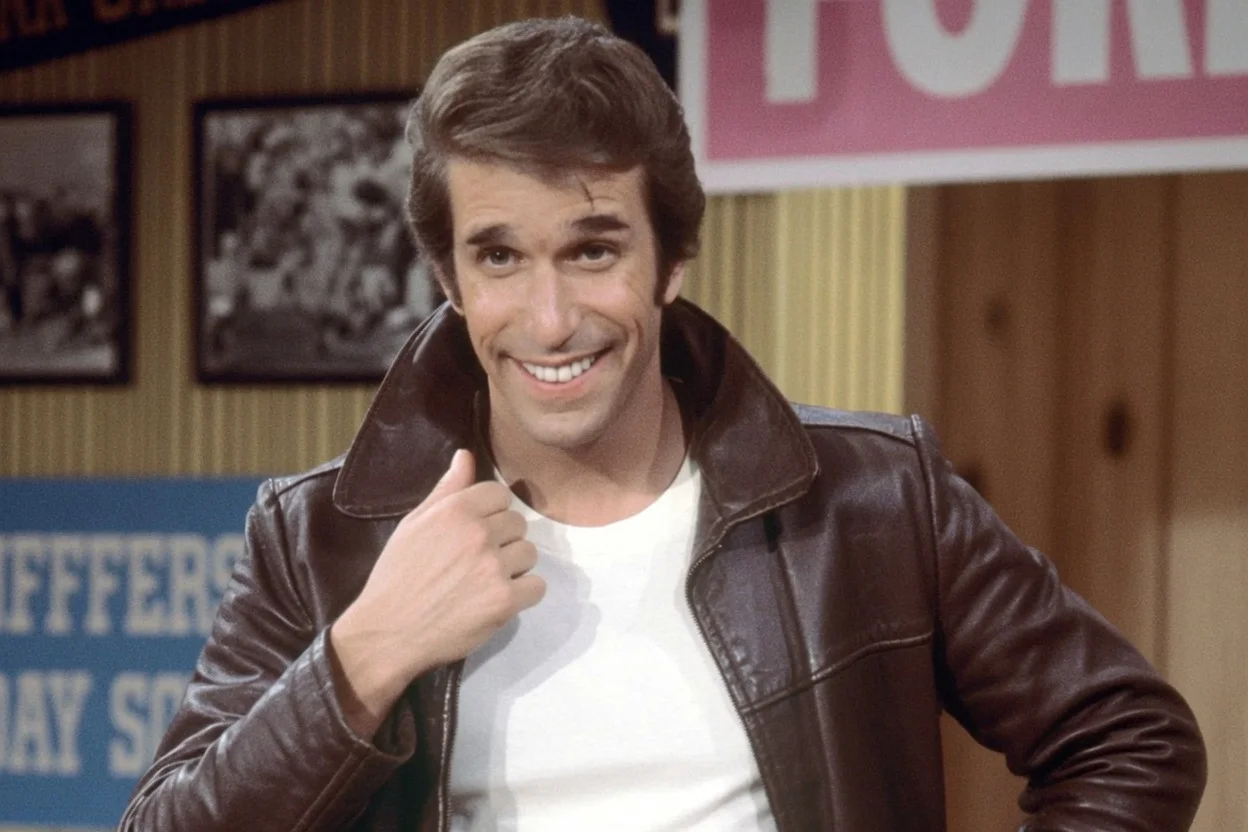
TLDR: Henry Winkler’s Fonzie turned a minor supporting character into one of television’s biggest stars, then nearly ended his career when the role became impossible to escape.
Decades later, a 2018 Emmy win, a candid memoir about a lifelong struggle with dyslexia, and one of the most enduring friendships in Hollywood have made his story one of the best second acts in television history.
Henry Winkler was never supposed to be the star of Happy Days. Arthur “Fonzie” Fonzarelli started as a minor supporting character, a leather-jacketed greaser meant to add a little edge to Richie Cunningham’s otherwise wholesome world.
Within two seasons, Fonzie had become the most popular character on television, and Winkler had become a household name almost overnight.
That overnight fame came with a cost nobody warned him about. For more on the rest of the cast, the full Happy Days cast breakdown covers what happened to everyone else.
He Refused to Let the Show Be Renamed After Him
As Fonzie-mania grew, ABC floated a plan to rename the show Fonzie’s Happy Days, hoping to capitalize on Winkler’s sudden popularity.
Ron Howard threatened to quit over it, telling executives he would walk away from his contract and return to film school rather than watch the ensemble get sidelined.
Winkler backed him completely. He told network executives that changing the title would be an insult to everyone he was working with, and asked them directly why they would fix something that wasn’t broken.
Garry Marshall’s sister later confirmed that Marshall himself was prepared to walk if the network had gone through with it. ABC backed down, and the ensemble cast that made the show work stayed intact.
The Leather Jacket Has a Wilder History Than Fans Realize
Fonzie’s leather jacket became one of the most recognizable costumes in television history, and over the show’s eleven seasons, at least seven different jackets were made or used. Their individual fates are almost as colorful as the show itself.
One jacket was donated to the Smithsonian’s National Museum of American History in 1980, where it remains on permanent display. The very first jacket Winkler wore was stolen directly from the Paramount costume department and never recovered.
Another had its thermal lining ripped out entirely so Winkler could water-ski in the infamous “jumping the shark” episode, a stunt that destroyed the jacket in the process and ended up coining one of the most famous phrases in television criticism.
Garry Marshall kept two in his own private collection.
Winkler held onto two jackets personally for decades. In December 2021, he auctioned one as part of a complete Fonzie outfit, including the original boots, jeans, and t-shirt, selling for just over $75,000 at a Bonhams TCM auction, with a portion of the proceeds donated to a charity supporting families at the U.S.-Mexico border.
He has said he kept the final jacket for himself because he couldn’t bring himself to try it on without weeping. Sharp-eyed fans have also spotted a subtle nod to the role decades later, in 1996’s Scream, where Winkler played a principal whose office closet contains a hanging replica of the jacket.
His Parents Called Him “Dumb Dog” Before Anyone Knew Why He Struggled
In his 2023 memoir Being Henry: The Fonz… and Beyond, Winkler revealed a private struggle that ran underneath his entire career. He had severe, undiagnosed dyslexia, and his parents, German Jewish refugees who had fled the Nazis in 1939, had no framework for understanding why he struggled so badly in school.
They called him lazy and stupid, and used the German phrase “dummer Hund,” meaning dumb dog, to describe him.
Winkler carried that shame through Emerson College and Yale School of Drama, leaning on rapid improvisation to mask his difficulty reading scripts, including during his entire run on Happy Days.
He wasn’t formally diagnosed until he was an adult, after his wife’s son Jed struggled to write even two sentences for a school report and was evaluated for learning difficulties.
Watching Jed’s diagnosis unfold, Winkler recognized his own childhood in it, a moment that was both a relief and a source of fresh anger at the decades of punishment he never deserved.
He later co-wrote the bestselling Hank Zipzer children’s book series about a dyslexic boy, turning his own painful history into something that could help other kids avoid it.
Ron Howard’s Phone Call Felt Like the End of the World
Winkler and Ron Howard built one of the most enduring friendships in television, and their bond was tested the moment Howard decided to leave the show in 1980 to pursue directing full time.
Howard called Winkler personally from a phone booth near Stage 19 to tell him before it hit the press.
Winkler has said his first thought was that his life was over, that his great acting partner and good friend wouldn’t be there anymore.
He pushed past the panic in the moment and told Howard to go be the best director he could be, since directing had always been the plan. The friendship only deepened from there.
Howard cast Winkler in his first major studio film, Night Shift, two years later, and Winkler has said that if Howard were a brain surgeon, he would be his first patient regardless of whether he actually needed the surgery.
He Found a Way Back, Decades Later
When Happy Days ended in 1984, Winkler discovered that nobody in Hollywood could picture him as anything but Fonzie. The acting offers that came in were all variations on the same character, and he spent the following decades building a career mostly behind the camera instead, producing and directing rather than acting.
His path back to acting came gradually, through character roles in Arrested Development and Parks and Recreation, before culminating in Barry, the HBO dark comedy where he played acting teacher Gene Cousineau.
The role earned him a Primetime Emmy in 2018, more than three decades after Fonzie first made him famous, and gave him one of the most satisfying late-career turns of any actor from his generation.
Now 80, Winkler shows no interest in slowing down, splitting his time between selective acting work, producing, and writing children’s books, still close with the cast that made him famous and still finding new ways to be seen as more than the character that started it all.
Is Henry Winkler still alive?
Yes. Henry Winkler is alive and active as of 2026 at age 80, continuing to act, produce, and write children’s books.
Did Henry Winkler really have dyslexia?
Yes. Winkler revealed in his 2023 memoir Being Henry that he struggled with undiagnosed dyslexia throughout his childhood and his entire run on Happy Days, and was not formally diagnosed until adulthood.
What happened to Fonzie’s leather jacket?
At least seven jackets were made over the show’s run. One is in the Smithsonian, one was stolen and never recovered, one was destroyed during a water-skiing stunt, and Winkler auctioned another in 2021 for over $75,000, keeping the final one for himself.
Why did Henry Winkler struggle to find acting work after Happy Days?
Casting directors and producers could not see past his role as Fonzie, leading to years of typecasting. He shifted to producing and directing before eventually returning to acting and winning an Emmy for his role in Barry in 2018.