TLDR: Four teenage girls were murdered at an Austin yogurt shop in 1991. Two innocent men spent years in prison for it. In 2026, DNA confirmed the real killer was Robert Eugene Brashers — a drifter and serial predator who shot himself during a police standoff in 1999, taking his secrets with him.
On the night of December 6, 1991, four girls were getting ready to close up a yogurt shop on West Anderson Lane in Austin, Texas.
Jennifer Harbison, 17, was finishing her shift. Her younger sister Sarah, 15, had stopped by with their friend Amy Ayers, 13. Eliza Thomas, also 17, was working alongside Jennifer. None of them made it home.
A patrol officer spotted smoke from the I Can’t Believe It’s Yogurt! shop just before midnight. When firefighters pushed inside, they found all four girls bound, gagged, and shot in the head. The killer had set the place on fire to destroy the evidence.
What followed was one of the most painful sagas in American true crime history.
Two innocent young men were coerced into confessions and sent to prison. The real killer drove away that night and spent eight more years murdering people across six states before dying in a motel room in Missouri. And the families of those four girls waited 34 years for an answer.
In September 2025, they finally got one.
What Happened the Night of December 6, 1991
The shop had closed at 11:00 p.m. The girls locked the front door and started cleaning up. What happened in the next hour has never been fully reconstructed, because the only person who knows didn’t live long enough to tell it.
The fire department’s arrival saved almost nothing in the way of evidence. Thousands of gallons of water and the shop’s own sprinkler system had turned the crime scene into a saturated ruin. Investigators found the victims in the back.
They recovered one spent shell casing, a .380, that had rolled into a floor drain before the water reached it. That casing sat in an evidence locker for 34 years. It turned out to be the most important piece of evidence in the entire case.
Autopsies confirmed that two different guns had been used. Three of the girls were shot with a .22 caliber pistol. Amy Ayers was shot with both the .22 and a .380. DNA from vaginal swabs and fingernail scrapings was collected, but the quantities were measured in picograms, trillionths of a gram, far too small for any technology available in 1991 to identify.
Eight Years of Nothing, Then Two Wrong Men
The case went cold almost immediately. For eight years, Austin police collected thousands of tips and cleared hundreds of suspects. None of it led anywhere.
Then in 1999, a new task force focused on a group of teenagers who had been briefly questioned back in 1991: Robert Springsteen, Michael Scott, Maurice Pierce, and Forrest Welborn. None of them had been serious suspects at the time. Sergeant Hector Polanco, nicknamed “The Cobra” by colleagues, led the interrogations that followed.
Springsteen was questioned for five straight hours in September 1999. Detectives told him his DNA had been found at the scene, a lie. They told him his friends had already given him up, also a lie. He eventually broke down and said what they wanted to hear, believing the actual DNA would eventually clear him.
Scott’s interrogation went even further, with total questioning time reaching 12 to 18 hours across multiple sessions. One officer reportedly held a gun to his head to drive home the reality of the death penalty.
Both men confessed. Springsteen was sentenced to death in 2001. Scott received life in prison in 2002. The charges against Pierce and Welborn were eventually dropped for lack of evidence.
The convictions were overturned in 2006 after a Supreme Court ruling changed the rules around using one man’s confession against another without allowing cross-examination. When advanced DNA testing was applied to the original evidence in 2008, it produced a 16-marker Y-chromosome profile of an unknown male who matched none of the four original suspects.
Not even close.
Springsteen and Scott were released in 2009. Maurice Pierce never saw his name cleared. He was killed in 2010 during a confrontation with police after allegedly grabbing an officer’s knife.
Who Was Robert Eugene Brashers?
He was born on March 13, 1958, in Newport News, Virginia. He served in both the Army and the Navy after high school. By the mid-1980s, he had started killing people.
In November 1985, Brashers shot a woman named Michelle Wilkerson in Port St. Lucie, Florida, twice in the head and neck after she rejected his advances. She survived. He served three and a half years of a 12-year sentence and was paroled in 1989.
In April 1990, he murdered Genevieve Zitricki, 28, in Greenville, South Carolina, bludgeoning, raping, and strangling her before submerging her body in a bathtub.
DNA from that scene was uploaded to a federal database in 1995, but the degraded samples from Austin were not sensitive enough to trigger a match.
On December 6, 1991, he was in Austin. He had been driving a truck reported stolen in Georgia a week earlier. Less than 48 hours after the yogurt shop murders, a Border Patrol officer stopped him on Interstate 10 between El Paso and Las Cruces.
He was carrying a .380 AMT Backup pistol, the exact gun that fired the casing recovered from that Austin floor drain. There was no system in place to connect those dots in 1991. The gun was eventually returned to his family.
He kept moving. In 1992 he was arrested in Georgia on auto theft and weapons charges and served five years. In March 1997 he sexually assaulted a 14-year-old girl in Memphis. In March 1998 he murdered a mother and daughter named Sherri and Megan Scherer in Portageville, Missouri, binding them before shooting them.
In November 1998 he shot and killed 43-year-old Linda Rutledge in Lexington, Kentucky, then set the building on fire, just like he had in Austin. He was never a suspect in the yogurt shop investigation during any of this.
The End: A Missouri Motel, January 1999
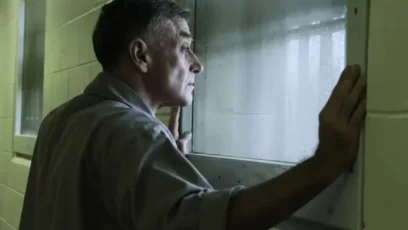
Police in Kennett, Missouri identified a stolen vehicle at a Super 8 motel on January 13, 1999. When officers entered the room, they found Brashers hiding under the bed with a loaded firearm. He took his wife, daughter, and two stepdaughters hostage.
After a four-hour standoff he released his family, then pressed the .380 AMT Backup pistol to his own head and fired. He was declared brain-dead and died six days later on January 19, 1999. He was 40 years old.
For the next 26 years, the Austin cold case had an answer sitting in a Missouri motel room that nobody knew about.
How the DNA Finally Matched 34 Years Later
The breakthrough came through two separate threads pulling tight at almost the same time. Detective Daniel Jackson had taken over the cold case in 2022, and in June 2025 he submitted the original .380 shell casing to the National Integrated Ballistic Information Network, a nationwide ballistic database that hadn’t existed in 1991.
The database returned a hit: the casing matched the gun used in the 1998 Linda Rutledge murder in Kentucky, a case already forensically linked to Brashers.
That led Jackson to the DNA. In 2018, South Carolina investigators had used genetic genealogy to connect Brashers to the 1990 Zitricki murder. Their lab had a comprehensive 27-marker Y-STR profile from that case. Jackson requested a nationwide manual comparison against that profile in August 2025.
On August 22, 2025, South Carolina confirmed a 27-out-of-27 allele match to the mystery donor DNA from the Austin yogurt shop.
To eliminate any remaining doubt, investigators reanalyzed DNA from Amy Ayers’ fingernail clippings using 2025 sensitivity technology. The likelihood ratio came back at 2.5 million to one. Amy had fought back that night.
That DNA under her fingernails was her attacker’s. It just took 34 years and three generations of forensic science to read it.
On September 29, 2025, Austin Police Chief Lisa Davis confirmed Brashers as the sole perpetrator. On February 19, 2026, Judge Dayna Blazey declared Michael Scott and Forrest Welborn “actually innocent” in a formal courtroom hearing.
Where Are Michael Scott and Robert Springsteen Now?
Michael Scott was present in the courtroom on February 19, 2026. He addressed the judge directly. “I lost my family. I lost my youth,” he said. “Every day I have carried the weight of a crime I did not commit.” Forrest Welborn was also there. Robert Springsteen did not attend.
His attorney submitted a written statement on his behalf, describing 27 years of what he called persecution and repeated harassment even after his release. Under Texas law, wrongfully convicted individuals are entitled to up to $80,000 per year of wrongful imprisonment. Civil lawsuits are ongoing.
Hector Polanco, the detective who ran the coerced interrogations, was never criminally charged for his role.
He had been suspended in 1992 for perjury in an unrelated case, then successfully sued the city for discrimination and was reinstated. A Travis County DA investigator testified in 2024 that the methods used during the Polanco era were “totally out of control.”
What the Families Said
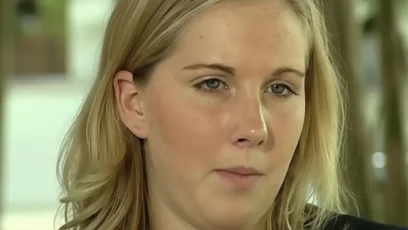
Sonora Thomas was 13 years old when her sister Eliza was murdered.
She became a therapist, a career she has said grew directly from her need to understand grief. When the Brashers identification was announced, she said the news eased her suffering. The two parts of her mind that had been pulling against each other for 34 years, one demanding answers and one giving up hope, had finally come together.
Barbara Ayres-Wilson, the mother of Jennifer and Sarah Harbison, had been one of the most visible faces of the case for decades and participated in the 2025 HBO documentary.
After the announcement she said: “We never wanted anyone to go to jail for anything they did not do. Vengeance was never it. It was always the truth.” She had spent 34 years saying that. In 2026, she finally had the truth to go with it.
Why It Took 34 Years
When Border Patrol stopped Brashers on December 8, 1991, two days after the murders, he was carrying the murder weapon. There was simply no database that could connect a gun in New Mexico to a shell casing in Texas. NIBIN didn’t exist. Ballistic databases in 1991 were local, not national.
The DNA from South Carolina’s 1990 Zitricki murder wasn’t uploaded to the federal CODIS system until 1995. And even then, the degraded picogram-level samples from the yogurt shop weren’t sensitive enough to trigger a match against a partial profile.
It took 27-marker Y-STR kits and keyboard search technology developed in the 2020s to finally bridge the gap.
Three states had pieces of this puzzle in their evidence lockers for three decades. South Carolina had the DNA. Kentucky had the ballistics. Texas had the crime.
None of them had a system that could make those pieces talk to each other. That failure cost two men years of their lives. It cost the families of four girls the chance to ever see the man who killed them face a courtroom. Brashers was already dead.
He had been dead for 26 years when his name was finally read aloud in Austin.