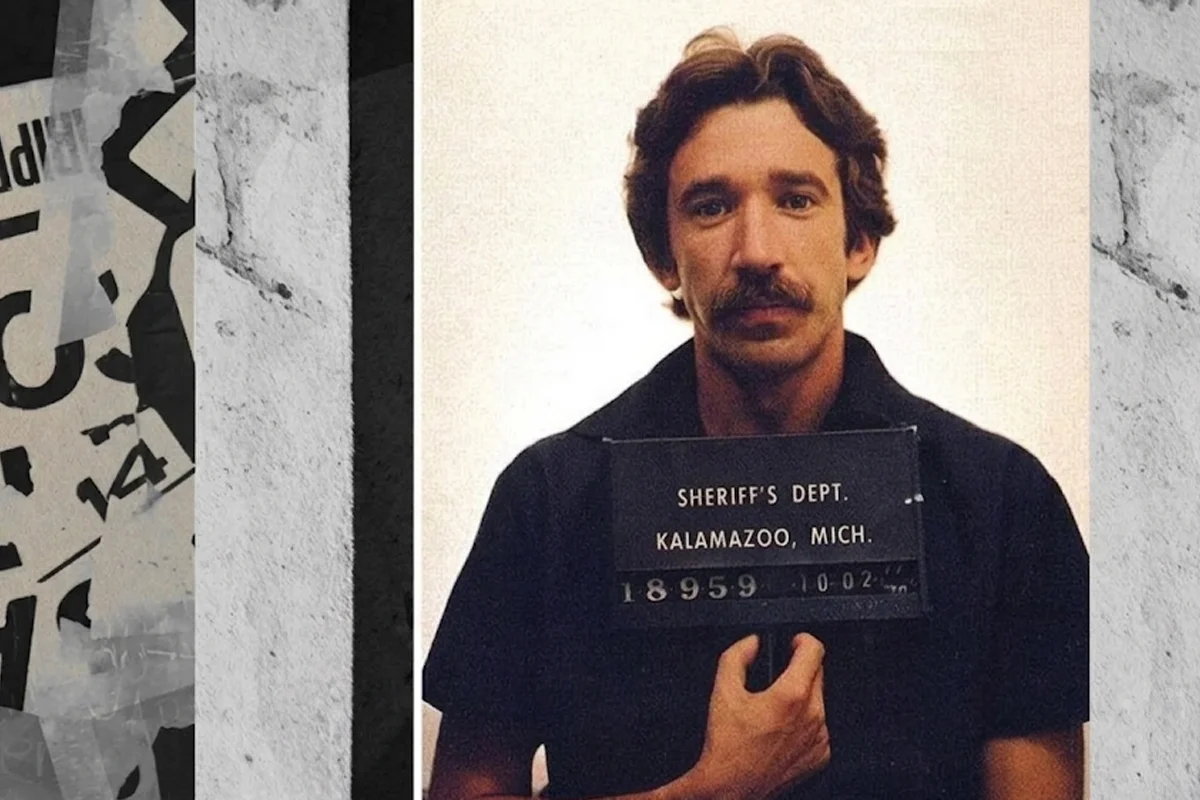
TLDR: On October 2, 1978, Timothy Alan Dick was arrested at a Michigan airport carrying 1.4 pounds of cocaine and faced life in prison without parole under a law that had been enacted just weeks earlier.
He cooperated with prosecutors, named approximately 20 people in his drug network, served two years and four months at a federal prison in Minnesota, and was paroled in June 1981.
Ten years after his release, he was starring in Home Improvement as America’s favorite TV dad.
The man the world knows as Tim Allen was not always Tim Allen. He was born Timothy Alan Dick, and for the first 28 years of his life he was, by his own description, a lost adolescent who never grew up after his father died.
His father Gerald was killed in a car crash on Interstate 70 in November 1964, struck by a drunk driver while bringing the family home from a football game. Timothy was eleven.
He had opted out of the trip that day to visit a neighbor. An uncle told him immediately to stop crying and man up. He did, and the grief went somewhere it was not supposed to go.
What followed was fourteen years of escalating bad decisions that nearly ended with him dying in a federal prison. Instead they produced one of the most improbable second acts in American entertainment history.
The Double Life
By 1978, Timothy Dick was 25 years old and living what he later called a “terribly stressful existence.”
On paper, he was a young advertising professional in the Detroit area with a college degree from Western Michigan University and a new wife named Laura Deibel. He had started doing stand-up comedy on a dare at the Comedy Castle in Royal Oak and was finding that he was good at it.
Off paper, he was running cocaine through a loose network of college-age acquaintances. His partner was his roommate Gerald Mead. Their supplier was a man named Thomas Warner.
One of their distributors was a dealer named Dennis McCarthy. The operation was not a cartel. It was suburban and disorganized and, as it turned out, extremely vulnerable.
McCarthy’s associate Charles Willette had been using chartered planes to move product across Michigan. The charter company noticed the pattern and reported it to police.
Willette, realizing he was being watched, went to the FBI and offered to cooperate. Through Willette the FBI got to McCarthy. Through McCarthy an undercover Michigan State Police officer got to Timothy Dick.
The officer completed two smaller purchases to establish trust, then proposed a larger deal: one and a half pounds, allegedly for a friend.
The Airport and the Locker
The transaction was set for October 2, 1978, at the Kalamazoo/Battle Creek International Airport. Timothy had seen a locker-handover scheme on television and decided to replicate it. He placed the cocaine in an airport locker and handed the key to the undercover officer in exchange for $42,000.
As soon as the locker was opened and the drugs confirmed, the officer signaled the backup team. Timothy was surrounded by officers with guns drawn. He was carrying 650 grams of cocaine. Approximately 1.4 pounds.
The timing was catastrophic in a very specific way. Michigan had enacted a law just weeks earlier called the 650-lifer law, which mandated life in prison without the possibility of parole for anyone convicted of delivering or possessing with intent to deliver 650 grams or more of cocaine or heroin.
The law was designed to target kingpins. It did not distinguish between kingpins and a 25-year-old advertising executive who had watched too many crime movies.
Timothy Dick had just qualified for a mandatory life sentence.
The Deal
Confronted with the prospect of dying in a state prison, he cooperated.
He cooperated extensively. He provided the names of his associates, his suppliers, and other players in the Michigan drug trade.
Approximately 20 people were implicated. Four of the higher-level dealers were eventually incarcerated. He later described himself and his partner as having “taken the punishment for about 20 guys,” which is one way of framing what cooperation looks like from the inside.
The cooperation moved his prosecution from state court, where the 650-lifer law was unavoidable, to federal court, where sentencing was more flexible.
On November 26, 1979, he was sentenced to three to seven years in federal prison. The sentencing judge reportedly told him that he expected Timothy to become a very successful comedian.
He was right, but it would take a decade.
His decision to cooperate became a permanent part of his biography and not an entirely comfortable one. A former associate who later encountered the now-famous Allen reportedly said he was torn between shaking his hand and punching him.
Allen has never disputed what he did or minimized it. He has framed it consistently as a survival decision made by a terrified man who was not prepared to spend his life in prison.
Sandstone
He served his sentence at the Federal Correctional Institution in Sandstone, Minnesota, among other federal facilities he was moved through. His inmate number was 04276-040. He served two years and four months before being paroled on June 12, 1981.
The first moments were the worst. In the 2021 WTF with Marc Maron podcast, the most detailed public account he has given, he described being placed in a holding cell with twenty other men and a single open toilet in the middle of the room.
“When I went to jail, reality hit so hard that it took my breath away, took my stance away, took my strength away. I was put in a holding cell with twenty other guys — we had to crap in the same crapper in the middle of the room — and I just told myself, I can’t do this for seven and a half years. I want to kill myself.”
He survived by following a rule an older inmate gave him on the bus to the facility: grow a beard, stay quiet, mind your own business, and never tell anyone what you are in for.
The last part mattered especially. His status as an informant made him a potential target. Humor became his protection. When bored inmates were looking for someone to direct aggression at, he made them laugh instead.
It worked well enough that he organized a comedy show inside the prison, bringing in a magician for one performance. He ended up working backstage, which meant he could see every trick being performed.
He said it ruined magic for him.
After about eight months he adjusted. He stopped counting days, on advice that focusing on time made it slower. He read biographies of successful people and noticed they all made lists. He started making lists of simple things he wanted to do when he got out. He began learning, very late, how to be an adult.
Two men who had helped him through his sentence were shot to death on the day they were released from prison. One was reportedly driven to a waterfront and shot in the back of the head. He has said those losses removed any remaining ambiguity about the world he had been part of.
Tim Allen Didn’t Exist Yet
He was paroled in June 1981 and returned to Detroit. He went back to advertising work and back to the Comedy Castle. A local television talk show producer asked him to perform but said the name “Timothy Dick” could not go on screen. He became Tim Allen.
He spent the next decade on the Midwest club circuit, building the hyper-masculine persona around power tools and lawn care and the grunting sound that became his trademark.
In 1990 he had a breakthrough Showtime special. In 1991, exactly ten years after his parole, Home Improvement premiered on ABC. Within three years it was the number-one-rated show on American television.
Timothy Dick, who had faced dying in a state prison at 25, was now America’s favorite TV dad.
What He Has Said About All of It
He has talked about the arrest and prison in interviews across decades, with the 2021 Marc Maron podcast being the most extensive.
His framing has been consistent. He does not present himself as a victim of the system. He does not minimize the crime. He describes a young man who lost his father at eleven, never processed it, and spent the next fourteen years making increasingly dangerous decisions until the system intervened.
“Prison grew me up,” he has said. “I was an adolescent that woke up too early when my father was killed, and I stayed at that angry adolescent level.” He has called the bust something that “probably saved my life” and has described the holding cell as the moment the real Tim Allen began.
He is not alone among celebrities who made decisions before fame that could have destroyed everything. The full list includes names that may surprise you.
From Prison to $100 Million
The financial rebuild took exactly ten years from parole to Home Improvement.
The show ran for eight seasons on ABC from 1991 to 1999, and Allen’s salary escalated from roughly $200,000 per episode in the early seasons to $1.25 million per episode in the final season — making him the highest-paid actor on television at the time.
ABC offered him $2 million per episode to come back for a ninth season. He declined.
Over 204 episodes, his base salary from Home Improvement alone is estimated to have exceeded $100 million. Syndication residuals have added approximately $18 million since the show ended in 1999.
The Toy Story franchise added a separate income stream. He earned less than $50,000 for the first film in 1995 — standard scale for a project nobody was certain would work.
By Toy Story 2 in 1999 that had become $5 million. By Toy Story 3 in 2010 it was approximately $22 million including residuals and bonuses tied to the film’s billion-dollar performance.
In November 1994, during a single week, he held the number-one rated show on television (Home Improvement), the number-one film at the box office (The Santa Clause), and the number-one book on the New York Times Bestseller list. That convergence has happened to almost nobody else in the history of American entertainment.
His production company Boxing Cat Productions gave him producer fees and backend participation on The Santa Clause sequels and later projects. His second long-running series, Last Man Standing, ran for nine seasons and added an estimated $45 million in base salary.
His car collection includes a 1966 Ferrari 330 GTC valued at over $3.4 million. His primary residence is in the Orchard Lake area of Michigan, where homes in his neighborhood list north of $10 million.
As of 2025-2026, his net worth is estimated at $100 million — built by a man who spent two years and four months in federal prison and walked out with nothing but a list of things he wanted to do.
What did Tim Allen do before he was famous?
Before his breakthrough with Home Improvement, Tim Allen was arrested in 1978 for drug trafficking at a Michigan airport. He was carrying 1.4 pounds of cocaine and faced life in prison under Michigan’s 650-lifer law. He cooperated with prosecutors, named approximately 20 people in his drug network, and served two years and four months in federal prison before being paroled in June 1981.
How much cocaine did Tim Allen have when he was arrested?
Tim Allen was arrested on October 2, 1978, at the Kalamazoo/Battle Creek International Airport in Michigan with 650 grams of cocaine, approximately 1.4 pounds. He attempted to complete the transaction using a locker handover scheme he had seen on television. The amount triggered Michigan’s 650-lifer law, which mandated life in prison without parole.
Did Tim Allen snitch on his friends to get out of prison?
Yes. Facing a mandatory life sentence under Michigan’s 650-lifer law, Tim Allen cooperated extensively with prosecutors. He provided the names of approximately 20 people in his drug network, which helped move his prosecution from state to federal court where sentencing was more flexible. He was sentenced to three to seven years and served two years and four months. He has never disputed or minimized the cooperation in public, framing it as a survival decision.
Where did Tim Allen serve his prison sentence?
Tim Allen served his federal prison sentence primarily at the Federal Correctional Institution in Sandstone, Minnesota, though he was moved through multiple federal facilities during his incarceration. His inmate number was 04276-040. He was paroled on June 12, 1981, after serving two years and four months of his three-to-seven-year sentence.
How did Tim Allen go from prison to Home Improvement?
After his parole in June 1981, Tim Allen returned to Detroit and resumed both advertising work and stand-up comedy at the Comedy Castle. He spent the following decade building his act on the Midwest club circuit. A local television producer asked him to drop the Dick surname, and he became Tim Allen. His 1990 Showtime special Men Are Pigs led to ABC developing Home Improvement around his stand-up persona. The show premiered in September 1991, exactly ten years after his parole, and became the number-one-rated show on American television within three years.