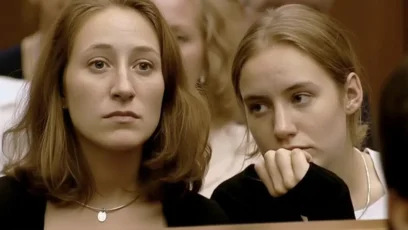
TLDR: Michael Peterson walked free in 2017 after serving 8 years for his wife’s death. The documentary made him a folk hero. What it didn’t show: $143,000 in debt, computer files deleted after she died, a $25 million judgment he can never escape, and the documentary editor who fell in love with him while he was in prison.
On December 9, 2001, at 2:41 a.m., Michael Peterson called 911 from his Durham, North Carolina mansion to report that his wife Kathleen had fallen down the stairs.
When paramedics arrived, they found her surrounded by what first responders described as an “enormous amount of blood” that had already begun to clot and harden.
The blood pattern suggested she’d been dead far longer than the few minutes Peterson claimed had passed since he discovered her.
Kathleen Peterson, 48, was a tech executive at Nortel Networks earning over $140,000 a year. She had seven deep lacerations on her scalp, defensive wounds on her arms, and a fractured thyroid cartilage.
Her blood alcohol was 0.07%, just below the legal limit, and she had Valium in her system.
Michael Peterson, a novelist and former mayoral candidate, told police he’d been sitting by the pool for hours while Kathleen went inside. He said he found her at the bottom of the stairs when he came in around 2:30 a.m.
The medical examiner’s conclusion was immediate: homicide.
What followed was the longest criminal trial in Durham County history, an eight-year prison sentence, a documentary that turned Peterson into a folk hero, and a legal saga that wouldn’t end until 2017.
As of 2026, Michael Peterson is free, living in a ground-floor apartment in Durham specifically chosen because it has no stairs. He’s 80 years old, walks five miles a day, and continues to insist he’s innocent.
But the $25 million judgment against him means he’ll never profit from his story. And the evidence the documentary conveniently left out tells a very different story than the one millions of viewers believed.
The Computer Evidence the Documentary Ignored
The Staircase documentary presented Michael and Kathleen Peterson as a happily married couple with an “understanding” about Michael’s bisexuality.
The filmmakers suggested Kathleen knew about and accepted Michael’s sexual orientation.
Court records tell a different story.
Computer forensics expert Todd Markley analyzed Michael Peterson’s computer and found it had been accessed at 10:20 p.m. on December 9, the night Kathleen died.
The browser history showed pornographic images and email correspondence with a male escort who went by the name “Soldier Top Brad.”
The timing is critical. Michael claimed he was lounging by the pool for several hours that evening while Kathleen worked on her computer preparing for a Monday conference call.
But the computer activity shows someone was using Michael’s account to view pornography and communicate with male escorts during the exact time Michael said he was outside.
The prosecution’s theory: Kathleen discovered the emails that night. The couple fought. Michael killed her.
Even more damaging was the pattern of file deletion. Court records show that 216 files were deleted from Michael’s computer the day before Kathleen died.
Another 352 files were purged two days after her death using a disc-cleaning program called “Quick Clean.”
The documentary never mentioned any of this.
When Kathleen’s daughter Caitlin Atwater, who initially defended Michael publicly, learned about the “Soldier Top Brad” evidence during the 2003 trial, she changed her position entirely.
She’s been estranged from Michael and her step-siblings ever since.
The Financial Motive the Documentary Downplayed
The Cedar Street mansion at 1810 Cedar Street looked like old money. The reality was very different.
At the time of Kathleen’s death, the Peterson household carried approximately $143,000 in credit card debt.
Michael Peterson hadn’t produced significant income from his novels in over two years. The couple had three daughters enrolled in expensive universities.
Their primary asset, Kathleen’s Nortel Networks stock, had cratered from a peak value of over $2 million to just $50,000 following the dot-com bubble burst.
Kathleen was also reportedly fearful of impending layoffs at Nortel, where she served as Director of Information Services.
If she lost her job, she’d lose the life insurance coverage that came with it.
Her death triggered multiple insurance policies and employment benefits totaling approximately $1.8 million.
The prosecution argued Michael had a $1.8 million motive to kill her before she could lose her job and the associated coverage.
The Staircase spent hours on the defense’s theory of an accidental fall. It spent virtually no time on the Petersons’ dire financial situation.
The $25 Million Judgment That Will Follow Him Forever
In 2002, Kathleen’s daughter Caitlin Atwater filed a wrongful death lawsuit against Michael Peterson.
In 2007, a $25 million consent judgment was entered against Peterson.
Peterson attempted to discharge this debt in bankruptcy court. A judge ruled in 2009 that the judgment was non-dischargeable because it resulted from a “willful and malicious” act.
This $25 million judgment effectively ensures that Michael Peterson cannot profit from his celebrity status.
As of 2026, any significant income he earns, including proceeds from his memoirs Behind the Staircase and Beyond the Staircase, is legally subject to seizure by Caitlin Atwater.
Peterson has publicly stated that he donates all proceeds from his books to charity to bypass this financial obligation.
The distribution of Kathleen’s $1.4 million life insurance policy was governed by North Carolina’s “Slayer Rule,” which prevents a person from benefiting from a life insurance policy if they are convicted of the death of the insured.
Following Michael’s 2003 conviction, the funds were eventually split between Caitlin Atwater and her biological father, Fred Atwater.
A secondary legal battle occurred regarding $384,000 in Nortel employment benefits. Nortel accidentally paid these funds to Michael after his indictment but before his conviction.
In 2005, a federal court ruled that Nortel had erred and might be required to pay the funds a second time to Caitlin, as she had never legally waived her right to her mother’s benefits.
The 1985 Death That Showed a Pattern
The 1985 death of Elizabeth Ratliff in Graufenhausen, Germany, provided the prosecution with what they termed a “blueprint for murder.”
Ratliff, a close friend of Michael and his first wife, Patty, was found dead at the bottom of a staircase.
German authorities initially ruled the death a natural result of a cerebral hemorrhage. Durham prosecutors exhumed her body in April 2003.
The second autopsy, performed by Dr. Deborah Radisch, found that Ratliff had suffered seven deep lacerations to the scalp, mirroring the injuries found on Kathleen Peterson.
Radisch concluded the death was a “homicidal assault.”
Witnesses such as Karin Hamm, a neighbor in Germany, claimed to have seen Peterson hurrying away from Ratliff’s home on the night of her death, though this testimony was heavily contested by the defense.
The documentary focused on the emotional toll the exhumation took on Ratliff’s daughters, Margaret and Martha, while downplaying the similarities in the wound patterns identified by the medical examiner.
Two women Michael Peterson knew well, both found dead at the bottom of staircases, both with seven deep scalp lacerations.
The statistical probability of this being coincidence is astronomical.
The Blood Spatter Analyst Who Fabricated Evidence
Duane Deaver’s testimony was the linchpin of the 2003 conviction.
He claimed that the blood spatter on the stairwell walls and Michael’s clothing was inconsistent with a fall and could only have resulted from a beating.
He specifically pointed to a drop of blood found on the inside of Michael’s shorts, asserting it could only have landed there if Michael was standing over Kathleen while she was being struck.
In 2010, an investigation into the North Carolina State Bureau of Investigation revealed that Deaver had misrepresented evidence in numerous cases, including the high-profile Greg Taylor exoneration.
Post-conviction hearings revealed that Deaver had conducted what he called “victory dance” experiments.
He repeatedly beat a blood-soaked sponge with a fireplace tool until he achieved the desired spatter pattern, discarding all contradictory results.
Independent reviews by experts such as Paulette Sutton later confirmed that Deaver’s experiments were scientifically invalid.
The blood spatter on the shorts could easily have resulted from Michael cradling Kathleen as she gasped for air, a phenomenon known as expirated blood.
In December 2011, Judge Orlando Hudson ruled that Deaver had provided “false and misleading” testimony during the 2003 trial, particularly regarding his qualifications and the unscientific experiments he used to “prove” Michael Peterson’s guilt.
Peterson’s conviction was vacated, and he was released on bond after serving eight years in prison.
The Owl Theory: From Internet Joke to Scientific Possibility
The “Owl Theory,” first proposed by attorney Larry Pollard in late 2009, has moved from a fringe internet conspiracy to a scientifically debated possibility.
Pollard’s argument rests on the specific morphology of the lacerations on Kathleen’s scalp, which he noted resembled the “trident” pattern of a raptor’s talons.
In 2010, it was discovered that the evidence collected during the initial autopsy included three microscopic owl feathers and a sliver of wood found in Kathleen’s hair.
She was clutching these items in her hand at the time of her death.
Three independent experts signed affidavits stating that the injuries were consistent with a strike from a Barred Owl:
- Dr. Alan van Norman, a neurosurgeon and owl expert
- Patrick T. Redig, professor of veterinary medicine
- Kate P. Davis, director of Raptors of the Rockies
The theory posits that Kathleen was attacked outside while hanging Christmas decorations, causing her to flee into the house in a state of shock.
Once inside, the combination of blood loss, alcohol, and the disorientation of the attack led to a catastrophic fall down the narrow stairwell.
This scenario explains several anomalies that both the beating and fall theories struggle with.
A beating severe enough to cause seven deep lacerations typically results in skull fractures or brain bruising. Neither were present in Kathleen’s case.
The scratches on Kathleen’s face and the “defensive” wounds on her arms could be interpreted as attempts to ward off a bird of prey.
The presence of pine needles and wood slivers in her hair suggests contact with the outdoors immediately preceding her collapse in the stairwell.
As of 2026, the scientific consensus is that the Owl Theory is “biologically plausible” but forensically unproven.
Durham prosecutors continue to dismiss it as a diversionary tactic, noting that the presence of microscopic feathers could be explained by environmental contamination or the use of down pillows in the home.
However, for many forensic pathologists, the theory remains the only explanation that accounts for the lack of internal head trauma alongside the severity of the external scalp injuries.
In the Durham area, multiple residents have reported silent, high-speed strikes from Barred Owls that resulted in deep lacerations and significant blood loss.
In one case, a victim described the sensation as being “hit in the back of the head with a baseball bat.”
The Documentary Editor Who Fell in Love With Her Subject
The most significant ethical breach involved Sophie Brunet, the documentary’s editor, who entered into a romantic relationship with Michael Peterson while he was in prison.
This relationship began in 2004 and lasted until 2017.
While director Jean-Xavier de Lestrade defended the integrity of the editing process, critics argue that Brunet’s personal investment in Michael’s freedom inevitably shaped the series’ empathetic portrayal of the defense team.
David Rudolf, Michael’s lead attorney, granted the film crew unprecedented access to the defense’s strategy meetings.
Some legal experts believe this transformed the documentary into a piece of advocacy rather than journalism.
Rudolf admitted that he saw the documentary as a way to combat the “sleazy character” trope often associated with defense attorneys.
However, the filmmakers’ decision to withhold information that Michael himself eventually admitted, such as the fact that he never actually discussed his bisexuality with Kathleen, suggests a narrative bias that favors the defense.
The Alford Plea: Guilty But Claiming Innocence
On February 24, 2017, Peterson entered an Alford plea to the reduced charge of voluntary manslaughter.
This specific plea allowed Peterson to maintain his innocence while acknowledging that the state possessed sufficient evidence to convict him.
Judge Hudson sentenced him to 86 months, a duration Peterson had already exceeded during his initial incarceration, allowing him to remain free with no further supervised release.
As of 2026, despite the finality of the criminal case, Michael Peterson remains a convicted felon, a status he continues to contest in public statements.
During the 2017 Alford plea hearing, Kathleen’s sister Candace Zamperini addressed the court in a ten-day-prepared statement, famously dismissing the plea as “Alford Schmalford” and asserting that it simply meant “guilty.”
Kathleen’s sisters have consistently accused the documentary filmmakers of being “co-conspirators” in Michael’s defense and continue to speak out against any media portrayal that suggests his innocence.
The Family That Fractured
The Peterson case fundamentally altered the lives of the five children raised within the Cedar Street home.
Caitlin Atwater was initially Michael’s most vocal advocate, appearing by his side during early media interviews.
Her pivot occurred after reviewing her mother’s autopsy report and learning of the “Soldier Top Brad” evidence.
In her 2017 interview, Caitlin explained that her closure came from “listening day after day to all the evidence, on both sides” during the 2003 trial.
As of 2026, she remains completely estranged from Michael and her siblings, living a private life in Virginia under her married name.
Michael’s biological sons, Todd and Clayton, have never wavered in their support.
Clayton, the eldest, served four years in prison for a separate incident, an attempted bombing at Duke University in the 1990s. He now resides in Maryland with his wife and two children.
Todd, who was the first family member to see Kathleen’s body and Michael’s first confidant that night, has lived in Tennessee and North Carolina.
In recent years (2022 to 2026), Todd has been active on social media, often posting content that alternates between fierce defense of his father and erratic rants about the trauma of the trial.
The Ratliff sisters, who lost their biological mother to a staircase death in 1985 and their adoptive mother to the same in 2001, have remained loyal to Michael.
Margaret lives in California and Martha in Colorado. Both have appeared in follow-up episodes of The Staircase, stating that their love for Michael is unaffected by the revelations about his personal life or the prosecution’s theories regarding their biological mother.
Michael Peterson in 2026
Peterson resides in a modest two-bedroom, ground-floor apartment, chosen specifically because it contains no stairs.
For several years between 2019 and 2021, he lived with his first wife, Patty, who remained his most ardent supporter until her death from a heart attack in 2021.
Following her death, Clayton Peterson described the two as having found a quiet companionship in their final years.
As of 2026, Michael Peterson maintains a limited but active public presence. He continues to give interviews, often using the platform to decry the “homophobia” of the original prosecution.
In early 2023, he met with reporters for a three-hour interview to mark his 80th birthday, stating, “What happened in that trial could not happen today.”
He remains physically active, reportedly walking five miles daily through the wooded neighborhoods of Durham.
His health remains stable, and he continues to write, though he remains legally barred from profiting from any accounts of the crime.
Kathleen Peterson: The Victim Lost in the Debate
Lost in the forensic debates is the portrait of the victim.
Kathleen Peterson was a trailblazer in the North Carolina tech sector, serving as one of the few female executives at Nortel Networks during its zenith.
Kathleen’s career at Nortel spanned seventeen years, during which she rose from an entry-level position to the Director of Information Services.
She oversaw complex infrastructure during the early years of the internet boom.
She was known in Durham as a “mainstay” of the arts, serving on the boards of several local non-profits.
Her friends described her as the “host with the most,” a woman who managed a high-pressure career while maintaining a meticulously curated social life.
During the trial, Dr. Radisch presented a study of 287 stairway deaths in North Carolina.
Of the 29 cases involving individuals in Kathleen’s age range, none had more than three scalp lacerations, and none had the specific pattern of seven distinct impacts found on Kathleen.
This statistical outlier remains the prosecution’s strongest argument for homicide.
What Really Happened on December 9, 2001
Twenty-five years later, three main theories remain:
- The Prosecution’s Theory: Michael killed Kathleen after she discovered his secret communications with male escorts. The financial pressure of $143,000 in debt and Kathleen’s impending layoff provided additional motive. The seven scalp lacerations, the statistical rarity of such injuries in accidental falls, and the identical wound pattern on Elizabeth Ratliff in 1985 all point to murder.
- The Defense’s Theory: Kathleen fell down the stairs after drinking wine and taking Valium. The blood spatter analyst fabricated evidence. The forensic investigation was compromised by prosecutorial bias. Michael’s bisexuality and financial troubles were irrelevant to what happened that night.
- The Owl Theory: A Barred Owl attacked Kathleen outside while she was hanging Christmas decorations. The attack caused seven talon strikes to her scalp. She fled inside in shock, where blood loss and disorientation caused her to fall down the stairs. This explains the lack of skull fractures, the presence of owl feathers and wood fragments in her hair, and the defensive wounds on her arms.
The Alford plea provided a legal conclusion, but it offered no moral closure for a community and a family divided by a quarter-century of litigation.
Whether Michael Peterson is a victim of a corrupt forensic system or a calculated murderer who used the media to secure his freedom remains a question without a definitive answer.
What is certain: the documentary that made him famous left out nearly everything the jury heard.
The computer forensics showing activity at 10:20 p.m. The 352 files deleted after Kathleen’s death. The $143,000 in credit card debt. The $1.8 million in life insurance. The statistical impossibility of two women Michael knew both dying from staircase falls with identical injury patterns.
The Staircase gave viewers a compelling story about a man fighting an unjust system.
The court records tell the story of a woman who spent seventeen years building a career in tech, who served on nonprofit boards, who was known as the “host with the most” in Durham.
And who died at the bottom of a staircase on December 9, 2001, surrounded by an enormous amount of blood, while her husband sat by the pool.