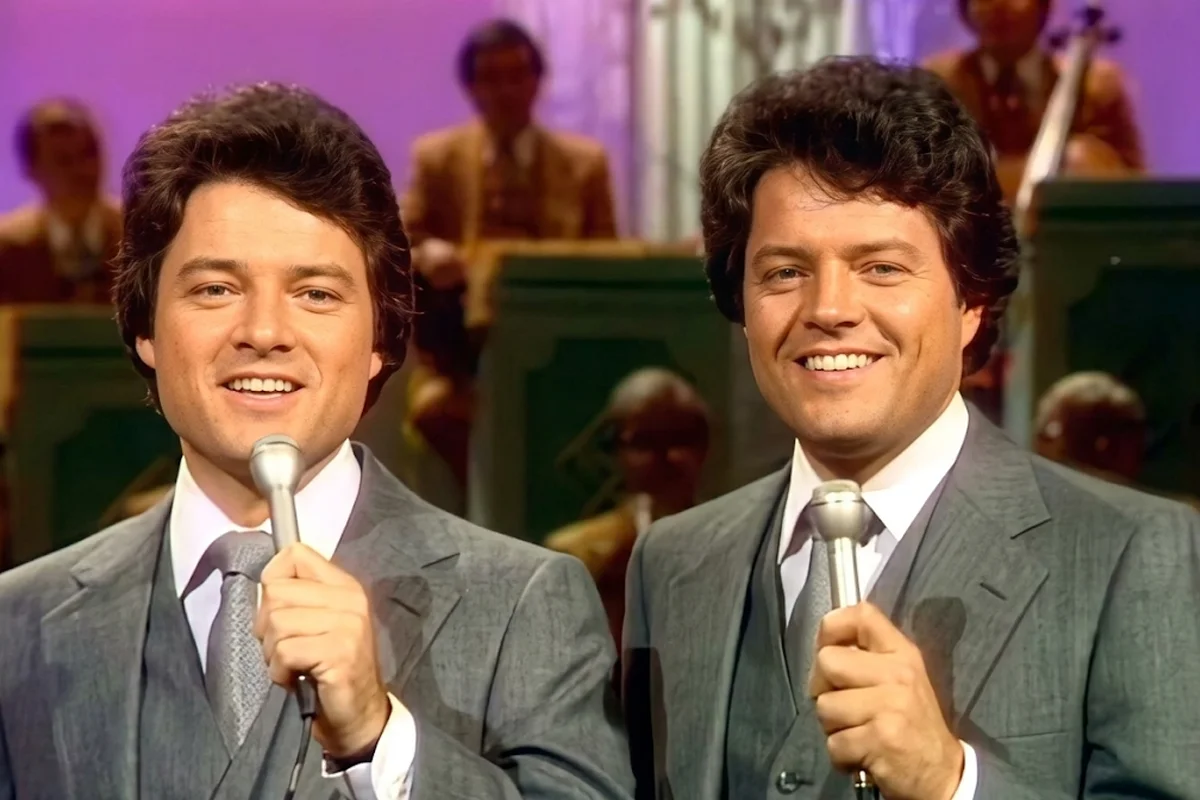
TLDR: David and Roger Otwell were identical twin brothers from Tulia, Texas who joined The Lawrence Welk Show in October 1977 after Lawrence Welk heard their demo tape and called them personally.
Paired with the Aldridge Sisters as a quartet, they became one of the show’s most popular acts during its final five years.
After the show ended they toured, recorded a Christian album, and returned to Texas where they built business careers.
Both brothers are alive and living in the Amarillo area as of 2025-2026.
Most people who ended up on The Lawrence Welk Show got there through auditions, connections, or years of persistent knocking on doors. David and Roger Otwell got there because Lawrence Welk picked up the phone and called them himself.
The brothers had recorded a demo tape of original songs and sent it to the Welk organization, addressed to financial manager Ted Lennon. Among the hundreds of submissions that arrived daily, theirs stood out enough to reach Welk himself. He listened. Then he dialed.
In one of the twins’ most-told stories from that era, Welk opened the call with something like “Guess who dis is?” The brothers, 20 years old and still in Texas, packed their guitars into a Chevy Malibu Classic and drove to California.
They joined the cast in October 1977 and never looked back.
Tulia, Texas and the Sound of Siblings
Roger and David Otwell were born on August 2, 1956, in Tulia, Texas. Roger arrived first, by 13 minutes. They were the youngest of four children born to Orville and Alyne Otwell on a small farm in Swisher County, situated in the Texas Panhandle between Amarillo and Lubbock.
Their older siblings were a brother, Vondean, and a sister, Barbara, who passed away in 2021.
Their father played basic guitar chords and favored old Hank Williams tunes. Their mother was 45 when the twins were born, and both parents had come of age during the Depression. That background shaped the family’s values around hard work, faith, and community.
Music entered the picture early. As freshmen in high school, the brothers formed the “Indecision Band,” knowing exactly three songs. A noon concert earned enough applause to hook them for life.
They also played tuba in the Tulia High School band, an instrument that gave them something most vocalists lack. It provided a foundational understanding of harmonic structure and rhythmic pulse from the bass up. That tuba training earned them both scholarships to Lubbock Christian College.
Classical music turned out not to be their calling (“not our cup of dish,” as David later put it in his best Welk impression), but the scholarships got them there. When their mother suffered a heart attack, they transferred to West Texas State University in Canyon to be closer to home.
By the mid-1970s they had transitioned from tuba to acoustic guitar and were writing their own material, performing as a folk trio with a friend under the name The Otwell Brothers.
In 1976, they dropped out of college to pursue performing full-time. The demo tape followed shortly after.
The 20-Minute Audition That Created the Quartet
Their debut episode aired on October 22, 1977, a show themed “Song and Dance Men.” Their first featured number, “How Do You Say Goodbye,” drew thousands of fan letters.
But the more consequential moment had come before that, in a production meeting that shaped the next five years of their lives.
The Aldridge Sisters, Sheila and Sherry, had been working their way through their own four-audition process that same year and had just been hired as regulars. Welk recognized something when he put the two sibling acts in the same room. He introduced the four of them and issued a challenge: come up with a song together in 20 minutes.
They improvised tight harmonies on “Oh, Shenandoah.” Welk listened, then delivered his verdict: there was only one open slot for a new act. He would hire them, but only as a quartet — The Aldridge Sisters and the Otwell Twins. All four or none. They accepted, despite each pair having hoped for a separate duo spot. The pairing became permanent for the show’s remaining run.
The quartet worked on every level Welk cared about. Two sets of siblings, harmonically balanced across the full vocal range, visually symmetrical, young enough to feel contemporary, wholesome enough to satisfy the show’s core audience. T
he Aldridges brought polished North Carolina charm. The Otwells brought Texan sincerity and their own acoustic guitar accompaniment — a detail Welk frequently highlighted on air, proud that they didn’t rely solely on the house orchestra.
Five Years in the Musical Family
The quartet’s repertoire ranged widely — “You Light Up My Life,” “Bye Bye Love,” “Doin’ What Comes Naturally,” “Walkin’ in the Sunshine,” big-band tributes, gospel numbers, and the kind of contemporary country-pop the show was absorbing in its final syndication years.
They hosted themed episodes including a “Morning-Noon-Night” solar-themed show and performed in cruise episodes, patriotic specials, and ensemble holiday productions.
Working for Lawrence Welk was, in their words, Show Business 101. Rehearsals ran Tuesdays. Filming happened Wednesdays at CBS Television City in Stage 33, often in front of a live audience.
Welk was particular about everything: hair trimmed, sideburns short, no stray accents on air. He actually told the twins he was limiting their on-camera talking because “nobody can understand your accents.”
He also steered them away from solo television appearances, including The Tonight Show, with a logic that was bluntly Welkian: he wanted them famous, just not too famous.
Pay on the show was famously low. The twins later described it as “the worst in Hollywood.” The annual tours made up the difference, taking the cast to Tahoe, Las Vegas, and other casino resorts where the money was considerably better.
Along the way they shared a dressing room with Suzanne Somers, opened for Chuck Berry, worked alongside John Denver and James Arness, and befriended Dallas Cowboys figures including coach Tom Landry.
One particularly memorable night involved an overnight stay at Welk’s Beverly Hills home, a late McDonald’s run, and a 5 a.m. wake-up call.
Their relationship with Myron Floren, Bobby Burgess, and the other veterans of the cast was warm. The Musical Family functioned as a genuine community, and the twins were mentored by established cast members in the nuances of television performance.
They stayed close with the Aldridge Sisters throughout. For the first eight months of the quartet’s existence, neither pair knew the sisters were already married. The sisters had kept it quiet. The twins were the ones who eventually figured it out.
Tulia Girls and Texas Values
Both brothers married women from Tulia, a detail they have mentioned with evident pride in interviews over the years. Roger married Millicent “Millie” Murff at the First Methodist Church in Tulia around 1981, with David serving as best man.
They have two children: daughter Rachel Elizabeth and son Adam. David married Leslie around 1983.
The brothers talked daily throughout their adult lives and maintained the kind of closeness that made their harmonies feel effortless, because it was.
Their faith remained central throughout. The a cappella Church of Christ tradition they grew up in had given them their first harmonic education, and they returned to church settings consistently throughout their post-Welk careers. A Christian album recorded during their touring years in the early 1980s reflected that continuity.
After the Show: Nashville, Gatlinburg, and Home
When the show ended in 1982, the twins based themselves in Nashville for about three years, touring and recording. A year-long residency in Gatlinburg, Tennessee followed, along with continued appearances at the Welk Theatre in Branson, Missouri, as that city emerged as the center of the traditional variety entertainment world in the late 1980s and 1990s.
They were consistent participants in the Welk reunion circuit: the “Forever Blowing Bubbles” concert series, the 2001 PBS special Lawrence Welk: Milestones and Memories, and the wraparound hosting segments for PBS reruns where they introduced vintage episodes and shared behind-the-scenes stories.
They continued writing songs, collaborating with Darrell Bledsoe on material that included a track tied to a Martin guitar story and another connected to Blue Dog art.
By the late 1990s, both brothers had made the decision most of their colleagues didn’t: they went home to Texas. Roger ran the Tulia Cotton Warehouse. David built United Filters, a water filtration and petroleum-related business in the Amarillo area.
They were still headlining shows at venues like the Cactus Theater in Lubbock as recently as the mid-2010s, drawing older Welk audiences and younger fans drawn to the music and the story.
Where Are the Otwell Twins Now
David and Roger Otwell turned 69 in August 2025 and will turn 70 in August 2026. Both are alive and living in the Amarillo and Tulia area of Texas with their families. Fan groups continue to mark their birthdays and share clips, and recent posts confirm they remain present in their community.
One clarification for researchers: an obituary appeared in April 2026 for a “David Smith Otwell,” an analytics engineer born in Evanston, Illinois, who passed away at 63 in Arizona.
That is a different person entirely. The David Otwell of the Otwell Twins was born in Tulia, Texas in 1956 and is approximately seven years older than the individual in that notice.
Two boys who drove a Chevy Malibu Classic from the Texas Panhandle to Hollywood because Lawrence Welk called them on the phone. Five years on national television. Decades of keeping the music alive in churches and concert halls and PBS wraparounds.
Then home to Texas, to the cotton warehouse and the water filtration business and the Martin guitars and the faith that started the whole thing in the first place. That’s the Otwell Twins.
Who are the Otwell Twins from the Lawrence Welk Show?
David and Roger Otwell are identical twin brothers born on August 2, 1956, in Tulia, Texas, who joined The Lawrence Welk Show in October 1977. Guitar-playing singer-songwriters, they were paired with the Aldridge Sisters as a quartet that became one of the show’s most popular acts during its final five years of original production.
How did the Otwell Twins join the Lawrence Welk Show?
The brothers recorded a demo tape of original songs and sent it to the Welk organization. Lawrence Welk heard it personally and called them directly. They drove from Texas to California in a Chevy Malibu Classic and joined the cast in October 1977. Their debut episode on October 22, 1977 featured their first number How Do You Say Goodbye, which drew thousands of fan letters.
Who were the Aldridge Sisters and Otwell Twins?
The Aldridge Sisters and Otwell Twins were a mixed-gender quartet formed on The Lawrence Welk Show in late 1977, consisting of sisters Sheila and Sherry Aldridge from North Carolina and twin brothers David and Roger Otwell from Tulia, Texas. Lawrence Welk paired the two sibling acts together after a 20-minute improvised audition on Oh Shenandoah, declaring he would only hire them as a combined quartet. The group became one of the show’s most beloved acts from 1977 to 1982.
Are the Otwell Twins still alive?
Yes. As of 2025-2026, both David and Roger Otwell are alive and living in the Amarillo and Tulia area of Texas. They turned 69 in August 2025 and will turn 70 in August 2026. An April 2026 obituary for a David Smith Otwell in Arizona refers to an unrelated individual born in Evanston, Illinois, and is not the Otwell Twin.
What did the Otwell Twins do after the Lawrence Welk Show?
After the show ended in 1982, the brothers toured out of Nashville for several years, recorded a Christian album, and performed a year-long residency in Gatlinburg, Tennessee. They returned to Texas and built business careers in the Amarillo area, with Roger running the Tulia Cotton Warehouse and David building United Filters, a water filtration and petroleum business. They remained active in Welk reunion tours, PBS specials, and the Forever Blowing Bubbles concert series through the 2000s and continued performing at venues like the Cactus Theater in Lubbock into the mid-2010s.