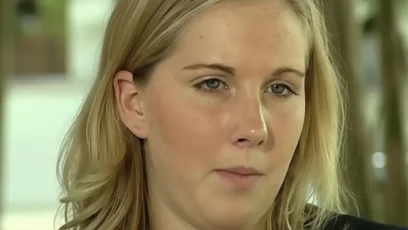
Denise Huskins was kidnapped and raped in 2015. Police called it a hoax and compared her to Gone Girl. She and her boyfriend Aaron Quinn won a $2.5 million settlement.
The detective who destroyed their lives was named Officer of the Year and is still employed.
They got married, had two daughters, and now train Olympic athletes while retraining police departments worldwide.
On March 23, 2015, at 3:00 a.m., Denise Huskins and Aaron Quinn were awakened by bright flashing lights and red laser dots crossing their bedroom walls.
A pre-recorded voice instructed them: “Wake up, this is a robbery. We’re not here to hurt you.”
The intruder drugged them with a sleep-inducing liquid, blindfolded them with blacked-out swim goggles, and bound them with zip ties.
He told Aaron that Denise would be taken for 48 hours and returned upon payment of two ransom installments of $8,500 each.
Denise was placed in the trunk of Aaron’s car and driven 200 miles to a cabin in South Lake Tahoe. For two days, she was held captive and raped twice on camera.
When Aaron called police, they didn’t believe him. They interrogated him for 18 hours, told him Denise was dead, and tried to get him to confess to murder.
When Denise was released and showed up alive, police held a press conference and called the entire kidnapping a hoax.
They compared it to the movie Gone Girl. The media ran with it. Denise and Aaron became global laughingstocks.
Three months later, the kidnapper was caught. Everything Denise and Aaron said was true.
Nearly 10 years later, in February 2026, Denise Huskins and Aaron Quinn are married with two daughters, living on California’s Central Coast, training Olympic athletes, and retraining police departments worldwide on how not to destroy victims’ lives.
The detective who called them liars? He was promoted to Sergeant and is still employed by Vallejo Police.
This is what happened after the nightmare ended.
The 18-Hour Interrogation
After Denise was taken, Aaron Quinn was sedated and traumatized. But instead of being treated as a victim, he was subjected to an 18-hour interrogation by Detective Mat Mustard and FBI Agent David Sesma.
They didn’t believe his story. The tactics were too sophisticated, too “movie-like.” Red lasers, pre-recorded voices, swim goggles as blindfolds. It sounded fabricated.
Investigators adopted what’s called a “guilt-presumptive” posture. They suspected Aaron of murdering Denise and making up the kidnapping story to cover it.
They repeatedly told him, “She’s dead.”
They tried to coerce a confession while his family waited in the police station, unaware of what was happening.
Aaron took a polygraph test. FBI Special Agent Peter French falsely told him he had failed. This is a common interrogation tactic designed to break a suspect’s resolve.
For 18 hours, Aaron insisted Denise had been kidnapped. Police insisted he was lying.
The Gone Girl Press Conference
On March 25, 2015, Denise was released by her captor near her father’s home in Huntington Beach, California, about 400 miles from Vallejo.
She appeared just hours before the ransom deadline.
Before the Vallejo Police Department had even interviewed her, they held a press conference.
Lt. Kenny Park publicly declared the incident a hoax. He stated that the couple had “plundered valuable resources” and owed the community an apology.
The department compared the case to the book and film Gone Girl, which features a woman who fakes her own kidnapping.
The media seized on the comparison. Within hours, Denise Huskins was being called the “real-life Gone Girl” around the world.
She had just been kidnapped and raped twice. Now she was being accused of lying about it on global television.
The couple received death threats. They couldn’t return to work. They couldn’t leave their homes without being recognized and harassed.
Denise and Aaron later described this secondary trauma as more devastating than the kidnapping itself.
The Rookie Detective Who Solved It
In June 2015, three months after the press conference, Detective Misty Carausu in Dublin, California was investigating a home invasion in her jurisdiction.
The case shared several signature elements with the Huskins kidnapping. Blacked-out swim goggles. Zip ties. Sophisticated tactics.
During a search of the suspect’s vehicle and a cabin in South Lake Tahoe, Carausu found a single strand of blonde hair on a pair of swim goggles.
Further investigation revealed that the suspect was Matthew Daniel Muller, a disbarred Harvard-educated attorney and former Marine.
Evidence recovered from Muller’s possessions included a laptop stolen from Aaron Quinn, Denise’s hair, and video recordings of the sexual assaults.
Matthew Muller was the kidnapper. He had acted alone. Everything Denise and Aaron said was true.
The Vallejo Police Department had destroyed two innocent victims on national television.
The $2.5 Million Settlement
Following Muller’s arrest, Denise and Aaron filed a federal defamation and civil rights lawsuit against the City of Vallejo and several police officers.
The lawsuit detailed the “vicious and shocking attack” on their reputations and the intentional infliction of emotional distress.
In a pivotal 2017 ruling, U.S. District Judge Troy Nunley allowed the suit to proceed. He stated that the conduct of the police went beyond mere skepticism and could be viewed by a jury as “extreme and outrageous.”
In March 2018, the City of Vallejo reached a $2.5 million settlement with the couple.
While the settlement provided financial security and was an implicit admission of wrongdoing, it did not initially result in disciplinary action against the officers involved.
It was not until 2021 that the city and the department issued a formal public apology, admitting the case had not been handled with appropriate sensitivity.
The $2.5 million figure sounds substantial. But after legal fees, which typically run 33 to 40 percent, the couple likely netted between $1.3 million and $1.5 million.
After taxes and the costs of relocating and rebuilding their careers, the settlement provided stability but did not make them wealthy.
In interviews, they have described ongoing financial stress from the career disruption that the settlement couldn’t fully repair.
Detective Mat Mustard Was Promoted
One of the most disturbing aspects of the case’s aftermath is the lack of accountability within the Vallejo Police Department.
Detective Mat Mustard, who led the 18-hour interrogation and was central to the “hoax” narrative, was never disciplined.
Instead, he was named the department’s Officer of the Year in April 2016.
He was later promoted to Sergeant in September 2018.
As of February 2026, the City of Vallejo has confirmed that Mat Mustard remains a sworn officer and a city employee.
He holds a leadership role within the police union.
The man who destroyed Denise Huskins and Aaron Quinn’s lives on national television faced no consequences. He was rewarded.
September 29, 2018: They Got Married
On September 29, 2018, Denise Huskins and Aaron Quinn were married at the Monarch Cove Inn in Capitola, California.
They described the wedding as a celebration of survival and love.
The couple credits their shared trauma with “stripping away the noise” of daily life and solidifying their relationship.
They relocated to California’s Central Coast, far from Vallejo, where they could build a new life away from the geographic center of their trauma.
Their first daughter, Olivia, was born in March 2020, exactly five years to the day after Denise was released by her captor.
Their second daughter, Naomi, was born in 2022.
While they have achieved a high degree of normalcy, they continue to navigate the lingering psychological effects of the kidnapping and the public shaming.
They utilize therapeutic modalities such as Eye Movement Desensitization and Reprocessing (EMDR) to manage post-traumatic stress.
From Physical Therapists to Olympic Trainers
Before the kidnapping, Denise and Aaron were both clinical physical therapists working at Kaiser Permanente.
Denise earned her Doctorate in Physical Therapy from Long Island University in 2012 and specialized in Proprioceptive Neuromuscular Facilitation (PNF).
Aaron graduated from Azusa Pacific University’s physical therapy program and specialized in treating neurological injuries like strokes and traumatic brain injuries.
After the kidnapping and the public accusations, returning to their careers was difficult. Colleagues and patients recognized them. The stigma of being called liars followed them.
But they rebuilt.
As of 2026, Denise continues to work in orthopedic settings on the Central Coast with an emphasis on Pilates-based rehabilitation.
Aaron has become a key trainer at Apiros, where he works alongside Austin Einhorn to train high-level collegiate, professional, and Olympic athletes.
His expertise in the Anat Baniel Method, which he studied for four years to treat children with special needs, has further diversified his clinical practice.
They have successfully transitioned from victims to elite professionals in their field.
Victim F: The Book That Changed Everything
In 2021, Denise and Aaron released their book, Victim F: From Crime Victims to Suspects to Survivors, co-authored with Nicole Weisensee Egan.
The book served as a manifesto against victim-blaming and a detailed critique of the “confirm-to-convict” culture within law enforcement.
It received widespread acclaim from figures such as Elizabeth Smart, herself a kidnapping survivor, and Scott Berkowitz of RAINN (Rape, Abuse & Incest National Network).
The book provided the couple with a platform to tell their story in their own words, without the filter of law enforcement or media interpretation.
It also laid the groundwork for what would become a global phenomenon three years later.
American Nightmare: The Netflix Documentary
In January 2024, Netflix released the docuseries American Nightmare, which told Denise and Aaron’s story to a global audience.
The documentary’s use of actual interrogation footage provided an undeniable look at the psychological pressure and bias Aaron faced during his 18-hour interrogation.
It made it impossible for the Vallejo Police Department to maintain their narrative of “understandable skepticism.”
The documentary became a massive hit, sparking renewed outrage over the department’s conduct and bringing international attention to the need for police reform.
For Denise and Aaron, the documentary represented final, public vindication.
Millions of people around the world now knew the truth. They were victims, not hoaxers.
Retraining Police Departments Worldwide
One of the most significant legacies of the Huskins-Quinn case is their active role in reshaping law enforcement training.
In collaboration with El Dorado County District Attorney Vern Pierson, the couple has become a central component of the Science-Based Interviewing (SBI) movement.
This method advocates for a non-confrontational, information-gathering approach to interrogations. It’s being taught to officers worldwide as a more ethical and effective alternative to the traditional Reid technique, which focuses on extracting confessions.
Aaron’s 18-hour interrogation footage is now used as a pedagogical tool to demonstrate the failures of confession-driven interrogation.
By analyzing the “guilt-presumptive” behavior and “tunnel vision” that led to their wrongful accusation, Denise and Aaron are helping to ensure that future investigators prioritize evidence over bias.
This work is driven by their awareness that many victims lack the resources to hire attorneys and fight back against institutional defamation as they did.
Matthew Muller’s Other Victims
The years 2024 and 2025 saw a remarkable expansion of justice in the case.
Due to persistent advocacy by Denise, Aaron, and investigators like Misty Carausu and Seaside Police Chief Nick Borges, Matthew Muller began to confess to previously unsolved crimes.
These confessions revealed a predatory career that spanned over three decades.
In January 2025, Muller confessed to two home invasions in Santa Clara County that occurred in 2009.
In June 2025, he pleaded guilty to a 1993 kidnapping and rape near Folsom Lake, a crime committed when he was just 16 years old.
In July 2025, he was sentenced for a 2015 kidnapping in San Ramon that had gone unreported for a decade.
These developments brought closure to more than a dozen victims who were previously ignored or whose cases had gone cold.
As of February 2026, Matthew Muller is serving multiple life sentences and is expected to die in prison.
Witnesses of the Year: Final Vindication
In July 2025, Denise Huskins and Aaron Quinn were honored by the California District Attorneys Association (CDAA) as “Witnesses of the Year.”
This award recognized their courage in reliving their trauma to assist in the prosecution of Muller’s additional crimes.
Sacramento County District Attorney Thien Ho stated that without the couple’s persistence, these victims would never have obtained justice.
This recognition serves as a definitive counter-narrative to the “hoaxer” label they carried for nearly a decade.
From being publicly accused of fabricating a crime to being honored as the state’s most valuable witnesses, the arc of their vindication is complete.
Vallejo Police in 2026: Still Broken
As of February 2026, the Vallejo Police Department continues to face significant challenges.
The department remains under a settlement agreement with the California Department of Justice, which requires the implementation of 45 specific reforms to address bias and accountability.
While 20 of these reforms had been completed by late 2024, progress remains slow.
The department is currently facing a staffing shortage that has required patrol support from the Solano County Sheriff through the end of 2026.
In December 2025, the city announced that the Police Oversight and Accountability Commission could finally begin operating after years of delays caused by negotiations with the police union.
Under the leadership of Permanent Police Chief Jason Ta, the department is attempting to move toward “21st-century policing.”
But the continued presence of Mat Mustard in a leadership role within the union and the department remains a point of contention.
Where Denise and Aaron Are Now
As of February 2026, Denise Huskins and Aaron Quinn live on California’s Central Coast with their two daughters, Olivia and Naomi.
They continue to work as physical therapists, with Aaron training Olympic-level athletes and Denise specializing in orthopedic rehabilitation.
They travel the world training police departments in science-based interviewing techniques.
They advocate for other victims of wrongful accusations and institutional betrayal.
They manage ongoing PTSD through therapy and mutual support.
They have built a life defined not by the 48 hours of Denise’s kidnapping, but by the decade of advocacy and reconstruction that followed.
The detective who called them liars still has his job.
But Denise and Aaron Quinn have their daughters, their careers, their marriage, and the knowledge that they helped change how police treat victims.
That’s what victory looks like after an American nightmare.
Denise Huskins and Aaron Quinn: Frequently Asked Questions
Are Denise Huskins and Aaron Quinn still together?
Yes. Denise Huskins and Aaron Quinn got married on September 29, 2018, at the Monarch Cove Inn in Capitola, California. As of February 2026, they are still married and living on California’s Central Coast with their two daughters, Olivia (born March 2020) and Naomi (born 2022). They credit their shared trauma with strengthening their relationship and continue to work together advocating for police reform and training law enforcement worldwide.
How much money did Denise Huskins and Aaron Quinn get from the settlement?
Denise Huskins and Aaron Quinn reached a $2.5 million settlement with the City of Vallejo in March 2018. However, after legal fees (typically 33-40 percent, estimated at $825,000 to $1 million) and taxes, they likely netted between $1.3 million and $1.5 million. In interviews, they have described ongoing financial stress from career disruption that the settlement couldn’t fully repair. The settlement provided stability but did not make them wealthy, especially after relocation costs and rebuilding their careers.
What happened to Detective Mat Mustard from the Gone Girl case?
Detective Mat Mustard, who led the 18-hour interrogation of Aaron Quinn and was central to calling the kidnapping a hoax, was never disciplined. Instead, he was named the Vallejo Police Department’s Officer of the Year in April 2016. He was promoted to Sergeant in September 2018. As of February 2026, the City of Vallejo has confirmed that Mat Mustard remains a sworn officer and city employee. He holds a leadership role within the police union. The man who publicly destroyed Denise and Aaron’s reputations faced no consequences and was rewarded with promotion.
What do Denise Huskins and Aaron Quinn do now?
As of 2026, both continue working as physical therapists on California’s Central Coast. Denise works in orthopedic settings with an emphasis on Pilates-based rehabilitation. Aaron has become a key trainer at Apiros, where he trains high-level collegiate, professional, and Olympic athletes. He specializes in the Anat Baniel Method for treating children with special needs. Beyond their clinical work, they travel worldwide training police departments in Science-Based Interviewing techniques and advocate for victims of wrongful accusations. In July 2025, they were honored as Witnesses of the Year by the California District Attorneys Association.
How many victims did Matthew Muller have?
Matthew Muller’s criminal career spanned over three decades with more than a dozen known victims. In 1993, he committed a kidnapping and rape near Folsom Lake when he was 16 years old. In 2009, he committed two home invasions in Santa Clara County. In 2015, he kidnapped Denise Huskins and committed another kidnapping in San Ramon. Due to persistent advocacy by Denise, Aaron, and investigators, Muller began confessing to previously unsolved crimes in 2024-2025. As of February 2026, he is serving multiple life sentences and is expected to die in prison.
Did Vallejo Police ever apologize to Denise Huskins?
The City of Vallejo did not formally apologize until 2021, six years after the kidnapping and three years after the $2.5 million settlement. The 2021 apology admitted the case had not been handled with appropriate sensitivity. However, no officers were disciplined. Lt. Kenny Park, who held the Gone Girl press conference, and Detective Mat Mustard, who led the interrogation, faced no consequences. Mat Mustard was actually promoted. The apology came only after sustained public pressure and the couple’s advocacy work.
What is the American Nightmare documentary about?
American Nightmare is a Netflix docuseries released in January 2024 that tells the story of Denise Huskins and Aaron Quinn. The documentary uses actual interrogation footage showing the 18-hour interrogation Aaron endured and the Vallejo Police Department’s rush to judgment in calling the kidnapping a hoax. It reveals how police compared Denise to Gone Girl and destroyed the couple’s reputations before Matthew Muller was caught three months later. The documentary became a massive hit and sparked renewed outrage over police misconduct and the need for interrogation reform.
How did police catch Matthew Muller?
Police did not catch Matthew Muller through the Vallejo investigation. In June 2015, three months after the kidnapping, Detective Misty Carausu in Dublin, California was investigating a home invasion that shared signature elements with the Huskins case. During a search of the suspect’s vehicle and a cabin in South Lake Tahoe, Carausu found a single strand of blonde hair on blacked-out swim goggles. Further investigation revealed the suspect was Matthew Muller, a disbarred Harvard-educated attorney and former Marine. Evidence included a laptop stolen from Aaron Quinn, Denise’s hair, and video recordings of the sexual assaults. A rookie detective in a different jurisdiction solved what Vallejo Police had called a hoax.