TLDR: Comfortably Smug wears sunglasses due to blinding studio lights and discomfort seeing himself on monitors. They also replace the anonymity he lost after his 2012 Hurricane Sandy hoax scandal and have become his signature brand.
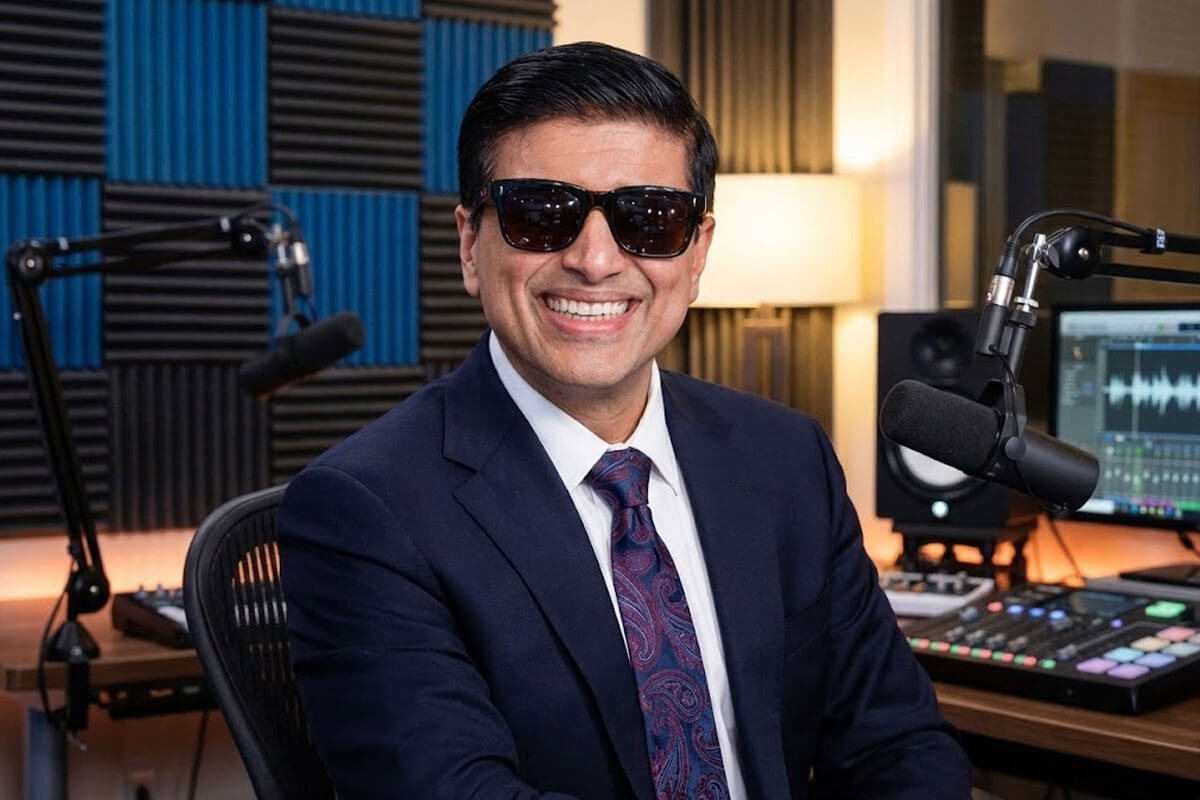
If you’ve seen Comfortably Smug on the Ruthless podcast or during his Fox News appearances, you’ve probably noticed one thing: the sunglasses. Always the sunglasses.
Whether he’s recording in a studio, appearing on Jesse Watters Primetime, or mixing cocktails during the show’s variety segments, Republican strategist Shashank Tripathi (better known by his online moniker) keeps his eyes hidden behind dark shades. It’s become such a signature part of his brand that fans and critics alike have wondered: why does Comfortably Smug wear sunglasses indoors?
The answer, it turns out, is far more complex than simple fashion preference. The sunglasses serve multiple purposes, from practical studio considerations to psychological protection rooted in one of the internet’s most infamous political scandals. They’re simultaneously a defense mechanism, a branding choice, and a deliberate rejection of traditional media norms.
The Official Explanation: Studio Lights and Self-Perception
During podcast recordings, Tripathi has been refreshingly candid about his eyewear choice. According to transcripts from behind-the-scenes segments, he cites two main reasons for the constant shades.
First, the studio lighting is genuinely overwhelming. Modern video podcast setups utilize high-intensity LED lighting arrays to ensure broadcast-quality picture, and for someone unaccustomed to studio environments, the brightness can be physically debilitating. The sunglasses provide legitimate relief from what he describes as “blinding light” that makes it difficult to focus on the task at hand.
But it’s the second reason that reveals something more psychologically interesting. Tripathi admits he doesn’t like looking at himself on the return monitors that show speakers their own image during recording.
“I don’t like looking at myself in the eyes,” he explained during one segment, noting that the glasses help him avoid that self-conscious feedback loop. In the age of Zoom and video podcasts, creators are constantly confronted with their own image on screen, which can create an uncomfortable cycle of self-awareness. For Tripathi, maintaining the “Comfortably Smug” persona requires a certain detachment, and making eye contact with himself might break the performance.
The Hurricane Sandy Scandal That Changed Everything
To truly understand the sunglasses, you have to go back to October 2012, when Hurricane Sandy devastated the East Coast and Comfortably Smug was still a completely anonymous Twitter account. That’s when the user behind the handle decided to spread a series of elaborate hoaxes during the crisis.
The account falsely claimed that the New York Stock Exchange trading floor was underwater, that Con Ed workers were trapped in a building, and that the subway system would be shut down for a week. Major news outlets, including CNN and the Weather Channel, picked up these fabricated reports, causing real confusion during an already chaotic disaster.
The tweets weren’t just internet trolling. They targeted the nervous system of New York City itself, spreading panic about finance, power, and transit infrastructure. At the time, the power of the Comfortably Smug account lay entirely in its anonymity. Nobody knew who was behind the chaos, which made the voice feel omnipotent and terrifyingly unaccountable.
That all changed when BuzzFeed journalist Jack Stuef conducted a digital forensic investigation and unmasked the account’s owner: Shashank Tripathi, a 29-year-old hedge fund analyst who also served as campaign manager for Christopher Wight, a Republican congressional candidate.
The revelation was devastating on multiple levels. The anonymous chaos agent turned out to be a member of the establishment, a finance professional and political operative. Tripathi was forced to resign from the Wight campaign immediately.
New York City Councilman Peter Vallone publicly called for the Manhattan District Attorney to investigate potential criminal charges for reckless endangerment, though legal experts noted the high bar for prosecuting speech. Tripathi issued a humiliating public apology, admitting to “irresponsible and inaccurate tweets” and taking “full responsibility.”
The 2012 unmasking was total and complete. Everyone now knew exactly who Shashank Tripathi was and what he had done. When he eventually returned to prominence years later, the dynamic had fundamentally shifted. He was no longer anonymous, but the Comfortably Smug persona needed to be resurrected as something separate from the disgraced operative who had been publicly shamed.
The Sunglasses as a New Kind of Mask
Enter the sunglasses. Having been forcibly stripped of his digital anonymity, Tripathi adopted a physical form of concealment. The eyewear functions as what some observers have called a “vestigial mask,” a replacement for the anonymity he lost in 2012.
By hiding his eyes, he maintains a barrier between his private self and the public character. It’s a refusal to fully engage in the social contract of transparency that typically comes with being a public figure.
Most public figures seeking redemption after a scandal attempt to humanize themselves, showing vulnerability and making direct eye contact with their audience. Tripathi chose the opposite path. He leaned into the villain role. The sunglasses effectively communicate: “You know my name, but you don’t have access to my interiority.” It’s a rejection of the demand for vulnerability that our culture typically places on people who have been “canceled.”
The choice also carries specific cultural weight. In American pop culture, sunglasses worn indoors signal a particular type of elite detachment. Think Gordon Gekko from Wall Street or the countless “finance bros” who populate movies about excess and power. Given Tripathi’s background as a hedge fund analyst, the sunglasses reinforce the “Comfortably Smug” moniker itself, suggesting someone so secure in their status that social norms about eye contact and transparency simply don’t apply.
Political Theater and the “Heel” Character
The Ruthless podcast, which Tripathi co-hosts with Josh Holmes (former chief of staff to Mitch McConnell), explicitly frames politics as a form of combat and entertainment. In this context, Smug has adopted the role of the “heel,” the villain you love to hate.
In professional wrestling, heels often wear sunglasses to hide their eyes, making them appear emotionless and inhuman. It creates distance that allows the audience to project their feelings onto the character without guilt.
By wearing the glasses consistently, Smug signals to his audience that he’s in on the joke. He understands that he’s a controversial figure due to the Sandy hoax, and rather than apologizing endlessly, he amplifies the caricature. It’s a classic “heel turn” in wrestling terms. In the current political climate where “cancel culture” often demands apologies and displays of authentic emotion, the sunglasses are a visual middle finger to those expectations.
The visual contrast on the Ruthless podcast is deliberate. Holmes represents the establishment insider, the traditional D.C. operative. Smug, with his ever-present sunglasses, visually represents the internet-native base, the outsider who happens to be deeply embedded in the GOP apparatus.
This allows the show to appeal to both establishment Republicans and the populist MAGA base simultaneously. Without the sunglasses, Tripathi would look like just another political consultant. With them, he maintains the edgy, rebellious aesthetic that made the Comfortably Smug account famous in the first place.
From Internet Troll to Mainstream Media Brand
The ultimate validation of the sunglasses strategy came when Fox News not only allowed but embraced the look during Tripathi’s appearances on shows like Jesse Watters Primetime. Traditional television news has strict dress codes, and eye contact has always been considered essential for building trust with viewers.
By letting Smug appear on air with sunglasses, Fox News essentially validated the “internet aesthetic” over traditional broadcast standards.
The sunglasses have become so integral to the brand that they’re treated almost like intellectual property. When the Ruthless podcast launched in October 2020 following the death of Justice Ruth Bader Ginsburg, the show was designed to be a counterweight to liberal media dominance. The visual consistency of Smug’s appearance, sunglasses always firmly in place, became part of the show’s identity.
During lifestyle segments like the “Smug Smash” cocktail mixing session with Kennedy, the glasses reinforce the image of someone perpetually on vacation, treating politics like a leisure activity rather than a burden.
The eyewear has helped Comfortably Smug transition from anonymous Twitter troll to recognizable media personality without fully sacrificing the mystique that made the character compelling. They create an asymmetry of observation: he can see the audience through the camera lens, but the audience can never quite read his intentions, his sincerity, or his vulnerabilities. In debates or during cutting remarks, this provides a tactical advantage. There’s no moment of eye contact for opponents to find empathy or connection.
The Permanent Performance
At the core of the sunglasses question is a deeper truth about modern political media: authenticity is optional, but brand consistency is not. Digital avatars don’t age, don’t get tired, and don’t have bags under their eyes.
By covering the most expressive part of the human face, Tripathi brings his physical body as close as possible to the consistency of a digital avatar. The sunglasses eliminate the biological indicators of fatigue or uncertainty, allowing the idea of Comfortably Smug to override the reality of Shashank Tripathi.
The glasses also serve as an instant filter for the audience. People who “get it” understand that the sunglasses are simultaneously a bit, a flex, and a brand. Those who don’t get it (traditional media critics, liberal opponents) view them as rude or ridiculous. The accessory sorts viewers into friends and enemies immediately, which is exactly what effective political branding is supposed to do.
So why does Comfortably Smug wear sunglasses? Because they’re not just sunglasses. They’re the scar tissue from a 2012 scandal, transformed into armor for 2025. They’re a practical solution to studio lighting and the psychological discomfort of self-observation.
They’re a cultural signifier of finance-world detachment and political villainy. They’re a corporate asset that differentiates Tripathi from every other conservative pundit in a crowded media landscape.
Most importantly, they’re the face that replaced the face he lost when BuzzFeed unmasked him 13 years ago. In an era where political discourse is increasingly defined by performance and persona, the sunglasses allow the human operator to recede, leaving only the invincible, unblinking character to engage the world.
Shashank Tripathi may be the man behind the account, but Comfortably Smug is the sunglasses. And in that distinction lies the entire story of how internet culture has reshaped political media for the digital age.