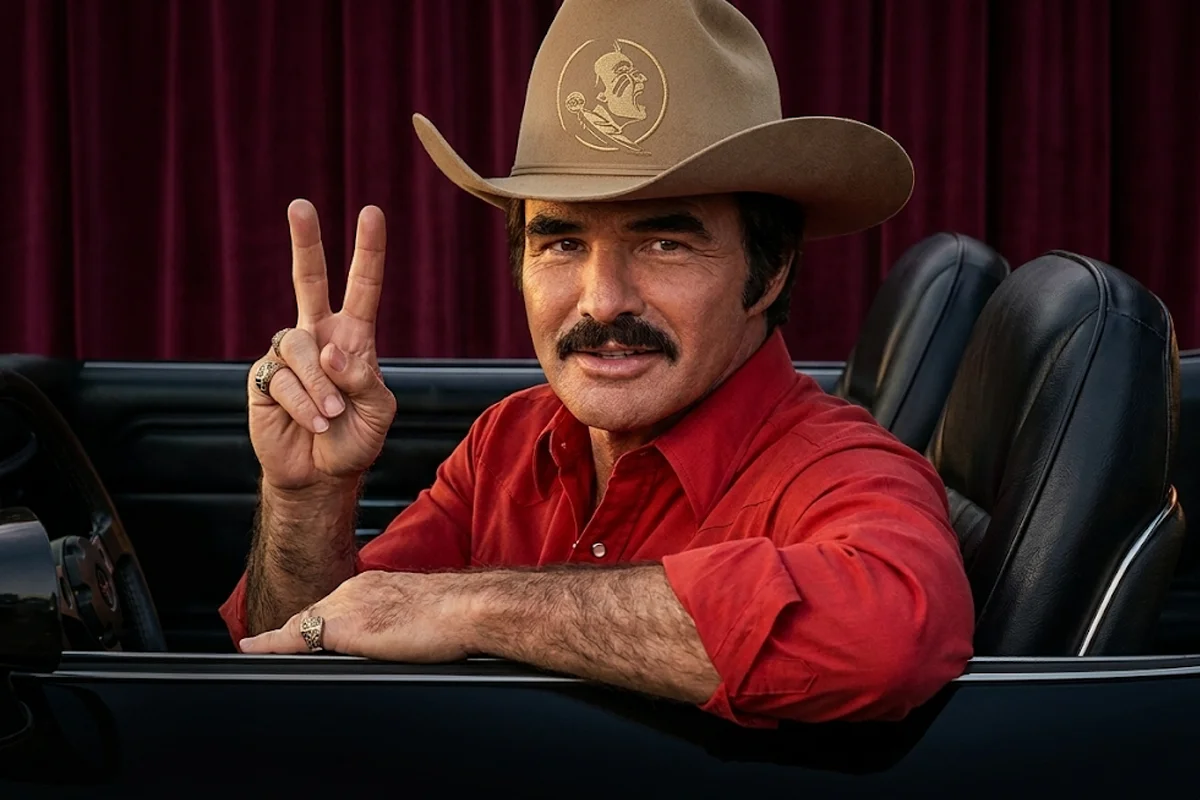
TLDR: Burt Reynolds rose from a small-town Florida kid to Hollywood’s No. 1 box-office star, with his early break as blacksmith Quint Asper on Gunsmoke setting the whole thing in motion.
His career spanned five decades, survived bankruptcy and addiction, and ended with a hard-won respect that a generation of silly car-chase comedies once threatened to bury.
Before the mustache became iconic, before the Bandit made him a superstar, Burt Reynolds was just a Florida kid who had lost everything he thought his future was built on.
A football scholarship at Florida State University looked like his path out of Riviera Beach, right up until a knee injury ended it. He enrolled at Palm Beach Junior College, took a drama class on a professor’s suggestion almost as an afterthought, and won a Florida State Drama Award in 1956 for a production of Outward Bound.
Hollywood didn’t come looking for him right away, but he was already heading that direction.
Burton Leon Reynolds Jr. was born on February 11, 1936, in Lansing, Michigan, but it was the swamps and flatlands of Palm Beach County that shaped him.
His father, an Army veteran, became police chief of Riviera Beach, and Reynolds grew up close to the Everglades in a household that valued toughness and self-sufficiency.
Those qualities would serve him well in the film roles that made him famous, even if it took a decade of television work to get there.
Quint Asper and the Gunsmoke Years
Reynolds joined Gunsmoke in Season 8, taking on the recurring role of Quint Asper, a half-Comanche Indian blacksmith working out of Dodge City.
He appeared in approximately 50 episodes across three seasons from 1962 to 1965, holding his own opposite James Arness in one of the most-watched shows on American television. It was the kind of role that put a face in millions of living rooms every week, and Reynolds made the most of it.
He was physically imposing and naturally charismatic, but the serious, brooding demands of the role had limits. When Reynolds departed the show, it was with the cast’s blessing rather than in conflict.
The Gunsmoke run was never going to be his final destination, and everyone involved seemed to understand that. He went on to star in the short-lived series Hawk in 1966 as a full-blooded Iroquois detective in New York City, and then in the ABC series Dan August from 1970 to 1971.
None of those later TV projects caught fire, but they kept him working and kept him sharp.
Deliverance and the Making of a Star
The turning point came in 1972 with John Boorman’s Deliverance. Reynolds played Lewis Medlock, the hyper-confident outdoorsman who leads a canoe trip into the Georgia wilderness with results no one survives cleanly.
The film was a critical and commercial success, and it demonstrated something that a few seasons of TV had only hinted at: Reynolds had genuine dramatic range when the material demanded it.
He later called it one of his proudest achievements.
That same year, he posed for the first-ever male nude centerfold in Cosmopolitan, a moment that cemented his sex-symbol status but one he would come to have mixed feelings about.
The playful image worked against him in some ways, making it harder for critics and studio executives to take him seriously as a dramatic actor. The tension between his gifts as a performer and his image as a good-time guy would follow him for most of his career.
The Longest Yard arrived in 1974, then Semi-Tough in 1977, and then Smokey and the Bandit that same year, a car-chase comedy that became one of the highest-grossing films of the decade.
From 1978 to 1982, Reynolds was ranked Hollywood’s No. 1 box-office star according to the annual Top Ten Money Making Stars Poll. He wasn’t just popular.
He was, for a stretch, the biggest movie star in the world.
The Choices That Changed Everything
At the absolute peak of that run, Reynolds made a series of decisions that would define the downward slope of his career as much as the upward one.
His long friendship with stuntman-turned-director Hal Needham produced reliable box office hits like Smokey and the Bandit and Hooper, but it also produced Stroker Ace in 1983, a film that became a symbol of creative coasting.
The broadcaster Howard Cosell confronted Reynolds about it directly in an interview captured by writer James Wolcott in a Vanity Fair profile around 1988: “At the height of your stardom, you made certain career choices that were not exactly the soundest. You elected to do Stroker Ace with Hal Needham, and thus you did not do Terms of Endearment.”
Reynolds reflected in later interviews that he didn’t specifically recall passing on Terms of Endearment, but he didn’t argue with the larger point. The choices had consequences.
The mid-1980s brought a string of films that ranged from disappointing to damaging.
Stick in 1985, Heat in 1986, and Switching Channels in 1988 symbolized a career stalled in neutral. During production of Heat, Reynolds punched director Dick Richards, which led to a lawsuit.
The incident became part of the Wolcott Vanity Fair piece as evidence of how far things had slipped from the easy confidence of the Bandit years.
Reynolds made a memorable quip about his commercial slide to Johnny Carson on The Tonight Show: “I haven’t had a hit since Joan Collins was a virgin.” The self-awareness was always there. The hits weren’t.
Addiction, Bankruptcy, and Finding His Way Back
Behind the public narrative of a faded star, something more serious was happening.
A jaw fracture suffered during production on City Heat in the mid-1980s led to a prescription painkiller dependency that nearly killed him. Reynolds later spoke openly about consuming as many as 50 pills a day, primarily Halcion, during the early 1990s.
The addiction compounded every other problem, professional and personal, and left him in a physically diminished state that alarmed people close to him.
His marriage to actress Loni Anderson, which began in 1988, became one of the most publicly contentious divorces in Hollywood when it collapsed in 1993.
They had adopted a son, Quinton Anderson Reynolds, and the custody and support battles played out in tabloids and courtrooms simultaneously.
By 1996, Reynolds filed for Chapter 11 bankruptcy, listing roughly $6.65 million in assets against $11.2 million in debts accumulated through alimony obligations and bad investments.
His Jupiter Farms ranch in Florida, which he had used as a filming location, was eventually sold to the Palm Beach County School District in 1999 for $3.8 million.
He had also founded the Burt Reynolds Dinner Theatre in 1979 and the Burt Reynolds Institute for Theatre Training in Jupiter, Florida, both of which reflected a genuine commitment to the craft that the car-chase comedies sometimes obscured.
Even at his lowest points, he never stopped caring about acting as something more than a paycheck.
Evening Shade and the Boogie Nights Comeback
The first comeback came on television.
CBS cast Reynolds as Wood Newton in Evening Shade, a Southern-set sitcom that ran from 1990 to 1994.
The role fit him perfectly and reminded audiences how naturally funny he could be when given room to breathe.
He won a Primetime Emmy Award for Outstanding Lead Actor in a Comedy Series in 1991 and added a Golden Globe to go with it. The television world had always been good to him, going back to those early days pounding the anvil in Dodge City.
The second comeback was the one that genuinely surprised people. Paul Thomas Anderson cast Reynolds as Jack Horner, a pornographic film director in 1970s Los Angeles, in Boogie Nights in 1997.
The role required Reynolds to play a character defined by misplaced paternal warmth and complete moral blindness, and he delivered one of the best performances of his career.
The Academy nominated him for Best Supporting Actor in 1998. He didn’t win, but the nomination reframed how the industry thought about him.
For a brief period, he was the most interesting story in Hollywood again.
Dinah Shore, Sally Field, and the Relationships That Defined Him
Reynolds was involved with entertainer Dinah Shore throughout much of the 1970s, a relationship notable partly because Shore was 20 years his senior.
The pairing fascinated the public and the press in equal measure, and Reynolds spoke warmly about Shore in interviews for decades afterward.
His relationship with Sally Field, which lasted from the late 1970s into the early 1980s, was the one he seemed to regret losing most. He expressed in several interviews over the years that he believed she was the love of his life, though Field offered a more complicated account of the relationship in her own memoir.
His son Quinton, adopted with Loni Anderson, maintained a very low public profile throughout his life and into adulthood.
Reynolds’s 2011 will named his niece, Nancy Lee Brown Hess, as executor and personal representative. Quinton was intentionally omitted from direct inheritance, with Reynolds noting in the document that he had provided for his son separately through a declaration of trust.
Loni Anderson died in 2025, leaving Quinton without either parent.
Death and the Documentary Record
Reynolds died on September 6, 2018, at Jupiter Medical Center in Jupiter, Florida. He had been taken from his home in Hobe Sound after experiencing chest pains, and the cause of death was cardiopulmonary arrest. He was 82 years old.
His remains were not interred until February 11, 2021, his 85th birthday, more than two and a half years after his death. He was buried at Hollywood Forever Cemetery in Los Angeles.
The long gap between his death and burial was never fully explained in public statements from the family or estate.
The CW broadcast a documentary, I Am Burt Reynolds, premiering on December 30 and 31, 2023, in which friends and family reflected on his life, his addiction, his financial troubles, and the regrets he carried.
It was a portrait of someone who had lived at full volume and paid real prices for it, and who never stopped being compelling to watch.
The arc from Florida football prospect to Gunsmoke blacksmith to the biggest star in Hollywood to Boogie Nights redemption is one of the stranger and more honest stories American popular culture produced in the 20th century.
Reynolds went through more versions of himself than most careers allow, and the audience stayed curious about him through nearly all of them.
What role did Burt Reynolds play on Gunsmoke?
Burt Reynolds played Quint Asper, a half-Comanche Indian blacksmith, on Gunsmoke from 1962 to 1965. He appeared in approximately 50 episodes across three seasons before departing to pursue a film career.
When was Burt Reynolds the number one box-office star?
Burt Reynolds was ranked Hollywood’s No. 1 box-office star from 1978 to 1982 according to the annual Top Ten Money Making Stars Poll. His run of hits including Smokey and the Bandit and The Longest Yard drove that dominance.
Did Burt Reynolds win an Oscar?
Burt Reynolds was nominated for the Academy Award for Best Supporting Actor in 1998 for his role as Jack Horner in Boogie Nights, but he did not win. He did win a Primetime Emmy Award and a Golden Globe for his role in the CBS series Evening Shade.
How did Burt Reynolds die?
Burt Reynolds died on September 6, 2018, at Jupiter Medical Center in Jupiter, Florida, from cardiopulmonary arrest. He was 82 years old.
Did Burt Reynolds file for bankruptcy?
Yes. Burt Reynolds filed for Chapter 11 bankruptcy in 1996, listing approximately $6.65 million in assets against $11.2 million in debts. His financial difficulties stemmed from alimony obligations following his divorce from Loni Anderson and a series of bad investments.