TLDR: Steve Jobs died in 2011 leaving $10.2 billion to his wife Laurene Powell Jobs through a trust. 80% of it came from Disney stock (from selling Pixar), not Apple.
Laurene has publicly stated she’s spending it all down during her lifetime – “it ends with me.” She runs Emerson Collective, an LLC that funds climate change ($3.5B commitment), journalism (bought The Atlantic), immigration reform, and Democratic politics.
The four Jobs kids (Lisa, Reed, Erin, Eve) get support and opportunities but won’t inherit the billions. She’s sold half the Disney stock and almost all the Apple stock.
Her net worth is now $11.9-14.6 billion – it hasn’t grown much because she’s actively giving it away.
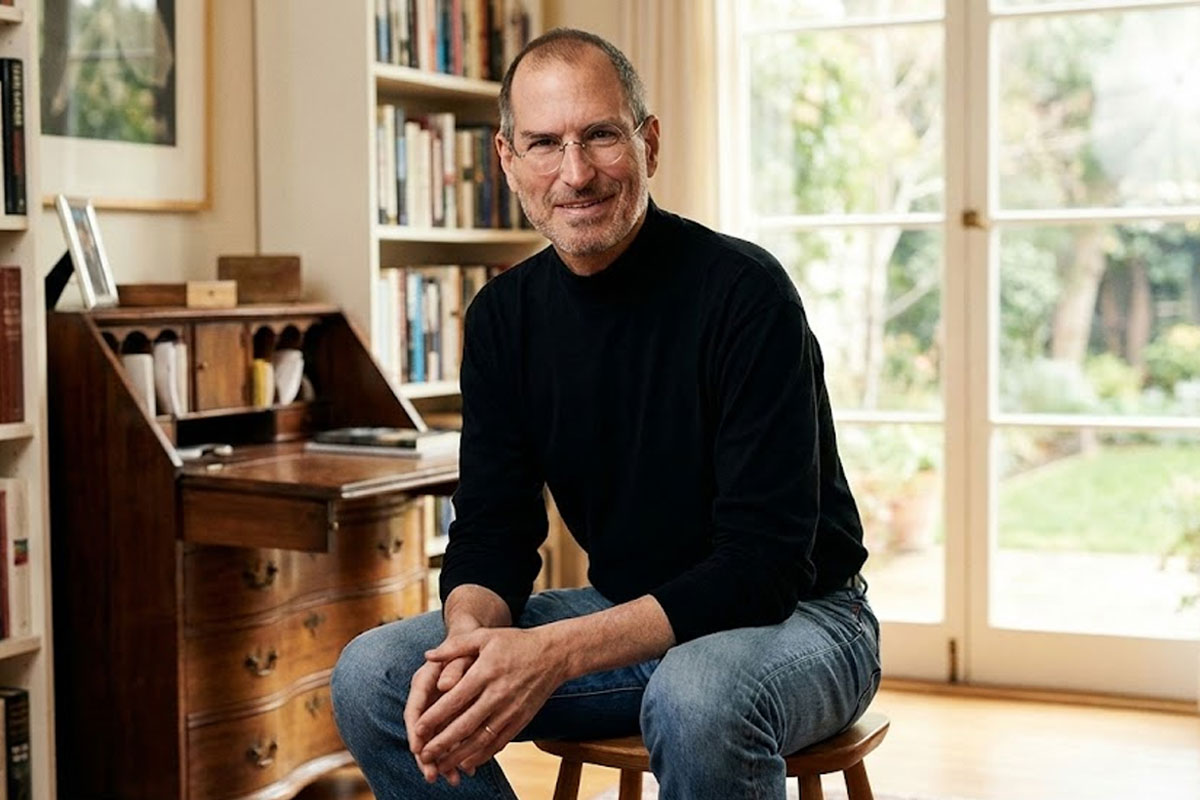
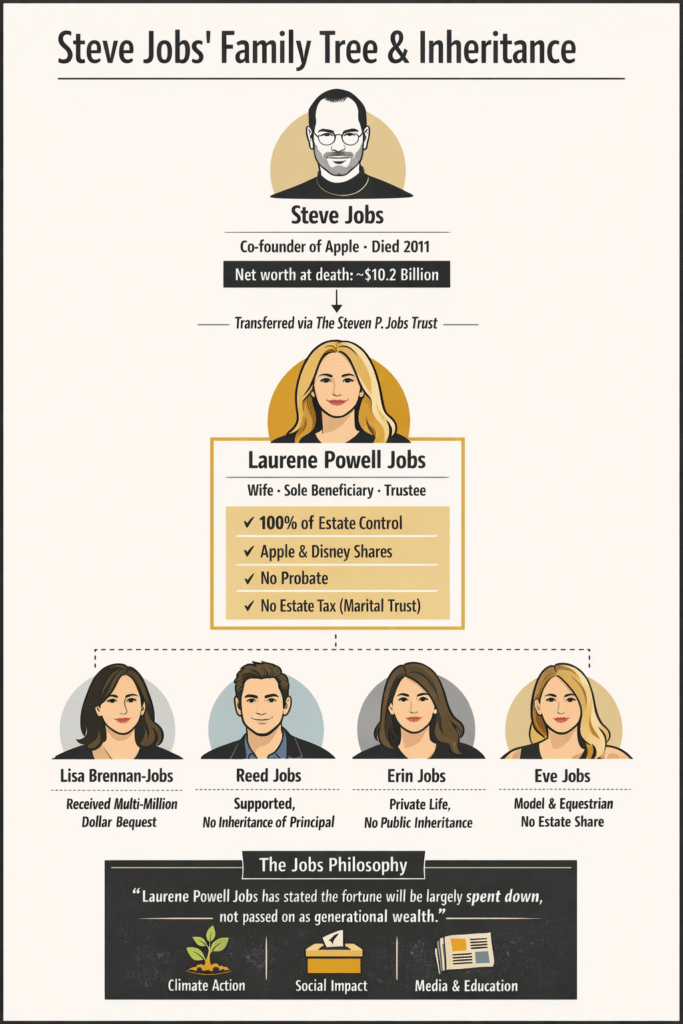
Steve Jobs died on October 5, 2011, with a fortune estimated at $10.2 billion. Every penny went to his wife of 20 years, Laurene Powell Jobs, through the Steven P. Jobs Trust.
Here’s what makes this different from every other tech billionaire estate: Laurene has explicitly said she’s spending it all.
Not leaving it to the kids. Not building a dynasty.
She told The New York Times in 2020: “I’m not interested in legacy wealth buildings, and my children know that. If I live long enough, it ends with me.”
And she means it. She’s committed $3.5 billion to climate change. She bought The Atlantic magazine. She’s a mega-donor to Democratic politics. She sold half the Disney stock and almost all the Apple stock for cash to fund these projects.
Unlike estates that created family wars like Prince’s or Aretha Franklin’s, or ones stuck in probate like Michael Jackson’s, Steve Jobs’ estate was set up to be completely private.
No probate, no public fighting, just a clean transfer to his wife and a plan to spend it on changing the world.
This is the story of what happened to Steve Jobs’ $10 billion and why his kids won’t inherit it.
80% of Steve Jobs’ Fortune Came From Disney, Not Apple
Here’s the wild part most people don’t know. When Steve Jobs died, only about 20% of his wealth came from Apple. The other 80% – roughly $4.6 to $4.74 billion – came from Disney stock.
How did the guy who invented the iPhone make most of his money from Mickey Mouse? It goes back to Pixar.
After Apple kicked him out in 1985, Jobs bought the computer graphics division of Lucasfilm for $5 million in 1986. That became Pixar. He subsidized it for a decade while it lost money. Then Toy Story hit in 1995 and everything changed.
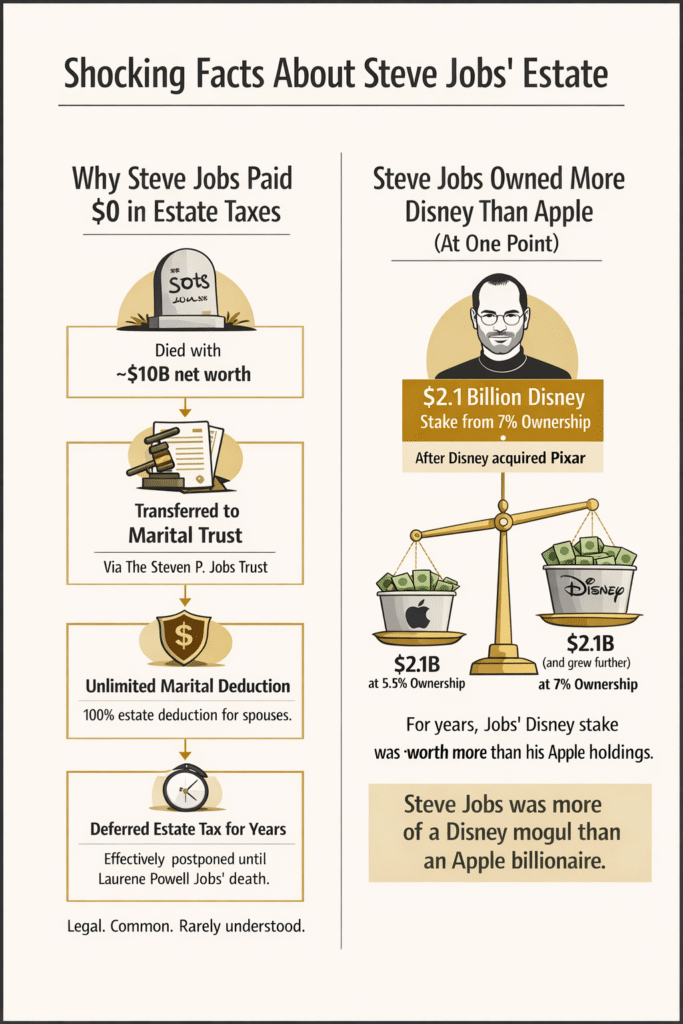
In 2006, Disney bought Pixar for $7.4 billion in an all-stock deal. Jobs became Disney’s single largest individual shareholder with 138 million shares – about 7.7% of the entire company. More than the Disney family owned. More than the CEO.
When he died in 2011, those Disney shares were worth around $4.6 billion. His Apple stake? Only about $2.05 billion. Disney was double.
Here’s the genius move: Jobs held the Disney stock until he died. Under U.S. tax law, when you die, your heirs get a “step-up in basis.” That means the cost basis resets to the value on your death date.
By holding until death, Jobs avoided an estimated $867 million in capital gains taxes that would have been owed if he’d sold the stock while alive.
Jobs Sold His Original Apple Stake in 1985 and Lost Out on Hundreds of Billions
When Apple fired Steve Jobs in 1985, he was bitter. He sold his entire founder’s stake – about 11% of the company. He kept exactly one share so he could attend shareholder meetings.
If he’d held that original 11%, his estate would have been worth exponentially more. We’re talking potentially the wealthiest person in history by a wide margin. But he sold it all.
The Apple stock he owned when he died – 5.55 million shares worth $2.05 billion – came from later. Mostly from stock options when Apple bought his company NeXT in 1997 and from his compensation as CEO during the turnaround.
Everything Went to Laurene Through a Trust to Avoid Probate
Steve Jobs put everything into the Steven P. Jobs Trust while he was alive. The Disney stock, the Apple stock, the houses, the yacht being built in the Netherlands, the Gulfstream jet – all of it went into the trust.
When he died, control passed immediately to Laurene Powell Jobs as the successor trustee. No probate court. No public inventory of assets. No creditors filing claims. Unlike Robin Williams’ estate which had family fights in court or Whitney Houston’s probate, the Jobs estate stayed completely private.
The transfer to Laurene used the “unlimited marital deduction.” You can transfer unlimited wealth to a surviving spouse tax-free. That’s how $10.2 billion moved to Laurene without the estate paying a single dollar in estate tax.
The tax isn’t eliminated – it’s just deferred until Laurene dies. But here’s the thing: if she spends it all down on philanthropy and politics like she says she will, there won’t be anything left to tax.
Laurene Powell Jobs: “It Ends With Me”
Laurene Powell Jobs isn’t some widow who inherited money and started shopping. She has a degree in political science and economics from Wharton, worked in fixed-income trading at Goldman Sachs, and got her MBA from Stanford where she met Steve.
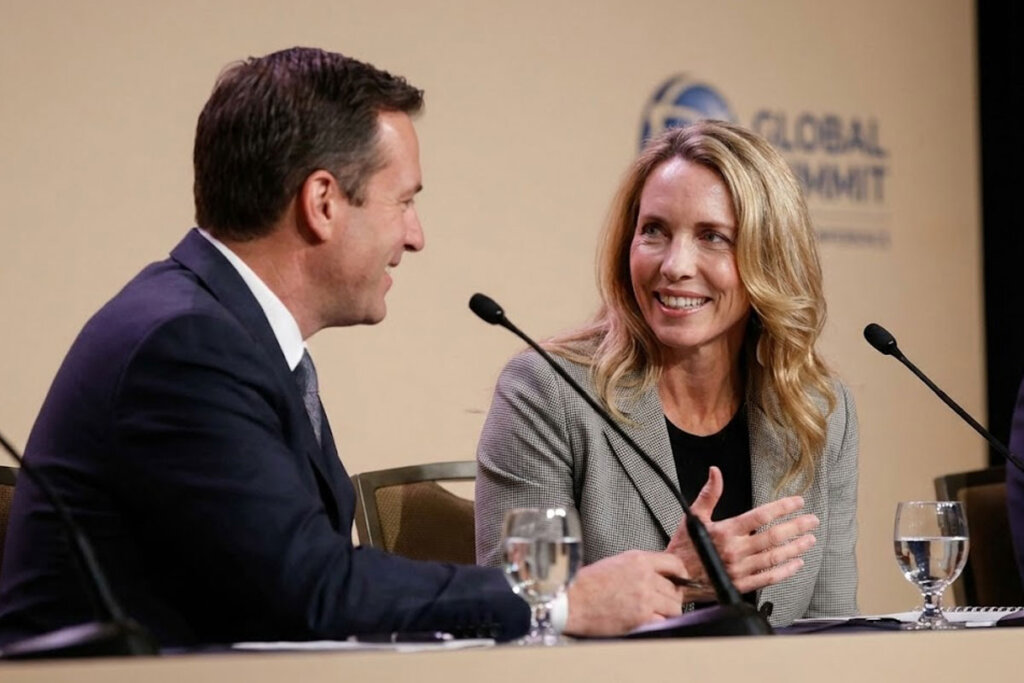
In a 2020 New York Times interview, she made her philosophy crystal clear: “I inherited my wealth from my husband, who didn’t care about the accumulation of wealth. I’m not interested in legacy wealth buildings, and my children know that. Steve wasn’t interested in that. If I live long enough, it ends with me.”
That’s the governing principle of the entire estate. She’s actively trying to spend down the fortune to zero during her lifetime. No dynastic wealth. No trust funds for great-grandchildren. The kids can make their own money.
It’s the opposite of how families like the Rockefellers or even modern tech billionaires structure their estates. She’s essentially disinheriting future generations from the massive wealth, forcing them to actually work.
She Runs It Through Emerson Collective, Not a Foundation
To execute this spend-down strategy, Laurene doesn’t use a traditional foundation like the Gates Foundation. She uses Emerson Collective, an LLC she founded in 2004.
The difference is huge. A foundation has strict rules, must file public tax forms, can’t do politics, and has to follow “prudent investor” guidelines. An LLC has none of those restrictions.
Emerson Collective can donate to political campaigns, lobby for legislation, invest in high-risk startups, buy media companies, and do it all anonymously. No IRS Form 990 disclosures. Total flexibility.
She’s used this structure to:
Buy a majority stake in The Atlantic magazine in 2017. Invest in journalism (Axios, ProPublica, Mother Jones). Fund immigration reform advocacy and Dream Act campaigns. Launch the Waverley Street Foundation with $3.5 billion committed to climate change over 10 years.
Donate massive sums to Democratic candidates like Joe Biden and Kamala Harris. Fund the XQ Institute with $100 million to reinvent American high schools.
Unlike estates that stayed purely focused on preserving wealth like Agatha Christie’s or Dr. Seuss’, or those managing music royalties like Elvis’s for family benefit, Laurene is actively burning through the money on causes.
She Sold Half the Disney Stock and Almost All the Apple Stock
In 2017, regulatory filings showed Laurene sold about half of the massive Disney stake. The holding dropped from 138 million shares to about 64 million. That sale generated an estimated $6-7 billion in cash.
By selling below 5% ownership, she no longer has to publicly disclose Disney sales. So nobody knows exactly how much she still owns, but it’s definitely less than the original stake.
Then she did something even more shocking: she sold almost all the Apple stock. By 2021, reports showed she had “fully exited” the position. Recent filings show Emerson Collective holding only about 53,000 Apple shares – negligible compared to the original 5.5 million.
This is wild because Apple stock exploded in value between 2011 and 2025. If she’d just held it, the estate would potentially be worth $100 billion today. But she sold it for cash to fund her projects.
That’s proof she’s serious about the spend-down. She’s prioritizing current impact over maximum wealth accumulation. The fortune isn’t growing – it’s being deployed.
She Made $1 Billion Profit Flipping a Sports Team Stake
In 2017, Laurene bought a 20% stake in Monumental Sports & Entertainment (owns the NBA Wizards and NHL Capitals) for about $500 million. In late 2025, she sold it to Arctos Partners and the Qatar Investment Authority for roughly $1.5 billion.
That’s a $1 billion profit in 8 years. The sale replenished Emerson Collective’s cash after years of massive grants and political donations.
Managing estates as active investment vehicles is rare. Most celebrity estates, like Frank Sinatra’s, focused on licensing and royalties. Laurene is buying and selling major assets like a hedge fund.
The Four Jobs Kids Won’t Inherit Billions
Steve Jobs had four children: Lisa Brennan-Jobs (from his relationship with Chrisann Brennan before he married Laurene), and Reed, Erin, and Eve Jobs (with Laurene). The estate plan deliberately bypasses them for the massive fortune.
Lisa Brennan-Jobs got “millions” directly from Steve’s estate as a specific bequest. This is separate from what Laurene controls. Lisa went to Harvard, became a writer, and published a memoir about growing up as Steve’s estranged daughter. She lives in Brooklyn and seems removed from the Silicon Valley empire.
Reed Jobs was on track to be a doctor at Stanford when his dad died of pancreatic cancer. He pivoted to working for his mom at Emerson Collective, managing health investments and funding cancer research.
In 2023, he launched his own venture capital firm called Yosemite with over $200 million – backed by Emerson Collective, obviously. He controls capital, but didn’t inherit billions personally.
Erin Siena Jobs is the most private. She studied architecture at Tulane and lives quietly. There’s almost no public information about her involvement in business or philanthropy. She’s using the family’s wealth to buy privacy.
Eve Jobs is the opposite – totally public.
She’s an accomplished equestrian (ranked among top riders globally under 25) and a model signed with DNA Model Management. She’s done campaigns for Louis Vuitton and Glossier.
In July 2025, she married British Olympic equestrian Harry Charles in a wedding estimated to cost $6.7 million.
The kids are clearly supported. Eve’s $6.7 million wedding wasn’t self-funded. They have safety nets, elite educations, connections. But they’re not getting the principal. The “no legacy wealth” rule means Laurene is spending down the fortune, not building trusts for her grandkids.
Her Net Worth Hasn’t Grown Much Because She’s Giving It Away
In 2011, Laurene inherited $10.2 billion. As of early 2026, her net worth is estimated at $11.9 to $14.6 billion. That’s almost flat over 15 years during the greatest bull market in history.
Why hasn’t it grown? Because she’s spending billions. The $3.5 billion climate commitment alone is a third of the original estate. Add in grants, political donations, media acquisitions, and the lack of growth makes sense.
Compare that to estates that grew massively like James Brown’s (sold for $90M after starting at $5M) or Prince’s (went from debt to $2-3 billion). Laurene is deliberately preventing growth through aggressive spending.
If she lives another 20-30 years and keeps this pace, the estate really could end with her. That $14 billion could be zero by the time she dies if it’s all deployed into climate, education, immigration, journalism, and politics.
The Bottom Line on Steve Jobs’ Inheritance
Steve Jobs died in 2011 with $10.2 billion. About 80% came from Disney stock (from selling Pixar in 2006), only 20% from Apple. Everything went to his wife Laurene Powell Jobs through the Steven P. Jobs Trust, using the unlimited marital deduction to avoid estate taxes.
Laurene has explicitly stated she’s spending it all down during her lifetime – “it ends with me.” She runs Emerson Collective as an LLC (not a foundation), giving her complete flexibility to fund politics, climate change, immigration reform, and journalism without public disclosure or restrictions.
Major moves: Sold half the Disney stock (2017) for $6-7 billion cash. Sold almost all the Apple stock (by 2021). Committed $3.5 billion to climate change via Waverley Street Foundation. Bought The Atlantic magazine. Mega-donor to Democratic politics. Made $1 billion profit flipping a sports team stake.
The four Jobs children (Lisa, Reed, Erin, Eve) are supported with safety nets and opportunities, but won’t inherit the billions. Lisa got millions directly. Reed got backing to start his own $200M VC firm. Eve had a $6.7M wedding. But they’re not getting the principal – that’s being spent on causes.
Laurene’s net worth is now $11.9-14.6 billion – barely grown from $10.2B in 2011 because she’s actively giving it away. If she lives long enough, the estate could genuinely end at zero.
This is radically different from other tech/celebrity estates. Unlike Michael Jackson’s kids who are supposed to eventually get billions, or estates stuck in family warfare.
It’s also opposite from estates focused on preservation like Johnny Cash’s, corporate ownership like Marilyn Monroe’s (owned by Authentic Brands Group), or estates managing intellectual property for family benefit like Agatha Christie’s or Dr. Seuss’.
Steve Jobs famously said he didn’t care about accumulating wealth. Laurene is honoring that by actively dismantling the fortune dollar by dollar. The legacy won’t be a dynasty of rich descendants. It’ll be the institutions funded, the climate initiatives launched, the journalism supported, and the political change enabled.
From an estate planning perspective, Jobs did it right. He used a revocable living trust to avoid probate completely, unlike Robin Williams whose trust still led to family court battles. Everything transferred privately to Laurene with zero public drama.
The “spend-down” philosophy is controversial. Some people think it’s irresponsible not to build generational wealth. Others think it’s the most responsible thing a billionaire can do – actually deploy the capital to solve problems rather than hoard it.
Either way, it’s working. Laurene Powell Jobs controls one of the most powerful private capital deployment vehicles in America. She’s using it to shape policy, fund journalism, fight climate change, and support immigration reform. The fortune is being weaponized for specific political and social outcomes.
The Jobs kids know they’re not getting billions. Eve can have her $6.7 million wedding and model for Louis Vuitton. Reed can run a $200 million VC firm. But the principal? That’s going to save the planet, elect Democrats, and fund cancer research.
Steve Jobs spent his life fighting for control – control of his products, his company, his vision. In death, he handed total control to Laurene and trusted her to do what she thought was right. Unlike estates that created endless litigation like James Brown’s (19 years of court battles) or Tupac’s, the Jobs estate has been drama-free.
Laurene Powell Jobs is 61 years old as of 2026. If she lives to 90, she has 29 years to spend down $14 billion. That’s about $480 million a year. Between the Waverley climate commitment, political donations, journalism investments, and education grants, she’s on track to do it.
When she dies, there might not be much left. The kids will have their own careers, their own money from smaller trusts and inheritances, but they won’t be “Jobs dynasty” billionaires. The Steve Jobs fortune will have been converted into impact – measurable change in climate, education, immigration policy, and democratic institutions.
That’s the inheritance: not money, but mission. Not dynasty, but disruption. Steve Jobs changed technology. Laurene Powell Jobs is using his fortune to try to change the world. And when she’s done, like she said: it ends with her.
Like Hugh Hefner who left detailed instructions that created specific outcomes, or estates that maintained tight control like Frank Sinatra’s, Steve Jobs’ estate planning achieved exactly what he wanted: privacy, clean transfer, and empowerment of his wife to do what she thought was right with the money.
Mission accomplished.