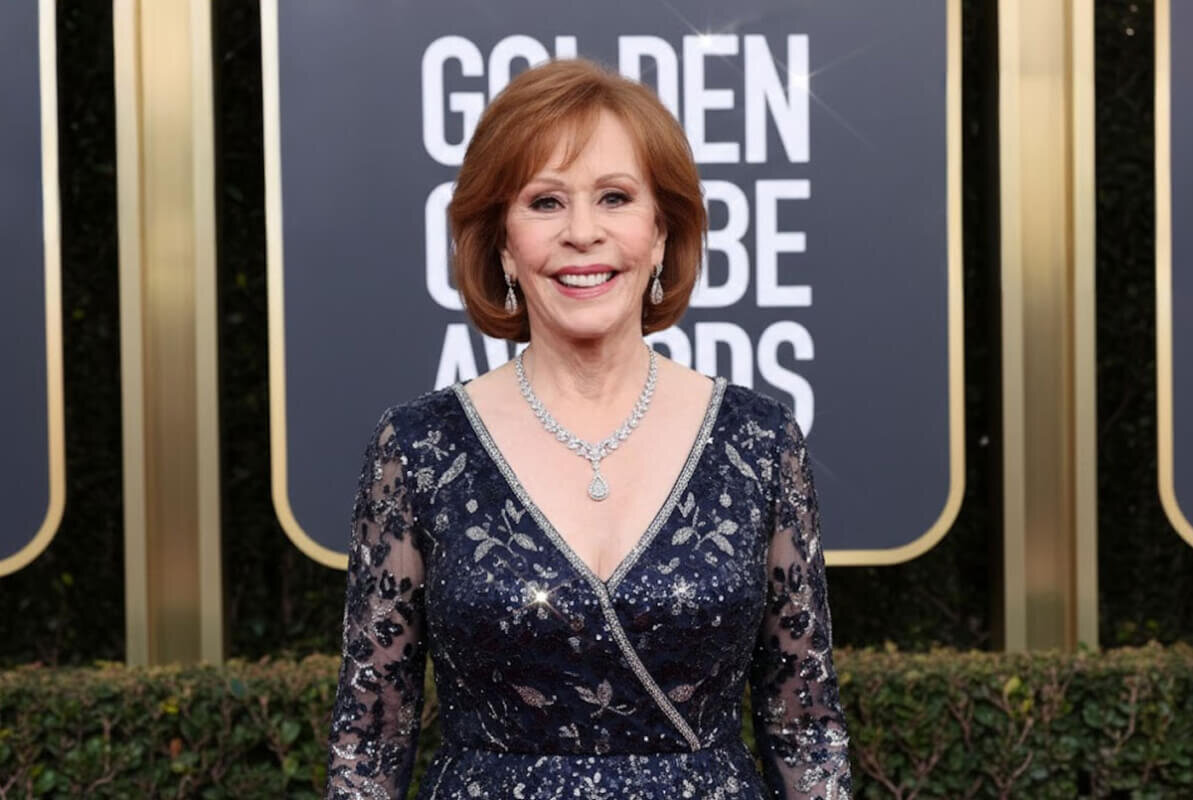
TLDR: Carol Burnett is worth $45 million in 2026 at age 92, built on ownership of The Carol Burnett Show through her company Whacko Inc. and recent earnings from starring in Apple TV+’s Palm Royale.
She just donated 140+ awards to UCLA in November 2025 and is transitioning from acting to producing and writing after Palm Royale Season 2 concluded in January 2026.
In January 2026, Carol Burnett finished filming the season finale of Palm Royale on Apple TV+. She was 92 years old. The episode required her to perform “Something Good,” a song associated with her lifelong friend Julie Andrews. She nailed it in one take.
Then she went home to her Montecito estate, worth somewhere between $12 million and $15 million, and started thinking about what comes next.
Because at 92, with a net worth of $45 million and a career spanning seven decades, Carol Burnett isn’t done.
She’s just changing the game.
This is the story of how a woman who started with a $1,000 loan from an anonymous stranger became one of the smartest businesswomen in Hollywood. How she fought CBS executives who told her “variety is a man’s game” and won ownership of her show.
How she turned The Carol Burnett Show into a perpetual revenue engine that still generates income 48 years after its final episode.
And how she’s spending her 90s starring in prestige television, donating her legacy to UCLA, and preparing for the long goodbye on her own terms.
The Deal That Built a Fortune
Carol Burnett is worth $45 million in 2026. But the foundation of that fortune was laid in the late 1960s with a contract clause that CBS executives probably wish they could take back.
When Burnett signed with CBS, her contract included what she called “the button” clause. It gave her the unilateral right to demand that CBS produce 30 episodes of a variety show.
When she exercised this right, the network was contractually obligated to fund it, even though executives were skeptical that a woman could host a variety show.
They tried to talk her out of it. They told her variety was a man’s game. She pushed forward anyway. But she included one crucial stipulation: her production company, Whacko Inc., would own the show.
That decision is why Carol Burnett is worth $45 million today instead of $5 million.
Most stars in the 1960s were paid a salary and maybe got small residuals when their shows aired in reruns. But Burnett, as the owner of the copyright to The Carol Burnett Show, has been the primary beneficiary of the show’s syndication for nearly 50 years.
Every time the show airs on MeTV or Pluto TV, Burnett’s company gets paid. Every time someone buys a DVD box set or streams an episode digitally, she gets a cut.
For five decades, The Carol Burnett Show has been a revenue engine that never stops.
It’s the George Lucas model applied to television. Bet on ownership over upfront cash, and let the long tail of content licensing make you rich.
Palm Royale and the $4 Million Payday
In November 2025, Palm Royale Season 2 premiered on Apple TV+. Carol Burnett played Norma Dellacorte, a wealthy Palm Beach socialite who spent most of Season 1 in a coma but woke up fully operational for Season 2.
The show ran for 10 episodes, concluding in January 2026. Burnett appeared in every episode, sharing scenes with Kristen Wiig, Laura Dern, and Ricky Martin. At 92, she was doing 12-hour days on set, memorizing dialogue, hitting her marks, and improvising comedic bits.
And she got paid handsomely for it.
Industry analysts estimate that Burnett earned between $150,000 and $250,000 per episode for her role in Palm Royale. Over two seasons and 20 episodes total, that’s roughly $4 million in gross earnings. For a 92-year-old actress, that’s a massive capital infusion.
But the financial impact goes beyond the salary. Palm Royale reignited interest in Burnett’s back catalog. Search traffic for “Carol Burnett” spiked during the show’s release windows. Streaming numbers for The Carol Burnett Show went up. Book sales for her memoirs increased.
New fans discovering Burnett through Apple TV+ went looking for her old work. And every time they watched, read, or bought something, it generated revenue.
The Montecito Estate
Carol Burnett lives in Montecito, California, one of the most expensive real estate markets in the country. Her neighbors include Oprah Winfrey, Prince Harry, and Meghan Markle. Ellen DeGeneres sold a property in the area for $32 million in 2024.
Burnett’s estate is valued between $12 million and $15 million as of 2026. She’s owned it for years, which means her cost basis is relatively low compared to current market value. The property is almost certainly mortgage-free, providing a massive pillar of stability in her net worth.
Montecito attracts wealthy retirees because of its privacy, climate, and wellness culture. Demand for properties like Burnett’s remains high, insulating her asset from broader real estate market volatility.
As long as billionaires want to live in Southern California, her home will appreciate.
The November 2025 Donation
In November 2025, Carol Burnett made a strategic move that signaled a shift from wealth accumulation to legacy curation. She donated over 140 of her major awards to UCLA, including Emmys, Golden Globes, Peabody Awards, and her Presidential Medal of Freedom.
This wasn’t just a sentimental gesture. It was a masterclass in estate planning.
By donating these items to an institutional archive, Burnett ensures they’re preserved in climate-controlled conditions and made available for scholarly research. This elevates her work from entertainment to cultural history.
It also creates a significant charitable tax deduction. The appraised value of a Carol Burnett Golden Globe is substantial. That deduction can be used to offset the high income she generated from Palm Royale, optimizing her tax position for 2025 and 2026.
And it simplifies her estate. Physical awards are difficult to value and distribute in a will. By donating them during her lifetime, Burnett removes them from her probate estate, making the eventual inheritance process easier for her children.
Along with the donation, she established the Carol Burnett Endowed Undergraduate Scholarship in Music Theater at UCLA. Burnett often tells the story of how she only attended UCLA because of a $1,000 anonymous loan.
This scholarship closes that circle, creating a permanent funding structure for future students.
The Reunion With Vicki Lawrence
One of the most significant moments of Palm Royale Season 2 was the on-screen reunion of Carol Burnett and Vicki Lawrence. Lawrence played Lottie, the mother of Burnett’s character Norma.
This reversed the dynamic they’d had on The Carol Burnett Show in the 1970s. Back then, a 20-something Lawrence played Mama Harper, the elderly mother to Burnett’s character Eunice, even though Burnett was 16 years older.
On Palm Royale, Lawrence (now 76) played the mother to Burnett (now 92), continuing the age-inappropriate casting gag that had defined their “Family” sketches.
But the reunion was more than a casting joke. It marked the healing of a relationship that had fractured during the Mama’s Family era in the 1980s. When Burnett divorced producer Joe Hamilton, she “divorced everyone” associated with the show, including Lawrence. They were estranged for years.
By 2025, they’d reconciled. Lawrence told interviewers they were “closer than ever now.” Burnett said working with Lawrence again felt “like old times.” The showrunner called their reunion “one of the most touching moments” he’d ever witnessed on set.
For Burnett, bringing Lawrence into Palm Royale was a way of honoring their shared history while building something new.
What Happened to the Rest of the Cast
Carol Burnett is one of the last survivors of The Carol Burnett Show original cast. Harvey Korman died in 2008 with a net worth of $25 million. Tim Conway died in 2019 after a brutal conservatorship battle with his family. Lyle Waggoner died in 2020, but his trailer company Star Waggons sold for $222 million in 2021.
Vicki Lawrence is still alive at 76, touring as Mama Harper and appearing in Palm Royale alongside Burnett. And Dick Van Dyke, who briefly joined the show in 1977, just turned 100 and is still going to the gym three times a week.
But Burnett has outlasted most of them. And unlike Conway, who spent his final years unable to speak, or Korman, who died suddenly from an aneurysm, Burnett is still sharp, still working, still making creative decisions.
The Transition to Producing and Writing
In late 2025 interviews, Carol Burnett was candid about her future. She said, “Unless something just unbelievable comes up, I don’t feel that I can top being with Palm Royale.”
This wasn’t a retirement announcement. It was a pivot announcement.
Burnett is transitioning from on-camera acting to behind-the-scenes work. The rigors of a single-camera production are physically taxing for a 92-year-old. Hair, makeup, lighting, 12-hour days on set. It’s exhausting. Palm Royale likely represents her final series regular role.
But she’s not disappearing. She’s shifting to writing and producing. This allows her to remain creatively active and generate income without the physical demands of performance.
She’s also continuing voice acting work. She voiced Chairol Burnett in Toy Story 4, appeared on the Frasier reboot, and did voice work for the Pixar short Carl’s Date.
Voice acting requires no makeup, no costumes, and can be recorded from a home studio. It’s the most sustainable path for Burnett to continue working into her mid-90s.
The Books That Keep Selling
Carol Burnett is a prolific author. Her memoirs include In Such Good Company, This Time Together, Carrie and Me, and One More Time. These books provide a steady stream of passive income.
Celebrity memoirs have a long shelf life, especially those by beloved figures. They’re perennial sellers around holidays like Mother’s Day and Christmas. The release of Palm Royale likely triggered a restocking cycle in bookstores, keeping Burnett’s titles visible and driving sales.
With the rise of audiobooks, Burnett’s narration of her own memoirs adds another revenue stream. Her distinctive voice is a selling point, and audio royalties often command higher margins than print.
The Lost Episodes Strategy
For decades, only a portion of The Carol Burnett Show was available in syndication. The “syndication package” included sketches from seasons 6 to 11, but seasons 1 to 5 were locked away, unavailable to the public.
In the late 2010s, Burnett’s company executed a strategic release of these “Lost Episodes.” The phased release created a new revenue cycle that continues in 2026 through DVD box sets and digital downloads.
This is smart content management. Instead of dumping everything at once and saturating the market, Burnett’s team released the episodes gradually, creating recurring waves of interest and revenue.
They also solved a major problem that plagued other variety shows. Music licensing is expensive. The cost to clear songs often exceeds the revenue potential, leaving shows like The Muppet Show or Saturday Night Live with edited episodes where musical numbers are cut.
Burnett’s team aggressively secured the rights to keep the majority of musical numbers intact. This preservation of the “complete” experience adds premium value to her library in the streaming marketplace.
The Tours That Aren’t Happening
If you search for “Carol Burnett tickets 2026,” you’ll find listings on ticket aggregator sites for shows at venues like the Pickens County Performing Arts Center. But these aren’t Carol Burnett appearances. They’re tribute shows.
Local theatrical productions recreate scenes from The Carol Burnett Show, and they use her name and imagery in their marketing. This creates consumer confusion, making people think Burnett is touring when she’s not.
Burnett conducted Q&A tours extensively in the 2010s, traveling to theaters across the country to talk about her career and take questions from audiences. But that era appears to have ended. Her public appearances are now restricted to high-impact industry events like the Golden Globes, Emmy FYC panels, and award ceremonies.
At 92, she’s choosing quality over quantity. A few meaningful appearances rather than a grueling tour schedule.
The Brand That Never Dies
In 2019, the Golden Globes created a lifetime achievement award in Carol Burnett’s name. The Carol Burnett Award is presented annually to someone who’s made outstanding contributions to television. In 2026, it was given to Sarah Jessica Parker.
The existence of this award ensures that Burnett’s name is spoken with reverence on a global broadcast every January, keeping her relevant even when she’s not personally nominated. It’s branding that outlasts a career.
Her reputation is also Teflon. She’s universally perceived as kind, professional, and apolitical. This makes her an attractive partner for brands like Apple TV+ that want to project a wholesome yet prestigious image.
In an era of cancel culture, Burnett’s brand is bulletproof. She’s the nice lady who made people laugh for 50 years. That goodwill has economic value.
How She Compares to the Legends
Carol Burnett’s $45 million net worth puts her in elite company, but it’s instructive to compare her to other legends of her era.
Lucille Ball, Burnett’s mentor, died in 1989 with a net worth of roughly $40 million (unadjusted for inflation). Burnett has surpassed her mentor in longevity and active career duration.
Ball ran Desilu Productions, a full studio operation. Burnett focused solely on her own content through Whacko Inc., a leaner but equally profitable model.
Betty White experienced a massive resurgence in her late 80s and early 90s with Hot in Cleveland and the Snickers Super Bowl commercial.
Burnett’s Palm Royale arc mirrors this, proving that the “Betty White Model” of career twilight is replicable for performers with sufficient goodwill and talent.
Mary Tyler Moore was a contemporary icon, but her later years were less active due to health issues. Burnett’s physical robustness at 92 allows her to occupy the space of “Last Living Legend of the Golden Age,” granting her a monopoly on accolades and opportunities in this specific niche.
The Long Goodbye
Carol Burnett is 92 years old. She’s worth $45 million. She just finished starring in a hit show on Apple TV+. She donated her awards to UCLA. She established a scholarship for future performers. And she’s transitioning from acting to producing and writing.
This is what a controlled exit looks like. She’s not fading away. She’s not being forgotten. She’s orchestrating her own legacy, step by step, ensuring that her impact lasts long after she’s gone.
The donation to UCLA preserves her physical legacy. The scholarship ensures her name appears on financial aid letters for decades. The ownership of The Carol Burnett Show through Whacko Inc. guarantees that her estate will continue generating revenue for her heirs.
And the success of Palm Royale introduced her to a new generation who will now seek out her old work.
As long as there are screens to play The Carol Burnett Show and audiences to read her memoirs, the Burnett estate will continue to generate wealth. But more importantly, as long as people value laughter, kindness, and resilience, Carol Burnett’s cultural value will appreciate.
She’s not done yet. She’s just changing how she plays the game.
And at 92, with $45 million in the bank and a legacy secured at UCLA, she’s playing it better than almost anyone in Hollywood.