TLDR: Lyle Waggoner died March 17, 2020 at age 84 from cancer at his Westlake Village home.
Eighteen months later, his company Star Waggons sold for $222 million, making the handsome announcer from The Carol Burnett Show far richer than any of his former castmates, including Carol Burnett herself.
Lyle Waggoner died on March 17, 2020 in his Westlake Village, California home. He was 84 years old. The cause was cancer. His wife Sharon was by his side. They’d been married for 60 years.
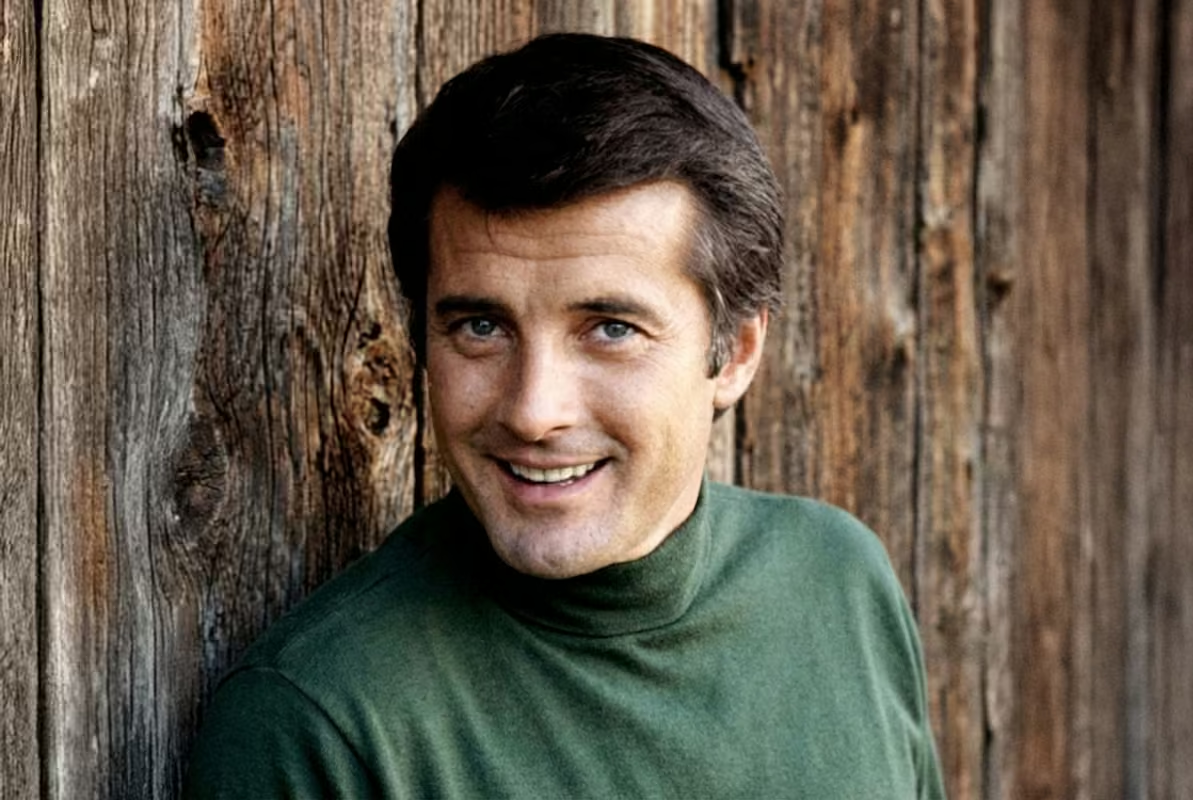
The obituaries described him as the handsome announcer from The Carol Burnett Show and Steve Trevor from Wonder Woman.
They mentioned his five decades in show business, his charm, his good looks, his Walk of Fame star.
But they missed the most important part of the story.
Lyle Waggoner wasn’t just an actor. He was a businessman who saw a problem, built a company to solve it, and created an empire that outlived his acting career by decades.
In September 2021, eighteen months after Waggoner’s death, his company Star Waggons was sold to Hudson Pacific Properties for $222 million.
That’s not a typo. $222 million. For a trailer rental business.
The beautiful prop from The Carol Burnett Show turned out to be the richest member of the cast by a mile. This is how he did it.
The Hunk Who Almost Played Batman
Lyle Waggoner joined The Carol Burnett Show in 1967 as the announcer and resident leading man. He opened every episode, introduced the guests, and played the handsome husband, boyfriend, or romantic interest in sketches that needed a pretty face.
He wasn’t the comedian. That was Harvey Korman and Tim Conway.
He wasn’t the star. That was Carol Burnett.
He was the straight man, the prop, the guy who looked good in a tuxedo.
In 1966, before joining the show, Waggoner auditioned for Batman in the ABC series. He lost the role to Adam West.
Years later, West admitted that Waggoner was “too good-looking” for the part. Batman needed to be accessible. Waggoner looked like a movie star.
So he joined The Carol Burnett Show instead and spent seven years being the handsome guy.
He left in 1974, feeling typecast as “the hunk,” and immediately landed the role of Steve Trevor on Wonder Woman, where he spent another four years being the handsome guy.
By 1979, Waggoner was 44 years old and tired of being decoration. He wanted to build something that lasted. So he started paying attention to what was happening on Hollywood sets.
The Trailer Problem
While working on Wonder Woman in the late 1970s, Waggoner noticed that the trailers provided for actors were terrible.
They were old motorhomes, cramped and uncomfortable, with bad lighting, no climate control, and plumbing that barely worked.
For extras and day players, that was fine. But for stars spending 12 to 16 hours a day on set, these trailers were miserable. And the studios didn’t care because they didn’t own the trailers. They rented them from vendors who had no incentive to maintain them.
Waggoner saw an opportunity.
If someone built high-quality, well-maintained trailers specifically designed for Hollywood productions, stars would demand them. And studios would pay premium prices to keep their talent happy.
In 1979, Waggoner founded Star Waggons. He bought a garage, learned to weld, and started building trailers himself.
Building the Empire
Waggoner’s first units were converted motorhomes. He started with one. Then two. Then five. He rented them to productions, reinvested the rental income into more units, and slowly built a fleet.
In 1981, the federal government passed the Economic Recovery Tax Act, which included a 10 percent Investment Tax Credit for businesses buying equipment.
Waggoner used the tax break to expand his fleet aggressively, buying more motorhomes and converting them into high-end mobile dressing rooms.
But in 1988, he made a strategic pivot. Instead of converting motorhomes, he started building custom trailers from scratch. This gave him total control over design, layout, and quality.
Waggoner’s trailers featured innovations that became industry standard:
- Hydraulic slide-outs that expanded interior space when parked
- Zoned interiors with separate lounging, working, and sleeping areas
- Professional makeup lighting with adjustable color temperature
- High-end climate control systems
- Soundproofing to block out set noise
These weren’t motorhomes anymore. They were luxury mobile offices. And they were expensive to rent. But studios paid because their stars demanded them.
The Numbers That Made Him Rich
By 2016, Star Waggons had grown to nearly 700 trailers. The company was generating $17 million in annual revenue. But revenue isn’t profit. The real value was in the assets.
Each custom Star Waggon trailer cost between $200,000 and $500,000 to build, depending on size and features. A fleet of 700 trailers represented an asset base worth well over $200 million. And those trailers generated rental income every time they were deployed to a production.
Waggoner didn’t take venture capital. He didn’t go public. He built the business slowly, using rental income to fund expansion, and kept ownership within his family.
His sons Jason and Beau worked in the business and eventually took over operations as Waggoner stepped back.
When Waggoner died in March 2020, the company was still family-owned and operating at full capacity. Then COVID-19 hit and Hollywood shut down. Productions stopped. Trailers sat idle. It was a disaster for the rental business.
But it was also an opportunity for a buyer.
The $222 Million Sale
In September 2021, Hudson Pacific Properties bought Star Waggons for $222 million. The deal included the entire fleet, the maintenance facilities, the brand, and the client relationships Waggoner had spent 42 years building.
Hudson Pacific is a real estate investment trust that owns studio lots, soundstages, and production facilities across Los Angeles. Buying Star Waggons gave them vertical integration. They could now offer trailers as part of their production service packages.
For Waggoner’s family, the sale was life-changing. Even after taxes, they walked away with over $100 million. Waggoner’s sons Jason and Beau stayed on to run the company under new ownership, ensuring continuity.
The sale happened eighteen months after Waggoner’s death. He never saw the final number. But he knew what he’d built. And he knew it was valuable.
The Real Estate Portfolio
Star Waggons wasn’t Waggoner’s only investment. He also owned significant real estate in Southern California.
In 2007, he sold a property in La Quinta for $2.1 million. In 2011, he listed an Oxnard beachfront home for $4.4 million. His primary residence in Westlake Village, where he died, was a luxury estate in a gated community.
These weren’t flashy investments.
They were steady, conservative real estate plays that appreciated over time. Combined with his Star Waggons equity, Waggoner’s total net worth at death was likely in the $150 to $200 million range before the sale.
After the sale, his estate’s value exceeded $300 million.
The 60-Year Marriage
Lyle Waggoner married Sharon Kennedy on September 17, 1961. She was an actress and financial adviser. They had two sons, Jason and Beau, and stayed married for 60 years.
Sharon was involved in the Star Waggons business from the beginning. She managed finances, handled contracts, and helped Waggoner navigate the business side of Hollywood.

When Waggoner died, she was by his side. They were months away from their 60th wedding anniversary.
Unlike Tim Conway’s family, which fought a brutal conservatorship battle in court, the Waggoner family stayed united. There were no estate fights, no public disputes.
The business transitioned smoothly to the next generation.
How Lyle Waggoner Beat Everyone
Let’s compare Lyle Waggoner’s wealth to the rest of The Carol Burnett Show cast:
Carol Burnett is worth an estimated $45 million. Harvey Korman died with $25 million. Tim Conway left behind $15 to $20 million. Vicki Lawrence is worth about $8 million.
Lyle Waggoner’s estate, after the Star Waggons sale, was worth over $300 million. He didn’t just beat them. He lapped them.
And he did it by doing something none of the others thought to do: he looked at the business infrastructure of Hollywood and asked, “What problem can I solve?”
Carol, Harvey, Tim, and Vicki all stayed in front of the camera. They acted, they performed, they toured, they did voice work. They made good livings. But their wealth was capped by their ability to work.
Waggoner built a business that operated whether he worked or not. By 1990, he was barely acting anymore. But Star Waggons kept generating revenue.
The trailers were rented to every major production in Los Angeles. The business grew while Waggoner relaxed in Westlake Village.
The Final Chapter
In early 2020, Lyle Waggoner was diagnosed with cancer. He fought for a few months, but the disease progressed quickly. On March 17, 2020, he died at home with Sharon by his side.
He was 84 years old. He’d been married for 60 years. He’d built a $222 million company from a single converted motorhome.
And he’d proven that the pretty boy from The Carol Burnett Show was smarter than anyone gave him credit for.
His obituary in The Hollywood Reporter mentioned his acting career, his charm, his good looks. But the real story was buried in the business section.
Lyle Waggoner didn’t just play the straight man on television. He became the richest person in the room by seeing a problem no one else noticed and building a solution that lasted 42 years.
While Harvey Korman was touring with Tim Conway, performing the same sketches they’d done in the 1970s, Waggoner was building a fleet of 700 trailers that would sell for nine figures after his death.
The handsome announcer, the guy who almost played Batman, the prop who introduced Carol Burnett every week for seven years, turned out to be the best businessman in Hollywood.
And unlike Tim Conway’s tragic final years, Waggoner lived long enough to see his vision validated with a nine-figure exit.
The beautiful prop proved he was anything but.