TLDR: Elvis Presley called Priscilla “Satnin,” the same nickname he used for his mother Gladys. After Gladys died in 1958, Elvis transferred this deeply personal pet name to Priscilla when they met in Germany in 1959. The word itself likely came from “shortening bread,” a Depression-era term of endearment that became part of Elvis and Gladys’s private “baby talk” language.
Elvis Presley had a nickname for Priscilla that few people outside his inner circle understood. He called her “Satnin,” a term so private and peculiar that even decades after his death, it remains one of the most intimate details of their relationship. But the nickname didn’t originate with Priscilla at all. It belonged to someone else first: Elvis’s mother, Gladys.
The story of “Satnin” is a window into Elvis’s deepest emotional world, revealing how the King of Rock and Roll never quite recovered from losing his mother and how he tried to fill that void with the woman who would become his wife.
The Nickname Started with Elvis’s Mother
Before Priscilla ever heard the word “Satnin,” it was Gladys Presley’s special name. Elvis and his mother shared an extraordinarily close bond, forged in the poverty of Depression-era Tupelo, Mississippi.
The two developed their own private language, a form of baby talk that they used throughout Elvis’s life, even as he became the most famous man in the world.
“Satnin” was the crown jewel of that secret vocabulary. According to Billy Smith, Elvis’s first cousin who lived at Graceland, the word came from “shortening,” as in shortening bread.
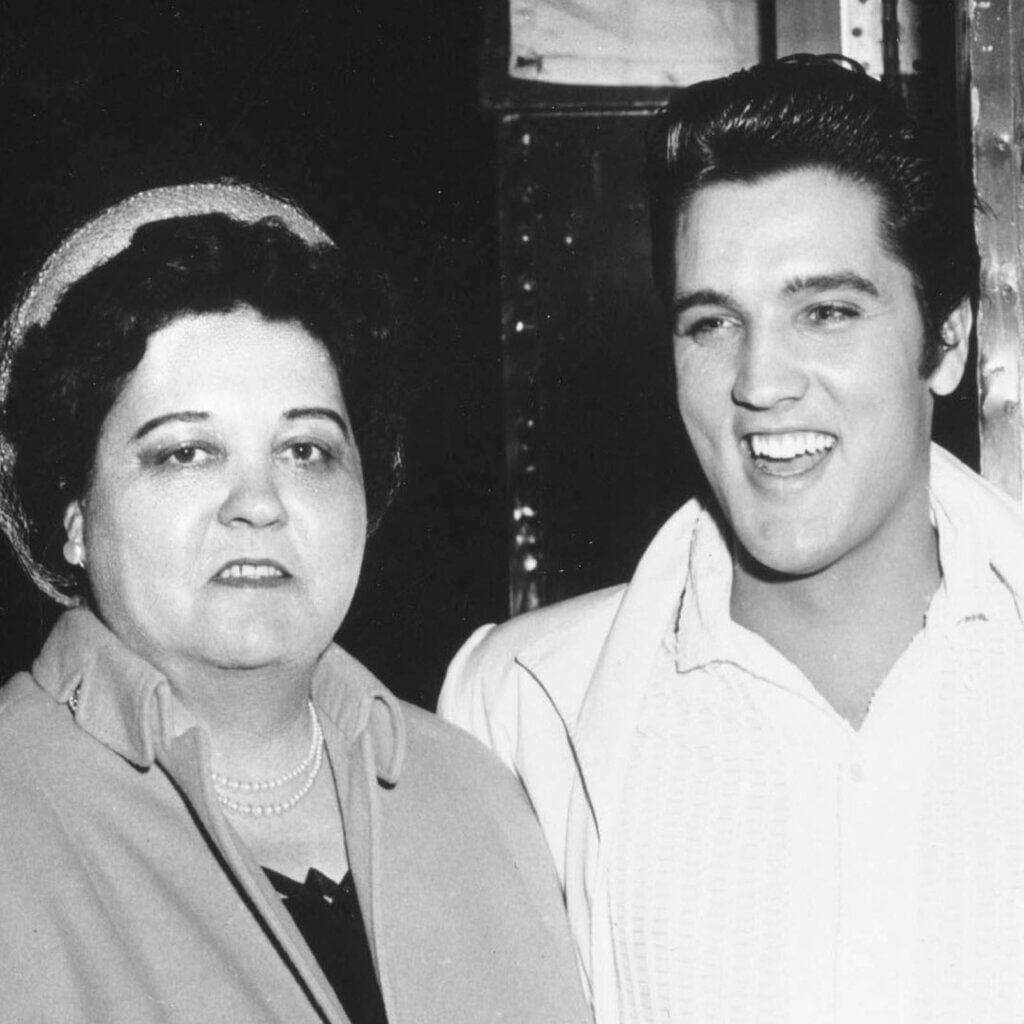
Smith recalled Elvis patting his mother’s belly and saying, “Baby’s going to bring you something to eat, Satnin.” In the Southern dialect, “shortening” naturally became “shortnin’,” which through the region’s distinctive r-dropping accent evolved into “Satnin.”
The reference to shortening bread wasn’t random. For a family that knew real hunger during the Great Depression, food meant love. The old folk song “Shortnin’ Bread” was about a mother feeding her baby, and in the Presley household, that kind of maternal care and sustenance was everything.
The nickname was playful and tender, referencing Gladys’s weight while also encoding the comfort and safety she represented to her only surviving son.
There’s an alternate theory, though. June Juanico, one of Elvis’s early girlfriends, claimed he told her the name came from a modified version of the lullaby. According to her account, Gladys used to sing “mama’s little baby has satnin skin” instead of “mama’s little baby loves shortnin’ bread.”
This version frames the nickname as a compliment about soft, satin-like skin rather than a playful tease about weight.
The truth is probably somewhere in between. Elvis was known to tailor his stories depending on his audience. Telling a glamorous girlfriend that her nickname meant “lard” wouldn’t have been very romantic.
But the linguistic evidence and family testimony strongly support the “shortening bread” origin.
How the Name Moved from Mother to Wife
On August 14, 1958, Gladys Presley died of heart failure at age 46. Elvis was devastated. Witnesses described him throwing himself onto her coffin, weeping and calling out “Satnin.” It was the most profound loss of his life, and in many ways, he never recovered from it.
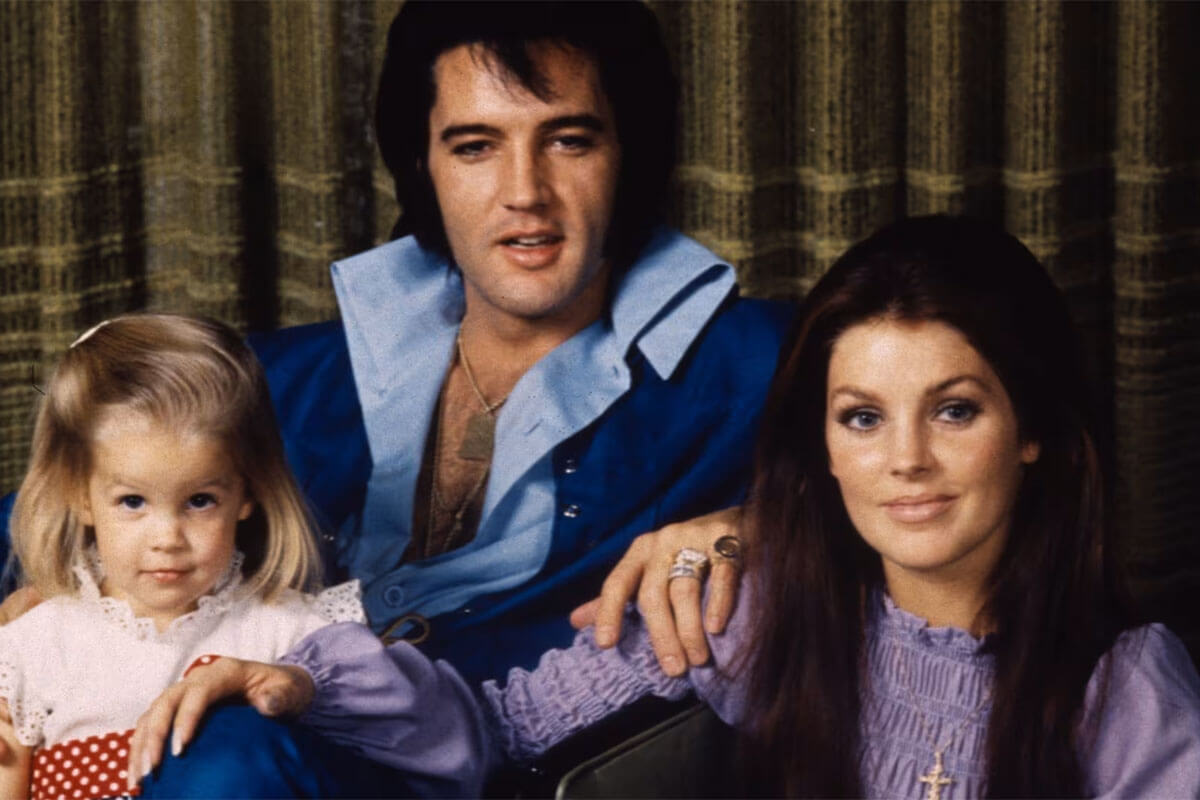
Just one year later, while stationed in West Germany during his Army service, Elvis met 14-year-old Priscilla Beaulieu. The timing was everything. Elvis was emotionally unmoored, grieving his mother and searching for something to anchor him. Priscilla, young and moldable, became that anchor.
According to Lamar Fike, a key member of Elvis’s inner circle known as the Memphis Mafia, the transfer was deliberate: “He also started calling her ‘Satnin’ since Gladys was gone.” The position was vacant, and Priscilla was chosen to fill it.
This wasn’t just about a cute nickname. Elvis actively groomed Priscilla to resemble his mother. He instructed her on how to dress, insisted she dye her hair black like Gladys’s, and dictated her makeup. The nickname was the linguistic component of this transformation.
By calling Priscilla “Satnin,” Elvis was trying to recreate the emotional comfort and unconditional love he’d lost.
Elvis and Priscilla existed in what those around them called a “bubble,” a private world where they communicated in baby talk and used pet names constantly. He called her “Satnin” and “Nungen” (young one), and she learned to respond in kind.
For Elvis, who lived under constant public scrutiny, this private language was a sanctuary, a way to return to the safety of his childhood relationship with his mother.
The Psychological Weight of the Nickname
The problem with transferring a mother’s nickname to a wife is obvious in hindsight. By calling Priscilla “Satnin,” Elvis was essentially casting her as a maternal figure rather than a romantic partner.
Biographers have long noted that Elvis struggled with what psychologists call the Madonna-Whore complex, where a man can’t desire the woman he loves or love the woman he desires.
By naming Priscilla after his mother, Elvis may have inadvertently created a psychological barrier to their intimacy. Historical accounts and Priscilla’s own memoir suggest that Elvis’s sexual interest in her waned significantly, particularly after she gave birth to their daughter Lisa Marie.
Once she became a mother herself, she fully embodied the “Satnin” role in Elvis’s mind, and the incest taboo kicked in.
The nickname became a feedback loop. Elvis missed his mother, so he projected her qualities onto Priscilla. He called her “Satnin” to cement that projection. But in doing so, he transformed her into a mother figure in his subconscious, which killed his desire for her. He then sought physical intimacy elsewhere through affairs, while still loving Priscilla deeply but platonically.
Priscilla Still Uses the Name Today
Perhaps the most telling detail about the nickname’s significance came in August 2025, when Priscilla posted a tribute to Elvis on the anniversary of his death. She signed it simply: “Satnin.”
Despite their divorce in 1973, despite Elvis’s infidelities, despite the complicated dynamics that plagued their marriage, Priscilla still identifies with the name. It suggests that for her, “Satnin” represents something sacred, a unique intimacy that, however flawed, belonged only to them.
She inherited not just a nickname but a legacy, a connection to both Elvis and Gladys that no one else could claim.
The name has also appeared in recent films about the couple. Baz Luhrmann’s Elvis (2022) and Sofia Coppola’s Priscilla (2023) both feature the nickname prominently, using it to illustrate the hermetic seal around Elvis’s private world.
In Coppola’s film especially, “Satnin” becomes a symbol of the power imbalance in their relationship, with Priscilla being addressed by a name that wasn’t really hers, carrying the weight of a ghost she could never replace.
In the end, “Satnin” was more than a pet name. It was an inheritance. When Elvis looked at Priscilla and whispered that word, he wasn’t just seeing his wife. He was feeling the echo of the only unconditional love he’d ever known.
The nickname was a bridge between past and present, between mother and lover, between the poverty-stricken boy from Tupelo and the King of Rock and Roll.
It was the sound of safety in an increasingly chaotic life, a single word that carried the weight of Elvis’s entire emotional universe.
“`