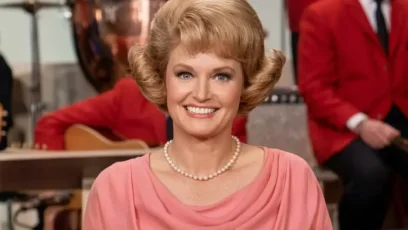
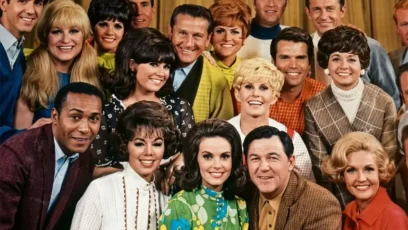
TLDR: The Lennon Sisters, Dianne, Peggy, Kathy, and Janet, spent 13 years as the most beloved act on The Lawrence Welk Show before leaving in 1968 over pay and creative disputes. In 1969, their father and manager was murdered by a stalker obsessed with Peggy, a tragedy that reshaped the family permanently.
As of 2026, all four original sisters are still alive, and the trio of Kathy, Janet, and younger sister Mimi continues to perform after more than 70 years in the entertainment industry.
On Christmas Eve 1955, four sisters from Venice, California walked onto a television stage and sang for the first time in front of a national audience. Dianne was 16. Peggy was 14. Kathy was 12. Janet was just 9 years old.
Their performance of “He” on The Lawrence Welk Show stopped viewers in their tracks. By the time the holidays were over, the Lennon Sisters were famous.
What followed was 13 years as fixtures of the most-watched variety program in America, a violent tragedy that shattered their family, and more than seven decades of performing that has made them one of the longest-running vocal acts in entertainment history. Their story is not just about harmony. It’s about survival.
How Four Sisters From Venice Ended Up on National Television
The Lennon Sisters grew up in a two-bedroom house in Venice, California, the eldest four of twelve children born to Bill and Isabelle Lennon. Music wasn’t a hobby in the Lennon household. It was the air they breathed.
Their father, Bill, had performed with his own siblings in a group called the Lennon Brothers. The girls absorbed harmonies the way other kids learned to ride bikes, entirely by ear, without ever learning to read a note of music.
That natural ability to stack their voices into something that sounded polished and professional would become their calling card for the next seven decades.
The sisters started performing locally out of practical necessity. The family was crowded into that small Venice home, with the parents sleeping on a pull-out sofa in the living room. The girls began singing at church socials and community clubs to raise money for a dormitory addition to the house.
The break came through a high school connection. Dianne’s classmate was Larry Welk Jr., son of bandleader Lawrence Welk. He brought the girls to his father’s attention, and Welk, confined to his bed with an illness at the time, heard them sing in his own home.
Dressed in a maroon smoking jacket and velvet slippers, he booked them on the spot for the Christmas Eve broadcast.
Thirteen Years as America’s Sweethearts
The Lennon Sisters became one of the defining acts of early American television. During their peak years on the Welk show, weekly audiences frequently reached 30 million viewers. At a time when only a handful of channels existed, that number represented a genuinely massive share of the country tuning in every Saturday night.
Their popularity went far beyond the show itself. Throughout the late 1950s and early 1960s, they were among the most photographed women in the United States, their fame often compared in the press to that of Jacqueline Kennedy and Elizabeth Taylor.
They recorded for Coral Records and later Dot Records, charting hits including “Tonight You Belong to Me” in 1956 and scoring a number one in Japan with “Sad Movies (Make Me Cry)” in 1961.
The “Lennon sound” was built on a precise vocal architecture that each sister contributed to differently. Peggy anchored the high harmonies. Kathy provided the low end, with a solo range that stretched to pieces like “Malaguena.” Dianne and Janet rotated through the lead and middle parts, giving the group a flexibility that let them cover an unusually wide range of material.
None of them could read sheet music. Every arrangement they learned, they learned by ear. It was that instinctive approach that gave the group its warmth and kept it sounding like a family rather than a product.
Why They Left the Welk Show in 1968
By the mid-1960s, the sisters were adults with husbands and children of their own. Their circumstances had changed dramatically since 1955. Their compensation hadn’t.
Lawrence Welk paid union scale wages across his Musical Family, roughly $180 per week. For teenage girls living at home in the late 1950s, that had been meaningful money. For married women supporting households in 1965, it was increasingly untenable. The sisters pushed for more, and Welk pushed back.
Creative differences compounded the tension. The sisters wanted to modernize. They appeared on The Jerry Lewis Show in shorter, trendier outfits and performed contemporary hits like “Sunny,” signaling a direction they wanted to take their careers.
Welk’s show operated on a rigid “family-oriented” brand, and his producers resisted any shift that might disturb the carefully constructed image the sisters had projected since they were children.
A compromise in 1967 reduced their appearances to once a month, but that arrangement didn’t hold. In February 1968, the sisters were officially let go from the program. Their final performance of “Sweet and Low” ended a 13-year run on what were, by multiple accounts, acrimonious terms.
They left with a new ABC variety series lined up, Jimmy Durante Presents the Lennon Sisters Hour, and a genuine sense of freedom after years of constraint. What they couldn’t have anticipated was what was about to happen.
The Murder That Changed Everything
In the summer of 1969, while the sisters were filming the early episodes of their new show, a 38-year-old former Air Force officer named Chet Young arrived in Los Angeles with a plan.
Young had developed a severe obsession with Peggy Lennon. He believed, in the grip of a delusion that had led to multiple institutionalizations, that he and Peggy were married, and that her father Bill was the obstacle standing between them. He had been stalking the sisters for years without their knowledge.
On August 12, 1969, Young confronted Bill Lennon in the parking lot of the Venice Golf Course in Marina Del Rey, where Lennon worked as an instructor. He shot and killed him and fled the scene.
The timing was almost incomprehensibly terrible. The murder occurred just days after the Tate-LaBianca killings, and Los Angeles was already in a state of collective terror. The Lennon family was placed under 24-hour police protection. The sisters were effectively confined to their homes for weeks while a nationwide manhunt began.
During all of this, they were still obligated to keep producing their television show. They later described that period as psychologically harrowing in ways that are difficult to fully convey.
Two months after the murder, Chet Young was found dead of a self-inflicted gunshot wound in the trunk of a car. Investigators discovered a letter that contained a cutout image of Bill Lennon with a gun pointed at his head and the words “High Noon,” which corresponded exactly to the time of the shooting.
Their father had been at every television performance since Christmas Eve 1955. His absence left a void that never fully closed.
How Andy Williams Helped Them Rebuild
The Jimmy Durante variety hour lasted one season. Critics noted an awkward fit between the veteran comedian and the sisters, and the group was visibly struggling to maintain their performance standards under the weight of everything they had just been through. When the show was cancelled, they faced rebuilding from scratch.
Andy Williams stepped in. Recognizing both their talent and their vulnerability, Williams invited them to become regulars on his show and to tour with him extensively. It was a lifeline, and it worked.
The partnership led to a decade-long residency at Caesar’s Palace in Las Vegas, where the sisters developed a more sophisticated concert act built around Great American Songbook material. Working with producer Snuff Garrett and the musicians known as the Wrecking Crew, they made recordings during this period that are now considered high points of mid-century vocal pop.
They had grown up on television as perfectly dressed teenagers singing pristine harmonies. In Las Vegas, they became something more nuanced, adult vocalists capable of carrying a full evening of entertainment on their own terms.
The Return to Welk and the Move to Branson
The professional break with Lawrence Welk lasted 14 years. In 1982, he personally invited the sisters to perform at his new theater in Branson, Missouri, and they accepted. Whatever bitterness remained from 1968 had faded, and the reconciliation opened a new chapter.
By 1994, the sisters had become the featured headliners at the Welk Champagne Theater, moving their families from Los Angeles to the Ozarks to establish a permanent residency. The arrangement gave them what they had always wanted: creative autonomy within a stable, appreciative environment.
They eventually transitioned to the Andy Williams Moon River Theatre in Branson, where they continue to hold an annual Christmas residency. Branson suited them. It’s a town built around exactly the audience that had loved them since 1955.
Where the Lennon Sisters Are Today
The group’s lineup changed significantly around the turn of the century. Peggy retired in 1999 after more than 40 years of performing, replaced by younger sister Mimi, who had been filling in on and off for years and fit naturally into the group’s vocal blend. Dianne retired in 2001.
As of March 2026, all four original sisters are still alive. Dianne is 86, Peggy is 84, Kathy is 82, and Janet is 79. The performing trio of Kathy, Janet, and Mimi, now 70, remains active on the touring circuit.
Beyond the stage, Kathy and Janet have built a parallel enterprise around the “Best Pals” doll line, cloth reproductions of the paper dolls that were sold in their name back in the 1950s.
The venture includes recordings specifically made for younger audiences, an attempt to pass the Lennon vocal legacy to a generation that has no memory of the original show.
They have also released multiple volumes of “Archive Treasures,” featuring live recordings and television performances from their 1969 variety show that had never previously been made available to the public. Their official YouTube channel and fan club journals keep a dedicated international following engaged with both the history and the present.
The honors have continued to accumulate. They were inducted into the National Vocal Group Hall of Fame in 2001 and the Great American Songbook Hall of Fame in 2022. They remain the only female vocal group to have performed for seven consecutive U.S. Presidents, from Eisenhower through Reagan.
They started singing to pay for a bigger house in Venice. More than 70 years later, they’re still singing.
Not many acts in any era of American entertainment can say the same.