TLDR: Norma Zimmer was the beloved “Champagne Lady” on The Lawrence Welk Show from 1960 to 1982, becoming one of the most recognized faces in American television.
Before that, she had been a Hollywood session singer whose uncredited voice appeared on dozens of major films and recordings, including Bing Crosby’s “White Christmas” and the Disney film Alice in Wonderland.
Her public image was one of serene elegance, but her real life was defined by poverty, a traumatic childhood with two alcoholic parents, and a long string of personal hardships she wrote about candidly in her 1976 autobiography.
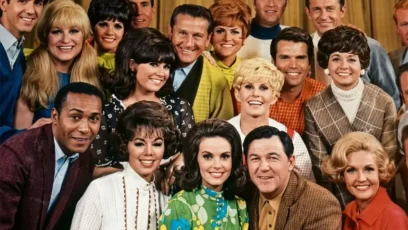
For 22 years, Norma Zimmer closed every episode of The Lawrence Welk Show the same way: a waltz with Lawrence Welk himself, her blonde hair swept up, her gown elegant, her smile radiating a kind of unhurried grace that felt almost from another era.
To the millions of viewers who tuned in every Saturday night, she was the Champagne Lady, the embodiment of everything the show stood for. Warmth. Stability. A world that made sense.
What almost none of them knew was where she had come from.
She Grew Up in a Tar-Paper Shack With No Running Water
Norma Zimmer was born Norma Larsen on July 13, 1923, in a log cabin on her grandfather’s dairy farm in Shoshone County, Idaho. Her father, Peter, was of Norwegian heritage and had real talent as a violinist. He had dreams of a professional music career.
Those dreams ended in a Seattle shipyard. While working there to support his young family, Peter Larsen suffered a severe accident that crushed his hand. His career as a violinist was over before it had properly begun. The loss broke something in him that never fully healed.
The family moved back toward the coast, eventually settling in the Seattle and Tacoma areas of Washington. By the time Norma was nine years old, both of her parents were deep into alcoholism. The family lived in a series of tenements, and for a time, a tar-paper shack with no electricity and no running water.
Norma later described experiencing chronic hunger during those years. The home was emotionally abusive.
And yet, in her 1976 autobiography Norma, she wrote about her parents without bitterness, describing her father as a man who did his best to teach violin and maintain his dignity, and her mother as someone with a genuine pioneer spirit who found ways to provide with almost nothing.
What got her through it was music, and eventually, faith.
Her Father Told Her She’d Never Be a Musician
As a child, Norma wanted to follow her father into music by learning the violin. She went to him and asked him to teach her.
He looked at her hands and told her they were too small. She would never play the instrument competently.
It was almost certainly his own bitterness speaking rather than any real assessment of her ability. But the dismissal redirected her entirely. She turned to her voice instead, encouraged by a high school music teacher who recognized what she had. Slowly, painfully, she began to overcome a shyness so severe it had made ordinary social situations difficult.
Performing was, in a strange way, easier than just being in a room with people. On stage she had a role. She knew what she was supposed to do.
She Turned Down a Scholarship to Move to Hollywood
Norma was a strong enough student to earn a scholarship to Seattle University. It was a real opportunity, a path to a stable conventional life that her own upbringing had never offered.
She turned it down.
A guest artist had heard her sing at a church choir performance and told her, directly, that she should move to Los Angeles and audition for professional vocal groups. At 18, that advice was enough. She packed up and headed south.
The Los Angeles music scene of the 1940s ran on session singers. Radio, film, and commercial recordings all needed polished vocal ensembles, and Zimmer’s soprano, clear and precise with almost no intrusive vibrato, was exactly what producers were looking for.
She quickly found her way into the most prestigious groups working in the city, including the Norman Luboff Choir and the Ken Darby Singers.
She Sang on “White Christmas” and Nobody Knew Her Name
For most of the 1940s and 50s, Norma Zimmer was one of the most heard and least known voices in American music. Session singers didn’t get credits. They showed up, they sang, they left.
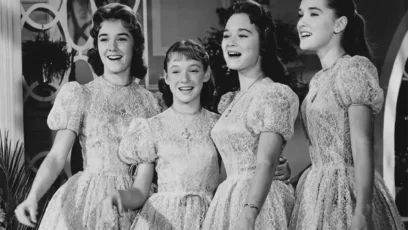
As part of a vocal quartet called The Girlfriends, she provided backing vocals for Frank Sinatra, Dean Martin, and Perry Como. She sang on Bing Crosby’s recording of “White Christmas,” arguably the best-selling single in the history of recorded music. Her voice is in those recordings. Her name is not.
Her film work was equally substantial and equally anonymous. She contributed vocal work to the soundtracks of Singin’ in the Rain (1952), 3:10 to Yuma (1957), and the Bing Crosby vehicle Mr. Music (1950), among others.
The one credit that has since gained her a measure of recognition among film historians came in 1951, when she was cast as the singing voice of the White Rose in Disney’s Alice in Wonderland. Her soprano leads the flowers through “All in the Golden Afternoon” in the Garden of Live Flowers sequence, capturing exactly the kind of ethereal, slightly imperious quality the animation required.
Disney fans have made something of a niche fascination of tracing that voice back to her.
How She Became the Champagne Lady
The opening that brought Norma Zimmer to national television was created by a controversy she had nothing to do with.
The original Champagne Lady, Alice Lon, had been fired by Lawrence Welk in 1959 for what he described as showing too much leg on camera.
Welk, deeply conservative and protective of the show’s family image, stated publicly that he had no tolerance for anything “the least bit immoral” and felt Lon had crossed a line.
The firing generated enormous viewer backlash. Welk tried to bring Lon back. She refused.
For the next year, the show auditioned a rotating series of guest vocalists while searching for a permanent replacement. None of them stuck.
Zimmer was already known to the Welk organization. She had appeared as a studio singer on a Welk Thanksgiving album in 1956. Her reputation for professionalism, her classical vocal training, and her naturally composed demeanor made her an obvious candidate. She officially joined the show as Champagne Lady on New Year’s Eve, 1960.
Welk called her a “treasure.” The audience agreed immediately.
There was one moment of hesitation on Zimmer’s part before she accepted the title. Given that alcohol had devastated her family, she had reservations about being publicly associated with champagne, even in a theatrical context. She resolved it by concluding that the “Champagne Lady” designation was an honorific tied to the show’s musical brand, not a literal endorsement.
Once she made that peace with it, she never looked back.
The “One More Week” Arrangement That Lasted Twenty Years
After her first three years on the show, Zimmer told Welk she wanted to leave.
Not the television program. The road tours. The constant travel was pulling her away from her two young sons, Ron and Mark, and she had not survived the childhood she survived only to give her own children an absent mother. She wanted out of the touring life.
Welk made her a deal. Stop the tours, he said. But stay on the television show until I find a replacement. Just one more week.
Each week, a new guest singer would appear as a potential new Champagne Lady. Each week, Welk would ask Zimmer to come back for one more episode. This arrangement, which both parties apparently treated as genuinely temporary, continued for twenty years.
She stayed home with her family. She drove herself to the taping. She waltzes with Welk. She went home. For two decades.
The Faith That Held Everything Together
Norma Zimmer’s Christian faith was not a public relations strategy. It was, by her own account, the thing that kept her functional through a life that threw an extraordinary amount at her.
She had found her way to Christianity independently, as a young woman seeking what she described as the “loving care” that had been absent from her childhood. She remained an active churchgoer throughout her life, singing in choirs long before she was famous and long after the show had ended.
At the height of her television fame, she was devoting enormous amounts of time to Christian music work. In 1972 alone, she traveled approximately 80,000 miles as a guest soloist for Billy Graham Crusades, performing at massive evangelistic events around the world.
She was a regular presence on Robert Schuller’s Hour of Power, televised from the Crystal Cathedral, and recorded solo albums for Word Records that established her as one of the most prominent voices in traditional Christian music in the country.
She was also invited to sing at a White House religious service during the Nixon administration, a moment that placed her in the unusual position of being a television star, a church singer, and a guest of the President simultaneously.
Her Autobiography Read Like the Book of Job
In 1976, at the peak of her fame, Zimmer published Norma, a memoir that surprised readers with its candor. The woman who waltzed serenely through American living rooms every Saturday night had, it turned out, lived through an almost unrelenting series of hardships.
Beyond the poverty and her parents’ alcoholism, the book catalogued a broken back, a brain shunt, debilitating arthritis, a toxemic pregnancy, a near-fatal reaction to penicillin, twisted intestines, severe psoriasis, a water skiing accident, a crooked agent, a crooked car salesman, and a house fire accidentally started by the family dog.
Her sister died of liver disease. Her father was found dead in a car.
Critics who reviewed the book noted that the accumulated weight of these events was almost biblical in proportion, and some drew direct comparisons to the story of Job. What struck readers most was how Zimmer wrote about all of it without self-pity. The book was relentlessly optimistic, rooted in her “confidence in God’s loving care.”
One of the book’s most discussed passages described a night when her toddler son Ronnie was gravely ill with croup. As she lay beside him praying, she wrote that she saw a brightness in the room and believed she witnessed a guardian angel, described as a blonde woman in a blouse and skirt.
She believed it preceded his recovery.
Whether or not readers shared her interpretation, the story captured something essential about who she was: a woman who faced the worst with her eyes open and came out believing.
She Also Ran a Trailer Park and a Ski Lodge
One of the more quietly telling details of Norma Zimmer’s life is what she and her husband Randy did outside of show business.
The couple, married on June 5, 1944 in Pasadena, owned and operated a ski lodge at Kratka Ridge in the San Gabriel Mountains. They also owned a mobile home park in Brea, California, with over 100 spaces. Zimmer didn’t just own it from a distance. She lived there herself and walked the grounds, greeting residents with the same smile she gave television audiences of millions.
For a national television star, it was an almost defiantly unpretentious way to live. It also said everything about the values she had built from the ruins of her childhood: stability, community, the dignity of ordinary life.
Randy Zimmer died in 2008, ending a marriage of 64 years. His death left her without the person who had been the bedrock of her adult life since she was 20 years old.
What Happened to Norma Zimmer in the End
In her final years, Zimmer divided her time between her home in Brea and a place in Park City, Utah.
Even in her mid-70s she was working out at a gym three days a week and gardening regularly. She made a trip back to Shoshone County, Idaho, to see the old log cabin and farm she had left as a toddler.
By her own account, it gave her a sense of closure she hadn’t known she needed.
Norma Zimmer died peacefully at her Brea home on May 10, 2011, at the age of 87. The cause of death was not publicly detailed. Larry Welk described it as a peaceful end to an active and well-lived life.
The response from the Welk fan community was immediate and emotional. Viewers described her as an “angel” and a “ray of sunshine.” Obituaries ran in the New York Times and in Variety.
She received a star on the Hollywood Walk of Fame for her television work, and in 2005 had been inducted into the Scandinavian-American Hall of Fame in recognition of her Norwegian and Finnish heritage.
The Lawrence Welk Show still airs on PBS every Saturday night in many markets, in the same time slot it occupied during its original run. Anyone who tunes in can still see her waltz.
The woman in the elegant gown, smiling like nothing in the world could touch her, who grew up in a tar-paper shack with no running water, and chose, every single week, to be effervescent anyway.