TLDR: On January 12, 2026, Mattel released the first-ever Autistic Barbie doll as part of their Fashionistas line.
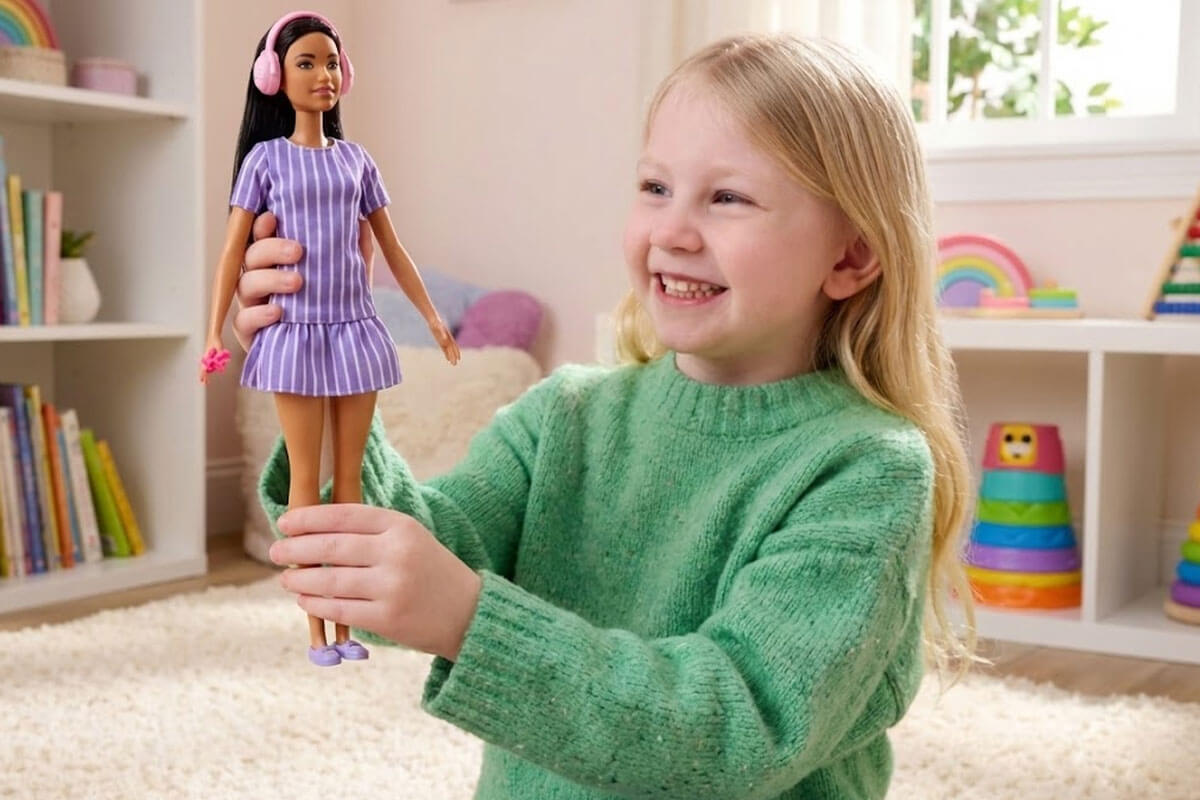
After an 18-month collaboration with the Autistic Self Advocacy Network (ASAN), the doll was designed with specific features: eyes that look slightly to the side (representing how many autistic people avoid direct eye contact), articulated limbs for hand-flapping and stimming, and three accessories (a pink AAC communication tablet, noise-canceling headphones, and a fidget spinner).
The doll wears loose-fitting purple clothing for sensory comfort and has a face sculpt inspired by Mattel employees in India, representing autistic women of color who are often underdiagnosed.
The release sparked both celebration (especially from families with higher support needs who use AAC devices) and criticism (from some who felt it relied on stereotypes).
The doll costs about $12, making it accessible rather than boutique, and represents a major shift from Mattel’s 1997 failure with wheelchair-using Becky whose chair couldn’t fit through the Dreamhouse door.
On January 12, 2026, Mattel did something that’s never been done before in the 65-year history of Barbie. They released an autistic doll.
Not a doll that represents a physical disability you can see, like a wheelchair or a prosthetic limb. An autistic doll. A doll representing a neurological condition that’s often invisible, that “doesn’t look any one way,” that exists on a spectrum so wide it’s almost impossible to capture in a single toy.
And yet Mattel tried. After 18 months of working with the Autistic Self Advocacy Network (ASAN), a group run by autistic people themselves, they created a doll with an averted gaze, loose clothing for sensory comfort, and accessories including a communication tablet, noise-canceling headphones, and a fidget spinner.
The response has been everything you’d expect from trying to represent something as complex as autism in plastic form. Joy, criticism, validation, skepticism. Some families with autistic children cried seeing the AAC tablet. Others argued the doll relies on stereotypes that don’t represent everyone on the spectrum.
Here’s the full story of how this doll came to exist, what makes it different, and why it matters.
Why Making an Autistic Barbie Was So Complicated
The challenge Mattel faced was fundamental. How do you represent autism when it’s not visible?
When they made a wheelchair-using Barbie in 2019, that was straightforward. The wheelchair is the representation. When they made a Barbie with Down syndrome in 2023, they could use specific physical features like a shorter frame and rounder facial features.
But autism is neurological. You can’t see it by looking at someone. And it’s a spectrum, meaning it expresses itself differently in every person. Some autistic people are non-speaking. Others are highly verbal. Some have significant sensory sensitivities. Others don’t. Some stim visibly. Others mask their traits completely.
Noor Pervez, ASAN’s Community Engagement Manager who worked on the project, explained the impossible task: “We can try and show some of the ways that autism expresses itself,” but acknowledged that any single representation would inevitably exclude parts of the spectrum.
So they took a “composite” approach. The doll has a collection of common traits and tools that many (but not all) autistic people use. The goal was to maximize relatability for the widest number of autistic children, even though no single child has all those traits at once.
They Partnered With the Right Organization
Mattel’s choice of partner was crucial. In the autism advocacy world, there’s a deep divide between organizations run by parents and clinicians (often focused on “curing” autism) and organizations run by autistic people themselves (focused on acceptance and rights).
By choosing ASAN, an organization grounded in the neurodiversity movement with the slogan “Nothing About Us, Without Us,” Mattel deliberately avoided more controversial groups like Autism Speaks, which many autistic self-advocates reject.
This partnership meant the doll was designed through the lens of lived experience rather than clinical observation. Colin Killick, ASAN’s Executive Director, stated: “Partnering with Barbie allowed us to share insights and guidance throughout the design process to ensure the doll fully represents and celebrates the autistic community, including the tools that help us be independent.”
The collaboration lasted 18 months. That’s a long time for a toy development cycle, but it was necessary. They debated everything from fabric weight to seam placement to whether the doll should wear tight clothing (for compression, which some autistic people prefer) or loose clothing (for freedom of movement, which others prefer).
The Design Choices Are Incredibly Specific
Every single element of this doll was intentional. Let’s break down what makes it different from a regular Barbie.
- The Averted Gaze: Traditional Barbies have eyes painted looking straight forward, simulating direct eye contact and social engagement. The Autistic Barbie’s eyes are “shifted slightly to the side.” This validates the experience of autistic people who find direct eye contact overstimulating, aggressive, or painful. In neurotypical culture, eye contact is demanded as a sign of respect. This doll refuses that demand. It normalizes looking away as a valid form of attention.
- Articulated Limbs for Stimming: The doll has bendable elbows and wrists. While articulated Barbies exist in other lines, this one is specifically marketed as being designed for “hand flapping” and other stims (self-stimulatory behaviors). Stimming has historically been stigmatized and suppressed in behavioral therapies. By engineering a doll that can flap its hands, Mattel is reclaiming stimming as a necessary tool for emotional regulation rather than something to be eliminated.
- The Clothing: The doll wears a “loose-fitting, purple pinstripe A-line dress” with minimal fabric-to-skin contact. This acknowledges sensory processing disorder, where seams and tight fabrics can cause physical pain or distraction. The shoes are flat-soled for stability, acknowledging the motor coordination difficulties (dyspraxia) that often co-occur with autism.
- The Face Sculpt: The doll’s face was inspired by Mattel employees in India and mood boards of women with Indian backgrounds. This is intersectional representation. It challenges the media stereotype of autism as a condition primarily affecting white males. Black, Hispanic, and Asian children are often diagnosed later or less frequently than white children. By centering a woman of color as the face of autism, Mattel is trying to change who people picture when they think “autistic person.”
The Accessories Are the Game-Changer
The three accessories that come with the doll are what make it truly revolutionary.
- The Pink AAC Tablet: This is the most significant piece. The tablet displays symbol-based Augmentative and Alternative Communication (AAC) apps. For the non-speaking and minimally-speaking autism community, this is massive representation. Historically, non-speaking people have been the most marginalized within the autism spectrum, often assumed to lack intelligence or competence. By giving Barbie an AAC device, Mattel is saying that communication is valid whether it’s spoken or selected on a screen. The screen shows symbols (icons), not just text, validating systems like PECS or Proloquo2Go that millions of autistic people use daily.
- The Noise-Canceling Headphones: Pink over-the-ear headphones designed to “block out background noise” and reduce sensory overload. Headphones have become the unofficial signifier of autism in public spaces. By making them a Barbie accessory, Mattel destigmatizes a tool that often draws stares. If Barbie wears them to manage her environment, it becomes a fashion choice as much as a medical necessity.
- The Fidget Spinner: A pink finger clip fidget spinner that actually spins. While fidget spinners had a trend moment in 2017, for autistic people they remain functional tools for proprioceptive input and focus regulation. This reinforces the stimming narrative.
This Isn’t Mattel’s First Try at Disability Representation
To understand why this doll matters, you need to know about Mattel’s past failure: Share a Smile Becky.
In 1997, Mattel released Becky, Barbie’s friend who used a wheelchair. The doll itself was fine. The problem? Becky’s wheelchair couldn’t fit through the front door of the Barbie Dreamhouse.
This accidentally illustrated what disability advocates call the “Social Model of Disability.” The idea is that people aren’t disabled by their bodies but by the barriers society creates. Becky wasn’t disabled by using a wheelchair. She was disabled by architecture that excluded her.
Mattel’s response at the time wasn’t to redesign the Dreamhouse. They just discontinued Becky. The “problem” (the wheelchair) was removed instead of fixing the environment.
When Mattel relaunched a wheelchair-using Barbie in 2019 as part of the Fashionistas line, they also introduced a ramp for the Dreamhouse. That signaled a philosophical shift toward systemic inclusion. Changing the environment to accommodate the user, not removing the user.
Since then, they’ve systematically added diversity: a Barbie with Down syndrome in 2023 (developed with the National Down Syndrome Society), a Blind Barbie in 2024 (with the American Foundation for the Blind), and now the Autistic Barbie in 2026.
The Response Has Been Split
The autism community’s reaction has been as varied as the spectrum itself.
The Validation Camp: For many families, especially those with higher support needs or who use visible aids like AAC devices, the doll was a triumph. Parents noted their children get bullied for wearing ear defenders or using communication devices. Having Barbie use these same tools normalizes them. One parent said, “If autistic people didn’t get shamed for using AACs and sensory protection all the time, I might be more accepting of [the criticism], but it sounds a lot like being upset at sharing a label with people who can’t talk.”
The Stereotype Critique: Some autistic people, particularly those with lower support needs who don’t use visible aids, argued the doll relies on stereotypes. The critique goes: “Autism isn’t a visual disability and it doesn’t have a ‘look.’ My life isn’t centered around being autistic. Turning autism into a doll with a specific look or set of accessories feels off.” They worried this would become the only acceptable image of autism, potentially invalidating those who mask their traits or don’t use support tools.
The Pragmatic Middle: Many took a practical view. A doll can’t demonstrate executive dysfunction or hyperfocus without props. Visual signifiers are necessary for a visual medium. As one person put it, “Of course autism does not have a ‘look,’ that’s not the point of the doll. The point is having items that an autistic child would identify with.”
The Indian Market Connection
The fact that the face sculpt was inspired by Indian employees resonated strongly in India when Mattel India announced the launch.
This wasn’t just a Western doll exported to the East. It had indigenous design roots. A portion of sales in India goes to the India Autism Center, which works on awareness and inclusion.
In the Global South, autism diagnosis and support often lag significantly behind Western countries. By introducing a high-visibility autistic character who looks South Asian, Mattel potentially accelerates conversations about neurodivergence in regions where stigma can be particularly high.
How This Compares to Bruno the Train
Interestingly, this isn’t Mattel’s first autistic character. In 2022, they introduced Bruno the Brake Car to Thomas & Friends, also in partnership with ASAN.
But the approach was totally different. Bruno is mechanical and routine-oriented. He loves schedules and timetables. He rolls in reverse. When overwhelmed, he “flaps his ladders.” His autism makes him useful (keeping cargo steady, knowing detailed maps).
The Autistic Barbie is social and sensory-oriented. Her autism is about how she experiences the world and manages sensory input. She’s not useful because of autism. She’s joyful while navigating a sensory-challenging world.
Bruno represents the “savant” archetype (detail-oriented, functional). Barbie represents the independent self-advocate who uses tools to thrive.
The Marketing Featured Autistic Influencers
Mattel didn’t just make the doll and hope for the best. They collaborated with autistic influencers to promote it.
Madison Marilla, an autism advocate, said: “I never considered that I might be autistic, because we had never seen anyone that looked like me have that label assigned to them. This autistic Barbie makes me feel truly seen and heard. I hope all the kids I’ve mentored feel the same.”
The promotional videos showed influencers unboxing the doll and directly mapping their own experiences onto its features. “The fidget spinner feels relatable. I myself carry around a toy bag.” “I noticed that the eye gaze is a little indirect, as people with autism often struggle with eye contact.”
This served as a user manual for the public, explaining exactly how to interpret the design choices. It also authenticated the doll, using real testimonials to shield Mattel from accusations of commodification.
The Economic Side: The “Purple Dollar”
Let’s be clear about the business angle. The “Purple Dollar” refers to the spending power of the disabled community. With autism prevalence estimated at 1 in 31 to 1 in 36 children, this is a massive demographic.
By pricing the doll at about $12 (the standard Fashionista price), Mattel ensures accessibility. This isn’t a boutique specialty item. It’s available at Walmart and Target. That ubiquity is its own form of radical inclusion. Any family can afford it.
Mattel also funded research with Cardiff University on the neurological benefits of doll play. The findings suggest that playing with dolls activates brain regions associated with social information processing and empathy.
The theory is that playing with the Autistic Barbie (enacting scenarios where she needs her headphones or uses her tablet) can help build empathy in all children, teaching neurotypical kids how to interact with neurodivergent peers.
Why This Matters Beyond Just a Toy
The Autistic Barbie represents something bigger than just adding another doll to the Fashionistas line.
It’s about making the invisible visible. For decades, autistic children grew up without seeing themselves represented in mainstream culture. When they did see autism portrayed, it was often through the lens of tragedy or as a problem to be solved.
This doll says: the tools you use (AAC devices, headphones, fidgets) aren’t medical equipment to be hidden. They’re accessories. They’re part of your life, and that’s okay. If Barbie uses them, they’re cool.
The averted gaze is particularly revolutionary. Traditional toys demand engagement, eye contact, performance. This doll exists in a state of “parallel attention.” It looks at something else in the environment rather than performing for the user. It validates that autistic social interaction is different, not deficient.
For neurotypical children playing with this doll, it’s an education. They learn that their autistic classmate who wears headphones or uses a tablet to communicate isn’t “weird.” They’re just using tools, like Barbie.
The Imperfect Solution to an Impossible Problem
Is this doll perfect? No. Can a single doll represent a spectrum so vast it includes non-speaking children and PhD physicists, people with significant support needs and people who mask completely? Absolutely not.
The critiques about stereotyping are valid. Not every autistic person uses headphones or fidgets. The doll does risk creating a narrow image of what autism “looks like.”
But the alternative is invisibility. And for the families whose children do use AAC devices, who do wear headphones, who do stim visibly, this doll is the first time they’ve seen themselves in the toy aisle. That matters.
The 18-month collaboration with ASAN, an organization run by autistic people, was crucial. It wasn’t perfect, but it was genuine partnership. “Nothing About Us, Without Us” was actually followed.
And unlike Share a Smile Becky, whose wheelchair couldn’t fit through the Dreamhouse door, this doll comes with the tools to navigate her environment. The environment hasn’t been fixed (the world is still overwhelming), but she has headphones, a communication device, and stimming mechanisms to manage it. That’s the reality for many autistic people. You adapt to a world not built for you.
The story of Mattel’s Autistic Barbie is ultimately about trying to solve an impossible problem: how to represent the invisible, how to capture a spectrum in plastic, how to make every autistic child feel seen without excluding any of them.
They didn’t solve it perfectly. But they tried, they listened, and they created something that made a lot of families cry with relief when they saw it.
For many kids, this is the first doll that looks like their life. The first time the tools of their survival became the accessories of a fashion icon.
That’s not just representation. That’s redesigning the architecture of belonging, one averted gaze at a time.