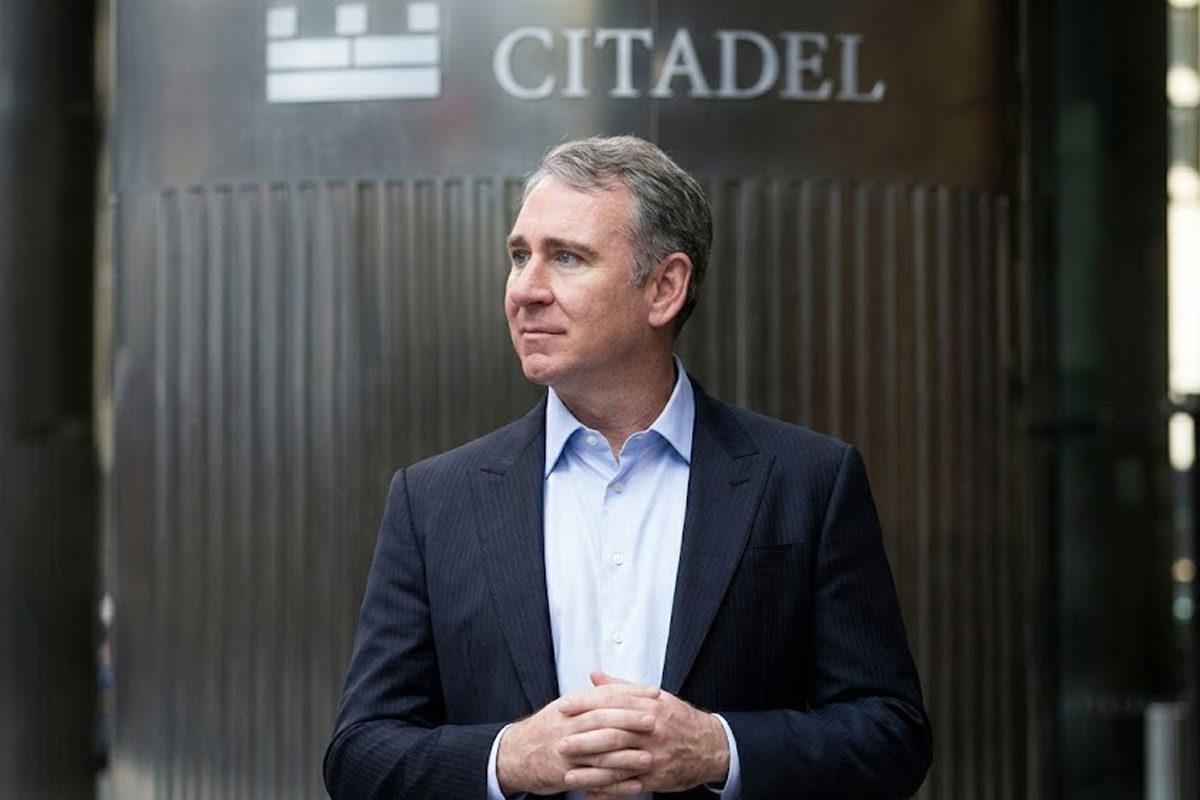
TLDR: Ken Griffin’s net worth stands at approximately $51.2 billion as of January 2026, making him the 34th richest person in the world.
The Citadel founder built his fortune through two powerhouse entities: Citadel LLC, a $67 billion hedge fund, and Citadel Securities, the market-making giant that executes one in four stock trades in America.
Kenneth C. Griffin isn’t your typical billionaire tech founder or inherited fortune heir. The 56-year-old financial titan built his $51.2 billion empire the old-fashioned Wall Street way, through sheer mathematical brilliance, algorithmic trading, and an uncanny ability to read market patterns.
What sets Griffin apart from other hedge fund billionaires is his dual-engine money machine.
While most managers run either a hedge fund or a trading firm, Griffin operates both at elite levels, creating a financial flywheel that has generated over $90 billion in lifetime investment gains.
The scale of Griffin’s wealth becomes clearer when you break down where it comes from. His fortune isn’t sitting in stocks or bonds that anyone can buy.
Instead, the vast majority represents his ownership stakes in two private companies he built from scratch.
Citadel LLC, the hedge fund he founded in 1990 from his Harvard dorm room, accounts for roughly $18.5 billion of his net worth based on the firm’s management of $67 billion in client assets. But the real wealth engine is Citadel Securities, the market-making operation that Griffin spun up in 2002.
That business alone is valued at approximately $24.8 billion of his fortune, and it’s growing faster than almost any financial firm on the planet.
The Hedge Fund Side: Citadel LLC’s Disciplined Approach
Citadel LLC had an unusual year in 2025. While the S&P 500 surged 16.5% on the back of artificial intelligence hype and big tech dominance, Griffin’s flagship Wellington fund posted a 10.2% return. For most hedge funds, double-digit gains would be cause for celebration.
For Citadel, which has built a reputation as the most profitable hedge fund in history, it marked the weakest performance since 2018.
The underperformance came from specific bets that didn’t pan out. Reports indicate the fund lost money on natural gas price wagers that worked brilliantly in 2022 but flopped in 2025 when mild weather and ample inventories compressed volatility.
The firm’s complex hedging strategies, designed to protect against market crashes, acted as a drag in a year when simply owning the stock market would have been the winning move.
What Griffin did next revealed his long-term thinking. In December 2025, Citadel returned $5 billion in profits to its investors. This wasn’t a sign of trouble. It was a deliberate strategic choice.
Griffin has consistently refused to let his hedge fund balloon beyond the point where it can effectively deploy capital. Since 2017, the firm has returned over $32 billion to clients, keeping the fund nimble enough to exit positions without moving markets against itself.
This discipline is why Citadel remains the most profitable hedge fund of all time, with approximately $90.4 billion in cumulative gains since inception, edging out rivals like Bridgewater and D.E. Shaw.
The Real Money Machine: Citadel Securities
If Citadel LLC is the steady compounder, Citadel Securities is the rocket ship. The market-making arm generated $3.4 billion in trading revenue during just the first quarter of 2025, a 45% jump from the previous year.
Net income for that same quarter hit $1.7 billion, representing a profit margin that would make tech companies jealous. By midyear, the firm had already banked $2.66 billion in profits.
The secret to this explosive growth is Citadel Securities’ dominance of retail stock and options trading. The firm executes roughly 25% of all U.S. stock trades, but the real goldmine is options.
In the third quarter of 2025 alone, Citadel Securities paid $282.3 million to retail brokers like Robinhood and Charles Schwab for the right to execute their customers’ options orders. That number dwarfed competitors, with the next closest firm paying $241.9 million.
Why pay so much? Because seeing that order flow provides an informational advantage that Griffin’s algorithms exploit to capture spreads, the tiny price differences between what buyers pay and sellers receive.
Multiply those fractions of a penny across billions of transactions, and you get a business throwing off multiple billions in annual profits with just 1,800 employees.
The growth trajectory suggests Citadel Securities could be worth significantly more than current estimates. With profit margins exceeding 50% and revenue growing at tech-company rates, some analysts believe the market-making business could eventually be worth more than the entire hedge fund operation.
Beyond Finance: Real Estate and American History
Griffin’s $51 billion fortune extends well beyond corporate equity. His real estate portfolio alone tops $2.2 billion, concentrated heavily in South Florida as part of his systematic relocation of Wall Street talent to Miami.
The centerpiece is a developing $2.5 billion supertall headquarters tower in Miami’s Brickell district that will house both Citadel entities. In January 2026, he added to his Miami footprint with a $180 million purchase of a 298,000-square-foot office building in the trendy Wynwood arts district.
His Palm Beach holdings represent another $450 million investment, where Griffin has assembled a contiguous compound on the exclusive Billionaires Row. The property isn’t just a home but a secure estate designed for privacy and long-term family continuity.
Construction costs are estimated between $150 million and $400 million, creating one of the most valuable private residences in America alongside other mega-estates like Graceland, which has been valued at hundreds of millions as part of the Elvis Presley estate.
Griffin’s art collection adds another $2.1 billion to his net worth and doubles as a public relations strategy. He made headlines in June 2025 by acquiring a rare copy of the 13th Amendment for $13.7 million and the Emancipation Proclamation for $4.4 million.
These purchases complement his 2021 acquisition of a first-edition U.S. Constitution for $43.2 million, which he loaned to the National Constitution Center in Philadelphia.
The collection positions Griffin not merely as a trader but as a custodian of American heritage, softening the image of a man whose firms profit from microsecond advantages in financial markets.
Like many ultra-wealthy individuals planning their legacies, Griffin’s approach to preserving wealth for future generations involves both cultural assets and careful estate planning.
Betting on Crypto and AI
Griffin’s strategic investments in late 2025 reveal where he thinks finance is heading. Citadel Securities led a funding round for cryptocurrency exchange Kraken, investing as part of a deal that valued the exchange at $20 billion.
This marks a significant pivot for Griffin, who previously steered clear of crypto following the FTX collapse.
By backing a regulated, compliance-focused exchange ahead of its planned 2026 IPO, Griffin is positioning Citadel Securities to become the dominant market maker in digital assets, potentially capturing the wide spreads that exist in crypto trading.
His personal stock portfolio, managed through Citadel Advisors and valued at $125 billion, shows aggressive bets on artificial intelligence infrastructure.
Griffin doubled his Microsoft stake to over $2 billion worth of shares and increased his Meta Platforms position by a staggering 12,693% to $1.44 billion.
Simultaneously, he cut his Amazon holdings by 39%, suggesting he’s betting on corporate AI spending over consumer retail. Healthcare stocks like Eli Lilly and Boston Scientific also saw significant increases, a classic defensive rotation for the late stages of an economic cycle.
The Road Ahead
At 56 years old with a $51.2 billion fortune, Ken Griffin isn’t slowing down. His wealth continues to grow primarily through Citadel Securities, which is expanding at a rate that outpaces the more mature hedge fund business.
The firm’s entry into cryptocurrency market making and continued dominance of retail options trading suggest the market-making operation could drive Griffin’s net worth significantly higher over the next five years.
What separates Griffin from other billionaires isn’t just the size of his fortune but the infrastructure he controls. Through Citadel Securities, he operates a vital piece of American financial plumbing, the systems that allow everyday investors to buy and sell stocks at the click of a button.
Through Citadel LLC, he commands one of the largest pools of actively managed capital in the world.
And through his real estate investments in Miami, he’s literally rebuilding the geography of American finance, pulling talent and capital away from New York and Chicago to create “Wall Street South.”
That combination of financial power, market infrastructure control, and geographic reshaping makes Griffin one of the most influential figures in modern capitalism, even if his name doesn’t carry the same recognition as Elon Musk or Jeff Bezos.